Recognition: unknown
A high-resolution K-band spectral atlas of massive stars
Pith reviewed 2026-05-07 10:27 UTC · model grok-4.3
The pith
A high-resolution K-band spectral atlas of 81 massive stars has been compiled and released.
A machine-rendered reading of the paper's core claim, the machinery that carries it, and where it could break.
Core claim
We present a high-resolution (~45000), high signal-to-noise (>100) K-band spectral atlas of massive stars. It includes 81 stars consisting of known optical standards, spanning spectral and luminosity subclasses from O2 to O9, and supergiant luminosity and spectral subclasses from O2-B1. The telluric-corrected reduced spectra are publicly available, and are discussed here.
What carries the argument
A curated set of 81 optically classified massive star standards observed at high resolution in the K-band, after telluric correction and reduction.
Load-bearing premise
The selected stars serve as reliable standards for K-band classification without significant differences from their optical types, and that the telluric corrections introduce no artifacts that affect the spectra's usability.
What would settle it
Independent high-resolution K-band observations of the same stars showing major discrepancies after telluric correction, or residual atmospheric features mimicking stellar lines, would question the atlas reliability.
Figures
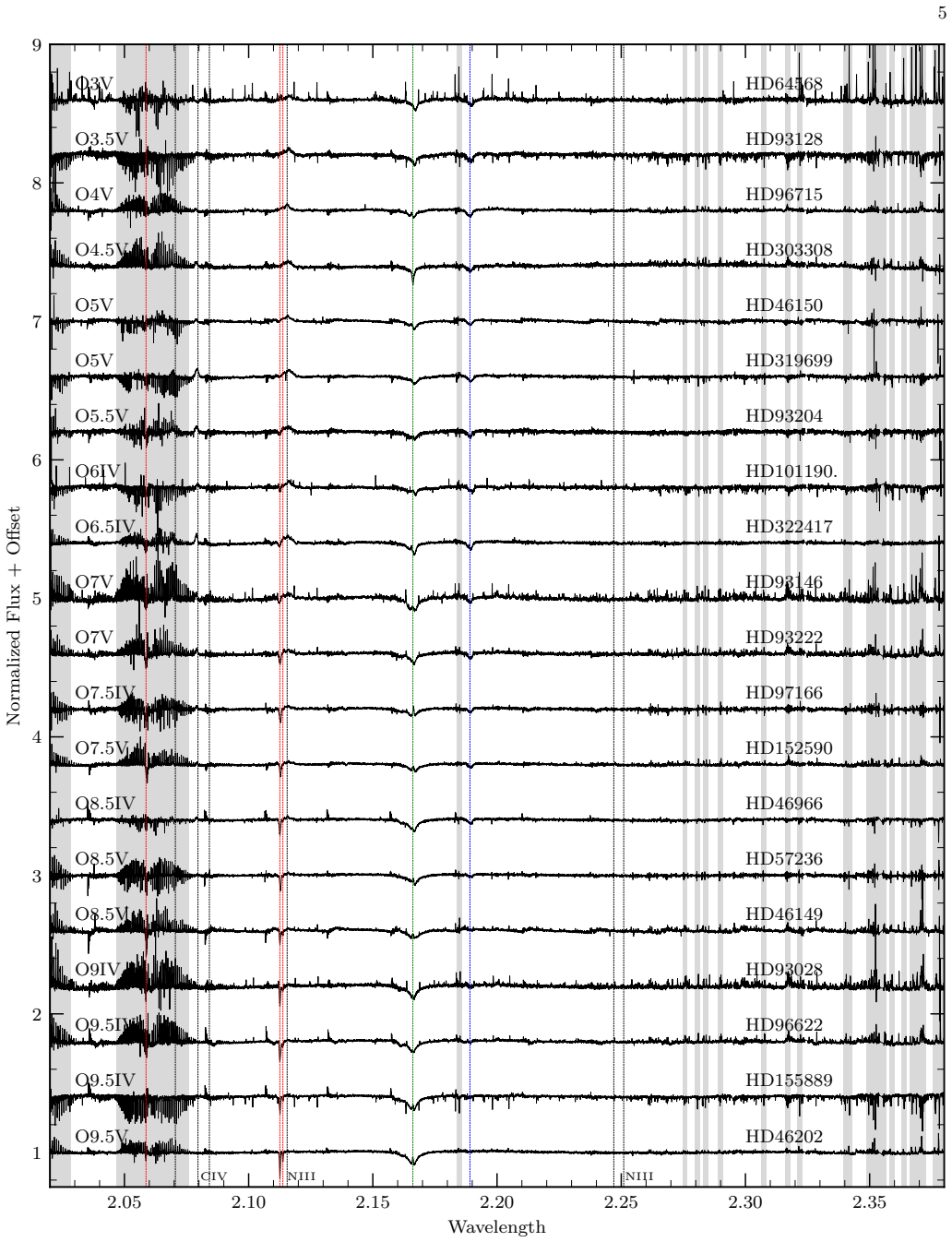

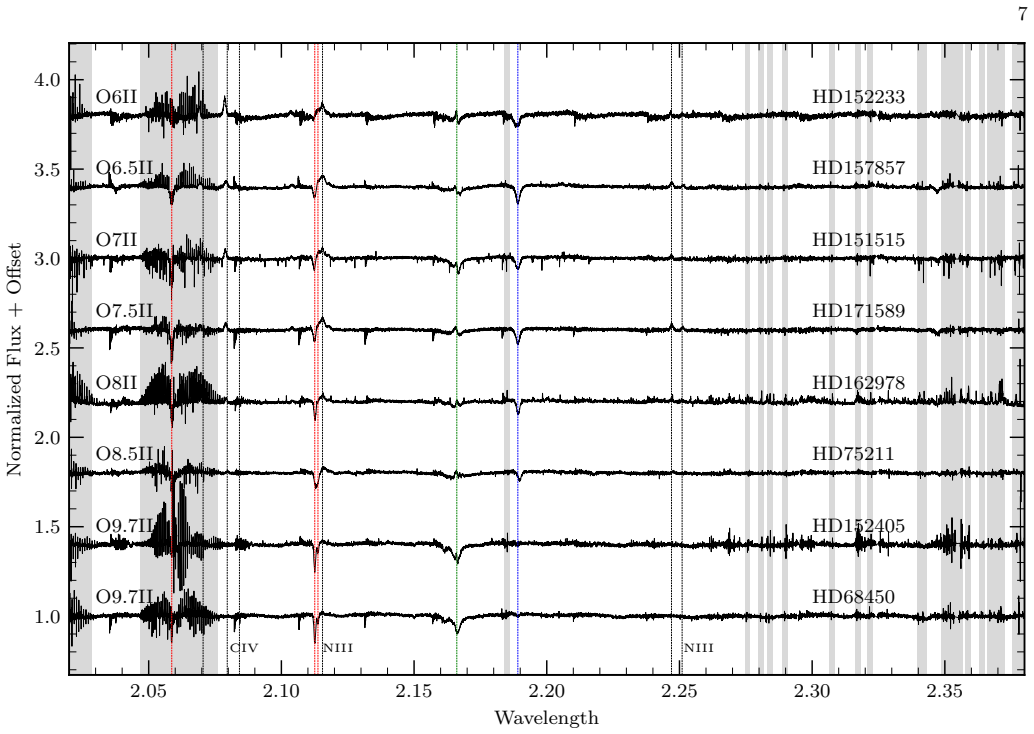

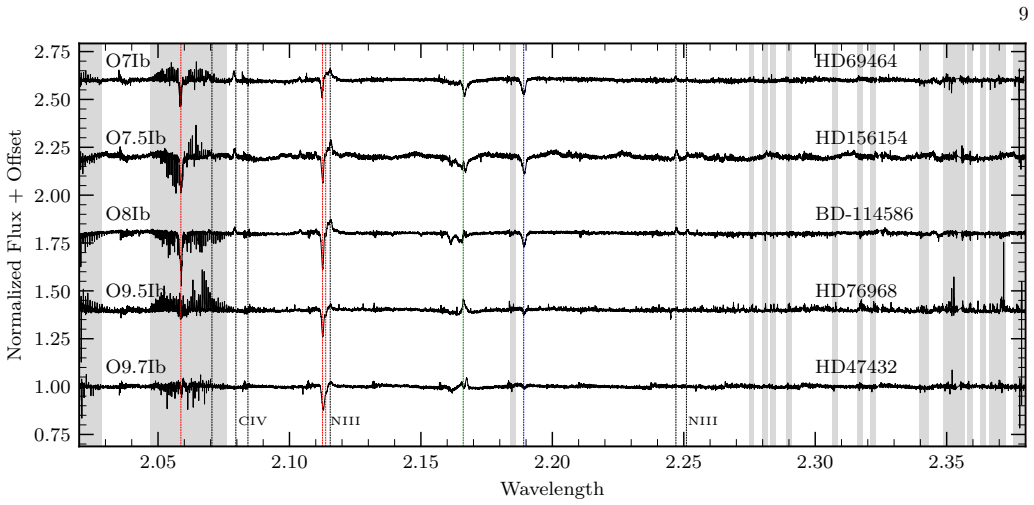
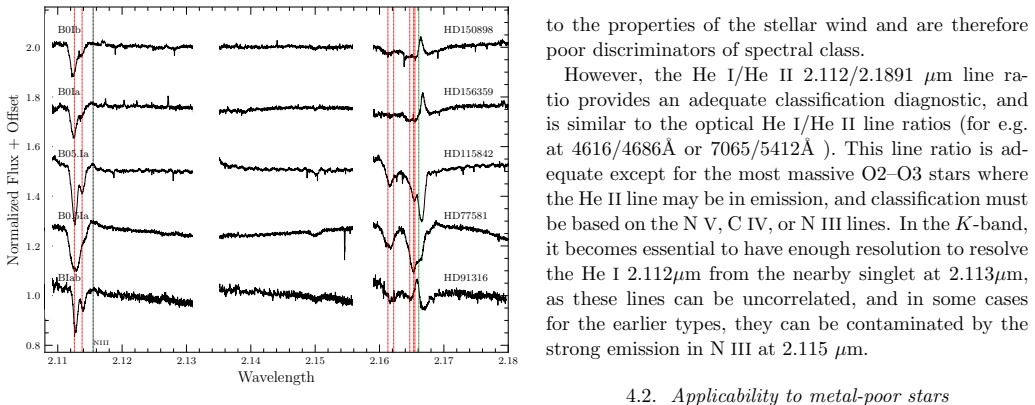


read the original abstract
A high-resolution ($\sim$45000), high signal-to-noise ($>$100) K-band spectral atlas of massive stars is presented. It includes 81 stars consisting of known optical standards, spanning spectral and luminosity subclasses from O2 to O9, and supergiant luminosity and spectral subclasses from O2-B1. The telluric-corrected reduced spectra are publicly available, and are discussed here.
Editorial analysis
A structured set of objections, weighed in public.
Referee Report
Summary. The manuscript presents a high-resolution (R ~ 45,000), high S/N (>100) K-band spectral atlas of 81 massive stars drawn from known optical standards. The sample spans O2–O9 spectral types and O2–B1 supergiant luminosity classes. Telluric-corrected, reduced spectra are released publicly and discussed in the text.
Significance. If the data reductions are shown to be free of significant artifacts, the atlas would fill a clear gap in the literature by supplying K-band standards for massive-star classification and population studies, where optical templates are often insufficient. The public release of the spectra is a concrete strength that enables immediate community use.
major comments (1)
- [Data reduction and validation section] Data reduction and validation section: The central claim that the atlas provides reliable K-band standards rests on the assertion of clean telluric corrections, yet no quantitative validation is supplied (e.g., rms residuals measured in line-free windows, direct comparison of corrected vs. uncorrected spectra, or consistency checks on diagnostic features such as Br γ at 2.166 μm and He I 2.112 μm). Without these metrics it is impossible to assess whether residuals at the few-percent level remain near classification lines.
minor comments (2)
- [Abstract] The abstract and introduction should explicitly state the wavelength coverage and the exact instrument/telescope used for the observations.
- [Figures] Figure captions for the atlas spectra should include the S/N measured per resolution element and the airmass range of the observations for each star.
Simulated Author's Rebuttal
We thank the referee for their constructive review and for recognizing the potential value of the atlas in filling a gap in K-band standards for massive stars. We address the single major comment below and will incorporate the requested quantitative validation in the revised manuscript.
read point-by-point responses
-
Referee: Data reduction and validation section: The central claim that the atlas provides reliable K-band standards rests on the assertion of clean telluric corrections, yet no quantitative validation is supplied (e.g., rms residuals measured in line-free windows, direct comparison of corrected vs. uncorrected spectra, or consistency checks on diagnostic features such as Br γ at 2.166 μm and He I 2.112 μm). Without these metrics it is impossible to assess whether residuals at the few-percent level remain near classification lines.
Authors: We agree that quantitative validation of the telluric corrections is essential to substantiate the atlas as reliable standards. The current manuscript emphasizes the public release of the reduced spectra and their discussion but does not include the specific metrics suggested. In the revised version we will expand the data reduction and validation section to report: RMS residuals measured in multiple line-free windows across the K-band; direct comparisons of corrected versus uncorrected spectra for representative targets; and consistency checks on key diagnostic features including Br γ at 2.166 μm and He I at 2.112 μm. These additions will allow readers to evaluate residual artifacts at the few-percent level near classification lines. revision: yes
Circularity Check
No circularity: purely observational data release with no derivations or predictions
full rationale
The paper presents a K-band spectral atlas of 81 massive stars based on observational data collection, reduction, and public release of telluric-corrected spectra. No equations, model fits, predictions, or derivation chains are claimed or present. The central claim reduces only to the empirical spectra themselves and their public availability, with no self-referential steps, fitted parameters renamed as predictions, or load-bearing self-citations that would create circularity. This is a standard observational catalog paper whose validity rests on data quality rather than any internal logical loop.
Axiom & Free-Parameter Ledger
Reference graph
Works this paper leans on
-
[1]
H., Gamen, R., Arias, J
Barb´ a, R. H., Gamen, R., Arias, J. I., et al. 2010, in Revista Mexicana de Astronomia y Astrofisica Conference Series, Vol. 38, Revista Mexicana de Astronomia y Astrofisica Conference Series, 30–32
2010
-
[2]
Bestenlehner, J. M., Crowther, P. A., Hawcroft, C., et al. 2025, A&A, 695, A198, doi: 10.1051/0004-6361/202452491
-
[3]
Bouret, J.-C., Lanz, T., Hillier, D. J., et al. 2015, MNRAS, 449, 1545, doi: 10.1093/mnras/stv379
-
[4]
Eldridge, J. J., & Stanway, E. R. 2022, ARA&A, 60, 455, doi: 10.1146/annurev-astro-052920-100646
-
[5]
Evans, C. J. 2011, Bulletin de la Societe Royale des Sciences de Liege, 80, 456, doi: 10.48550/arXiv.1009.4483 19
-
[6]
Evans, C. J., Ramirez-Agudelo, O. H., Garcia, M., Puech, M., & Yang, Y. 2018, arXiv e-prints, arXiv:1810.01738, doi: 10.48550/arXiv.1810.01738
-
[7]
Figer, D. F., McLean, I. S., & Najarro, F. 1997, ApJ, 486, 420, doi: 10.1086/304488
-
[8]
Garcia, M., Evans, C. J., Bestenlehner, J. M., et al. 2019, arXiv e-prints, arXiv:1908.04687, doi: 10.48550/arXiv.1908.04687 Giudici Michilini, F. N., Gamen, R., Ferrero, G., Morrell, N., & Barb´ a, R. 2025, ApJS, 281, 18, doi: 10.3847/1538-4365/ae0a51
-
[9]
Hanson, M. M., Conti, P. S., & Rieke, M. J. 1996, ApJS, 107, 281, doi: 10.1086/192366
-
[10]
Hanson, M. M., Kudritzki, R. P., Kenworthy, M. A., Puls, J., & Tokunaga, A. T. 2005, ApJS, 161, 154, doi: 10.1086/444363
-
[11]
Holgado, G., Sim´ on-D´ ıaz, S., Barb´ a, R. H., et al. 2018, A&A, 613, A65, doi: 10.1051/0004-6361/201731543
-
[12]
2013, A&A, 553, A6, doi: 10.1051/0004-6361/201219058
Husser, T.-O., Wende-von Berg, S., Dreizler, S., et al. 2013, A&A, 553, A6, doi: 10.1051/0004-6361/201219058
-
[13]
Kalari, V. M., Vink, J. S., Dufton, P. L., et al. 2014, A&A, 564, L7, doi: 10.1051/0004-6361/201323289
-
[14]
2024, Zenodo, doi: 10.5281/zenodo.11080095
Kaplan, K., Lee, J.-J., Sawczynec, E., & Kim, H.-J. 2024, Zenodo, doi: 10.5281/zenodo.11080095
-
[15]
Ralchenko, Reader, J., & and NIST ASD Team
Kramida, A., Yu. Ralchenko, Reader, J., & and NIST ASD Team. 2024, NIST Atomic Spectra Database (ver. 5.12), [Online]. Available:https://physics.nist.gov/asd [2026, February 11]. National Institute of Standards and
2024
-
[16]
Kurucz, R. L. 1992, in IAU Symposium, Vol. 149, The Stellar Populations of Galaxies, ed. B. Barbuy & A. Renzini, 225
1992
-
[17]
Lenorzer, A., Mokiem, M. R., de Koter, A., & Puls, J. 2004, A&A, 422, 275, doi: 10.1051/0004-6361:20047174
-
[18]
1990, ApJS, 72, 323, doi: 10.1086/191419
Solivella, G. 1990, ApJS, 72, 323, doi: 10.1086/191419
-
[19]
2018, in Society of Photo-Optical Instrumentation Engineers (SPIE) Conference Series, Vol
Mace, G., Sokal, K., Lee, J.-J., et al. 2018, in Society of Photo-Optical Instrumentation Engineers (SPIE) Conference Series, Vol. 10702, Ground-based and Airborne Instrumentation for Astronomy VII, ed. C. J
2018
-
[20]
Evans, L. Simard, & H. Takami, 107020Q, doi: 10.1117/12.2312345
-
[21]
Madau, P., & Dickinson, M. 2014, ARA&A, 52, 415, doi: 10.1146/annurev-astro-081811-125615 Ma´ ız Apell´ aniz, J., Pantaleoni Gonz´ alez, M., Barb´ a, R. H., et al. 2018, A&A, 616, A149, doi: 10.1051/0004-6361/201832787 Ma´ ız Apell´ aniz, J., Sana, H., Barb´ a, R. H., Le Bouquin, J.-B., & Gamen, R. C. 2017, MNRAS, 464, 3561, doi: 10.1093/mnras/stw2618 Ma´...
work page Pith review doi:10.1146/annurev-astro-081811-125615 2014
-
[22]
2018, A&A, 616, A135, doi: 10.1051/0004-6361/201833050
Martins, F. 2018, A&A, 616, A135, doi: 10.1051/0004-6361/201833050
-
[23]
A., & Claus, F
Otero, S. A., & Claus, F. 2004, Information Bulletin on Variable Stars, 5495, 1
2004
-
[24]
Ground-based and Airborne Instrumentation for Astronomy V , year = 2014, editor =
Park, C., Jaffe, D. T., Yuk, I.-S., et al. 2014, in Society of Photo-Optical Instrumentation Engineers (SPIE) Conference Series, Vol. 9147, Ground-based and Airborne Instrumentation for Astronomy V, ed. S. K. Ramsay, I. S. McLean, & H. Takami, 91471D, doi: 10.1117/12.2056431
-
[25]
Mokiem, M. R. 2005, A&A, 440, 261, doi: 10.1051/0004-6361:20052739
-
[26]
2012, MNRAS, 420, 1825, doi: 10.1111/j.1365-2966.2011.19805.x
Roman-Lopes, A., Barba, R. H., & Morrell, N. I. 2011, MNRAS, 416, 501, doi: 10.1111/j.1365-2966.2011.19062.x
-
[27]
Rubio, M., Barb´ a, R. H., & Kalari, V. M. 2018, A&A, 615, A121, doi: 10.1051/0004-6361/201730487
-
[28]
Sota, A., Ma´ ız Apell´ aniz, J., Morrell, N. I., et al. 2014, ApJS, 211, 10, doi: 10.1088/0067-0049/211/1/10
-
[29]
Sota, A., Ma´ ız Apell´ aniz, J., Walborn, N. R., et al. 2011, ApJS, 193, 24, doi: 10.1088/0067-0049/193/2/24
-
[30]
Tramper, F., Sana, H., de Koter, A., Kaper, L., & Ram´ ırez-Agudelo, O. H. 2014, A&A, 572, A36, doi: 10.1051/0004-6361/201424312
-
[31]
Tramper, F., Sana, H., Fitzsimons, N. E., et al. 2016, MNRAS, 455, 1275, doi: 10.1093/mnras/stv2373
-
[32]
1997, PhyS, 55, 707, doi: 10.1088/0031-8949/55/6/010
Tunklev, M., Engstr¨ om, L., Jup´ en, C., & Kink, I. 1997, PhyS, 55, 707, doi: 10.1088/0031-8949/55/6/010
-
[33]
Vacca, W. D., Cushing, M. C., & Rayner, J. T. 2003, PASP, 115, 389, doi: 10.1086/346193 van Hoof, P. A. M., & Verner, D. 1997, in ESA Special
-
[34]
Vink, J. S., de Koter, A., & Lamers, H. J. G. L. M. 2001, A&A, 369, 574, doi: 10.1051/0004-6361:20010127
-
[35]
Vink, J. S., Mehner, A., Crowther, P. A., et al. 2023, A&A, 675, A154, doi: 10.1051/0004-6361/202245650
-
[36]
Walborn, N. R. 1973, ApJ, 179, 517, doi: 10.1086/151891
-
[37]
Walborn, N. R., Howarth, I. D., Lennon, D. J., et al. 2002, AJ, 123, 2754, doi: 10.1086/339831
-
[38]
Ward, J. L., Oliveira, J. M., van Loon, J. T., & Sewi lo, M. 2017, MNRAS, 464, 1512, doi: 10.1093/mnras/stw2386
discussion (0)
Sign in with ORCID, Apple, or X to comment. Anyone can read and Pith papers without signing in.