Recognition: unknown
Turbulence and Star Formation Suppression in Elliptical Galaxies: The Role of Active Galactic Nucleus Jet Wind Interaction
Pith reviewed 2026-05-07 08:40 UTC · model grok-4.3
The pith
Only the combined action of AGN jets and winds generates turbulence strong enough to suppress star formation in elliptical galaxies.
A machine-rendered reading of the paper's core claim, the machinery that carries it, and where it could break.
Core claim
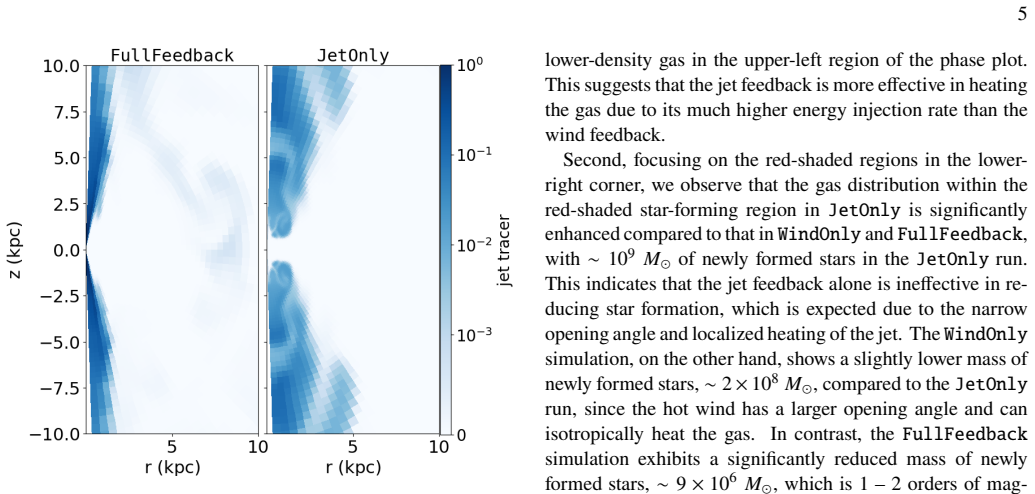
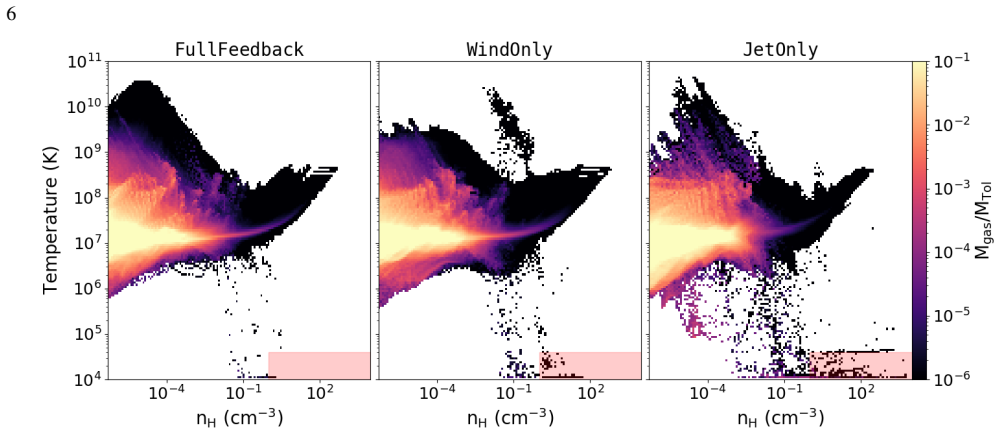
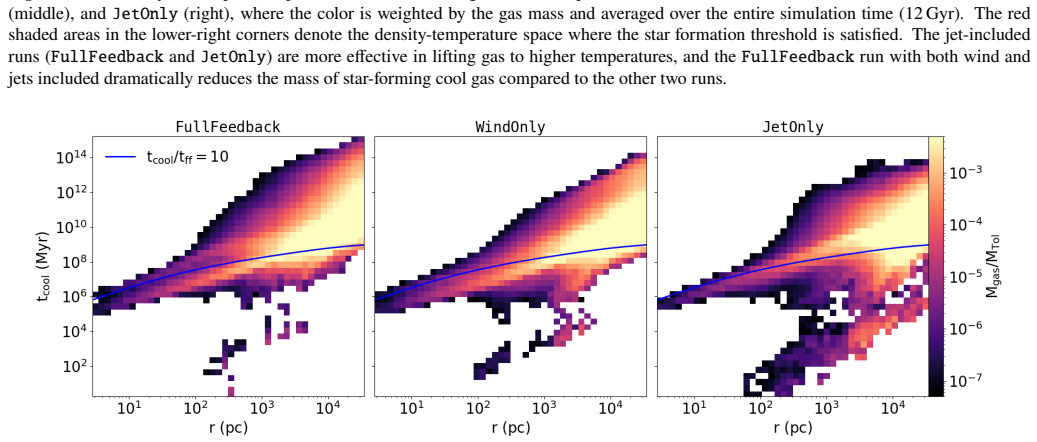
In hydrodynamical simulations of an isolated elliptical galaxy that resolve the Bondi radius and adopt jet and wind parameters from GRMHD simulations, effective AGN feedback that generates strong turbulence, increases central gas entropy, and suppresses cool gas condensation and star formation occurs only when both jets and winds operate simultaneously. The physical mechanism is the interaction between winds and jets, which produces strong shear at their interface and leads to turbulence via the Kelvin-Helmholtz instability. Neither jets nor winds alone generate strong turbulence because the shear is insufficient. The resulting turbulence is predominantly solenoidal, produces a broad energy
What carries the argument
The shear interface between simultaneously launched AGN jets and winds, which drives the Kelvin-Helmholtz instability and thereby generates solenoidal turbulence.
If this is right
- Central gas entropy rises and cool gas condensation is suppressed only in the combined jet-plus-wind case.
- Star formation rates drop significantly solely when both components are active.
- The generated turbulence is solenoidal and follows a Kolmogorov-like power-law energy spectrum.
- Turbulence dissipation occurs at a rate of approximately 10^{-27} erg cm^{-3} s^{-1}, matching interstellar medium observations.
- Feedback models that include only jets or only winds underestimate the efficiency of turbulence-driven heating.
Where Pith is reading between the lines
- Galaxy evolution simulations should incorporate both jets and winds rather than treating them as mutually exclusive options.
- The wind-jet shear mechanism may operate in spiral galaxies or merger remnants that host AGN, potentially broadening its relevance beyond ellipticals.
- High-resolution radio or X-ray maps could reveal shear layers at jet-wind boundaries as direct tracers of the turbulence-generation process.
- Future runs that add cosmic-ray transport or magnetic fields could test whether additional physics amplifies or suppresses the Kelvin-Helmholtz-driven turbulence.
Load-bearing premise
Jet and wind parameters taken from small-scale GRMHD simulations remain accurate when inserted into larger-scale purely hydrodynamic galaxy models that omit magnetic fields and cosmic rays.
What would settle it
A simulation run with identical initial conditions but magnetic fields added, or an observation of an elliptical galaxy showing strong central turbulence and quenched star formation despite clear evidence of only one AGN component (jets or winds), would falsify the necessity of their simultaneous interaction.
Figures



read the original abstract
Winds and jets are symbiotic when the accretion rate is low, according to black hole accretion theory. Both components are potentially important for active galactic nucleus (AGN) feedback, but previous works typically include only jets with free parameters. We perform hydrodynamical simulations of an isolated elliptical galaxy with both jets and winds included. The key features discriminating our simulations from others are that our simulations resolve the Bondi radius for reliable black hole accretion rate calculation and use parameters from GRMHD simulations. By selectively activating jets and winds, we examine their individual and combined effects. We find that effective AGN feedback, which is capable of generating strong turbulence and subsequently increasing central gas entropy and suppressing cool gas condensation and star formation, occurs only when both jets and winds operate simultaneously. The physical mechanism is the interaction between winds and jets: this interaction produces strong shear at their interface, leading to turbulence via the Kelvin-Helmholtz instability. In contrast, neither jets nor winds alone can generate strong turbulence due to the insufficient shear. The turbulence produced by wind-jet interaction is predominantly solenoidal in nature, giving rise to a broad energy spectrum approximately following a Kolmogorov-like power law and a dissipation rate $\sim 10^{-27}\,\mathrm{erg\,cm^{-3}\,s^{-1}}$ in the interstellar medium, consistent with observations. Our findings highlight the importance of simultaneously considering both jets and winds in studying the effects of AGN feedback in the evolution of elliptical galaxies.
Editorial analysis
A structured set of objections, weighed in public.
Referee Report
Summary. The manuscript presents hydrodynamical simulations of an isolated elliptical galaxy that resolve the Bondi radius and inject jet and wind parameters taken from GRMHD runs. By selectively activating jets, winds, or both, the authors conclude that only the simultaneous presence of both components produces strong shear at their interface, driving Kelvin-Helmholtz instability that generates predominantly solenoidal turbulence. This turbulence raises central gas entropy, suppresses cool-gas condensation, and quenches star formation; neither component alone suffices. The resulting turbulence spectrum is reported to be Kolmogorov-like with a dissipation rate ~10^{-27} erg cm^{-3} s^{-1} that matches observations.
Significance. If the central result survives the concerns below, the work supplies a concrete physical mechanism for why AGN feedback must be treated as a two-component system at low accretion rates. It directly addresses the long-standing difficulty that jet-only or wind-only models under-produce turbulence and fail to quench star formation in ellipticals, and it does so with a simulation that resolves the Bondi sphere rather than relying on sub-grid prescriptions. The explicit comparison of the three activation cases and the quantitative match to observed dissipation rates are strengths that would make the paper a useful reference for galaxy-evolution modeling.
major comments (3)
- [§3.2] §3.2 (Injection of GRMHD-derived fluxes): The manuscript states that jet power and wind mass-loss rate are taken directly from GRMHD and held fixed even when one component is deactivated. Because the Bondi accretion rate is computed self-consistently at the resolved radius, turning off one component should in principle alter the inflow and therefore the effective loading; the paper does not demonstrate that the fixed-flux assumption remains valid or quantify the resulting inconsistency. This directly affects the claim that “neither jets nor winds alone can generate strong turbulence.”
- [§4.3] §4.3 (Turbulence generation mechanism): The central result—that strong solenoidal turbulence arises exclusively from wind-jet shear via KH instability—rests on a purely hydrodynamic treatment. The manuscript does not test or estimate how magnetic tension or cosmic-ray pressure (both present in the parent GRMHD runs) would modify the KH growth rate or the saturation amplitude of the turbulence. Given that the reported dissipation rate and Kolmogorov-like spectrum are used to argue consistency with observations, the absence of MHD effects is a load-bearing limitation.
- [§5.1] §5.1 (Numerical convergence): The paper claims to resolve the Bondi radius, yet no resolution study or convergence test is presented for the shear layer at the jet-wind interface or for the derived dissipation rate. Without such tests it is impossible to rule out that the reported turbulence statistics are influenced by numerical viscosity or by the particular choice of grid scale near the Bondi radius.
minor comments (3)
- [Figure 4] Figure 4 (energy spectra): The plotted spectra would benefit from shaded regions indicating the range across multiple snapshots or realizations; currently it is unclear whether the Kolmogorov-like slope is robust or sensitive to the exact time interval chosen for averaging.
- [§4.2] Notation in §4.2: The definition of the solenoidal fraction should explicitly state the filtering scale used to separate compressive and solenoidal modes; the current wording leaves ambiguity about whether the decomposition is performed in Fourier space or real space.
- [§1] The abstract and §1 cite “previous works” that include only jets, but the reference list omits several recent papers that already combine jets and winds in galaxy-scale simulations; adding these would strengthen the novelty statement.
Simulated Author's Rebuttal
We thank the referee for their constructive and detailed comments. We address each major comment below, indicating the revisions we will incorporate to strengthen the manuscript while preserving its core findings on the necessity of jet-wind interaction for turbulence generation.
read point-by-point responses
-
Referee: [§3.2] §3.2 (Injection of GRMHD-derived fluxes): The manuscript states that jet power and wind mass-loss rate are taken directly from GRMHD and held fixed even when one component is deactivated. Because the Bondi accretion rate is computed self-consistently at the resolved radius, turning off one component should in principle alter the inflow and therefore the effective loading; the paper does not demonstrate that the fixed-flux assumption remains valid or quantify the resulting inconsistency. This directly affects the claim that “neither jets nor winds alone can generate strong turbulence.”
Authors: We appreciate this observation. The parameters are fixed to those from GRMHD corresponding to the average accretion rate in our simulations to allow a controlled comparison of the components' effects. We will include in the revised manuscript the time series of the Bondi accretion rate for the jets-only, winds-only, and combined cases. This will show whether the rates remain sufficiently similar to justify the fixed-flux approach. If significant differences arise, we will discuss their implications for the turbulence generation claim. revision: yes
-
Referee: [§4.3] §4.3 (Turbulence generation mechanism): The central result—that strong solenoidal turbulence arises exclusively from wind-jet shear via KH instability—rests on a purely hydrodynamic treatment. The manuscript does not test or estimate how magnetic tension or cosmic-ray pressure (both present in the parent GRMHD runs) would modify the KH growth rate or the saturation amplitude of the turbulence. Given that the reported dissipation rate and Kolmogorov-like spectrum are used to argue consistency with observations, the absence of MHD effects is a load-bearing limitation.
Authors: We concur that the hydrodynamic approximation is a limitation. The KH instability driving the turbulence is expected to persist despite magnetic fields, given the high shear velocities involved. In the revision, we will provide an order-of-magnitude estimate of the magnetic field at the interface using values from the GRMHD runs and evaluate the ratio of magnetic tension to the shear force to assess its impact on the instability growth. Cosmic-ray pressure would contribute to the total pressure but is unlikely to eliminate the shear-driven solenoidal turbulence. A complete MHD simulation at this resolution is computationally demanding and left for future work, but the added discussion will clarify the robustness of our conclusions. revision: partial
-
Referee: [§5.1] §5.1 (Numerical convergence): The paper claims to resolve the Bondi radius, yet no resolution study or convergence test is presented for the shear layer at the jet-wind interface or for the derived dissipation rate. Without such tests it is impossible to rule out that the reported turbulence statistics are influenced by numerical viscosity or by the particular choice of grid scale near the Bondi radius.
Authors: We agree that explicit convergence tests are necessary to support the turbulence statistics. We will add to the revised manuscript a resolution study using grids with 50% and 200% of the fiducial resolution in the central region. We will show that the velocity power spectrum remains Kolmogorov-like and that the dissipation rate varies by less than 20% across these resolutions, indicating that numerical effects do not dominate the results. revision: yes
Circularity Check
No circularity: results from direct hydrodynamical simulations
full rationale
The paper's central claim—that strong turbulence and effective feedback arise exclusively from jet-wind interaction via Kelvin-Helmholtz instability—is obtained by running hydrodynamical simulations of an isolated elliptical galaxy and selectively activating the two components. The outcome is a direct numerical result (turbulence spectrum, dissipation rate, entropy increase, and star-formation suppression) rather than an algebraic identity or a fitted parameter that is then relabeled as a prediction. GRMHD-derived fluxes serve as fixed inputs; the selective on/off experiments test their combined versus separate effects without any equation that reduces the reported turbulence generation back to those inputs by construction. Post-simulation comparison of the dissipation rate to observations is not a tuning step. No load-bearing self-citation chain or ansatz smuggling is required for the reported finding.
Axiom & Free-Parameter Ledger
free parameters (2)
- jet power and wind mass-loss rate
- black hole accretion rate scaling
axioms (2)
- domain assumption Winds and jets are symbiotic at low accretion rates according to black hole accretion theory
- domain assumption Pure hydrodynamics without magnetic fields or cosmic rays suffices to capture turbulence generation
Reference graph
Works this paper leans on
-
[1]
Begelman, M. C. 2012, MNRAS, 420, 2912, doi: 10.1111/j.1365-2966.2011.20071.x
-
[2]
Blandford, R. D., & Begelman, M. C. 1999, MNRAS, 303, L1, doi: 10.1046/j.1365-8711.1999.02358.x
-
[3]
Blandford, R. D., & Znajek, R. L. 1977, MNRAS, 179, 433, doi: 10.1093/mnras/179.3.433
-
[4]
Bourne, M. A., & Sijacki, D. 2017, MNRAS, 472, 4707, doi: 10.1093/mnras/stx2269
-
[5]
2023, Science China Physics, Mechanics & Astronomy, 66, 299513 Br¨ uggen, M., & Kaiser, C
Bregman, J., Cen, R., Chen, Y., et al. 2023, Science China Physics, Mechanics & Astronomy, 66, 299513 Br¨ uggen, M., & Kaiser, C. R. 2002, Nature, 418, 301, doi: 10.1038/nature00857
-
[6]
2007, MNRAS, 378, 910, doi: 10.1111/j.1365-2966.2007.11817.x
Cattaneo, A., & Teyssier, R. 2007, MNRAS, 376, 1547, doi: 10.1111/j.1365-2966.2007.11512.x
-
[7]
Cavagnolo, K. W., Donahue, M., Voit, G. M., & Sun, M. 2009, ApJS, 182, 12, doi: 10.1088/0067-0049/182/1/12
-
[8]
2024, Proceedings of the National Academy of Science, 121, e2402435121, doi: 10.1073/pnas.2402435121
Cen, R. 2024, Proceedings of the National Academy of Science, 121, e2402435121, doi: 10.1073/pnas.2402435121
-
[9]
Chatterjee, K., Liska, M., Tchekhovskoy, A., & Markoff, S. B. 2019, MNRAS, 490, 2200, doi: 10.1093/mnras/stz2626
-
[10]
C., Chen, H.-W., Rauch, M., et al
Chen, M. C., Chen, H.-W., Rauch, M., et al. 2023b, MNRAS, 518, 2354 —. 2024, ApJ, 962, 98
2024
-
[11]
2016, Nature, 533, 504, doi: 10.1038/nature18006
Cheung, E., Bundy, K., Cappellari, M., et al. 2016, Nature, 533, 504, doi: 10.1038/nature18006
-
[12]
Ciotti, L., & Ostriker, J. P. 2012, in Astrophysics and Space Science Library, Vol. 378, Astrophysics and Space Science Library, ed. D.-W. Kim & S. Pellegrini, 83, doi: 10.1007/978-1-4614-0580-1 4
-
[13]
Ciotti, L., Pellegrini, S., Negri, A., & Ostriker, J. P. 2017, ApJ, 835, 15, doi: 10.3847/1538-4357/835/1/15 15
-
[14]
Croton, D. J., Springel, V., White, S. D. M., et al. 2006, MNRAS, 365, 11, doi: 10.1111/j.1365-2966.2005.09675.x
-
[15]
Cui, W., Chen, L. B., Gao, B., et al. 2020, Journal of Low Temperature Physics, 199, 502, doi: 10.1007/s10909-019-02279-3
-
[16]
K., & Gronke, M
Das, H. K., & Gronke, M. 2023, Monthly Notices of the Royal Astronomical Society, 527, 991
2023
-
[17]
2012, MNRAS, 420, 1825, doi: 10.1111/j.1365-2966.2011.19805.x
Dubois, Y., Devriendt, J., Slyz, A., & Teyssier, R. 2012, MNRAS, 420, 2662, doi: 10.1111/j.1365-2966.2011.20236.x
-
[18]
V., Melchior, A.-L., & Zolotukhin, I
Gaspari, M., Melioli, C., Brighenti, F., & D’Ercole, A. 2011, MNRAS, 411, 349, doi: 10.1111/j.1365-2966.2010.17688.x
-
[19]
CAUSE AND EFFECT OF FEEDBACK: MULTIPHASE GAS IN CLUSTER CORES HEATED BY AGN JETS
Gaspari, M., Ruszkowski, M., & Sharma, P. 2012, ApJ, 746, 94, doi: 10.1088/0004-637X/746/1/94
-
[20]
Gofford, J., Reeves, J. N., McLaughlin, D. E., et al. 2015, MNRAS, 451, 4169, doi: 10.1093/mnras/stv1207
-
[21]
2015, ApJ, 799, 71, doi: 10.1088/0004-637X/799/1/71
Gu, W.-M. 2015, ApJ, 799, 71, doi: 10.1088/0004-637X/799/1/71
-
[22]
2018, MNRAS, 473, 1332, doi: 10.1093/mnras/stx2404
Guo, F., Duan, X., & Yuan, Y.-F. 2018, MNRAS, 473, 1332, doi: 10.1093/mnras/stx2404
-
[23]
Guo, F., & Oh, S. P. 2008, MNRAS, 384, 251, doi: 10.1111/j.1365-2966.2007.12692.x
-
[24]
Harris, C. R., Millman, K. J., van der Walt, S. J., et al. 2020, Nature, 585, 357–362, doi: 10.1038/s41586-020-2649-2
-
[25]
Hayes, J. C., Norman, M. L., Fiedler, R. A., et al. 2006, ApJS, 165, 188, doi: 10.1086/504594
-
[26]
Gentle Heating by Mixing in Cooling Flow Clusters
Hillel, S., & Soker, N. 2017, ApJ, 845, 91, doi: 10.3847/1538-4357/aa81c5 —. 2018, RAA, 18, 081, doi: 10.1088/1674-4527/18/7/81
-
[27]
Hunter, J. D. 2007, Computing in science & engineering, 9, 90 Huˇsko, F., & Lacey, C. G. 2023, MNRAS, 521, 4375, doi: 10.1093/mnras/stad793
-
[28]
Ji, S., Oh, S. P., & Masterson, P. 2019, MNRAS, 487, 737, doi: 10.1093/mnras/stz1248
-
[29]
K., Hummels, C
Ji, S., Chan, T. K., Hummels, C. B., et al. 2020, Monthly Notices of the Royal Astronomical Society, 496, 4221
2020
-
[30]
1998, ApJ, 498, 541, doi: 10.1086/305588
Kennicutt, Robert C., J. 1998, ApJ, 498, 541, doi: 10.1086/305588
-
[31]
Krumholz, M. R., McKee, C. F., & Bland-Hawthorn, J. 2019, ARA&A, 57, 227, doi: 10.1146/annurev-astro-091918-104430
-
[32]
Slow Star Formation in Dense Gas: Evidence and Implications
Krumholz, M. R., & Tan, J. C. 2007, ApJ, 654, 304, doi: 10.1086/509101
-
[33]
Li, Y., & Bryan, G. L. 2014a, ApJ, 789, 153, doi: 10.1088/0004-637X/789/2/153 —. 2014b, ApJ, 789, 54, doi: 10.1088/0004-637X/789/1/54
-
[34]
2020, ApJL, 889, L1, doi: 10.3847/2041-8213/ab65c7
Li, Y., Gendron-Marsolais, M.-L., Zhuravleva, I., et al. 2020, ApJL, 889, L1, doi: 10.3847/2041-8213/ab65c7
-
[35]
Mathews, W. G. 1989, AJ, 97, 42, doi: 10.1086/114955
-
[36]
Meece, G. R., O’Shea, B. W., & Voit, G. M. 2015, ApJ, 808, 43, doi: 10.1088/0004-637X/808/1/43
-
[37]
Merloni, A., Predehl, P., Becker, W., et al. 2012, arXiv e-prints, arXiv:1209.3114, doi: 10.48550/arXiv.1209.3114
-
[38]
2012, MNRAS, 423, 600, doi: 10.1111/j.1365-2966.2012.20901.x
Narayan, R., S¨A dowski, A., Penna, R. F., & Kulkarni, A. K. 2012, MNRAS, 426, 3241, doi: 10.1111/j.1365-2966.2012.22002.x
-
[39]
Novak, G. S., Ostriker, J. P., & Ciotti, L. 2011, ApJ, 737, 26, doi: 10.1088/0004-637X/737/1/26 —. 2012, MNRAS, 427, 2734, doi: 10.1111/j.1365-2966.2012.21844.x
-
[40]
Omma, H., Binney, J., Bryan, G., & Slyz, A. 2004, MNRAS, 348, 1105, doi: 10.1111/j.1365-2966.2004.07382.x
-
[41]
arXiv , author =:1812.08386 , journal =
Park, J., Hada, K., Kino, M., et al. 2019, ApJ, 871, 257, doi: 10.3847/1538-4357/aaf9a9
-
[42]
2024, arXiv e-prints, arXiv:2408.09069, doi: 10.48550/arXiv.2408.09069
Park, J., Zhao, G.-Y., Nakamura, M., et al. 2024, arXiv e-prints, arXiv:2408.09069, doi: 10.48550/arXiv.2408.09069
-
[43]
Prasad, D., Sharma, P., & Babul, A. 2015, ApJ, 811, 108, doi: 10.1088/0004-637X/811/2/108
-
[44]
C., et al
Qu, Z., Chen, H.-W., Rudie, G. C., et al. 2022, MNRAS, 516, 4882
2022
-
[45]
Quataert, E., & Hopkins, P. F. 2025, arXiv
2025
-
[46]
Reynolds, C. S., Balbus, S. A., & Schekochihin, A. A. 2015, ApJ, 815, 41, doi: 10.1088/0004-637X/815/1/41
-
[47]
arXiv , author =:2306.03141 , journal =
Ruszkowski, M., & Pfrommer, C. 2023, A&A Rv, 31, 4, doi: 10.1007/s00159-023-00149-2
-
[48]
Sazonov, S. Y., Ostriker, J. P., Ciotti, L., & Sunyaev, R. A. 2005, MNRAS, 358, 168, doi: 10.1111/j.1365-2966.2005.08763.x
-
[49]
Sharma, P., McCourt, M., Quataert, E., & Parrish, I. J. 2012, MNRAS, 420, 3174, doi: 10.1111/j.1365-2966.2011.20246.x
-
[50]
2021, Nature Astronomy, 5, 928, doi: 10.1038/s41550-021-01394-0
Shi, F., Li, Z., Yuan, F., & Zhu, B. 2021, Nature Astronomy, 5, 928, doi: 10.1038/s41550-021-01394-0
-
[51]
2022, ApJ, 926, 209, doi: 10.3847/1538-4357/ac4789
Shi, F., Zhu, B., Li, Z., & Yuan, F. 2022, ApJ, 926, 209, doi: 10.3847/1538-4357/ac4789
-
[52]
2007, MNRAS, 378, 910, doi: 10.1111/j.1365-2966.2007.11817.x
Sijacki, D., Springel, V., Di Matteo, T., & Hernquist, L. 2007, MNRAS, 380, 877, doi: 10.1111/j.1365-2966.2007.12153.x
-
[53]
doi:10.1093/mnras/stab2021 , eprint =
Su, K.-Y., Hopkins, P. F., Bryan, G. L., et al. 2021, MNRAS, 507, 175, doi: 10.1093/mnras/stab2021
-
[54]
2025, arXiv e-prints, arXiv:2510.20897
Su, T., Ji, S., Yuan, F., Xia, H., & Zou, Y. 2025, arXiv e-prints, arXiv:2510.20897. https://arxiv.org/abs/2510.20897
-
[55]
Talbot, R. Y., Bourne, M. A., & Sijacki, D. 2021, MNRAS, 504, 3619, doi: 10.1093/mnras/stab804
-
[56]
Tang, S., & Wang, Q. D. 2005, ApJ, 628, 205, doi: 10.1086/430875
-
[57]
Tombesi, F., Tazaki, F., Mushotzky, R. F., et al. 2014, MNRAS, 443, 2154, doi: 10.1093/mnras/stu1297
-
[58]
J., ZuHone, J
Turk, M., Goldbaum, N. J., ZuHone, J. A., et al. 2024, Introducing yt 4.0: Analysis and Visualization of Volumetric Data, Tech. rep., Manubot
2024
-
[59]
Turk, M. J., Smith, B. D., Oishi, J. S., et al. 2010, ApJS, 192, 9, doi: 10.1088/0067-0049/192/1/9
-
[60]
Vernaleo, J. C., & Reynolds, C. S. 2006, ApJ, 645, 83, doi: 10.1086/504029
-
[61]
Virtanen, P., Gommers, R., Oliphant, T. E., et al. 2020, Nature Methods, 17, 261, doi: 10.1038/s41592-019-0686-2
-
[62]
Voit, G. M., Meece, G., Li, Y., et al. 2017, ApJ, 845, 80, doi: 10.3847/1538-4357/aa7d04 16
-
[63]
Wang, Q. D., Nowak, M. A., Markoff, S. B., et al. 2013, Science, 341, 981, doi: 10.1126/science.1240755
-
[64]
2017, MNRAS, 465, 3291, doi: 10.1093/mnras/stw2944
Weinberger, R., Springel, V., Hernquist, L., et al. 2017, MNRAS, 465, 3291, doi: 10.1093/mnras/stw2944
-
[65]
2012, MNRAS, 423, 600, doi: 10.1111/j.1365-2966.2012.20901.x
Werner, N., Allen, S. W., & Simionescu, A. 2012, MNRAS, 425, 2731, doi: 10.1111/j.1365-2966.2012.21245.x
-
[66]
Werner, N., Oonk, J. B. R., Sun, M., et al. 2014, MNRAS, 439, 2291, doi: 10.1093/mnras/stu006
-
[67]
Xie, F.-G., Yuan, F., & Ho, L. C. 2017, ApJ, 844, 42, doi: 10.3847/1538-4357/aa7950 XRISM Collaboration, Audard, M., Awaki, H., et al. 2025, arXiv e-prints, arXiv:2509.04421, doi: 10.48550/arXiv.2509.04421 XRISM Science Team. 2020, arXiv e-prints, arXiv:2003.04962, doi: 10.48550/arXiv.2003.04962
-
[68]
Yang, H., Yuan, F., Yuan, Y.-F., & White, C. J. 2021, ApJ, 914, 131, doi: 10.3847/1538-4357/abfe63
-
[69]
Yang, H. Y. K., & Reynolds, C. S. 2016a, ApJ, 818, 181, doi: 10.3847/0004-637X/818/2/181 —. 2016b, ApJ, 829, 90, doi: 10.3847/0004-637X/829/2/90
-
[70]
Yao, Z., Yuan, F., & Ostriker, J. P. 2021, MNRAS, 501, 398, doi: 10.1093/mnras/staa3755
-
[71]
Yoon, D., Yuan, F., Ostriker, J. P., Ciotti, L., & Zhu, B. 2019, ApJ, 885, 16, doi: 10.3847/1538-4357/ab45e8
-
[72]
2012a, ApJ, 761, 130, doi: 10.1088/0004-637X/761/2/130
Yuan, F., Bu, D., & Wu, M. 2012a, ApJ, 761, 130, doi: 10.1088/0004-637X/761/2/130
-
[73]
Yuan, F., Gan, Z., Narayan, R., et al. 2015, ApJ, 804, 101, doi: 10.1088/0004-637X/804/2/101
-
[74]
Hot Accretion Flows Around Black Holes
Yuan, F., & Narayan, R. 2014a, ARA&A, 52, 529, doi: 10.1146/annurev-astro-082812-141003 —. 2014b, ARA&A, 52, 529, doi: 10.1146/annurev-astro-082812-141003
work page Pith review doi:10.1146/annurev-astro-082812-141003
-
[75]
2012b, ApJ, 761, 129, doi: 10.1088/0004-637X/761/2/129
Yuan, F., Wu, M., & Bu, D. 2012b, ApJ, 761, 129, doi: 10.1088/0004-637X/761/2/129
-
[76]
2018, ApJ, 857, 121
Yuan, F., Yoon, D., Li, Y.-P., et al. 2018, ApJ, 857, 121
2018
-
[77]
2025, ApJ, 985, 178, doi: 10.3847/1538-4357/adcaba
Zhang, H., Xia, H., Ji, S., et al. 2025, ApJ, 985, 178, doi: 10.3847/1538-4357/adcaba
-
[78]
2023, MNRAS, 526, 4245, doi: 10.1093/mnras/stad3011
Zhao, X., & Bai, X.-N. 2023, MNRAS, 526, 4245, doi: 10.1093/mnras/stad3011
-
[79]
Zhuravleva, I., Churazov, E., Schekochihin, A. A., et al. 2014, Nature, 515, 85, doi: 10.1038/nature13830
-
[80]
Zweibel, E. G. 2013, Physics of Plasmas, 20, 055501, doi: 10.1063/1.4807033
discussion (0)
Sign in with ORCID, Apple, or X to comment. Anyone can read and Pith papers without signing in.