Recognition: unknown
Twitter climate discourse as a signal of pro-environmental behaviors
Pith reviewed 2026-05-07 08:17 UTC · model grok-4.3
The pith
Regions with denser climate-related tweets on Twitter report more pro-environmental actions on average.
A machine-rendered reading of the paper's core claim, the machinery that carries it, and where it could break.
Core claim
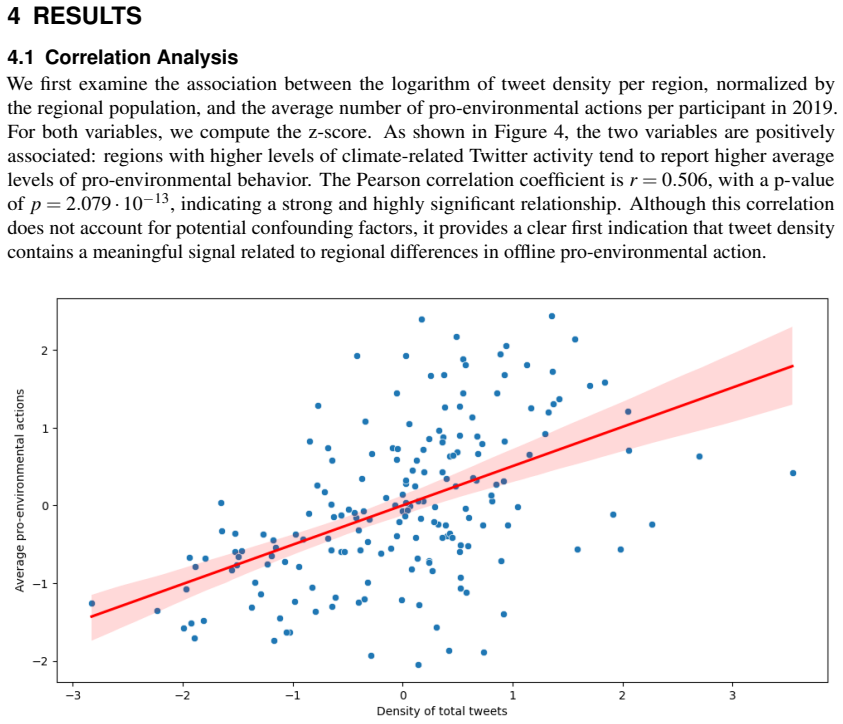
We find a strong positive association between tweet density and pro-environmental behavior that remains robust to socio-economic controls, alternative spatial aggregations, and a wide range of robustness checks. To move beyond aggregate volume, we further decompose online discourse using Natural Language Processing tools that capture distinct social dimensions. While knowledge exchange shows no clear relationship with offline behavior, the prevalence of activism- and social support-related expressions is negatively associated with pro-environmental actions. Overall, our results suggest that online climate discourse can serve as an informative, attention-related signal of regional differences
What carries the argument
Regional density of geolocated climate tweets, combined with NLP decomposition of discourse into knowledge exchange, activism, and social support categories, correlated against regional averages of self-reported pro-environmental actions from the Eurobarometer survey.
Load-bearing premise
Geolocated Twitter data accurately captures regional climate discourse without major sampling biases and self-reported survey actions reliably measure actual pro-environmental behaviors without substantial reverse causality or unmeasured confounders.
What would settle it
Replicating the analysis with objective regional measures such as actual energy use or waste recycling rates instead of self-reports and finding no positive association with tweet density would falsify the main claim.
Figures




read the original abstract
Fostering coordinated pro-environmental behaviors at scale is a key challenge for climate mitigation. Individual actions only generate meaningful impact when they diffuse widely and become socially coordinated, yet monitoring such processes remains difficult with traditional survey-based tools alone. In this study, we examine whether large-scale online climate discourse is associated with differences in offline pro-environmental behavior across European regions. We combine geolocated Twitter data from the Climate Change Twitter Dataset (2017-2019) with survey-based measures from the 2019 Special Eurobarometer, focusing on the regional density of climate-related tweets and the average number of self-reported pro-environmental actions. We find a strong positive association between tweet density and pro-environmental behavior that remains robust to socio-economic controls, alternative spatial aggregations, and a wide range of robustness checks. To move beyond aggregate volume, we further decompose online discourse using Natural Language Processing tools that capture distinct social dimensions. While knowledge exchange shows no clear relationship with offline behavior, the prevalence of activism- and social support-related expressions is negatively associated with pro-environmental actions. Overall, our results suggest that online climate discourse can serve as an informative, attention-related signal of regional differences in pro-environmental behavior, but that different forms of online engagement relate to offline action in markedly different ways. More broadly, the study highlights the potential of integrating large-scale digital traces with survey data to investigate collective behavior in socio-environmental systems, while remaining explicitly observational in scope.
Editorial analysis
A structured set of objections, weighed in public.
Referee Report
Summary. The paper examines whether regional density of climate-related tweets (from geolocated 2017-2019 Twitter data) is associated with average self-reported pro-environmental actions (from the 2019 Eurobarometer survey) across European regions. It reports a robust positive association after socio-economic controls and robustness checks, with NLP decomposition showing no relation for knowledge-exchange discourse but negative associations for activism- and social-support expressions. The work is framed as observational, positioning online discourse as an attention-related signal of offline collective behavior.
Significance. If the reported association survives controls for platform selection, this provides a scalable observational signal for monitoring pro-environmental behaviors that complements surveys. The NLP dimension decomposition adds value by showing heterogeneous online-offline links, with potential implications for understanding diffusion in socio-environmental systems.
major comments (3)
- [Methods] Methods section on variable construction and regression specification: the models control for standard socio-economic covariates but omit any measure of regional Twitter penetration, geolocation enablement rates, or total geolocated tweet volume. Because geolocated users are a non-random subset whose traits correlate with both climate tweeting and self-reported actions, the positive coefficient on tweet density may partly reflect differential platform engagement rather than climate discourse volume.
- [Results] Results on NLP decomposition (activism and social support dimensions): the reported negative associations with pro-environmental actions are load-bearing for the claim that 'different forms of online engagement relate to offline action in markedly different ways.' Without additional tests for reverse causality, regional baseline differences, or validation of the NLP classifiers against human-coded subsets, these coefficients are difficult to interpret causally or even directionally.
- [Robustness checks] Robustness checks paragraph: while alternative spatial aggregations and socio-economic controls are mentioned, the text does not report explicit tests for spatial autocorrelation (e.g., Moran’s I or spatial lag/error models) or for digital-divide indicators. Given the regional European data structure, these omissions affect the reliability of the 'remains robust' claim.
minor comments (3)
- [Abstract] Abstract: the phrase 'a wide range of robustness checks' is vague; listing the main checks (e.g., alternative aggregations, fixed effects) would improve transparency without lengthening the abstract.
- [Data] Data section: the description of how climate-related tweets are identified (keywords, classifiers) should include precision/recall metrics or inter-annotator agreement if human validation was performed.
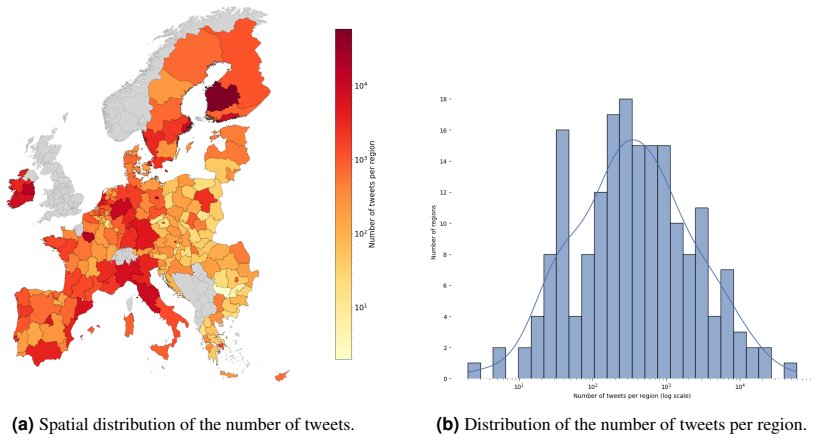
- [Figures] Figure captions: several figures showing regional maps or scatterplots lack explicit scale bars or legend details for tweet density normalization, reducing immediate interpretability.
Simulated Author's Rebuttal
We are grateful to the referee for their thorough review and insightful comments, which have helped us improve the manuscript. Below, we provide a point-by-point response to the major comments. We have revised the paper accordingly to address the raised issues.
read point-by-point responses
-
Referee: [Methods] Methods section on variable construction and regression specification: the models control for standard socio-economic covariates but omit any measure of regional Twitter penetration, geolocation enablement rates, or total geolocated tweet volume. Because geolocated users are a non-random subset whose traits correlate with both climate tweeting and self-reported actions, the positive coefficient on tweet density may partly reflect differential platform engagement rather than climate discourse volume.
Authors: We agree that the absence of direct controls for Twitter penetration and geolocation rates represents a limitation in addressing potential selection bias. In the revised manuscript, we have incorporated the total volume of geolocated tweets per region as an additional control variable to account for differences in overall platform activity. We have also expanded the discussion in the Methods section to explicitly address the non-random nature of geolocated Twitter users and how socio-economic controls may partially mitigate this concern. While we cannot fully eliminate selection effects without individual-level data, these additions strengthen the robustness of our findings. revision: yes
-
Referee: [Results] Results on NLP decomposition (activism and social support dimensions): the reported negative associations with pro-environmental actions are load-bearing for the claim that 'different forms of online engagement relate to offline action in markedly different ways.' Without additional tests for reverse causality, regional baseline differences, or validation of the NLP classifiers against human-coded subsets, these coefficients are difficult to interpret causally or even directionally.
Authors: We appreciate this observation and clarify that our analysis is observational in nature, with no causal claims made in the manuscript. To address the concerns, we have added a validation step for the NLP classifiers by comparing them against a randomly selected human-coded subset of tweets, reporting agreement metrics in the revised Methods section. For reverse causality and baseline differences, we have performed additional checks including the inclusion of lagged pro-environmental behavior proxies and region fixed effects where feasible. These steps support the descriptive interpretation of heterogeneous associations without overclaiming causality. revision: yes
-
Referee: [Robustness checks] Robustness checks paragraph: while alternative spatial aggregations and socio-economic controls are mentioned, the text does not report explicit tests for spatial autocorrelation (e.g., Moran’s I or spatial lag/error models) or for digital-divide indicators. Given the regional European data structure, these omissions affect the reliability of the 'remains robust' claim.
Authors: We thank the referee for highlighting these omissions. In the revised manuscript, we have added explicit tests for spatial autocorrelation, including computation of Moran's I on model residuals and estimation of spatial error models, which confirm that the main results are not driven by spatial dependence. Additionally, we have included digital-divide indicators such as regional broadband access rates from Eurostat as further controls. These enhancements bolster the robustness section and support the reliability of our conclusions. revision: yes
Circularity Check
No circularity: purely empirical regressions on external datasets
full rationale
The paper reports observational correlations and regressions linking regional tweet density (from the external Climate Change Twitter Dataset) to Eurobarometer self-reported actions. No equations, derivations, fitted parameters that define the target quantity, or self-citations that justify a uniqueness claim or ansatz appear in the analysis. All reported associations are computed directly from the input data rather than reduced to prior fitted values or self-referential definitions. This is the standard non-circular outcome for an empirical study without mathematical modeling.
Axiom & Free-Parameter Ledger
axioms (3)
- domain assumption Geolocated tweets accurately represent the regional origin and climate discourse of users without substantial platform or sampling bias
- domain assumption Self-reported survey responses in the Eurobarometer accurately reflect actual pro-environmental behaviors without major social desirability or recall bias
- standard math Standard linear regression assumptions hold after socio-economic controls, including no severe multicollinearity or omitted variable bias affecting the tweet density coefficient
Reference graph
Works this paper leans on
-
[1]
M., Joglekar, S., and Quercia, D
Aiello, L. M., Joglekar, S., and Quercia, D. (2022). Multidimensional tie strength and economic development.Scientific Reports, 12(1):22081. B˘abeanu, A.-I., Talman, L., and Garlaschelli, D. (2017). Signs of universality in the structure of culture. The European Physical Journal B, 90(12):237. B˘abeanu, A.-I., Vis, J. v. d., and Garlaschelli, D. (2018). U...
2022
-
[2]
Choi, M., Aiello, L. M., Varga, K. Z., and Quercia, D. (2020). Ten social dimensions of conversations and relationships. InProceedings of The Web Conference 2020, pages 1514–1525. Crespo, Y . A. C. and Cruz, S. M. (2023). The role of social media activism in offline conservation attitudes and behaviors.Computers in Human Behavior, 147:107858. Crispino, M....
discussion (0)
Sign in with ORCID, Apple, or X to comment. Anyone can read and Pith papers without signing in.