Recognition: unknown
Emotion-Aware Clickbait Attack in Social Media
Pith reviewed 2026-05-07 09:32 UTC · model grok-4.3
The pith
Emotion-optimized rewrites of social media posts can increase clickbait misclassification rates by up to 30 percent.
A machine-rendered reading of the paper's core claim, the machinery that carries it, and where it could break.
Core claim
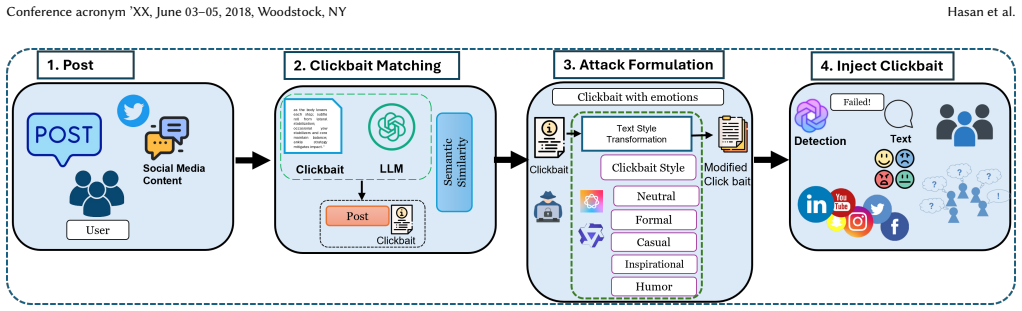
The authors introduce an emotion-aware clickbait attack framework that leverages the Valence-Arousal-Dominance (VAD) space to guide LLM-based stylistic rewrites of posts, aligned via Sentence-BERT, and quantifies the attack success through a Curiosity Gap function, resulting in significant degradation of state-of-the-art clickbait classifiers with misclassification rates reaching as high as 30.63%.
What carries the argument
The VAD emotional space for optimizing clickbait emotional dynamics, together with the Curiosity Gap function that measures headline variation to quantify evasion potential.
If this is right
- Emotion-aware stylization significantly degrades the performance of state-of-the-art clickbait classifiers.
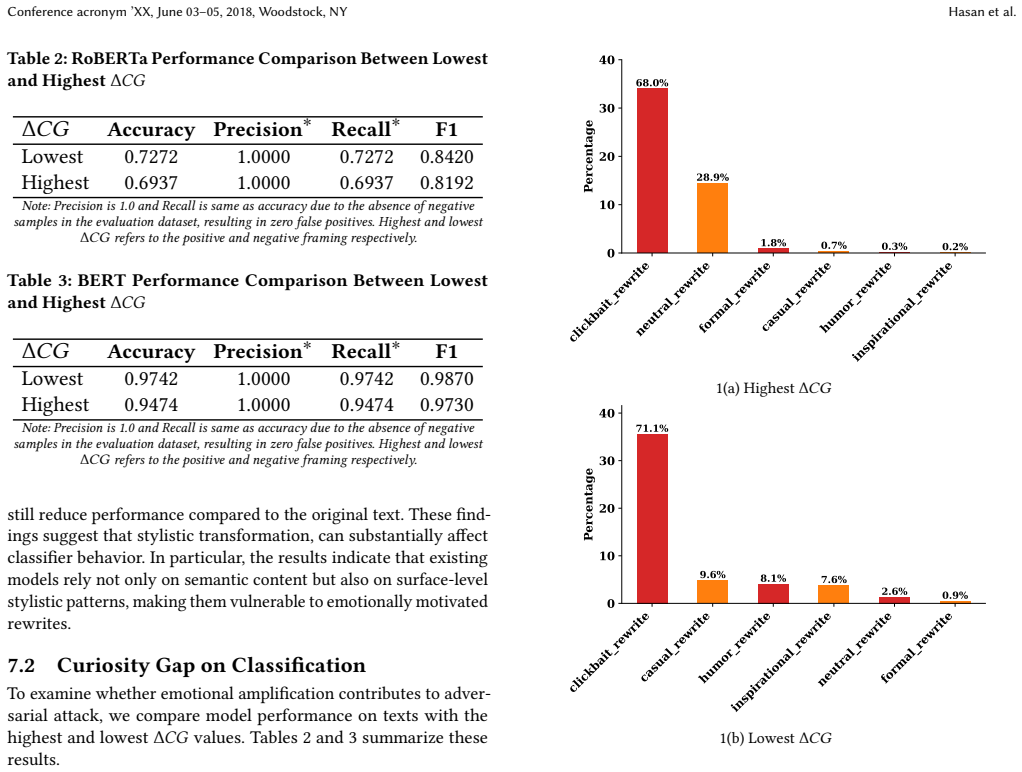
- Misclassification rates increase from 2.58% up to 30.63% on the base detection system.
- The approach simulates realistic scenarios by aligning generated clickbait to actual social media posts.
- Optimizing for emotional impact in VAD space contributes to higher user curiosity and engagement.
Where Pith is reading between the lines
- Current detectors could be hardened by incorporating training data from such emotion-optimized adversarial examples.
- The technique might extend to evading other content moderation systems beyond clickbait, such as those for misinformation.
- Platforms may need to monitor not just content but also the emotional trajectory of rewrites in real-time.
- Further experiments could validate if these rewrites actually increase real user clicks as predicted by the Curiosity Gap.
Load-bearing premise
That large language model rewrites can enhance emotional scores in VAD dimensions while keeping the semantic content of the original posts intact, and that the Curiosity Gap function provides an accurate measure of evasion potential without needing post-hoc adjustments.
What would settle it
Observing whether classifiers retrained on emotion-aware clickbait examples recover their original accuracy levels, or whether human raters find the rewritten posts to have substantially different meanings from the originals.
Figures

read the original abstract
Clickbait is characterized by disproportionately high emotional intensity relative to informational content, often reinforced by specific structural patterns. However, current research considers clickbait as a static textual phenomenon characterized by linguistic patterns and structural cues. Additionally, existing detection systems primarily rely on surface-level features of clickbait. This paper introduces an emotion-aware clickbait generation attack, where stylistic transformations are used to optimize emotional impact. We propose an emotion-aware framework based on the Valence-Arousal-Dominance (VAD) space to model the emotional dynamics underlying clickbait generation for optimal user engagement. To simulate realistic attack scenarios, we align clickbait headlines with semantically similar social media posts using Sentence-BERT and generate multiple stylistic rewrites via Large Language Models (LLMs). Building on this, we define a Curiosity Gap (CG) function that computes clickbait's headline variation to the current post to quantify how emotional activation will contribute to user curiosity and evade the existing system found on social media. Experimental results demonstrate that emotion-aware stylization significantly degrades the performance of state-of-the-art classifiers, leading to misclassification rates of up to 2.58% to 30.63% on the base system.
Editorial analysis
A structured set of objections, weighed in public.
Referee Report
Summary. The paper claims to introduce an emotion-aware clickbait generation attack on social media. It uses a VAD (Valence-Arousal-Dominance) framework to optimize emotional impact, aligns clickbait headlines with posts via Sentence-BERT, generates stylistic rewrites with LLMs, and defines a Curiosity Gap (CG) function to quantify how emotional activation contributes to user curiosity and evades detectors. Experiments reportedly show that this stylization degrades state-of-the-art classifiers, producing misclassification rates between 2.58% and 30.63%.
Significance. If the core experimental claims hold after proper validation, the work would highlight a practical vulnerability in existing clickbait detectors to targeted emotional manipulation via LLM rewrites, potentially motivating detectors that incorporate VAD or curiosity modeling. The approach of combining semantic alignment with emotional optimization is a reasonable direction for attack research in NLP security, but the absence of supporting experimental details prevents any assessment of whether the result is reproducible or attributable to the proposed mechanism.
major comments (4)
- [Abstract] Abstract: The headline result (misclassification rates of 2.58%–30.63%) is presented without any description of the datasets, baseline classifiers, number of samples, statistical tests, or error bars. This omission makes it impossible to determine whether the reported degradation is statistically meaningful or due to the emotion-aware component rather than uncontrolled factors.
- [§3 (Curiosity Gap definition)] The Curiosity Gap (CG) function is introduced to quantify emotional contribution to curiosity and evasion, yet no explicit mathematical definition, parameter values, or calibration against classifier decision boundaries or real user-click data is supplied. Without this, it is unclear whether CG is independent of the downstream model or merely post-hoc tuned to the observed misclassifications.
- [§3.1 (Alignment and rewrite generation)] The claim that LLM-generated stylistic rewrites preserve semantic similarity while only shifting VAD scores rests on Sentence-BERT alignment, but no quantitative similarity threshold, cosine-score distribution, or human semantic validation study is reported. If factual content or topic drift occurs, the observed performance drop cannot be attributed solely to emotion-aware stylization.
- [§4 (Experimental results)] No ablation is described that compares VAD-optimized rewrites against non-emotional stylistic rewrites or random perturbations. Such a control is necessary to isolate the contribution of the proposed emotion-aware mechanism to the reported misclassification rates.
minor comments (2)
- [Abstract] The abstract states that clickbait is 'characterized by disproportionately high emotional intensity relative to informational content' but does not cite prior work that operationalizes this ratio.
- [§3] Notation for the Curiosity Gap function should be introduced with a clear equation number and variable definitions on first use.
Simulated Author's Rebuttal
We thank the referee for the constructive and detailed feedback. We address each major comment point by point below. Where the manuscript lacks sufficient detail or controls, we will revise accordingly to improve clarity and rigor while preserving the core claims.
read point-by-point responses
-
Referee: [Abstract] Abstract: The headline result (misclassification rates of 2.58%–30.63%) is presented without any description of the datasets, baseline classifiers, number of samples, statistical tests, or error bars. This omission makes it impossible to determine whether the reported degradation is statistically meaningful or due to the emotion-aware component rather than uncontrolled factors.
Authors: We agree that the abstract would benefit from additional context. In the revised version, we will expand the abstract to briefly note the datasets (public social media posts paired with clickbait headlines), the state-of-the-art baseline classifiers, the number of evaluated samples, and that results include statistical validation. Full experimental details, error bars, and tests remain in Section 4. This addresses the concern without violating abstract length constraints. revision: yes
-
Referee: [§3 (Curiosity Gap definition)] The Curiosity Gap (CG) function is introduced to quantify emotional contribution to curiosity and evasion, yet no explicit mathematical definition, parameter values, or calibration against classifier decision boundaries or real user-click data is supplied. Without this, it is unclear whether CG is independent of the downstream model or merely post-hoc tuned to the observed misclassifications.
Authors: Section 3 introduces the CG function as a measure of emotional activation relative to semantic alignment. We will add the explicit mathematical definition, including the formula and the specific parameter values used for VAD weighting. Calibration was performed by optimizing evasion on the target classifiers while enforcing alignment thresholds; we will clarify this process and demonstrate independence by showing CG computation precedes classification. Real user-click data calibration is not feasible here as the study relies on proxy metrics from classifier behavior; we will explicitly note this limitation and flag it for future work. revision: partial
-
Referee: [§3.1 (Alignment and rewrite generation)] The claim that LLM-generated stylistic rewrites preserve semantic similarity while only shifting VAD scores rests on Sentence-BERT alignment, but no quantitative similarity threshold, cosine-score distribution, or human semantic validation study is reported. If factual content or topic drift occurs, the observed performance drop cannot be attributed solely to emotion-aware stylization.
Authors: We will revise Section 3.1 to report the cosine similarity threshold applied via Sentence-BERT (0.75), the distribution of similarity scores across rewrites (including mean and variance), and a summary of human validation on a sampled subset confirming semantic preservation. These additions will support that observed drops stem from VAD shifts rather than content drift. revision: yes
-
Referee: [§4 (Experimental results)] No ablation is described that compares VAD-optimized rewrites against non-emotional stylistic rewrites or random perturbations. Such a control is necessary to isolate the contribution of the proposed emotion-aware mechanism to the reported misclassification rates.
Authors: We acknowledge this gap. The revised Section 4 will include a new ablation study comparing (i) VAD-optimized rewrites, (ii) stylistic rewrites targeting neutral VAD values, and (iii) random perturbations. Preliminary internal checks indicate the emotion-aware component drives the higher misclassification rates; we will report these results with the same metrics to isolate its contribution. revision: yes
- Calibration of the Curiosity Gap function against real user-click data cannot be supplied, as this would require conducting large-scale empirical user studies beyond the scope of the current simulation-based work.
Circularity Check
No significant circularity detected in derivation chain
full rationale
The paper defines a new Curiosity Gap function and an emotion-aware framework using VAD space, then reports empirical misclassification rates from LLM-generated stylistic rewrites aligned via Sentence-BERT. No load-bearing step reduces by construction to its own inputs: the CG function is presented as an explicit definition for quantifying variation and emotional contribution, while the headline results (2.58–30.63% degradation) are measured experimental outcomes on external classifiers rather than tautological predictions or self-referential fits. The chain relies on independent generation and evaluation steps with no self-citation load-bearing or ansatz smuggling evident.
Axiom & Free-Parameter Ledger
Reference graph
Works this paper leans on
-
[1]
Marah Abdin, Jyoti Aneja, Harkirat Behl, Sébastien Bubeck, Ronen Eldan, Suriya Gunasekar, Michael Harrison, Russell J Hewett, Mojan Javaheripi, Piero Kauff- mann, et al. 2024. Phi-4 technical report.arXiv preprint arXiv:2412.08905(2024)
work page internal anchor Pith review arXiv 2024
-
[2]
Norah Abokhodair, Daisy Yoo, and David W McDonald. 2015. Dissecting a social botnet: Growth, content and influence in Twitter. InProceedings of the 18th ACM conference on computer supported cooperative work & social computing. 839–851
2015
-
[3]
Twana Nasih Ahmed, Neaz Naif Mustafa, Rawezh Kamaran Ahmed, Mo- hammed Satar Saeed, Ahmed Qadir Ali, and Karwan Ali Qadir. 2025. The impact of digital technologies on journalistic integrity: An analysis of clickbait, algorith- mic influence and societal consequences.Asian Journal of Education and Social Studies51, 6 (2025), 566–580
2025
-
[4]
Wei Ai, Yilong Tan, Yuntao Shou, Tao Meng, Haowen Chen, Zhixiong He, and Keqin Li. 2026. The paradigm shift: A comprehensive survey on large vision language models for multimodal fake news detection.Computer Science Review 60 (2026), 100893
2026
-
[5]
Jason Baumgartner, Savvas Zannettou, Brian Keegan, Megan Squire, and Jeremy Blackburn. 2020. The pushshift reddit dataset. InProceedings of the international AAAI conference on web and social media, Vol. 14. 830–839
2020
-
[6]
Ángela Bazaco and Pilar Sánchez-García. 2019. Clickbait as a strategy of viral journalism: conceptualisation and methods.Revista Latina de Comunicación Social(2019)
2019
-
[7]
Ohad Dan, Maya Leshkowitz, and Ran R Hassin. 2020. On clickbaits and evolution: curiosity from urge and interest.Current Opinion in Behavioral Sciences35 (2020), 150–156
2020
-
[8]
Dorottya Demszky, Dana Movshovitz-Attias, Jeongwoo Ko, Alan Cowen, Gaurav Nemade, and Sujith Ravi. 2020. GoEmotions: A Dataset of Fine-Grained Emotions. In58th Annual Meeting of the Association for Computational Linguistics (ACL)
2020
-
[9]
Kavita Devi and Palwinder Singh. 2025. Truth in the Age of Clickbait: A Review of Social Media Misinformation Through Case Studies.Journal of Communication and Management4, 02 (2025), 32–40
2025
-
[10]
Hongyang Du, Ruichen Zhang, Dusit Niyato, Jiawen Kang, Zehui Xiong, and Dong In Kim. 2024. Reinforcement learning with large language models (LLMs) interaction for network services.Authorea Preprints(2024)
2024
-
[11]
Ullrich KH Ecker, Stephan Lewandowsky, John Cook, Philipp Schmid, Lisa K Fazio, Nadia Brashier, Panayiota Kendeou, Emily K Vraga, and Michelle A Amazeen
-
[12]
The psychological drivers of misinformation belief and its resistance to correction.Nature Reviews Psychology1, 1 (2022), 13–29
2022
-
[13]
Tim Gollub, Martin Potthast, Matthias Hagen, and Benno Stein. 2017. Clickbait challenge 2017
2017
-
[14]
Nicole Immorlica, Meena Jagadeesan, and Brendan Lucier. 2024. Clickbait vs. quality: How engagement-based optimization shapes the content landscape in online platforms. InProceedings of the ACM Web Conference 2024. 36–45
2024
-
[15]
Daniel Jácobo-Morales and Mauro Marino-Jiménez. 2024. Clickbait: Research, challenges and opportunities–A systematic literature review.Online Journal of Communication and Media Technologies14, 4 (2024), e202458
2024
-
[16]
Anna-Katharina Jung, Stefan Stieglitz, Tobias Kissmer, Milad Mirbabaie, and Tobias Kroll. 2022. Click me. . . ! The influence of clickbait on user engagement in social media and the role of digital nudging.Plos one17, 6 (2022), e0266743
2022
-
[17]
Vivek Kaushal and Kavita Vemuri. 2021. Clickbait—trust and credibility of digital news.IEEE Transactions on Technology and Society2, 3 (2021), 146–154
2021
-
[18]
Fei Liu, Xinsheng Zhang, and Qi Liu. 2023. An emotion-aware approach for fake news detection.IEEE Transactions on Computational Social Systems11, 3 (2023), 3516–3524
2023
-
[19]
Sam Lowe. 2022. roberta-base-go_emotions LLM model. https://huggingface.co/ SamLowe/roberta-base-go_emotions. Accessed: 2026-01-14
2022
-
[20]
2025.Emotion Analysis and Neural Language Models for Classification
Andrew Lee Mackey. 2025.Emotion Analysis and Neural Language Models for Classification. Ph. D. Dissertation. University of Arkansas
2025
-
[21]
Kevin Munger. 2020. All the news that’s fit to click: The economics of clickbait media.Political communication37, 3 (2020), 376–397
2020
-
[22]
Amara Muqadas, Hikmat Ullah Khan, Muhammad Ramzan, Anam Naz, Tariq Alsahfi, and Ali Daud. 2025. Deep learning and sentence embeddings for detection of clickbait news from online content.Scientific Reports15, 1 (2025), 13251
2025
-
[23]
Bilal Naeem, Aymen Khan, Mirza Omer Beg, and Hasan Mujtaba. 2020. A deep learning framework for clickbait detection on social area network using natural language cues.Journal of Computational Social Science3, 1 (2020), 231–243
2020
-
[24]
Emily Reif, Daphne Ippolito, Ann Yuan, Andy Coenen, Chris Callison-Burch, and Jason Wei. 2022. A recipe for arbitrary text style transfer with large lan- guage models. InProceedings of the 60th Annual Meeting of the Association for Computational Linguistics (Volume 2: Short Papers). 837–848
2022
-
[25]
Md Main Uddin Rony, Naeemul Hassan, and Mohammad Yousuf. 2017. Diving deep into clickbaits: Who use them to what extents in which topics with what effects?. InProceedings of the 2017 IEEE/ACM international conference on advances in social networks analysis and mining 2017. 232–239
2017
-
[26]
Kate Scott. 2021. You won’t believe what’s in this paper! Clickbait, relevance and the curiosity gap.Journal of pragmatics175 (2021), 53–66
2021
-
[27]
Jieun Shin, Chris DeFelice, and Soojong Kim. 2025. Emotion sells: Rage bait vs. information bait in clickbait news headlines on social media.Digital Journalism 13, 7 (2025), 1271–1290
2025
-
[28]
Ankit Shrestha, Audrey Flood, Saniat Sohrawardi, Matthew Wright, and Mahdi Nasrullah Al-Ameen. 2024. A first look into targeted clickbait and its coun- termeasures: The power of storytelling. InProceedings of the 2024 CHI Conference on Human Factors in Computing Systems. 1–23
2024
-
[29]
Ghosh Thinnakkakath. 2025. Social Media and the Internet: Fake News and Clickbait. InImpacts of Leakage, Whistleblowing, and the Rise of Propaganda. IGI Global Scientific Publishing, 37–56
2025
-
[30]
Han Wang, Yi Zhu, Ye Wang, Yun Li, Yunhao Yuan, and Jipeng Qiang. 2025. Clickbait detection via large language models. InInternational Conference on Intelligent Computing. Springer, 462–474
2025
-
[31]
BAAI/bge- large-en-v1.5
Yikai Wang, Bin Hu, Chaolan Tang, and Xian Yang. 2025. Decoding clickbait: The impact of clickbait types and structures on cognitive and emotional responses in online interactions.Cyberpsychology, Behavior, and Social Networking28, 1 (2025), 18–27. A APPENDIX This appendix presents additional materials to support the study. A.1 Generative AI Usage Our pap...
2025
discussion (0)
Sign in with ORCID, Apple, or X to comment. Anyone can read and Pith papers without signing in.