Recognition: unknown
Star cluster formation from turbulent clumps. V. Stellar clustering around massive stars
Pith reviewed 2026-05-07 10:29 UTC · model grok-4.3
The pith
Massive stars in turbulent clumps rapidly acquire triple or higher-order companions through dynamical interactions.
A machine-rendered reading of the paper's core claim, the machinery that carries it, and where it could break.
Core claim
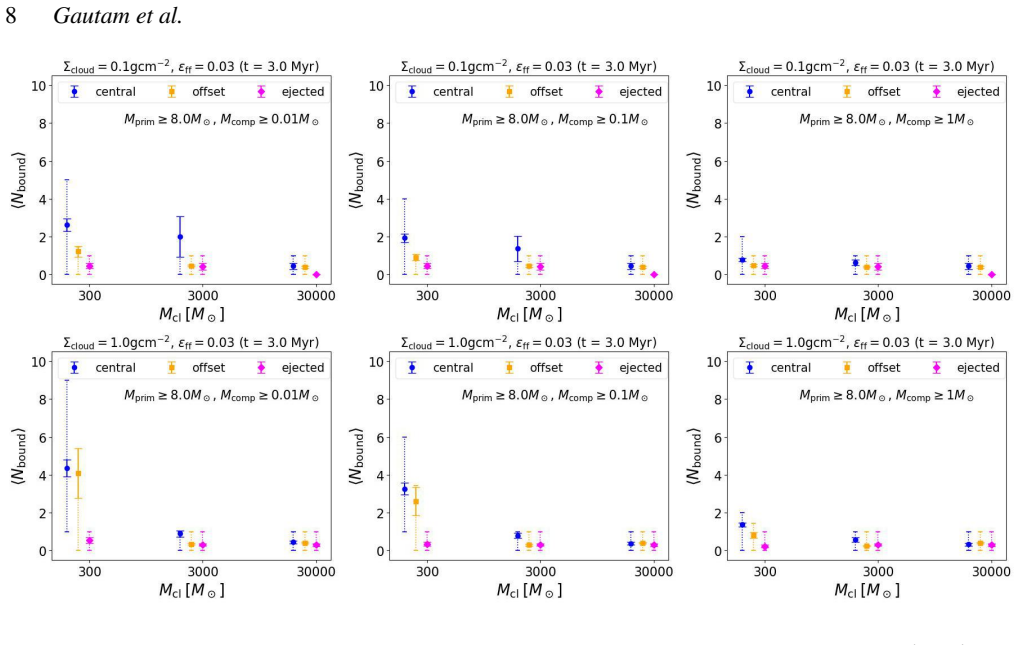
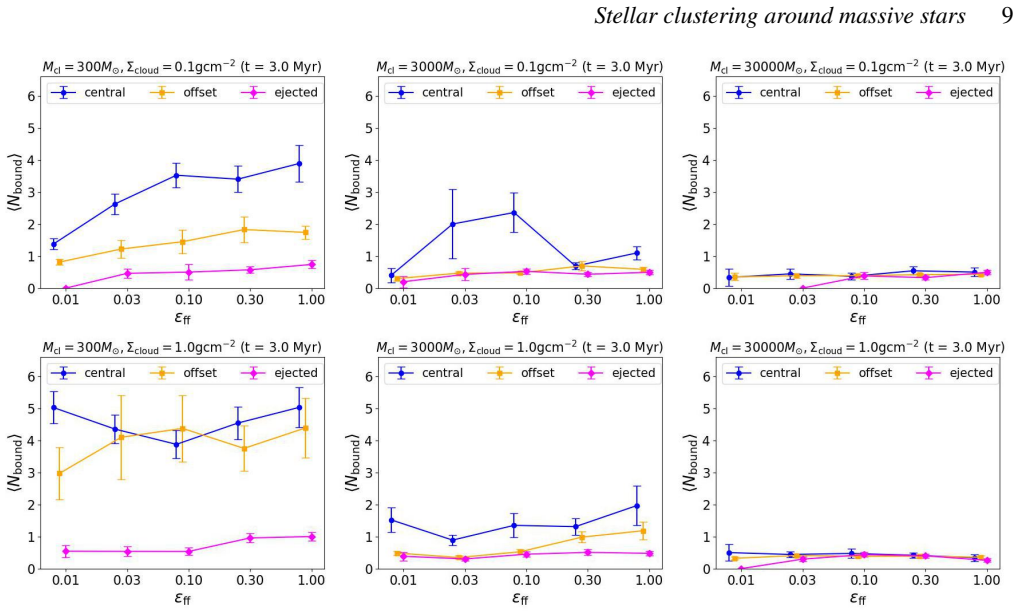
In N-body simulations of gradually forming star clusters from turbulent clumps with 50% primordial binaries, massive stars rapidly gather triple or higher-order bound companions and enhancements in local projected stellar density via dynamical processes. Secondary multiplicity increases towards cluster centers, tends to decrease in more massive clusters due to higher velocity dispersions but rises with mean density, and produces shallower N_* radial profiles than competitive accretion models, with AFGL 5180 better described by these models.
What carries the argument
N-body simulations tracking bound multiplicity and local projected stellar density N_* around massive stars in the Turbulent Clump Core Accretion paradigm.
If this is right
- Multiplicity and local density enhancements around massive stars increase towards the centers of clusters.
- Secondary multiplicity decreases in more massive clusters because of their higher velocity dispersions.
- Multiplicity rises as the mean density of the bound cluster increases.
- The radial profiles of local stellar density are shallower than those produced in competitive accretion simulations.
- Observed systems like AFGL 5180 are better matched by the turbulent clump models than by competitive accretion.
Where Pith is reading between the lines
- If dynamical processing dominates, then the observed multiplicity of massive stars in young clusters should correlate with local density and cluster age.
- Distinguishing formation models requires larger samples of observed young massive star systems.
- These simulations suggest that initial binary fractions and clump conditions strongly influence final multiplicity statistics.
Load-bearing premise
The initial conditions of the simulations and the assumed 50% primordial binary fraction accurately represent real star-forming clumps, with dynamical processing being the main driver of multiplicity.
What would settle it
Finding no correlation between massive star multiplicity and local stellar density or cluster age in a large sample of young clusters, or observing radial density profiles that match competitive accretion models instead.
Figures




read the original abstract
Massive stars (> 8 $M_\odot$) are known to have high degrees of multiplicity, e.g., with about 60% in triples or higher-order multiples. Such high levels of multiplicity may arise during formation (primary multiplicity) or through dynamical processing of already formed stars in dense clusters (secondary multiplicity). The level of primary multiplicity is an important metric to help distinguish between different formation scenarios, such as core accretion and competitive accretion. The level of secondary multiplicity is expected to evolve with time and be sensitive to local cluster environment. Here we analyze a suite of $N$-body simulations to study bound multiplicity and local projected stellar density, $N_*$, around massive stars within gradually forming star clusters with 50% primordial binaries in the Turbulent Clump Core Accretion (TCCA) paradigm. We find that massive stars rapidly gather triple or higher-order bound companions and enhancements in local $N_*$ via dynamical processes. We study these metrics as a function of environment in a given cluster, quantifying the increasing multiplicity that arises towards cluster centers. We find that secondary multiplicity tends to decrease in more massive clusters due to their higher velocity dispersions, but rises as the mean density of the bound cluster increases. We find our $N_*$ radial profiles are shallower compared to those in the STARFORGE simulations, which form massive stars via competitive accretion. A comparison to the AFGL 5180 system suggests it is better described by TCCA models. However, a larger number of observed systems is needed to better discriminate between these formation models.
Editorial analysis
A structured set of objections, weighed in public.
Referee Report
Summary. The manuscript analyzes a suite of N-body simulations of star cluster formation from turbulent clumps in the Turbulent Clump Core Accretion (TCCA) paradigm, initialized with a fixed 50% primordial binary fraction. It reports that massive stars (>8 M⊙) rapidly acquire triple or higher-order bound companions and local enhancements in projected stellar density N_* through dynamical interactions. Trends are quantified as functions of cluster environment, mass, and density; secondary multiplicity is found to decrease with cluster mass (due to higher velocity dispersions) but increase with mean bound-cluster density. The N_* radial profiles are reported as shallower than those in STARFORGE simulations (competitive accretion), and the AFGL 5180 system is suggested to be better matched by the TCCA runs, though more observed systems are needed for discrimination.
Significance. If the separation between initial and dynamically acquired multiplicity can be robustly demonstrated, the work would help quantify secondary multiplicity effects in dense environments and provide a useful metric for distinguishing core-accretion versus competitive-accretion scenarios for massive stars. The environmental trends and direct comparison to an observed system add concrete value, though the paper itself notes that larger observational samples are required.
major comments (2)
- [Abstract / methods] Abstract and methods description: the simulations adopt a fixed 50% primordial binary fraction without reported control runs at other fractions (0%, 25%, 75%). Because the initial multiplicity is already high, the reported rapid acquisition of triple and higher-order companions around massive stars cannot be unambiguously attributed to dynamical processing rather than inheritance from the initial conditions. Quantifying the fraction of final bound companions that form after the massive star has assembled most of its mass, or repeating the suite with varied primordial binary fractions, is needed to support the central claim of 'via dynamical processes'.
- [Results / comparison sections] Results on N_* profiles and multiplicity trends: the statement that profiles are shallower than in STARFORGE and that AFGL 5180 is better described by TCCA models lacks explicit quantitative metrics (e.g., fitted slopes with uncertainties, Kolmogorov-Smirnov statistics, or direct profile overlays with error bands). Without these, the comparative claim remains qualitative and its robustness to parameter choices or projection effects is difficult to assess.
minor comments (2)
- [Abstract] The abstract states 'a suite of N-body simulations' but does not summarize the number of realizations, total stellar mass range, or typical cluster radii; adding a concise table of run parameters would improve reproducibility.
- [Throughout] Notation for N_* (projected stellar density) should be defined at first use and distinguished clearly from three-dimensional density throughout the text.
Simulated Author's Rebuttal
We thank the referee for the thoughtful and constructive report. The comments highlight important points regarding the attribution of multiplicity to dynamical processes and the need for quantitative comparisons. We address each major comment below and will revise the manuscript to strengthen these aspects.
read point-by-point responses
-
Referee: [Abstract / methods] Abstract and methods description: the simulations adopt a fixed 50% primordial binary fraction without reported control runs at other fractions (0%, 25%, 75%). Because the initial multiplicity is already high, the reported rapid acquisition of triple and higher-order companions around massive stars cannot be unambiguously attributed to dynamical processing rather than inheritance from the initial conditions. Quantifying the fraction of final bound companions that form after the massive star has assembled most of its mass, or repeating the suite with varied primordial binary fractions, is needed to support the central claim of 'via dynamical processes'.
Authors: We agree that varying the primordial binary fraction in additional control runs would provide the strongest separation between primary and secondary multiplicity. However, our existing suite already tracks the time-dependent binding of companions relative to the mass assembly history of each massive star. In the revised manuscript we will add a dedicated analysis that quantifies, for each massive star, the fraction of its final bound companions that become bound after the star has reached 90% of its final mass. This will directly demonstrate the dynamical contribution even within the fixed 50% initial binary population. We note that performing an entirely new suite at multiple primordial fractions is beyond the scope of the current computational resources, but the post-assembly binding statistics will still allow a robust assessment of the dynamical channel. revision: partial
-
Referee: [Results / comparison sections] Results on N_* profiles and multiplicity trends: the statement that profiles are shallower than in STARFORGE and that AFGL 5180 is better described by TCCA models lacks explicit quantitative metrics (e.g., fitted slopes with uncertainties, Kolmogorov-Smirnov statistics, or direct profile overlays with error bands). Without these, the comparative claim remains qualitative and its robustness to parameter choices or projection effects is difficult to assess.
Authors: We concur that the comparative statements would benefit from explicit quantitative support. In the revised version we will (i) fit power-law slopes to the median N_* radial profiles in both TCCA and STARFORGE runs, reporting the best-fit indices and their uncertainties, (ii) perform two-sample Kolmogorov-Smirnov tests between the TCCA and STARFORGE N_* distributions at matched radii, and (iii) include direct overlay plots of the profiles with 16th–84th percentile error bands. We will also add a short discussion of projection effects by comparing face-on and random-line-of-sight projections. These additions will place the claim that TCCA models provide a better match to AFGL 5180 on a firmer statistical footing. revision: yes
Circularity Check
No significant circularity: results are direct outputs of N-body integration from explicit initial conditions
full rationale
The paper reports outcomes of forward N-body simulations initialized with a fixed 50% primordial binary fraction inside the TCCA framework. The central claims (rapid gathering of triple companions and local N_* enhancements around massive stars) are measured quantities from the evolved states of those runs, not quantities that reduce by definition or by fitting to the same data. No equations or steps equate a 'prediction' to a fitted input, rename a known result, or import a uniqueness theorem from self-citation that forces the outcome. Self-citations to prior TCCA work supply the initial-condition setup but do not carry the load of the reported multiplicity statistics, which remain independently falsifiable by re-running the stated N-body integrations. The fixed binary fraction is an unvaried modeling choice, but that is an assumption, not a circular reduction of the reported results to the inputs.
Axiom & Free-Parameter Ledger
free parameters (1)
- 50% primordial binaries
axioms (2)
- standard math N-body gravitational dynamics govern stellar interactions after formation
- domain assumption TCCA paradigm initial conditions represent real turbulent clumps
Reference graph
Works this paper leans on
-
[1]
write newline
" write newline "" before.all 'output.state := FUNCTION fin.entry write newline FUNCTION new.block output.state before.all = 'skip after.block 'output.state := if FUNCTION new.sentence output.state after.block = 'skip output.state before.all = 'skip after.sentence 'output.state := if if FUNCTION not #0 #1 if FUNCTION and 'skip pop #0 if FUNCTION or pop #1...
-
[2]
Anosova J. P., 1986, @doi [ ] 10.1007/BF00656037 , https://ui.adsabs.harvard.edu/abs/1986Ap&SS.124..217A 124, 217
-
[3]
Implementation and Initial Results
Appel S. M., et al., 2025, @doi [arXiv e-prints] 10.48550/arXiv.2509.15311 , https://ui.adsabs.harvard.edu/abs/2025arXiv250915311A p. arXiv:2509.15311
-
[4]
Bate M. R., Bonnell I. A., 1997, @doi [ ] 10.1093/mnras/285.1.33 , https://ui.adsabs.harvard.edu/abs/1997MNRAS.285...33B 285, 33
-
[5]
Beuther H., Kuiper R., Tafalla M., 2025, @doi [ ] 10.1146/annurev-astro-013125-122023 , https://ui.adsabs.harvard.edu/abs/2025ARA&A..63....1B 63, 1
-
[6]
Blaauw A., 1961, , https://ui.adsabs.harvard.edu/abs/1961BAN....15..265B 15, 265
1961
-
[7]
Bonnell I. A., Bate M. R., Clarke C. J., Pringle J. E., 2001, @doi [ ] 10.1046/j.1365-8711.2001.04270.x , https://ui.adsabs.harvard.edu/abs/2001MNRAS.323..785B 323, 785
-
[8]
Butler M. J., Tan J. C., 2012, @doi [ ] 10.1088/0004-637X/754/1/5 , https://ui.adsabs.harvard.edu/abs/2012ApJ...754....5B 754, 5
-
[9]
Butler M. J., Tan J. C., Teyssier R., Rosdahl J., Van Loo S., Nickerson S., 2017, @doi [ ] 10.3847/1538-4357/aa7054 , https://ui.adsabs.harvard.edu/abs/2017ApJ...841...82B 841, 82
-
[10]
Carretero-Castrillo M., Rib \'o M., Paredes J. M., Holgado G., Mart \' nez-Sebasti \'a n C., Sim \'o n-D \' az S., 2025, @doi [arXiv e-prints] 10.48550/arXiv.2510.21577 , https://ui.adsabs.harvard.edu/abs/2025arXiv251021577C p. arXiv:2510.21577
-
[11]
Chabrier G., 2003, @doi [ ] 10.1086/376392 , https://ui.adsabs.harvard.edu/abs/2003PASP..115..763C 115, 763
-
[12]
Chon S., Vigna-G \'o mez A., 2026, @doi [arXiv e-prints] 10.48550/arXiv.2601.06251 , https://ui.adsabs.harvard.edu/abs/2026arXiv260106251C p. arXiv:2601.06251
-
[13]
Costa Silva A. R., et al., 2022, @doi [ ] 10.1051/0004-6361/202142412 , https://ui.adsabs.harvard.edu/abs/2022A&A...659A..23C 659, A23
-
[14]
Cournoyer-Cloutier C., et al., 2024, @doi [ ] 10.3847/1538-4357/ad90b3 , https://ui.adsabs.harvard.edu/abs/2024ApJ...977..203C 977, 203
-
[15]
Crowe S., et al., 2024, @doi [ ] 10.1051/0004-6361/202348094 , https://ui.adsabs.harvard.edu/abs/2024A&A...682A...2C 682, A2
-
[16]
2012, MNRAS, 423, 600, doi: 10.1111/j.1365-2966.2012.20901.x
Dale J. E., Ercolano B., Bonnell I. A., 2012, @doi [ ] 10.1111/j.1365-2966.2012.21205.x , https://ui.adsabs.harvard.edu/abs/2012MNRAS.424..377D 424, 377
-
[17]
E., Ngoumou J., Ercolano B., Bonnell I
Dale J. E., Ngoumou J., Ercolano B., Bonnell I. A., 2014, @doi [ ] 10.1093/mnras/stu816 , https://ui.adsabs.harvard.edu/abs/2014MNRAS.442..694D 442, 694
-
[18]
Devine K. E., Churchwell E. B., Indebetouw R., Watson C., Crawford S. M., 2008, @doi [ ] 10.1088/0004-6256/135/6/2095 , https://ui.adsabs.harvard.edu/abs/2008AJ....135.2095D 135, 2095
-
[19]
Din c el B., et al., 2025, @doi [arXiv e-prints] 10.48550/arXiv.2511.14686 , https://ui.adsabs.harvard.edu/abs/2025arXiv251114686D p. arXiv:2511.14686
-
[20]
Farias J. P., Tan J. C., 2023, @doi [ ] 10.1093/mnras/stad1532 , https://ui.adsabs.harvard.edu/abs/2023MNRAS.523.2083F 523, 2083
-
[21]
Farias J. P., Tan J. C., Chatterjee S., 2017, @doi [ ] 10.3847/1538-4357/aa63f6 , https://ui.adsabs.harvard.edu/abs/2017ApJ...838..116F 838, 116
-
[22]
Farias J. P., Tan J. C., Chatterjee S., 2019, @doi [ ] 10.1093/mnras/sty3470 , https://ui.adsabs.harvard.edu/abs/2019MNRAS.483.4999F 483, 4999
-
[23]
The Astrophysical Journal553(1), 174 (2001)
Gammie C. F., 2001, @doi [ ] 10.1086/320631 , https://ui.adsabs.harvard.edu/abs/2001ApJ...553..174G 553, 174
-
[24]
Grudi \'c M. Y., Guszejnov D., Offner S. S. R., Rosen A. L., Raju A. N., Faucher-Gigu \`e re C.-A., Hopkins P. F., 2022, @doi [ ] 10.1093/mnras/stac526 , https://ui.adsabs.harvard.edu/abs/2022MNRAS.512..216G 512, 216
-
[25]
Guszejnov D., Hopkins P. F., Krumholz M. R., 2017, @doi [ ] 10.1093/mnras/stx725 , https://ui.adsabs.harvard.edu/abs/2017MNRAS.468.4093G 468, 4093
-
[26]
Heggie D. C., 1975, @doi [ ] 10.1093/mnras/173.3.729 , https://ui.adsabs.harvard.edu/abs/1975MNRAS.173..729H 173, 729
-
[27]
G., 1975, @doi [ ] 10.1086/111842 , https://ui.adsabs.harvard.edu/abs/1975AJ.....80.1075H 80, 1075
Hills J. G., 1975, @doi [ ] 10.1086/111842 , https://ui.adsabs.harvard.edu/abs/1975AJ.....80.1075H 80, 1075
-
[28]
M., 1997, @doi [ ] 10.1086/303982 , https://ui.adsabs.harvard.edu/abs/1997ApJ...480..681I 480, 681
Inutsuka S.-i., Miyama S. M., 1997, @doi [ ] 10.1086/303982 , https://ui.adsabs.harvard.edu/abs/1997ApJ...480..681I 480, 681
-
[29]
Issac N., Tej A., Liu T., Varricatt W., Vig S., Ishwara Chandra C. H., Schultheis M., Nandakumar G., 2020, @doi [ ] 10.1093/mnras/staa2301 , https://ui.adsabs.harvard.edu/abs/2020MNRAS.497.5454I 497, 5454
-
[30]
Kirk H., et al., 2017, @doi [ ] 10.3847/1538-4357/aa63f8 , https://ui.adsabs.harvard.edu/abs/2017ApJ...838..114K 838, 114
-
[31]
K \"o lligan A., Kuiper R., 2018, @doi [ ] 10.1051/0004-6361/201833686 , https://ui.adsabs.harvard.edu/abs/2018A&A...620A.182K 620, A182
-
[32]
Kroupa P., 2001, @doi [ ] 10.1046/j.1365-8711.2001.04022.x , https://ui.adsabs.harvard.edu/abs/2001MNRAS.322..231K 322, 231
-
[33]
Lewis S. C., et al., 2023, @doi [ ] 10.3847/1538-4357/acb0c5 , https://ui.adsabs.harvard.edu/abs/2023ApJ...944..211L 944, 211
-
[34]
2023, , 523, 5388, 10.1093/mnras/stad1644
Maity A. K., Dewangan L. K., Bhadari N. K., Ojha D. K., Chen Z., Pandey R., 2023, @doi [ ] 10.1093/mnras/stad1644 , https://ui.adsabs.harvard.edu/abs/2023MNRAS.523.5388M 523, 5388
-
[35]
Matzner C. D., 2002, @doi [ ] 10.1086/338030 , https://ui.adsabs.harvard.edu/abs/2002ApJ...566..302M 566, 302
-
[36]
McKee C. F., Tan J. C., 2003, @doi [ ] 10.1086/346149 , https://ui.adsabs.harvard.edu/abs/2003ApJ...585..850M 585, 850
-
[37]
Moe M., Di Stefano R., 2017, @doi [ ] 10.3847/1538-4365/aa6fb6 , https://ui.adsabs.harvard.edu/abs/2017ApJS..230...15M 230, 15
-
[38]
Nomoto K., Kobayashi C., Tominaga N., 2013, @doi [ ] 10.1146/annurev-astro-082812-140956 , https://ui.adsabs.harvard.edu/abs/2013ARA&A..51..457N 51, 457
-
[39]
Offner S. S. R., Moe M., Kratter K. M., Sadavoy S. I., Jensen E. L. N., Tobin J. J., 2023, in Inutsuka S., Aikawa Y., Muto T., Tomida K., Tamura M., eds, Astronomical Society of the Pacific Conference Series Vol. 534, Protostars and Planets VII. p. 275 ( @eprint arXiv 2203.10066 ), @doi 10.48550/arXiv.2203.10066
work page internal anchor Pith review doi:10.48550/arxiv.2203.10066 2023
-
[40]
Pineda J. E., et al., 2015, @doi [ ] 10.1038/nature14166 , https://ui.adsabs.harvard.edu/abs/2015Natur.518..213P 518, 213
-
[41]
Poveda A., Ruiz J., Allen C., 1967, Boletin de los Observatorios Tonantzintla y Tacubaya, https://ui.adsabs.harvard.edu/abs/1967BOTT....4...86P 4, 86
1967
-
[42]
Raghavan D., et al., 2010, @doi [ ] 10.1088/0067-0049/190/1/1 , https://ui.adsabs.harvard.edu/abs/2010ApJS..190....1R 190, 1
-
[43]
Reipurth B., Mikkola S., Connelley M., Valtonen M., 2010, @doi [ ] 10.1088/2041-8205/725/1/L56 , https://ui.adsabs.harvard.edu/abs/2010ApJ...725L..56R 725, L56
-
[44]
Reipurth B., et al., 2026, @doi [arXiv e-prints] 10.48550/arXiv.2602.06465 , https://ui.adsabs.harvard.edu/abs/2026arXiv260206465R p. arXiv:2602.06465
-
[45]
Reynolds N. K., et al., 2021, @doi [ ] 10.3847/2041-8213/abcc02 , https://ui.adsabs.harvard.edu/abs/2021ApJ...907L..10R 907, L10
-
[46]
Rogers H., Pittard J. M., 2013, @doi [ ] 10.1093/mnras/stt255 , https://ui.adsabs.harvard.edu/abs/2013MNRAS.431.1337R 431, 1337
-
[47]
Sana H., et al., 2012, @doi [Science] 10.1126/science.1223344 , https://ui.adsabs.harvard.edu/abs/2012Sci...337..444S 337, 444
-
[48]
Smith M. C., Sijacki D., Shen S., 2018, @doi [ ] 10.1093/mnras/sty994 , https://ui.adsabs.harvard.edu/abs/2018MNRAS.478..302S 478, 302
-
[49]
Staff J. E., Tanaka K. E. I., Tan J. C., 2019, @doi [ ] 10.3847/1538-4357/ab36b3 , https://ui.adsabs.harvard.edu/abs/2019ApJ...882..123S 882, 123
-
[50]
Staff J. E., Tanaka K. E. I., Ramsey J. P., Zhang Y., Tan J. C., 2023, @doi [ ] 10.3847/1538-4357/acbd47 , https://ui.adsabs.harvard.edu/abs/2023ApJ...947...40S 947, 40
-
[51]
Tan J. C., Beltr \'a n M. T., Caselli P., Fontani F., Fuente A., Krumholz M. R., McKee C. F., Stolte A., 2014, in Beuther H., Klessen R. S., Dullemond C. P., Henning T., eds, Protostars and Planets VI. pp 149--172 ( @eprint arXiv 1402.0919 ), @doi 10.2458/azu_uapress_9780816531240-ch007
-
[52]
Tanaka K. E. I., Tan J. C., Zhang Y., 2017, @doi [ ] 10.3847/1538-4357/835/1/32 , https://ui.adsabs.harvard.edu/abs/2017ApJ...835...32T 835, 32
-
[53]
Tanikawa A., Tajitsu A., Honda S., Maehara H., Sato B., Masuda K., Omiya M., Izumiura H., 2026, @doi [arXiv e-prints] 10.48550/arXiv.2601.21125 , https://ui.adsabs.harvard.edu/abs/2026arXiv260121125T p. arXiv:2601.21125
work page internal anchor Pith review Pith/arXiv arXiv doi:10.48550/arxiv.2601.21125 2026
-
[54]
Telkamp Z., et al., 2025, @doi [ ] 10.3847/1538-4357/adcd79 , https://ui.adsabs.harvard.edu/abs/2025ApJ...986...15T 986, 15
-
[55]
Tokovinin A., 2026, @doi [arXiv e-prints] 10.48550/arXiv.2601.05006 , https://ui.adsabs.harvard.edu/abs/2026arXiv260105006T p. arXiv:2601.05006
-
[56]
Tokovinin A., Moe M., 2020, @doi [ ] 10.1093/mnras/stz3299 , https://ui.adsabs.harvard.edu/abs/2020MNRAS.491.5158T 491, 5158
-
[57]
Tramper F., Sana H., de Koter A., Pauwels T., 2025, @doi [arXiv e-prints] 10.48550/arXiv.2509.18431 , https://ui.adsabs.harvard.edu/abs/2025arXiv250918431T p. arXiv:2509.18431
-
[58]
Vasyunina T., 2010, PhD thesis, Ruprecht-Karls University of Heidelberg, Germany
2010
-
[59]
Wall J. E., McMillan S. L. W., Mac Low M.-M., Klessen R. S., Portegies Zwart S., 2019, @doi [ ] 10.3847/1538-4357/ab4db1 , https://ui.adsabs.harvard.edu/abs/2019ApJ...887...62W 887, 62
-
[60]
Wang P., Li Z.-Y., Abel T., Nakamura F., 2010, @doi [ ] 10.1088/0004-637X/709/1/27 , https://ui.adsabs.harvard.edu/abs/2010ApJ...709...27W 709, 27
-
[61]
Zhang Y., Tan J. C., 2018, @doi [ ] 10.3847/1538-4357/aaa24a , https://ui.adsabs.harvard.edu/abs/2018ApJ...853...18Z 853, 18
-
[62]
Zummer M., Harmanec P., Barlow B., Blackford M., S vr c kov \'a J., 2025, @doi [arXiv e-prints] 10.48550/arXiv.2511.15544 , https://ui.adsabs.harvard.edu/abs/2025arXiv251115544Z p. arXiv:2511.15544
discussion (0)
Sign in with ORCID, Apple, or X to comment. Anyone can read and Pith papers without signing in.