Recognition: unknown
Gender Bias in YouTube Exposure: Allocative and Structural Inequalities in Political Information Environments
Pith reviewed 2026-05-07 08:02 UTC · model grok-4.3
The pith
YouTube's recommendation system allocates different political content and community structures to male-coded versus female-coded user profiles.
A machine-rendered reading of the paper's core claim, the machinery that carries it, and where it could break.
Core claim
Recommendation algorithms have become the dominant mechanism for information distribution on digital platforms. Through a controlled social-bot field experiment, we construct male-coded and female-coded profiles and track their exposure and click patterns to analyze recommendation trajectories. We find statistically significant differences in allocative bias across these profiles in issue distribution, ideological orientation, and political entities. We also observe structural bias characterized by distinct clustering patterns in the political information environments. Time-series analysis shows exposure pathways continue to be shaped by communities detected in the co-occurrence network and
What carries the argument
Controlled social-bot field experiment that deploys male-coded and female-coded profiles to track recommendation trajectories, measuring allocative bias through content distributions and structural bias through clustering in co-occurrence networks, with a simple collaborative-filtering model that reproduces the patterns.
If this is right
- Allocative bias produces unequal exposure to political issues, ideological orientations, and specific political entities between gender-coded profiles.
- Structural bias creates distinct clustering patterns that separate the information environments each profile encounters.
- Exposure pathways evolve over time under the combined influence of detected communities in co-occurrence networks and individual profile dynamics.
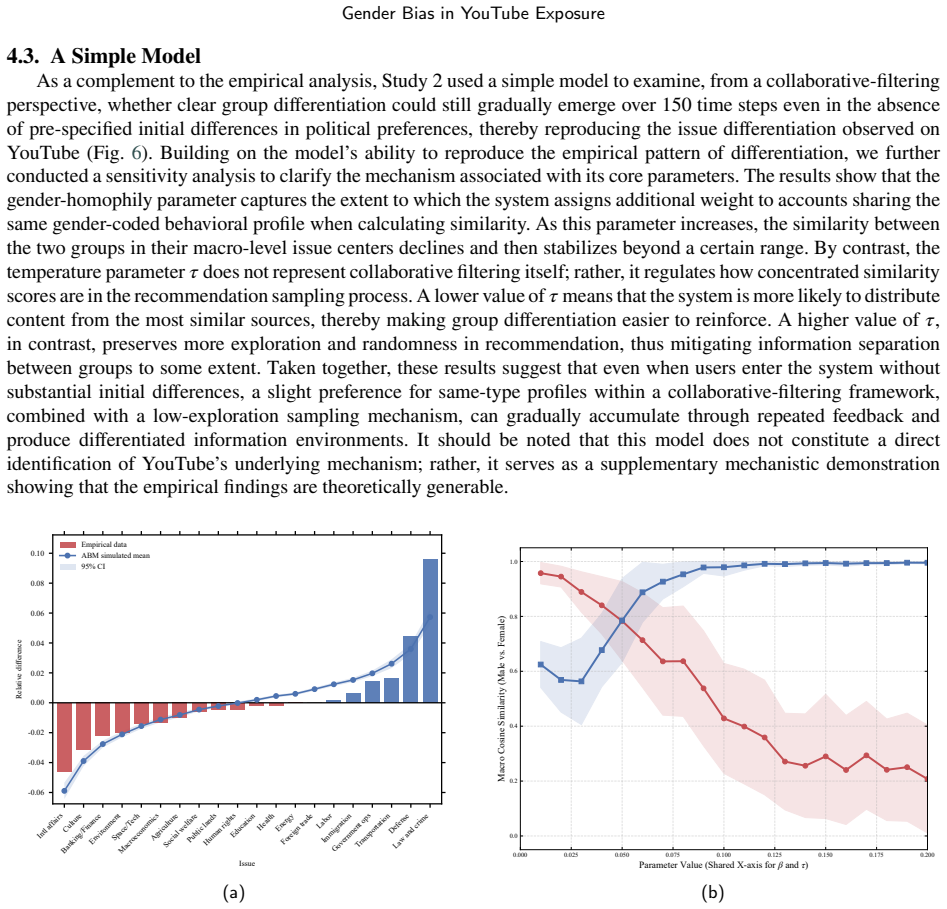
- A simple collaborative-filtering model can reproduce the full set of observed gender differences, showing the bias is reproducible from basic user-similarity logic.
- These mechanisms together reinforce societal inequalities by limiting cross-group access to political information.
Where Pith is reading between the lines
- If gender signals are removed from user profiles or downweighted in the algorithm, the allocative and structural differences might shrink, though the paper does not test this intervention.
- The same collaborative-filtering logic could generate parallel biases on other platforms that rely on user similarity for recommendations.
- Longer-term separation of political information environments could widen differences in knowledge or attitudes between demographic groups beyond what the short experiment captures.
- Audits that measure clustering in recommendation graphs alongside content counts would give a fuller picture of bias than content allocation alone.
Load-bearing premise
The male-coded and female-coded social-bot profiles accurately isolate gender as the causal factor in recommendation differences without confounding signals from account creation, browsing history simulation, or platform detection mechanisms.
What would settle it
Repeating the experiment with profiles that lack any gender signals in names, images, or initial activity and finding identical political recommendation patterns across groups would falsify the claim that gender coding drives the observed allocative and structural differences.
Figures


read the original abstract
Recommendation algorithms have become the dominant mechanism for information distribution on digital platforms, profoundly shaping personalized information consumption environments. However, gender bias, as a significant form of algorithmic discrimination, may cause users to experience unequal exposure within different political information environments. Taking YouTube as a case, we conduct a controlled social-bot field experiment, where male-coded and female-coded profiles are constructed. We track the exposure and click patterns of these bots to analyze their recommendation trajectories. We analyze the distribution of recommended content from two dimensions: allocative bias and structural bias. First, we find statistically significant differences in allocative bias across male-coded and female-coded profiles, particularly in terms of issue distribution, ideological orientation, and political entities. Secondly, we observe structural bias in the political information environments, characterized by distinct clustering patterns. Additionally, time-series analysis shows that exposure pathways continue to be shaped over time by both communities detected in the co-occurrence network and individual profile-level dynamics. Finally, we construct a simple collaborative-filtering model that reproduces the observed gender bias. We argue that gender bias in recommendation systems is reflected not only in the allocation of political content, but also in how community structures shape these environments, reinforcing societal inequalities and highlighting the need for algorithmic fairness.
Editorial analysis
A structured set of objections, weighed in public.
Referee Report
Summary. The paper reports results from a controlled social-bot field experiment on YouTube in which male-coded and female-coded profiles are constructed to track recommendation trajectories. It claims statistically significant differences in allocative bias (issue distribution, ideological orientation, and political entities) between the two profile types, documents structural bias via distinct clustering patterns in co-occurrence networks, presents time-series evidence that exposure pathways evolve under community and profile-level influences, and constructs a collaborative-filtering model that reproduces the observed gender bias. The authors conclude that recommendation systems embed both allocative and structural gender inequalities in political information environments.
Significance. If the experimental design successfully isolates gender as the sole causal factor and the statistical claims are robust, the work would add to the literature on algorithmic bias by jointly examining allocative and structural dimensions and by linking them to time-evolving community structures. The social-bot approach and the attempt to model the bias are potentially valuable contributions, but the current lack of methodological transparency and the circular nature of the modeling step substantially reduce the immediate significance of the findings.
major comments (3)
- [Abstract / Methods] Abstract and Methods: The abstract asserts 'statistically significant differences' in allocative bias without reporting sample sizes (number of profiles, videos, or sessions), the specific statistical tests used, effect sizes, or controls for confounders. This information is load-bearing for the central claim that gender produces the observed differences in issue distribution, ideology, and entities.
- [Methods] Methods (profile construction): The description of how male-coded versus female-coded profiles are built is insufficient. Details are missing on initial watch-history seeding, search-query simulation, subscription patterns, avatar/name selection, and any steps taken to prevent platform detection or bot identification. Without these, it is impossible to confirm that gender cues are isolated from other signals, undermining the causal interpretation of both allocative and structural bias results.
- [Modeling / Results] Modeling section: The collaborative-filtering model is explicitly constructed to reproduce the gender bias observed in the same experimental data. This renders the reproduction circular rather than an independent test or out-of-sample prediction, so it cannot distinguish platform mechanisms from experimental artifacts and does not strengthen the causal claim.
minor comments (2)
- [Abstract / Results] The abstract and results sections would benefit from explicit statements of the number of bots, duration of data collection, and exact definitions of 'issue distribution' and 'ideological orientation' metrics.
- [Figures] Figure captions and network diagrams should include node/edge definitions, community-detection algorithm parameters, and color legends to improve interpretability of the structural-bias claims.
Simulated Author's Rebuttal
We thank the referee for their constructive and detailed feedback, which identifies key areas where greater transparency can strengthen the manuscript. We address each major comment below and commit to revisions that improve methodological clarity while preserving the integrity of our claims. We believe these changes will enhance the paper's contribution to understanding algorithmic gender bias in political information environments.
read point-by-point responses
-
Referee: [Abstract / Methods] Abstract and Methods: The abstract asserts 'statistically significant differences' in allocative bias without reporting sample sizes (number of profiles, videos, or sessions), the specific statistical tests used, effect sizes, or controls for confounders. This information is load-bearing for the central claim that gender produces the observed differences in issue distribution, ideology, and entities.
Authors: We agree that the abstract's brevity limits inclusion of full statistical details, which are important for supporting the central claims. The manuscript already reports the number of profiles (20 male-coded and 20 female-coded), total recommended videos, and sessions in the Methods and Results sections, along with chi-square tests for issue and entity distributions, t-tests for ideological orientation, Cohen's d effect sizes, and controls for initial seeding and browsing patterns. In the revision, we will add a concise summary of sample sizes, tests, and effect sizes to the abstract and ensure the Results section explicitly highlights these controls to reinforce the causal interpretation. revision: yes
-
Referee: [Methods] Methods (profile construction): The description of how male-coded versus female-coded profiles are built is insufficient. Details are missing on initial watch-history seeding, search-query simulation, subscription patterns, avatar/name selection, and any steps taken to prevent platform detection or bot identification. Without these, it is impossible to confirm that gender cues are isolated from other signals, undermining the causal interpretation of both allocative and structural bias results.
Authors: We acknowledge that the current Methods description of profile construction lacks sufficient granularity for full reproducibility and causal isolation. In the revised manuscript, we will expand this section to detail the initial watch-history seeding (specific video categories and quantities for each gender-coded profile), search-query simulation (list of neutral and gender-neutral queries), subscription patterns (balanced across topics), avatar and name selection (standardized male/female names and images), and anti-detection measures (randomized inter-action delays, varied scroll patterns, residential IP proxies, and session length variation). These additions will better demonstrate that gender cues are the primary differentiating factor. revision: yes
-
Referee: [Modeling / Results] Modeling section: The collaborative-filtering model is explicitly constructed to reproduce the gender bias observed in the same experimental data. This renders the reproduction circular rather than an independent test or out-of-sample prediction, so it cannot distinguish platform mechanisms from experimental artifacts and does not strengthen the causal claim.
Authors: We respectfully disagree that the modeling renders the findings circular in a manner that invalidates the contribution. The collaborative-filtering model is not intended as an independent validation or out-of-sample test; rather, it illustrates that a standard user-item collaborative filtering algorithm, when trained on the observed interaction data, can generate similar allocative and structural gender biases. This provides a mechanistic account suggesting the biases stem from the recommendation system's core logic (user similarity and co-occurrence) rather than solely from experimental design. To address the concern, we will revise the section to explicitly state this illustrative purpose, discuss limitations regarding artifact distinction, and add a brief sensitivity analysis using alternative model specifications. revision: partial
Circularity Check
Collaborative-filtering model reproduces observed gender bias by construction from experimental data
specific steps
-
fitted input called prediction
[Abstract]
"Finally, we construct a simple collaborative-filtering model that reproduces the observed gender bias."
The model is constructed specifically to reproduce the gender bias already measured in the bot experiment's exposure and click patterns. A collaborative-filtering model trained or parameterized on the same profile trajectories and recommendation data will necessarily reproduce the observed differences by construction, rather than providing an independent derivation, out-of-sample prediction, or mechanistic validation separate from the input data.
full rationale
The paper's core experimental claims on allocative and structural bias derive from a controlled social-bot field experiment tracking recommendation trajectories for male-coded vs. female-coded profiles; these steps are independent data collection and analysis with no reduction to prior inputs or self-citations. The sole circular element is the final model, which is explicitly built to reproduce the same observed bias. This matches the fitted-input-called-prediction pattern but does not affect the primary findings, yielding partial circularity overall. No self-definitional, self-citation load-bearing, uniqueness, ansatz, or renaming issues appear in the derivation chain.
Axiom & Free-Parameter Ledger
axioms (1)
- domain assumption Statistical significance testing reliably identifies meaningful differences in recommendation distributions between profile types
Reference graph
Works this paper leans on
-
[1]
Public Opinion Quarterly 80, 298–320
Filter bubbles, echo chambers, and online news consumption. Public Opinion Quarterly 80, 298–320. Gillespie,T.,Boczkowski,P.J.,Foot,K.A.(Eds.),2014. MediaTechnologies:EssaysonCommunication,Materiality,andSociety. TheMITPress, Cambridge, MA. Guilbeault, D., Delecourt, S., Hull, T., Desikan, B.S., Chu, M., Nadler, E.,
2014
-
[2]
"whose side are you on?" estimating ideology of political and news content using large language models and few-shot demonstration selection.arXiv:2503.20797. Haroon, M., Wojcieszak, M., Chhabra, A., Liu, X., Mohapatra, P., Shafiq, Z.,
-
[3]
Proceedings of the National Academy of Sciences of the United States of America 120, e2213020120
Auditing youtube’s recommendation system for ideologically congenial, extreme, and problematic recommendations. Proceedings of the National Academy of Sciences of the United States of America 120, e2213020120. Helberger,N.,Karppinen,K.,D’Acunto,L.,2018. Exposurediversityasadesignprincipleforrecommendersystems. Information,Communication & Society 21, 191–2...
2018
-
[4]
Proceedings of the National Academy of Sciences of the United States of America 119, e2025334119
Algorithmic amplification of politics on twitter. Proceedings of the National Academy of Sciences of the United States of America 119, e2025334119. Kay,M.,Matuszek,C.,Munson,S.A.,2015. Unequalrepresentationandgenderstereotypesinimagesearchresultsforoccupations,in:Proceedings of the 33rd Annual ACM Conference on Human Factors in Computing Systems, Associat...
2015
-
[5]
5127–5138
Unmasking gender bias in recommendation systems and enhancing category-aware fairness, in: Proceedings of the ACM on Web Conference 2025, pp. 5127–5138. Kubiak, E., Efremova, M.I., Baron, S., Frasca, K.J.,
2025
-
[6]
Management Science 65, 2966–2981
Algorithmic bias? an empirical study of apparent gender-based discrimination in the display of stem career ads. Management Science 65, 2966–2981. Liu, N., Hu, X.E., Savas, Y., Baum, M.A., Berinsky, A.J., Chaney, A.J.B., Lucas, C., Mariman, R., de Benedictis-Kessner, J., Guess, A.M., Knox, D.,Stewart,B.M.,2025. Short-termexposuretofilter-bubblerecommendati...
2025
-
[7]
The interaction between political typology and filter bubbles in news recommendation algorithms, in: Proceedings of the Web Conference 2021, Association for Computing Machinery, New York, NY, USA. pp. 3791–3801. Mansoury,M.,Abdollahpouri,H.,Pechenizkiy,M.,Mobasher,B.,Burke,R.,2020. Feedbackloopandbiasamplificationinrecommendersystems, in: Proceedings of t...
2021
-
[8]
Journal of Communication 73, 101–112
Gender differences and similarities in news media effects on political candidate evaluations: a meta-analysis. Journal of Communication 73, 101–112. Singh,A.,Joachims,T.,2018. Fairnessofexposureinrankings,in:Proceedingsofthe24thACMSIGKDDInternationalConferenceonKnowledge Discovery & Data Mining, Association for Computing Machinery, New York, NY, USA. pp. ...
2018
-
[9]
Journal of Computer-Mediated Communication 29, zmad045
Smiling women pitching down: Auditing representational and presentational gender biases in image-generative AI. Journal of Computer-Mediated Communication 29, zmad045. Thelwall,M.,Foster,D.,2021. Maleorfemalegender-polarizedyoutubevideosarelessviewed. JournaloftheAssociationforInformationScience and Technology 72, 1545–1557. Thorson, K., Wells, C.,
2021
-
[10]
New Media & Society 26, 3541–3567
Representativeness and face-ism: Gender bias in image search. New Media & Society 26, 3541–3567. Vlasceanu,M.,Amodio,D.M.,2022. Propagationofsocietalgenderinequalitybyinternetsearchalgorithms. ProceedingsoftheNationalAcademy of Sciences of the United States of America 119, e2204529119. Wang,C.,Wang,K.,Bian,A.Y.,Islam,R.,Keya,K.N.,Foulds,J.R.,Pan,S.,2022. ...
2022
-
[11]
arXiv preprint arXiv:2304.08085
Instructuie: Multi-task instruction tuning for unified information extraction. arXiv preprint arXiv:2304.08085 . Yalcin, E., Bilge, A.,
-
[12]
PNAS Nexus 3, pgae518
Nudging recommendation algorithms increases news consumption and diversity on youtube. PNAS Nexus 3, pgae518. Zhou,M.,Zhang,J.,Adomavicius,G.,2024. Longitudinalimpactofpreferencebiasesonrecommendersystems’performance. InformationSystems Research 35, 1634–1656. Tan et al.:Preprint submitted to ElsevierPage 25 of 25
2024
discussion (0)
Sign in with ORCID, Apple, or X to comment. Anyone can read and Pith papers without signing in.