Recognition: unknown
Temporal and Content Coupling Analysis of Social Media User Behavior
Pith reviewed 2026-05-07 07:55 UTC · model grok-4.3
The pith
News clicks are driven mainly by historical interests during active hours, with patterns varying by user preference type.
A machine-rendered reading of the paper's core claim, the machinery that carries it, and where it could break.
Core claim
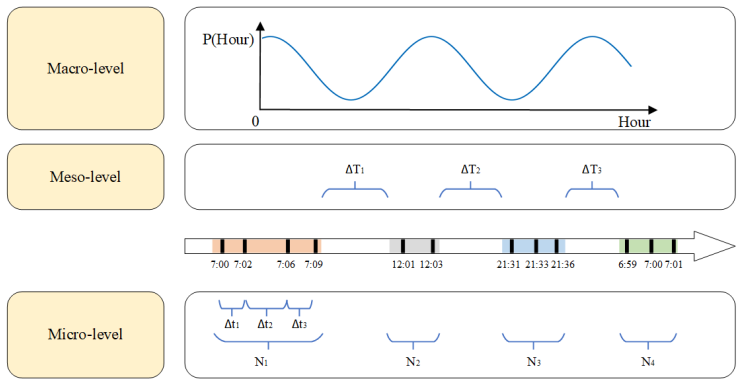
The authors claim that a multi-scale temporal-content framework applied to the MIND and Adressa news datasets reveals clear hierarchical temporal patterns—circadian rhythms via Fourier analysis at macroscale, power-law session intervals with exponent near 1 at mesoscale, and exponential distributions for action counts and intervals at microscale—while showing that historical interests dominate active time periods in driving clicks and that preference groups differ in frequency and sensitivity to diversity.
What carries the argument
The multi-scale temporal-content framework, which decomposes user activity into macroscale circadian rhythms, mesoscale power-law session intervals, and microscale exponential action patterns, then couples these timescales with content analysis to quantify how historical interests interact with time-based activity and diversity.
If this is right
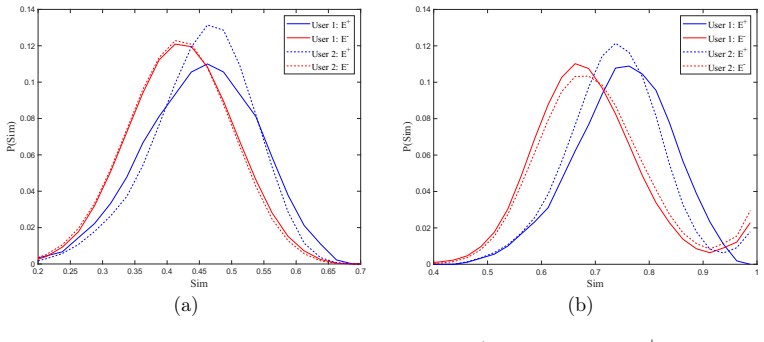
- Clicks are driven primarily by historical interests, with this effect weakening as content diversity increases.
- Timeliness and entertainment-oriented users click more frequently and rely more on historical interests.
- Diversified users click less frequently and are more sensitive to content diversity.
- Temporal patterns are hierarchical: circadian at macroscale, power-law at mesoscale, and exponential at microscale.
Where Pith is reading between the lines
- News platforms could improve engagement by prioritizing historical content during users' detected active hours.
- Segmenting users into preference groups could allow simpler, targeted strategies such as introducing more diversity only to certain segments.
- The same temporal-content coupling may appear in other online activities like video consumption or social posting, suggesting broader modeling opportunities.
- Testing the framework on additional datasets would clarify whether the patterns are domain-specific to news or apply across social media.
Load-bearing premise
The observed rhythms, distributions, and dominance of historical interests in the MIND and Adressa datasets are assumed to reflect general social media user behavior rather than being specific to these news platforms or their data collection.
What would settle it
Repeating the same multi-scale analysis on a large dataset from a non-news platform, such as a video-sharing or general social network site, and finding no circadian rhythms, no power-law session intervals, or no dominance of historical interests during active periods would falsify the claim that these couplings are general.
Figures





read the original abstract
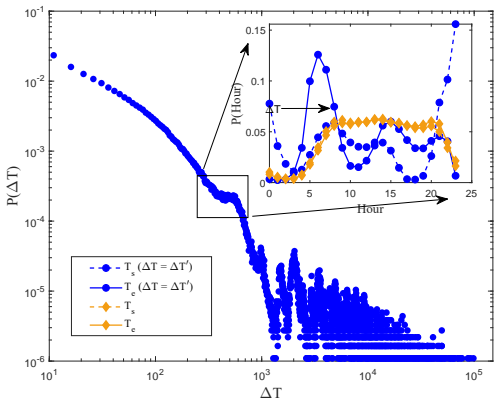
News consumption behavior is shaped by the coupling between temporal dynamics and content selection. This study proposes a multi-scale temporal-content framework and validates it on two large real-world news datasets, MIND and Adressa. Results reveal hierarchical temporal patterns. At the macroscale, Fourier modeling identifies clear circadian rhythms; at the mesoscale, session intervals follow a power-law distribution with $\alpha \approx 1$; and at the microscale, within-session action counts and inter-action intervals follow exponential distributions with $\lambda \approx 0.3$ and $\lambda \approx 0.02$, respectively. Content analysis shows that clicks are mainly driven by historical interests, while this dependence weakens as content diversity increases. Temporal-content coupling further indicates that users' historical interests dominate active time periods in shaping behavior. Preference groups also differ: timeliness and entertainment-oriented users click more frequently and rely more on historical interests, whereas diversified users click less and are more sensitive to content diversity.
Editorial analysis
A structured set of objections, weighed in public.
Referee Report
Summary. The paper proposes a multi-scale temporal-content framework for news consumption on social media and validates it empirically on the MIND and Adressa datasets. It reports hierarchical temporal patterns—circadian rhythms at macroscale via Fourier analysis, power-law session intervals (α ≈ 1) at mesoscale, and exponential distributions for within-session action counts (λ ≈ 0.3) and inter-action intervals (λ ≈ 0.02) at microscale—along with content analysis showing that clicks are primarily driven by historical interests, with this dependence weakening as content diversity increases. The central claims concern temporal-content coupling (historical interests dominate active periods) and differences across preference groups (timeliness/entertainment users click more and rely more on history; diversified users click less and are more sensitive to diversity).
Significance. If the distributional fits and coupling claims hold after rigorous validation, the work offers concrete empirical grounding for multi-scale user behavior models in social media, with potential value for recommendation algorithms that incorporate both temporal rhythms and content history. Credit is due for grounding the analysis in two named public datasets and reporting specific fitted parameter values rather than purely qualitative observations.
major comments (2)
- [Mesoscale temporal patterns] Mesoscale temporal patterns section: the claim that session intervals follow p(Δt) ∝ (Δt)^{-α} with α ≈ 1 is load-bearing for the hierarchical framework that connects macroscale circadian rhythms to microscale exponentials and underpins the subsequent temporal-content coupling conclusions. No xmin, xmax, normalization constant, KS-test p-value, or comparison to alternatives (log-normal, Weibull, truncated power-law) is reported, nor is any reference to standard MLE+KS procedures (Clauset et al.). For α = 1 the integral diverges logarithmically without an explicit upper cutoff; if the tail is an artifact of binning, finite observation windows, or dataset logging rules (e.g., session timeouts), the multi-scale bridge collapses.
- [Temporal-content coupling and preference groups] Temporal-content coupling and preference-group analysis sections: the assertion that 'historical interests dominate active time periods' and the reported group differences (timeliness/entertainment vs. diversified users) rest on unspecified quantitative measures. No details are given on the exact statistical models (e.g., regression coefficients, partial correlations, or controls for user activity level, time-of-day, or content popularity), error bars, or robustness checks, making it impossible to assess whether the dominance and group contrasts are load-bearing or sensitive to confounding.
minor comments (3)
- [Abstract] Abstract and methods: the reported λ values (0.3 and 0.02) and α ≈ 1 should be accompanied by confidence intervals or standard errors; the datasets' temporal coverage and user-sample sizes are not stated, limiting assessment of generalizability.
- [Figures and notation] Notation and figures: the power-law and exponential forms should explicitly state their support and any truncation; figure captions for the fitted distributions should include goodness-of-fit diagnostics or overlaid alternative models.
- [References] References: the power-law fitting discussion would benefit from citing Clauset et al. (2009) on statistical methods for power-law identification.
Simulated Author's Rebuttal
We thank the referee for the constructive and detailed feedback, which has helped us strengthen the statistical foundations and transparency of our multi-scale analysis. We address each major comment point by point below. Where the original submission lacked sufficient methodological detail, we have revised the manuscript to incorporate the requested information, including fitting procedures, model specifications, controls, and robustness checks. These changes preserve the core empirical findings while improving rigor.
read point-by-point responses
-
Referee: [Mesoscale temporal patterns] Mesoscale temporal patterns section: the claim that session intervals follow p(Δt) ∝ (Δt)^{-α} with α ≈ 1 is load-bearing for the hierarchical framework that connects macroscale circadian rhythms to microscale exponentials and underpins the subsequent temporal-content coupling conclusions. No xmin, xmax, normalization constant, KS-test p-value, or comparison to alternatives (log-normal, Weibull, truncated power-law) is reported, nor is any reference to standard MLE+KS procedures (Clauset et al.). For α = 1 the integral diverges logarithmically without an explicit upper cutoff; if the tail is an artifact of binning, finite observation windows, or dataset logging rules (e.g., session timeouts), the multi-scale bridge collapses.
Authors: We agree that the mesoscale power-law analysis requires explicit reporting of the fitting procedure to substantiate the hierarchical framework. In the revised manuscript we now detail the maximum-likelihood estimation following Clauset et al. (2009), including the estimated xmin (the lower bound of the power-law regime, selected to minimize the KS distance), xmax (set to the 99th percentile of observed intervals, approximately one day, to respect the macroscale circadian boundary), the normalization constant, and the KS goodness-of-fit p-value. We also report likelihood-ratio tests against log-normal and Weibull alternatives, confirming the power-law provides a statistically superior fit within the supported range. Regarding α ≈ 1 and potential divergence, we explicitly state that the distribution is truncated at xmax; this truncation is empirically justified by the daily periodicity already identified at the macroscale and by the finite observation windows of both datasets. We have added a citation to Clauset et al. and a supplementary figure showing the complementary cumulative distribution on log-log axes with the fitted line and bootstrap confidence bands. These additions confirm that the tail is not an artifact of binning or session-timeout rules, thereby preserving the multi-scale bridge. revision: yes
-
Referee: [Temporal-content coupling and preference groups] Temporal-content coupling and preference-group analysis sections: the assertion that 'historical interests dominate active time periods' and the reported group differences (timeliness/entertainment vs. diversified users) rest on unspecified quantitative measures. No details are given on the exact statistical models (e.g., regression coefficients, partial correlations, or controls for user activity level, time-of-day, or content popularity), error bars, or robustness checks, making it impossible to assess whether the dominance and group contrasts are load-bearing or sensitive to confounding.
Authors: We acknowledge that the original submission did not provide sufficient detail on the quantitative measures and controls used for the temporal-content coupling and preference-group analyses. In the revised manuscript we now specify the exact statistical models: mixed-effects logistic regression predicting click occurrence, with historical-interest similarity (cosine similarity of user embedding vectors from prior sessions) as the focal predictor, user-level random intercepts, and fixed-effect controls for time-of-day (hour dummies), content popularity (log view count), and overall user activity. We report the coefficient on historical interest, its standard error, and the interaction term with content diversity, together with bootstrap-derived confidence intervals. For the preference groups we describe the k-means clustering on user-level features (click rate, diversity index, timeliness preference) and include ANOVA or equivalent tests for between-group differences in click frequency and history reliance. Robustness checks—alternative clustering algorithms, activity-level quartiles, and exclusion of extreme users—are now reported in the main text and Appendix. These additions allow readers to evaluate the load-bearing status of the coupling claims and group contrasts. revision: yes
Circularity Check
No circularity: empirical multi-scale analysis grounded in external datasets
full rationale
The paper performs direct statistical analysis on two independent real-world datasets (MIND and Adressa). It reports observed distributions (Fourier-identified circadian rhythms at macroscale, power-law session intervals at mesoscale with α≈1, exponential within-session counts and intervals at microscale) and content correlations (historical interests driving clicks, modulated by diversity). These are fitted to data and interpreted as patterns; no equations define a quantity in terms of itself, no fitted parameters are relabeled as out-of-sample predictions, and no self-citations supply load-bearing uniqueness theorems or ansatzes. The temporal-content coupling claims follow from the empirical measurements rather than reducing to internal definitions or prior author results by construction. The work is therefore self-contained against external benchmarks.
Axiom & Free-Parameter Ledger
free parameters (3)
- power-law exponent α =
≈1
- exponential rate λ for action counts =
≈0.3
- exponential rate λ for inter-action intervals =
≈0.02
axioms (3)
- domain assumption Session intervals follow a power-law distribution
- domain assumption Within-session action counts and inter-action intervals follow exponential distributions
- standard math Fourier modeling can identify circadian rhythms in user activity
Reference graph
Works this paper leans on
-
[1]
C. E. Robertson, N. Proellochs, K. Schwarzenegger, P. Parnamets, J. J. Van Bavel, S. Feuerriegel, Negativity drives online news consumption,Nat. Hum. Behav.7 (2023) 812–822
2023
-
[2]
Brossard, New media landscapes and the science information consumer,Proc
D. Brossard, New media landscapes and the science information consumer,Proc. Natl. Acad. Sci. U.S.A.110 (2013) 14096–14101
2013
-
[3]
S. Raza, C. Ding, News recommender system: a review of recent progress, challenges, and opportunities,Artif. Intell. Rev.55 (2022) 749–800. 15
2022
-
[4]
J. R. Saura, A. Reyes-Menendez, N. de Matos, M. B. Correia, P. Palos-Sanchez, Consumer behavior in the digital age,J. Spat. Organ. Dyn.8 (2020) 190–196
2020
-
[5]
Ramesh, F
M. Ramesh, F. B. Flohr, Walk-the-talk: Llm driven pedestrian motion generation, in: 2024 35TH IEEE Intelligent Vehicles Symposium, IEEE IV 2024, 2024, pp. 3057–3062
2024
- [6]
-
[7]
Z. Xi, W. Chen, X. Guo, W. He, Y. Ding, B. Hong, M. Zhang, J. Wang, S. Jin, E. Zhou, R. Zheng, X. Fan, X. Wang, L. Xiong, Y. Zhou, W. Wang, C. Jiang, Y. Zou, X. Liu, Z. Yin, S. Dou, R. Weng, W. Qin, Y. Zheng, X. Qiu, X. Huang, Q. Zhang, T. Gui, The rise and potential of large language model based agents: a survey,Sci. China-Inf. Sci.68 (2025) 121101
2025
-
[8]
J. L. Nelson, S. C. Lewis, The structures that shape news consumption: Evidence from the early period of the covid-19 pandemic,Journalism23 (2022) 2495–2512
2022
-
[9]
Diaz-Campo, F
J. Diaz-Campo, F. Segado-Boj, E. Fernandez-Gomez, User habits and social media type as predictors of news consumption and sharing,Profes. Inf.30 (2021) e300417
2021
-
[10]
Y. Chen, W. Ye, C. Lin, Y. Chen, Unbiased news recommendation model time and con- tent,Expert Syst. Appl.256 (2024) 124864
2024
-
[11]
Y. Ding, B. Wang, X. Cui, M. Xu, Popularity prediction with semantic retrieval for news recommendation,Expert Syst. Appl.247 (2024) 123308
2024
-
[12]
Z. Ou, Z. Han, P. Liu, S. Teng, M. Song, Siir: Symmetrical information interaction mod- eling for news recommendation,IEEE Trans. Neural Netw. Learn. Syst.35 (2024) 17111– 17122
2024
-
[13]
Q. Meng, H. Yan, B. Liu, X. Sun, M. Hu, J. Cao, Recognize news transition from collective behavior for news recommendation,ACM Trans. Inf. Syst.41 (2023) 93
2023
-
[14]
C. Lim, S. Kim, Examining factors influencing the user’s loyalty on algorithmic news recommendation service,Humanit. Soc. Sci. Commun.11 (2024) 10
2024
-
[15]
A. Iana, M. Alam, H. Paulheim, A survey on knowledge-aware news recommender systems, Semant. Web15 (2024) 21–82
2024
-
[16]
Zhang, X
S.S. Zhang, X. Liang, Y.D. Wei, X.P. Zhou, J.C. Zhao, On statistical social behaviors from millions of cell phone users,Physica A-Stat. Mech. Appl.512 (2018) 456–467
2018
-
[17]
Zhang, H.Y
S.T. Zhang, H.Y. Yuan, L.L. Duan, Analysis of human behavior statistics law based on wechat moment,Physica A-Stat. Mech. Appl.540 (2020) 122854
2020
-
[18]
Kwon, W.S
O. Kwon, W.S. Son, W.S. Jung, The double power law in human collaboration behavior: The case of wikipedia,Physica A-Stat. Mech. Appl.461 (2016) 85–91
2016
-
[19]
D. Roy, M. Dutta, A systematic review and research perspective on recommender systems, J. Big Data9 (2022) 59
2022
-
[20]
L. I. Labrecque, J. vor dem Esche, C. Mathwick, T. P. Novak, C. F. Hofacker, Consumer power: evolution in the digital age,J. Interact. Mark.27 (2013) 257–269
2013
-
[21]
Sagkaya Gungor, T
A. Sagkaya Gungor, T. Ozansoy cadirci, Understanding digital consumer: A review, syn- thesis, and future research agenda,Int. J. Consum. Stud.46 (2022) 1829–1858
2022
-
[22]
T. G. Kormelink, I. C. Meijer, A user perspective on time spent: temporal experiences of everyday news use,Journalism Stud.21 (2020) 271–286
2020
-
[23]
H.S. Sheu, Z. Chu, D. Qi, S. Li, Knowledge-guided article embedding refinement for session-based news recommendation,IEEE Trans. Knowl. Data Eng.33 (2022) 7921– 7927
2022
-
[24]
Y. Wu, K. Li, G. Zhao, X. Qian, Personalized long- and short-term preference learning for next poi recommendation,IEEE Trans. Knowl. Data Eng.34 (2022) 1944–1957
2022
-
[25]
B. Koo, H. Jeon, U. Kang, Accurate news recommendation coalescing personal and global temporal preferences, in:Advances in Knowledge Discovery and Data Mining, PAKDD 2020, PT I, Vol. 12084 of Lecture Notes in Artificial Intelligence, Singapore Tourism Board, 2020, pp. 78–90
2020
-
[26]
Viana, M
P. Viana, M. Soares, R. Gaio, A. Correia, Consumer attitudes toward news delivering: an experimental evaluation of the use and efficacy of personalized recommendations,Inform. 16 11 (2020) 350
2020
-
[27]
Sakagami, T
H. Sakagami, T. Kamba, Learning personal preferences on online newspaper articles from user behaviors,Comput. Netw. ISDN Syst.29 (1997) 1447–1455
1997
-
[28]
Mitova, S
E. Mitova, S. Blassnig, E. Strikovic, A. Urman, A. Hannak, C. H. de Vreese, F. Esser, News recommender systems: a programmatic research review,Ann. Int. Commun. Assoc. 47 (2023) 84–113
2023
-
[29]
Z.D. Zhao, Z. Yang, Z. Zhang, T. Zhou, Z.G. Huang, Y.C. Lai, Emergence of scaling in human-interest dynamics,Sci. Rep.3 (2013) 3472
2013
-
[30]
Fortunato, A
S. Fortunato, A. Flammini, F. Menczer, A. Vespignani, Topical interests and the mitiga- tion of search engine bias,Proc. Natl. Acad. Sci. U.S.A.103 (2006) 12684–12689
2006
-
[31]
C. Feng, M. Khan, A. U. Rahman, A. Ahmad, News recommendation systems - accom- plishments, challenges and future directions,IEEE Access8 (2020) 16702–16725
2020
-
[32]
X. Yu, M. Haroon, E. Menchen-Trevino, M. Wojcieszak, Nudging recommendation al- gorithms increases news consumption and diversity on youtube,PNAS Nexus3 (2024) pgae518
2024
-
[33]
Espeland, The dynamics of political interest and news media avoidance: A generational and longitudinal perspective,Journalism Stud.25 (2024) 1476–1497
E. Espeland, The dynamics of political interest and news media avoidance: A generational and longitudinal perspective,Journalism Stud.25 (2024) 1476–1497
2024
-
[34]
Karnowski, A
V. Karnowski, A. S. Kuempel, L. Leonhard, D. J. Leiner, From incidental news exposure to news engagement. how perceptions of the news post and news usage patterns influence engagement with news articles encountered on facebook,Comput. Hum. Behav.76 (2017) 42–50
2017
-
[35]
Scheffauer, T
R. Scheffauer, T. Durotoye, H. G. de Zuniga, Incidental news exposure and political consumerism - exploring nuances,Telemat. Inform.84 (2023) 102044
2023
-
[36]
S. Park, J. Y. Lee, Incidental news exposure on facebook and its relation to trust in news, Soc. Media Soc.9 (2023) 20563051231158823
2023
-
[37]
Kleppe, M
M. Kleppe, M. Otte, Analysing and understanding news consumption patterns by tracking online user behaviour with a multimodal research design,Digit. Scholarsh. Humanit.32 (2017) 158–170
2017
-
[38]
T. G. Kormelink, I. C. Meijer, What clicks actually mean: Exploring digital news user practices,Journalism19 (2018) 668–683
2018
-
[39]
Tenenboim, A
O. Tenenboim, A. A. Cohen, What prompts users to click and comment: A longitudinal study of online news,Journalism16 (2015) 198–217
2015
-
[40]
F. Wu, Y. Qiao, J.H. Chen, C. Wu, T. Qi, J. Lian, D. Liu, X. Xie, J. Gao, W. Wu, M. Zhou, Mind: A large-scale dataset for news recommendation, in:58th Annual Meeting of the Association for Computational Linguistics (ACL 2020), Assoc. Comput. Linguist., 2020, pp. 3597–3606
2020
-
[41]
J. A. Gulla, L. Zhang, P. Liu, O. Ozgobek, X. Su, The adressa dataset for news rec- ommendation, in:2017 IEEE/WIC/ACM International Conference on Web Intelligence (WI 2017), IEEE; WIC; ACM, 2017, pp. 1042–1048
2017
-
[42]
Y. Lei, Z. Wu, Time series classification based on statistical features,EURASIP J. Wirel. Commun. Netw.2020 (2020) 46
2020
-
[43]
D. He, A. G¨ oker, Detecting session boundaries from web user logs, in:Proceedings of the 22nd Annual Colloquium on Information Retrieval Research (IRSG 2000), Cambridge, UK, 2000, pp. 57–66
2000
-
[44]
T 10-5 10-4 10-3 10-2 P(
Appendices Appendix A. Random Click Behavior Experiment Section 3.2 of the main text has verified the semantic similarity distribution, revealing that real user click behavior exhibits a historical interest dependency characteristic (i.e., the ”right-skewed phenomenon”), where the semantic similarity between clicked 17 content and historical interests is ...
2023
discussion (0)
Sign in with ORCID, Apple, or X to comment. Anyone can read and Pith papers without signing in.