Recognition: unknown
Monodromy action of mirror stops for toric Calabi-Yau surfaces
Pith reviewed 2026-05-07 05:37 UTC · model grok-4.3
The pith
For the A_{n-1} singularity, mirror symmetry induces an annular braid-group action on the partially wrapped Fukaya category by exact autoequivalences.
A machine-rendered reading of the paper's core claim, the machinery that carries it, and where it could break.
Core claim
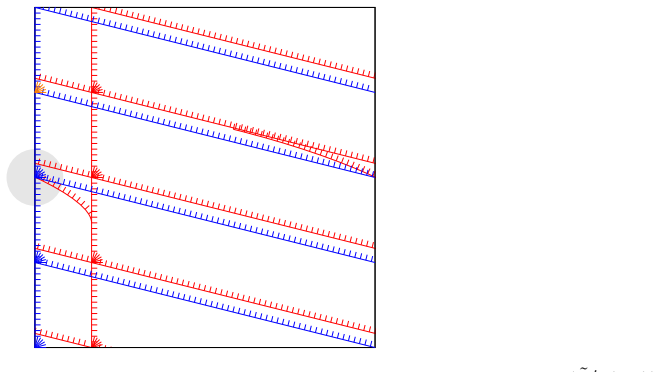
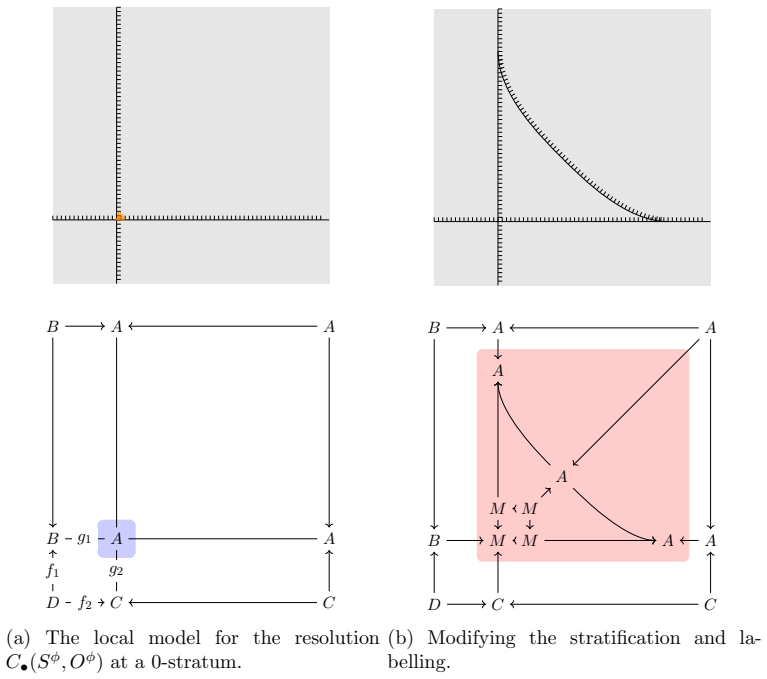
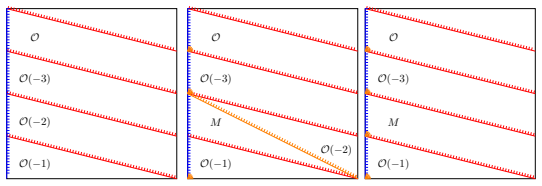
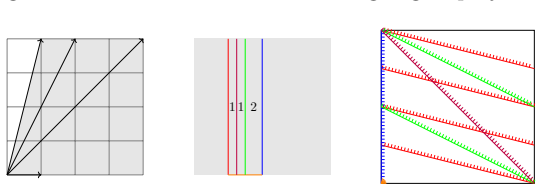
The authors construct an annular braid-group action on the partially wrapped Fukaya category associated to the A_{n-1} singularity. The standard braid subgroup recovers the Seidel-Thomas action on the derived category, while the additional annular generator corresponds to tensor product with O(-1). The action is obtained from the moduli space of Legendrians isotopic to the FLTZ Legendrian, which the authors propose as a model for the fundamental group of the stringy Kähler moduli space.
What carries the argument
The moduli space of Legendrians isotopic to the FLTZ Legendrian, which carries the fundamental-group action that models the stringy Kähler moduli space and induces exact autoequivalences on the partially wrapped Fukaya category.
If this is right
- The standard braid subgroup reproduces the Seidel-Thomas autoequivalences already known on the derived category.
- The new annular generator supplies an additional exact autoequivalence given by tensor product with O(-1).
- The same construction supplies a model for monodromy actions on partially wrapped Fukaya categories of other toric Calabi-Yau surfaces.
- The Floer-theoretic techniques extend homological mirror symmetry from toric varieties to semiprojective toric Deligne-Mumford stacks defined over any field.
Where Pith is reading between the lines
- The annular generator may encode information about non-compact directions or boundary behavior that is invisible to the ordinary braid action.
- The same Legendrian-moduli-space approach could be tested on other singularities whose FLTZ skeletons are known, to produce explicit annular-type actions.
- Direct comparison of the constructed autoequivalences with algebraic monodromy for low n would give a concrete check of the proposal.
Load-bearing premise
That the moduli space of Legendrians isotopic to the FLTZ Legendrian correctly captures the fundamental group of the stringy Kähler moduli space and lets the predicted mirror action be realized on the symplectic side.
What would settle it
An explicit loop in the Legendrian moduli space whose induced autoequivalence on the partially wrapped Fukaya category fails to match tensor product with O(-1) for the annular generator, or fails to match a known Seidel-Thomas twist for a standard generator, when compared against algebraic computations for small n.
Figures









read the original abstract
Mirror symmetry predicts an action by the fundamental group of a conjectural stringy K\"ahler moduli space on the derived category of an algebraic variety. For a toric variety, a model for this space is understood, but constructing the action is still an open problem in general. We propose that this action can be studied on the $A$-side via a moduli space of Legendrians isotopic to the FLTZ Legendrian. For the $A_{n-1}$ singularity, we construct an annular braid-group action on the corresponding partially wrapped Fukaya category by exact autoequivalences. The standard braid subgroup recovers the Seidel--Thomas action on the derived category, while the additional annular generator corresponds to tensor product with $\mathcal O(-1)$. We additionally extend the Floer theoretic approach to homological mirror symmetry for toric varities to the setting of semiprojective toric Deligne-Mumford stacks over an arbitrary field.
Editorial analysis
A structured set of objections, weighed in public.
Referee Report
Summary. The manuscript proposes studying the monodromy action predicted by mirror symmetry on the A-side for toric Calabi-Yau surfaces via a moduli space of Legendrians isotopic to the FLTZ Legendrian. For the A_{n-1} singularity, it constructs an annular braid-group action on the partially wrapped Fukaya category by exact autoequivalences; the standard braid subgroup recovers the Seidel-Thomas action on the derived category, while the additional annular generator corresponds to tensor product with O(-1). The paper also extends the Floer-theoretic approach to homological mirror symmetry for toric varieties to the setting of semiprojective toric Deligne-Mumford stacks over an arbitrary field.
Significance. If the central construction holds, the work supplies an explicit geometric model on the A-side for the mirror symmetry predicted action of the fundamental group of the stringy Kähler moduli space, realized through Legendrian isotopies in the partially wrapped Fukaya category. This yields a concrete match between the annular braid action and known B-side operations (Seidel-Thomas twists and tensoring by O(-1)), which is a tangible advance for these toric cases. The extension of Floer-theoretic HMS to semiprojective toric DM stacks over arbitrary fields also broadens the applicability of the framework.
major comments (3)
- [Introduction / abstract statement of the construction] The load-bearing modeling assumption that the moduli space of Legendrians isotopic to the FLTZ Legendrian has fundamental group isomorphic to (or surjecting onto the relevant part of) the fundamental group of the stringy Kähler moduli space is asserted rather than derived. This identification is required for the constructed isotopy functors to realize the mirror-predicted action; without an explicit computation or theorem establishing the isomorphism of fundamental groups, the geometric model does not yet guarantee that the annular braid action is the one predicted by mirror symmetry.
- [Construction for the A_{n-1} singularity] The claim that the isotopy-induced functors on the partially wrapped Fukaya category are exact autoequivalences satisfying the annular braid relations (with the extra generator acting as tensor product with O(-1)) is central but requires detailed verification. The abstract states that the standard braid subgroup recovers the Seidel-Thomas action, but the manuscript must supply the precise checks that the functors are exact and that the relations hold, particularly for the annular generator.
- [Extension to DM stacks] The extension of the Floer-theoretic approach to homological mirror symmetry to semiprojective toric Deligne-Mumford stacks over an arbitrary field is stated without supporting details on the necessary adaptations (e.g., how the wrapped Fukaya category and FLTZ Legendrian are defined for stacks, or how the field generality is handled). This extension is presented as an additional result but lacks the explicit support needed to assess its validity.
Simulated Author's Rebuttal
We thank the referee for their careful reading and constructive comments on our manuscript. The points raised identify places where additional justification and detail will strengthen the exposition. We address each major comment below, indicating the revisions we plan to incorporate.
read point-by-point responses
-
Referee: The load-bearing modeling assumption that the moduli space of Legendrians isotopic to the FLTZ Legendrian has fundamental group isomorphic to (or surjecting onto the relevant part of) the fundamental group of the stringy Kähler moduli space is asserted rather than derived. This identification is required for the constructed isotopy functors to realize the mirror-predicted action; without an explicit computation or theorem establishing the isomorphism of fundamental groups, the geometric model does not yet guarantee that the annular braid action is the one predicted by mirror symmetry.
Authors: We agree that an explicit derivation of the fundamental group is needed to make the modeling assumption fully rigorous. The manuscript constructs the moduli space of Legendrians isotopic to the FLTZ Legendrian and identifies its fundamental group with the annular braid group on the basis of the topology of the space of such Legendrians for the A_{n-1} singularity, together with the expected mirror correspondence. To address the referee's concern, we will add a dedicated subsection that computes the generators and relations of this fundamental group directly from the isotopy classes and establishes the surjection onto the relevant subgroup of the stringy Kähler moduli space fundamental group via the toric mirror dictionary. revision: yes
-
Referee: The claim that the isotopy-induced functors on the partially wrapped Fukaya category are exact autoequivalences satisfying the annular braid relations (with the extra generator acting as tensor product with O(-1)) is central but requires detailed verification. The abstract states that the standard braid subgroup recovers the Seidel-Thomas action, but the manuscript must supply the precise checks that the functors are exact and that the relations hold, particularly for the annular generator.
Authors: Sections 3 and 4 of the manuscript define the isotopy functors and verify the annular braid relations by explicit computation of compositions of isotopies and their induced maps on Floer cohomology. Exactness follows from the exactness of the isotopies and preservation of the wrapped structure; the standard braid subgroup is shown to recover the Seidel-Thomas twists by matching the action on the exceptional collection with the algebraic twists. The annular generator is shown to act as tensor product with O(-1) by direct computation on the structure sheaf. We acknowledge that these verifications would be clearer if presented as a single self-contained proposition with a step-by-step outline. We will revise the relevant sections to include such a proposition, together with a summary table of the key isotopy relations and the corresponding Floer computations. revision: partial
-
Referee: The extension of the Floer-theoretic approach to homological mirror symmetry to semiprojective toric Deligne-Mumford stacks over an arbitrary field is stated without supporting details on the necessary adaptations (e.g., how the wrapped Fukaya category and FLTZ Legendrian are defined for stacks, or how the field generality is handled). This extension is presented as an additional result but lacks the explicit support needed to assess its validity.
Authors: The extension is sketched in the final section by adapting the toric FLTZ construction to the stacky setting, replacing the variety with the corresponding semiprojective toric DM stack and defining the wrapped Fukaya category via the stacky symplectic form. The Floer-theoretic arguments are field-independent because they rely on transversality and compactness, which hold after suitable perturbation over any base field. We agree that the adaptations require more explicit description. We will expand the section with a subsection that defines the stacky FLTZ Legendrian, specifies the wrapped Fukaya category for DM stacks, and confirms that the main results on the annular braid action extend with only notational changes. revision: yes
Circularity Check
No significant circularity; A-side construction is independent and verified against known B-side results
full rationale
The paper proposes a model for studying the mirror symmetry predicted monodromy action via the moduli space of Legendrians isotopic to the FLTZ Legendrian. Within this model, for the A_{n-1} singularity, the annular braid-group action is constructed directly by exact autoequivalences on the partially wrapped Fukaya category. The standard braid subgroup recovers the Seidel-Thomas action on the derived category, and the additional annular generator is shown to correspond to tensor product with O(-1). These recoveries are explicit verifications against independently known results rather than reductions of a prediction to a fitted input or self-definition. The identification of fundamental groups is an explicit modeling assumption of the proposed framework, not a derived claim that collapses by construction. The additional extension of the Floer-theoretic approach to semiprojective toric DM stacks is presented as a separate contribution and does not load-bear the monodromy construction. No step matches any enumerated circularity pattern: there are no self-definitional equations, fitted parameters renamed as predictions, load-bearing self-citations, uniqueness theorems imported from the authors' prior work, ansatzes smuggled via citation, or renamings of known results. The derivation chain is therefore self-contained.
Axiom & Free-Parameter Ledger
axioms (2)
- domain assumption The FLTZ Legendrian exists for toric varieties and has the expected isotopy properties allowing a moduli space of Legendrians.
- domain assumption The partially wrapped Fukaya category for the A_{n-1} singularity admits exact autoequivalences forming an annular braid-group action.
Reference graph
Works this paper leans on
-
[1]
Frobenius direct images of line bundles on toric varieties
arXiv:1908.02317. 62 [Tho00] Jesper Funch Thomsen. “Frobenius direct images of line bundles on toric varieties.”J. Algebra226.2 (2000), pp. 865–874. [Tho06] Richard P Thomas. “Stability conditions and the braid group.”Communications in Analysis and Geometry14.1 (2006), pp. 135–161. [TWZ19] David Treumann, Harold Williams, and Eric Zaslow. “Kasteleyn opera...
-
[2]
Moment maps and geometric invariant theory
arXiv:2403.15660. [War21] Abigail Ward.Homological mirror symmetry for elliptic Hopf surfaces. 2021. arXiv: 2101.11546. [Woo10] Chris Woodward. “Moment maps and geometric invariant theory.”Les cours du CIRM 1.1 (2010), pp. 55–98. [Zho20] Peng Zhou. “Lagrangian Skeleta of Hypersurfaces in (C ∗)n.”Selecta Mathematica26.26 (2020). [Zho25] Peng Zhou. “Variati...
discussion (0)
Sign in with ORCID, Apple, or X to comment. Anyone can read and Pith papers without signing in.