Recognition: unknown
Quantum Scalar Spin Chirality in Coplanar Kagome Antiferromagnets
Pith reviewed 2026-05-07 06:36 UTC · model grok-4.3
The pith
Quantum fluctuations induce scalar spin chirality at zero temperature in coplanar kagome antiferromagnets when symmetry conditions are met.
A machine-rendered reading of the paper's core claim, the machinery that carries it, and where it could break.
Core claim
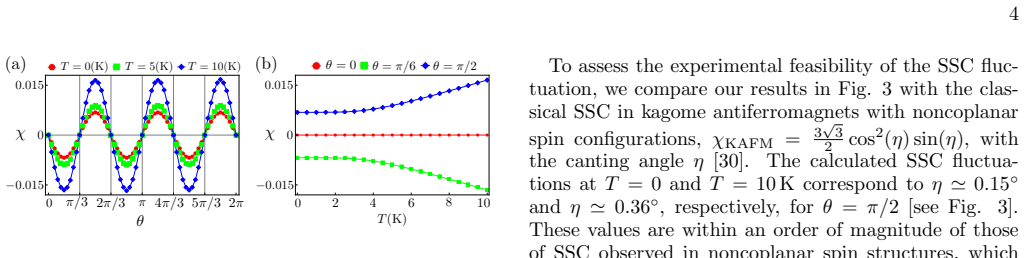
We theoretically demonstrate that quantum fluctuations inherent to antiferromagnets can generate scalar spin chirality at zero temperature even in coplanar ordered magnets. In a kagome antiferromagnet with coplanar ground-state spin configurations, the quantum-fluctuation-induced scalar spin chirality is shown to arise at zero temperature when an effective time-reversal-like antiunitary symmetry is broken in the Hamiltonian describing fluctuations, and a magnetic point group of the classical ground state allows for its presence. The scalar spin chirality fluctuations are shown to grow further with increasing temperature by thermally excited magnons. These scalar spin chirality fluctuations 4
What carries the argument
Quantum-fluctuation-induced scalar spin chirality arising from broken effective time-reversal-like antiunitary symmetry in the magnon Hamiltonian together with allowance by the magnetic point group of the classical coplanar state.
If this is right
- Scalar spin chirality appears at zero temperature inside coplanar ordered states.
- The chirality magnitude increases with temperature through thermally excited magnons.
- The fluctuating chirality can reach values comparable to the static chirality of noncoplanar spin structures.
- This mechanism applies to physical properties of coplanar spin systems that were previously assumed to lack chirality.
Where Pith is reading between the lines
- The same symmetry-based mechanism could operate in other frustrated lattices that support coplanar order.
- Fluctuation-induced chirality may contribute to transverse transport signals such as the thermal Hall effect in these materials.
- Detection via polarized neutron scattering or muon spin relaxation could test the temperature dependence predicted by the magnon picture.
- Adding weak Dzyaloshinskii-Moriya terms or small out-of-plane fields might tune the size of the induced chirality.
Load-bearing premise
The spin-wave expansion accurately describes the quantum fluctuations that break the effective time-reversal-like antiunitary symmetry while the magnetic point group still permits the chirality.
What would settle it
A direct measurement or higher-order calculation showing that scalar spin chirality remains exactly zero at T=0 in a coplanar kagome antiferromagnet where the magnetic point group permits it and the fluctuation Hamiltonian breaks the effective antiunitary symmetry would falsify the claim.
Figures


read the original abstract
We theoretically demonstrate that quantum fluctuations inherent to antiferromagnets can generate scalar spin chirality at zero temperature even in coplanar ordered magnets. In a kagome antiferromagnet with coplanar ground-state spin configurations, the quantum-fluctuation-induced scalar spin chirality is shown to arise at zero temperature when an effective time-reversal-like antiunitary symmetry is broken in the Hamiltonian describing fluctuations, and a magnetic point group of the classical ground state allows for its presence. The scalar spin chirality fluctuations are shown to grow further with increasing temperature by thermally excited magnons. These scalar spin chirality fluctuations can reach a magnitude comparable to the static one predicted for noncoplanar spin structures, highlighting their physical implications in coplanar spin systems.
Editorial analysis
A structured set of objections, weighed in public.
Referee Report
Summary. The manuscript claims that quantum fluctuations in coplanar kagome antiferromagnets induce a nonzero scalar spin chirality at zero temperature. This arises when an effective time-reversal-like antiunitary symmetry is broken in the quadratic fluctuation Hamiltonian obtained via Holstein-Primakoff expansion around the classical coplanar state, provided the magnetic point group of the ground state permits a finite expectation value. The authors further show that thermal magnons enhance the chirality with increasing temperature, and that the fluctuation-induced value can reach magnitudes comparable to the static chirality found in noncoplanar spin structures.
Significance. If the central calculation holds, the result is significant: it identifies a purely quantum mechanism for generating scalar spin chirality in coplanar ordered magnets, where classical symmetry would otherwise forbid it. This has direct implications for topological magnon bands, thermal Hall transport, and possible multiferroic responses in kagome antiferromagnets. The symmetry-based argument combined with linear spin-wave theory offers a transparent and potentially generalizable framework. The quantitative comparison to noncoplanar cases strengthens the physical relevance of the finding.
major comments (2)
- [§3.2] §3.2, Eq. (12) and the subsequent Bogoliubov transformation: the claim that the quadratic magnon Hamiltonian breaks the effective antiunitary symmetry and thereby permits a finite zero-point <χ> (where χ is the three-spin scalar chirality) is load-bearing. The explicit matrix elements that survive after the Bogoliubov vacuum average must be shown; it is not obvious a priori that the kagome point-group symmetries do not force the relevant contractions to vanish even when the antiunitary symmetry is absent.
- [§4.1] §4.1, the T=0 numerical evaluation of <χ>: the reported magnitude relies on summing over the magnon modes after diagonalization. Because χ is cubic in the original spins, this is formally a 1/S correction; the paper should demonstrate that the result is stable against the inclusion of the leading quartic magnon interactions or at least estimate their contribution, as uncontrolled higher-order terms could alter the sign or magnitude.
minor comments (3)
- [§2] The definition of the effective antiunitary operator (introduced in §2) should be written explicitly in terms of the spin operators or the bosonic fields so that readers can verify the symmetry-breaking statement without reconstructing it from the Hamiltonian.
- [Figure 3] Figure 3 (temperature dependence): the vertical axis label and the units of the plotted chirality should be stated clearly; the comparison to the noncoplanar static value is useful but would benefit from an explicit statement of the reference noncoplanar structure used.
- [Appendix] A short appendix tabulating the symmetry-allowed components of the chirality tensor for the relevant magnetic point group would make the central symmetry argument more transparent.
Simulated Author's Rebuttal
We thank the referee for their careful reading of our manuscript and for the constructive comments. We address each major comment below and have revised the manuscript to incorporate clarifications and additional details where appropriate.
read point-by-point responses
-
Referee: [§3.2] §3.2, Eq. (12) and the subsequent Bogoliubov transformation: the claim that the quadratic magnon Hamiltonian breaks the effective antiunitary symmetry and thereby permits a finite zero-point <χ> (where χ is the three-spin scalar chirality) is load-bearing. The explicit matrix elements that survive after the Bogoliubov vacuum average must be shown; it is not obvious a priori that the kagome point-group symmetries do not force the relevant contractions to vanish even when the antiunitary symmetry is absent.
Authors: We agree that explicitly displaying the surviving matrix elements strengthens the presentation. In the revised manuscript we have added Appendix C, which derives the Bogoliubov transformation for the quadratic Hamiltonian of Eq. (12) and computes the vacuum expectation value of the scalar-chirality operator expanded to linear order in the magnon operators. The effective antiunitary symmetry breaking generates anomalous (pairing) terms in the Bogoliubov–de Gennes matrix; after diagonalization these produce nonzero <b_k b_{-k}> correlators in the vacuum. We tabulate the relevant matrix elements for the three sublattices and verify that the magnetic point-group symmetries (which permit a finite χ) allow the imaginary parts of the Bogoliubov coefficients to survive, so that the contractions do not vanish. This explicit calculation confirms that the kagome point-group symmetries do not force <χ> to zero. revision: yes
-
Referee: [§4.1] §4.1, the T=0 numerical evaluation of <χ>: the reported magnitude relies on summing over the magnon modes after diagonalization. Because χ is cubic in the original spins, this is formally a 1/S correction; the paper should demonstrate that the result is stable against the inclusion of the leading quartic magnon interactions or at least estimate their contribution, as uncontrolled higher-order terms could alter the sign or magnitude.
Authors: We acknowledge that the computed <χ> is a leading 1/S quantum correction and that quartic magnon interactions could in principle generate further corrections. A complete treatment of the quartic terms would require a self-consistent 1/S^2 calculation or numerical methods beyond linear spin-wave theory, which lies outside the scope of the present work. In the revised manuscript we have added a paragraph in §4.1 that estimates the relative size of these higher-order contributions: the quartic interactions shift the magnon vacuum at order 1/S^2 and therefore correct <χ> by a relative factor of order 1/S. For the spin values relevant to kagome materials (S=1/2), the leading term remains dominant, and the sign of <χ> is protected by the same symmetry considerations that allow it at linear order. We therefore regard the reported magnitude as a reliable estimate of the fluctuation-induced chirality while noting that a full higher-order calculation is left for future study. revision: partial
Circularity Check
No circularity: explicit spin-wave computation of symmetry-allowed vacuum expectation
full rationale
The paper starts from the classical coplanar ground state on the kagome lattice, performs a Holstein-Primakoff expansion to obtain the quadratic fluctuation Hamiltonian, analyzes the magnetic point group to establish that an effective antiunitary symmetry is broken, and then evaluates the zero-point expectation value of the cubic scalar spin chirality operator directly from the Bogoliubov vacuum. This is a standard first-principles calculation within linear spin-wave theory; the target quantity is not presupposed, fitted, or redefined by the inputs. No load-bearing step reduces to a self-citation chain, an ansatz smuggled from prior work, or a renaming of a known result. The derivation remains self-contained against the stated Hamiltonian and symmetry constraints.
Axiom & Free-Parameter Ledger
axioms (2)
- domain assumption Effective time-reversal-like antiunitary symmetry is broken in the Hamiltonian describing fluctuations
- domain assumption Magnetic point group of the classical ground state allows presence of scalar spin chirality
Forward citations
Cited by 1 Pith paper
-
Fluctuation-driven chiral ferromagnetism
Magnetization-non-conserving spin-orbit interactions enable quantum fluctuations to stabilize chiral ferromagnetic phases with spontaneous orbital chirality and enhanced thermal Hall effect, contrary to classical pred...
Reference graph
Works this paper leans on
-
[1]
Gauge fields in real and momentum spaces in magnets: monopoles and skyrmions,
N. Nagaosa, X. Z. Yu, and Y. Tokura, “Gauge fields in real and momentum spaces in magnets: monopoles and skyrmions,” Philos. Trans. R. Soc. A370, 5806 (2012)
2012
-
[2]
Emergent electromagnetism in solids,
N. Nagaosa and Y. Tokura, “Emergent electromagnetism in solids,” Phys. Scr.T146, 014020 (2012)
2012
-
[3]
Topologi- cal orbital magnetization and emergent Hall effect of an atomic-scale spin lattice at a surface,
M. Hoffmann, J. Weischenberg, B. Dup´ e, F. Freimuth, P. Ferriani, Y. Mokrousov, and S. Heinze, “Topologi- cal orbital magnetization and emergent Hall effect of an atomic-scale spin lattice at a surface,” Phys. Rev. B92, 020401 (2015)
2015
-
[4]
Chirality-driven orbital mag- netic moments as a new probe for topological magnetic structures,
M. dos Santos Dias, J. Bouaziz, M. Bouhassoune, S. Bl¨ ugel, and S. Lounis, “Chirality-driven orbital mag- netic moments as a new probe for topological magnetic structures,” Nat. Commun.7, 13613 (2016)
2016
-
[5]
Role of Berry phase the- ory for describing orbital magnetism: From magnetic het- erostructures to topological orbital ferromagnets,
J.-P. Hanke, F. Freimuth, A. K. Nandy, H. Zhang, S. Bl¨ ugel, and Y. Mokrousov, “Role of Berry phase the- ory for describing orbital magnetism: From magnetic het- erostructures to topological orbital ferromagnets,” Phys. Rev. B94, 121114 (2016)
2016
-
[6]
Engineering chiral and topological orbital magnetism of domain walls and skyrmions,
F. R. Lux, F. Freimuth, S. Bl¨ ugel, and Y. Mokrousov, “Engineering chiral and topological orbital magnetism of domain walls and skyrmions,” Commun. Phys.1, 60 (2018)
2018
-
[7]
Topological–chiral magnetic interactions driven by emergent orbital magnetism,
S. Grytsiuk, J.-P. Hanke, M. Hoffmann, J. Bouaziz, O. Gomonay, G. Bihlmayer, S. Lounis, Y. Mokrousov, and S. Bl¨ ugel, “Topological–chiral magnetic interactions driven by emergent orbital magnetism,” Nat. Commun. 11, 511 (2020)
2020
-
[8]
Im- printing and driving electronic orbital magnetism using magnons,
L.-C. Zhang, D. Go, J.-P. Hanke, P. M. Buhl, S. Gryt- siuk, S. Bl¨ ugel, F. R. Lux, and Y. Mokrousov, “Im- printing and driving electronic orbital magnetism using magnons,” Commun. Phys.3, 227 (2020)
2020
-
[9]
Spin chirality, Berry phase, and anomalous Hall effect in a frustrated ferromagnet,
Y. Taguchi, Y. Oohara, H. Yoshizawa, N. Nagaosa, and Y. Tokura, “Spin chirality, Berry phase, and anomalous Hall effect in a frustrated ferromagnet,” Science291, 2573–2576 (2001)
2001
-
[10]
Chirality-driven anoma- lous Hall effect in weak coupling regime,
G. Tatara and H. Kawamura, “Chirality-driven anoma- lous Hall effect in weak coupling regime,” J. Phys. Soc. Jpn.71, 2613–2616 (2002)
2002
-
[11]
Time-reversal symmetry breaking and spontaneous Hall effect without magnetic dipole order,
Y. Machida, S. Nakatsuji, S. Onoda, T. Tayama, and T. Sakakibara, “Time-reversal symmetry breaking and spontaneous Hall effect without magnetic dipole order,” Nature (London)463, 210–213 (2010)
2010
-
[12]
Theory of the thermal Hall effect in quantum magnets,
H. Katsura, N. Nagaosa, and P. A. Lee, “Theory of the thermal Hall effect in quantum magnets,” Phys. Rev. Lett.104, 066403 (2010)
2010
-
[13]
Proposal to use neutron scattering to access scalar spin chirality fluctuations in kagome lattices,
P. A. Lee and N. Nagaosa, “Proposal to use neutron scattering to access scalar spin chirality fluctuations in kagome lattices,” Phys. Rev. B87, 064423 (2013)
2013
-
[14]
Spin chirality and Hall-like trans- port phenomena of spin excitations,
J. H. Han and H. Lee, “Spin chirality and Hall-like trans- port phenomena of spin excitations,” J. Phys. Soc. Jpn. 86, 011007 (2017)
2017
-
[15]
Spin chirality induced skew scattering and anomalous Hall effect in chiral magnets,
H. Ishizuka and N. Nagaosa, “Spin chirality induced skew scattering and anomalous Hall effect in chiral magnets,” Sci. Adv.4, eaap9962 (2018)
2018
-
[16]
Phonon Thermal Hall Effect in Mott Insulators via Skew Scattering by the Scalar Spin Chirality,
T. Oh and N. Nagaosa, “Phonon Thermal Hall Effect in Mott Insulators via Skew Scattering by the Scalar Spin Chirality,” Phys. Rev. X15, 011036 (2025)
2025
-
[17]
Orbital ferromagnetism and anomalous Hall effect in antiferromagnets on the dis- torted fcc lattice,
R. Shindou and N. Nagaosa, “Orbital ferromagnetism and anomalous Hall effect in antiferromagnets on the dis- torted fcc lattice,” Phys. Rev. Lett.87, 116801 (2001)
2001
-
[18]
Thermal Hall effect of spins in a paramagnet,
H. Lee, J. H. Han, and P. A. Lee, “Thermal Hall effect of spins in a paramagnet,” Phys. Rev. B91, 125413 (2015)
2015
-
[19]
Large anoma- lous Hall effect in a non-collinear antiferromagnet at room temperature,
S. Nakatsuji, N. Kiyohara, and T. Higo, “Large anoma- lous Hall effect in a non-collinear antiferromagnet at room temperature,” Nature (London)527, 212–215 (2015)
2015
-
[20]
Thermal Hall effects due to topological spin fluctuations in YMnO3,
H.-L. Kim, T. Saito, H. Yang, H. Ishizuka, M. J. Coak, J. H. Lee, H. Sim, Y. S. Oh, N. Nagaosa, and J.-G. Park, “Thermal Hall effects due to topological spin fluctuations in YMnO3,” Nat. Commun.15, 243 (2024). 6
2024
-
[21]
Topological Hall effect in the A phase of MnSi,
A. Neubauer, C. Pfleiderer, B. Binz, A. Rosch, R. Ritz, P. G. Niklowitz, and P. B¨ oni, “Topological Hall effect in the A phase of MnSi,” Phys. Rev. Lett.102, 186602 (2009)
2009
-
[22]
Large topological Hall effect in a short- period helimagnet MnGe,
N. Kanazawa, Y. Onose, T. Arima, D. Okuyama, K. Ohoyama, S. Wakimoto, K. Kakurai, S. Ishiwata, and Y. Tokura, “Large topological Hall effect in a short- period helimagnet MnGe,” Phys. Rev. Lett.106, 156603 (2011)
2011
-
[23]
Magnetic texture-induced thermal Hall effects,
K. A. van Hoogdalem, Y. Tserkovnyak, and D. Loss, “Magnetic texture-induced thermal Hall effects,” Phys. Rev. B87, 024402 (2013)
2013
-
[24]
Real-space and reciprocal-space Berry phases in the Hall effect of Mn 1−x Fex Si,
C. Franz, F. Freimuth, A. Bauer, R. Ritz, C. Schnarr, C. Duvinage, T. Adams, S. Bl¨ ugel, A. Rosch, Y. Mokrousov,et al., “Real-space and reciprocal-space Berry phases in the Hall effect of Mn 1−x Fex Si,” Phys. Rev. Lett.112, 186601 (2014)
2014
-
[25]
Tunable magnonic thermal Hall effect in skyrmion crys- tal phases of ferrimagnets,
S. K. Kim, K. Nakata, D. Loss, and Y. Tserkovnyak, “Tunable magnonic thermal Hall effect in skyrmion crys- tal phases of ferrimagnets,” Phys. Rev. Lett.122, 057204 (2019)
2019
-
[26]
Universal scal- ing law for chiral antiferromagnetism,
S. Xu, B. Dai, Y. Jiang, D. Xiong, H. Cheng, L. Tai, M. Tang, Y. Sun, Y. He, B. Yang,et al., “Universal scal- ing law for chiral antiferromagnetism,” Nat. Commun. 15, 3717 (2024)
2024
-
[27]
Magnon-induced scalar spin chirality in kagome and honeycomb ferromagnets,
N. Esaki, G. Go, and S. K. Kim, “Magnon-induced scalar spin chirality in kagome and honeycomb ferromagnets,” Phys. Rev. B112, 104440 (2025)
2025
-
[28]
Chiral spin states and superconductivity,
X.-G. Wen, F. Wilczek, and A. Zee, “Chiral spin states and superconductivity,” Phys. Rev. B39, 11413 (1989)
1989
-
[29]
Symmetry breaking due to Dzyaloshinsky-Moriya interactions in the kagom´ e lattice,
M. Elhajal, B. Canals, and C. Lacroix, “Symmetry breaking due to Dzyaloshinsky-Moriya interactions in the kagom´ e lattice,” Phys. Rev. B66, 014422 (2002)
2002
-
[30]
Magnon thermal Hall effect in kagome antiferromagnets with Dzyaloshinskii-Moriya interactions,
P. Laurell and G. A. Fiete, “Magnon thermal Hall effect in kagome antiferromagnets with Dzyaloshinskii-Moriya interactions,” Phys. Rev. B98, 094419 (2018)
2018
-
[31]
Thermal Hall effect in noncollinear coplanar insulating antiferromagnets,
A. Mook, J. Henk, and I. Mertig, “Thermal Hall effect in noncollinear coplanar insulating antiferromagnets,” Phys. Rev. B99, 014427 (2019)
2019
-
[32]
Or- bital Magnetic Moment of Magnons,
R. R. Neumann, A. Mook, J. Henk, and I. Mertig, “Or- bital Magnetic Moment of Magnons,” Phys. Rev. Lett. 125, 117209 (2020)
2020
-
[33]
Generic nearest-neighbor kagome model: XYZ and Dzyaloshinskii-Moriya couplings with comparison to the pyrochlore-lattice case,
K. Essafi, O. Benton, and L. D. C. Jaubert, “Generic nearest-neighbor kagome model: XYZ and Dzyaloshinskii-Moriya couplings with comparison to the pyrochlore-lattice case,” Phys. Rev. B96, 205126 (2017)
2017
-
[34]
Order as an effect of disorder,
J. Villain, R. Bidaux, J.-P. Carton, and R. Conte, “Order as an effect of disorder,” Journal de Physique41, 1263– 1272 (1980)
1980
-
[35]
Antiferromagnetic garnets with fluctu- ationally interacting sublattices,
E. F. Shender, “Antiferromagnetic garnets with fluctu- ationally interacting sublattices,” Soviet Journal of Ex- perimental and Theoretical Physics56, 178 (1982)
1982
-
[36]
Ordering due to disorder in a frus- trated vector antiferromagnet,
C. L. Henley, “Ordering due to disorder in a frus- trated vector antiferromagnet,” Phys. Rev. Lett.62, 2056 (1989)
2056
-
[37]
Pseudo- Goldstone Gaps and Order-by-Quantum Disorder in Frustrated Magnets,
J. G. Rau, P. A. McClarty, and R. Moessner, “Pseudo- Goldstone Gaps and Order-by-Quantum Disorder in Frustrated Magnets,” Phys. Rev. Lett.121, 237201 (2018)
2018
-
[38]
Scalar spin chirality Nernst effect,
G. Go, D. P. Goli, N. Esaki, Y. Tserkovnyak, and S. K. Kim, “Scalar spin chirality Nernst effect,” Phys. Rev. Res.7, L022066 (2025)
2025
-
[39]
Field Dependence of the Intrinsic Domain Magnetization of a Ferromagnet,
T. Holstein and H. Primakoff, “Field Dependence of the Intrinsic Domain Magnetization of a Ferromagnet,” Phys. Rev.58, 1098–1113 (1940)
1940
-
[40]
The spin-wave theory of antiferromagnetics,
R. Kubo, “The spin-wave theory of antiferromagnetics,” Phys. Rev.87, 568 (1952)
1952
-
[41]
Diagonalization of the quadratic boson hamiltonian,
J. H. P. Colpa, “Diagonalization of the quadratic boson hamiltonian,” Phys. A: Stat. Mech. App.93, 327 (1978)
1978
-
[42]
See the Supplemental Material for details
-
[43]
Anoma- lous Hall Effect Arising from Noncollinear Antiferromag- netism,
H. Chen, Q. Niu, and A. H. MacDonald, “Anoma- lous Hall Effect Arising from Noncollinear Antiferromag- netism,” Phys. Rev. Lett.112, 017205 (2014)
2014
-
[44]
Cluster multipole theory for anomalous Hall effect in antiferromagnets,
M.-T. Suzuki, T. Koretsune, M. Ochi, and R. Arita, “Cluster multipole theory for anomalous Hall effect in antiferromagnets,” Phys. Rev. B95, 094406 (2017)
2017
-
[45]
Investigation of spin chirality by polar- ized neutrons,
S. V. Maleyev, “Investigation of spin chirality by polar- ized neutrons,” Phys. Rev. Lett.75, 4682 (1995)
1995
-
[46]
The first observation of dynamical chirality by means of polarized neutron scattering in the triangular-lattice antiferromag- net,
S. V. Maleyev, V. P. Plakhty, O. P. Smirnov, J. Wos- nitza, D. Visser, R. K. Kremer, and J. Kulda, “The first observation of dynamical chirality by means of polarized neutron scattering in the triangular-lattice antiferromag- net,” J. Phys.: Condens. Matter10, 951 (1998)
1998
-
[47]
Magnetic chirality as probed by neutron scattering,
V. Simonet, M. Loire, and R. Ballou, “Magnetic chirality as probed by neutron scattering,” Eur. Phys. J. Spec. Top.213, 5–36 (2012)
2012
-
[48]
Proposal for detecting spin- chirality terms in Mott insulators via resonant inelastic x-ray scattering,
W.-H. Ko and P. A. Lee, “Proposal for detecting spin- chirality terms in Mott insulators via resonant inelastic x-ray scattering,” Phys. Rev. B84, 125102 (2011)
2011
-
[49]
Resonant inelastic x-ray scattering study of vector chiral ordered kagome antiferromagnet,
Z. Xiong, T. Datta, and D.-X. Yao, “Resonant inelastic x-ray scattering study of vector chiral ordered kagome antiferromagnet,” npj Quantum Mater.5, 78 (2020)
2020
-
[50]
Spin order in the Heisen- berg kagome antiferromagnet MgFe 3(OH)6Cl2,
M. Fujihala, X. G. Zheng, S. Lee, T. Kamiyama, A. Mat- suo, K. Kindo, and T. Kawae, “Spin order in the Heisen- berg kagome antiferromagnet MgFe 3(OH)6Cl2,” Phys. Rev. B96, 144111 (2017)
2017
-
[51]
Weak ferromagnetic order breaking the threefold rotational symmetry of the underlying kagome lattice in CdCu 3(OH)6(NO3)2 ·H 2O,
R. Okuma, T. Yajima, D. Nishio-Hamane, T. Okubo, and Z. Hiroi, “Weak ferromagnetic order breaking the threefold rotational symmetry of the underlying kagome lattice in CdCu 3(OH)6(NO3)2 ·H 2O,” Phys. Rev. B95, 094427 (2017)
2017
-
[52]
Negative-chirality order in the S = 1 2 kagome antiferromagnet CdCu3(OH)6(NO3)2 ·H 2O,
Y. Ihara, R. Hiyoshi, M. Shimohashi, K. Hayashi, R. Okuma, F. Orlandi, P. Manuel, G. J. Nilsen, and Z. Hiroi, “Negative-chirality order in the S = 1 2 kagome antiferromagnet CdCu3(OH)6(NO3)2 ·H 2O,” Phys. Rev. B106, 024401 (2022)
2022
-
[53]
Negative-vector- chirality 120◦ spin structure in the defect- and distortion- free quantum kagome antiferromagnet YCu 3(OH)6Cl3,
A. Zorko, M. Pregelj, M. Gomilˇ sek, M. Klanjˇ sek, O. Zaharko, W. Sun, and J.-X. Mi, “Negative-vector- chirality 120◦ spin structure in the defect- and distortion- free quantum kagome antiferromagnet YCu 3(OH)6Cl3,” Phys. Rev. B100, 144420 (2019)
2019
-
[54]
Anisotropic magnetic excitations from single- chirality antiferromagnetic state in Ca-kapellasite,
Y. Ihara, H. Yoshida, K. Arashima, M. Hirata, and T. Sasaki, “Anisotropic magnetic excitations from single- chirality antiferromagnetic state in Ca-kapellasite,” Phys. Rev. Res.2, 023269 (2020)
2020
-
[55]
q= 0 long- range magnetic order in centennialite CaCu 3(OD)6Cl2 · 0.6D2O: A spin- 1 2 perfect kagome antiferromagnet with J1 −J 2 −J d,
K. Iida, H. K. Yoshida, A. Nakao, H. O. Jeschke, Y. Iqbal, K. Nakajima, S. Ohira-Kawamura, K. Munakata, Y. In- amura, N. Murai, M. Ishikado, R. Kumai, T. Okada, M. Oda, K. Kakurai, and M. Matsuda, “q= 0 long- range magnetic order in centennialite CaCu 3(OD)6Cl2 · 0.6D2O: A spin- 1 2 perfect kagome antiferromagnet with J1 −J 2 −J d,” Phys. Rev. B101, 220408 (2020)
2020
-
[56]
Spin-phonon coupling and ther- mal Hall effect in the Kitaev model,
T. Oh and N. Nagaosa, “Spin-phonon coupling and ther- mal Hall effect in the Kitaev model,” Phys. Rev. B112, L081104 (2025)
2025
-
[57]
Spin rotation tech- nique for non-collinear magnetic systems: application to the generalizedVillain model,
J. T. Haraldsen and R. S. Fishman, “Spin rotation tech- nique for non-collinear magnetic systems: application to the generalizedVillain model,” J. Phys.: Condens. Mat- 7 ter21, 216001 (2009)
2009
-
[58]
Numerical simulations and magnetism,
S. Petit, “Numerical simulations and magnetism,” JDN 12, 105 (2011)
2011
-
[59]
Linear spin wave theory for single- Q incommensurate magnetic structures,
S. Toth and B. Lake, “Linear spin wave theory for single- Q incommensurate magnetic structures,” J. Phys.: Con- dens. Matter27, 166002 (2015)
2015
-
[60]
Non-Hermiticity and topological invariants of magnon Bogoliubov–de Gennes systems,
H. Kondo, Y. Akagi, and H. Katsura, “Non-Hermiticity and topological invariants of magnon Bogoliubov–de Gennes systems,” Prog. Theor. Exp. Phys.2020, 12A104 (2020). End Matter Linear spin-wave theory.—In this End Matter, we pro- vide a general theory for the SSC fluctuations in ordered magnets based on the linear spin-wave approximation [39, 40, 57–59]. W...
2020
discussion (0)
Sign in with ORCID, Apple, or X to comment. Anyone can read and Pith papers without signing in.