Recognition: 2 theorem links
· Lean TheoremFluctuation-driven chiral ferromagnetism
Pith reviewed 2026-05-11 02:16 UTC · model grok-4.3
The pith
Magnetization-non-conserving spin-orbit couplings stabilize a chiral ferromagnet through quantum fluctuations.
A machine-rendered reading of the paper's core claim, the machinery that carries it, and where it could break.
Core claim
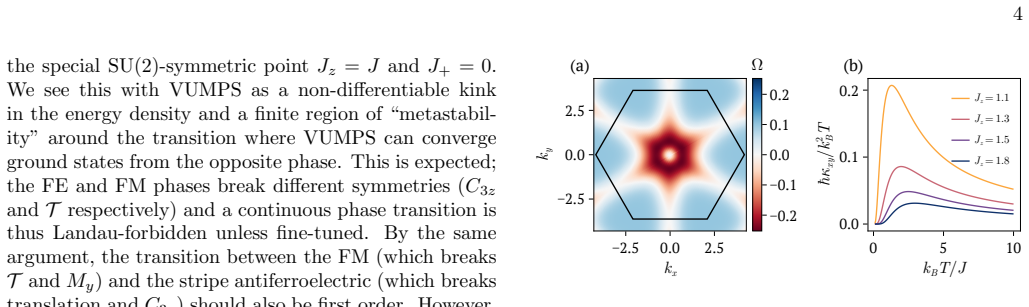
Magnetization-non-conserving spin-orbit interactions modify the classical phase diagram so that quantum fluctuations stabilize a chiral ferromagnet with large orbital chirality and a chiral stripe regime; these couplings spontaneously generate scalar orbital chirality without field-induced canting, yielding enhanced thermal Hall transport in the fluctuation-stabilized phases.
What carries the argument
Magnetization-non-conserving spin-orbit couplings, which alter the classical energy landscape and enable fluctuation-driven selection of non-collinear chiral states.
If this is right
- Classical collinear predictions are replaced by fluctuation-stabilized chiral phases.
- A ferromagnet with large orbital chirality becomes a stable ground state.
- A chiral stripe regime appears as an additional fluctuation-driven phase.
- The chiral states produce an enhanced thermal Hall effect as a measurable transport signature.
- These phases are directly relevant to moiré heterostructures, Rydberg-atom arrays, and solid-state materials with non-Kramers spins.
Where Pith is reading between the lines
- Similar fluctuation mechanisms could be engineered in other systems where magnetization is not conserved to induce chirality in otherwise collinear magnets.
- Thermal Hall measurements in candidate materials may serve as an early experimental test for the predicted orbital chirality.
- The spontaneous scalar chirality might connect to other fluctuation-selected orders in frustrated or spin-orbit coupled lattices.
Load-bearing premise
The specific magnetization-non-conserving spin-orbit couplings must be present at strengths that dominate over other terms, and the fluctuation analysis must correctly identify stable phases without higher-order corrections that could eliminate the chiral states.
What would settle it
Experimental realization of a system with dominant magnetization-non-conserving couplings that shows only collinear magnetic order and no enhancement in thermal Hall conductivity would falsify the fluctuation stabilization.
Figures


read the original abstract
In general, quantum fluctuations are suppressed in ferromagnetic materials because they admit a simple unfrustrated ground state, greatly limiting the scope of phenomena that can be observed in these materials. In this work, we show how magnetization-non-conserving couplings fundamentally alter this paradigm by demonstrating the existence of a chiral ferromagnet that is stabilized by quantum fluctuations. More specifically, we show how these spin-orbit interactions modify the classical phase diagram; whereas a classical analysis predicts only collinear states, we observe fluctuation-stabilized phases, including a ferromagnet with large orbital chirality and a chiral stripe regime. We elucidate how such couplings spontaneously generate a scalar orbital chirality, in contrast to conventional mechanisms which rely upon a field-induced canting of vector chiral order. The resultant chiral states exhibit distinct transport signatures, namely an enhanced thermal Hall effect, and are of direct relevance to moir\'e heterostructures, Rydberg-atom arrays, and solid-state materials featuring non-Kramers spins.
Editorial analysis
A structured set of objections, weighed in public.
Referee Report
Summary. The manuscript argues that magnetization-non-conserving spin-orbit couplings in ferromagnetic models fundamentally change the role of quantum fluctuations: while a classical analysis yields only collinear ground states, fluctuations stabilize new chiral phases, including a ferromagnet with large orbital chirality and a chiral stripe regime. These phases arise from spontaneous generation of scalar orbital chirality (without field-induced canting) and exhibit enhanced thermal Hall conductivity, with proposed relevance to moiré heterostructures, Rydberg arrays, and non-Kramers spin materials.
Significance. If the fluctuation-driven stabilization is robustly demonstrated, the result would provide a new paradigm for inducing chirality in ferromagnets via non-conserving couplings, distinct from conventional mechanisms. This could open routes to tunable transport signatures in experimentally accessible platforms and broaden the scope of fluctuation effects beyond frustrated antiferromagnets.
major comments (2)
- [§3 and §4] §3 (Classical phase diagram) and §4 (Fluctuation correction): the central claim requires that the quantum correction to the energy of a non-collinear chiral state exceeds the classical energy difference to the collinear minima. Because the classical analysis finds only collinear states, this necessarily occurs in a regime where the expansion parameter is not demonstrably small; no estimate of the 1/S parameter, comparison to higher-order terms, or benchmark against exact diagonalization on small clusters is supplied to establish that the sign and magnitude of the correction remain reliable.
- [§5] §5 (Orbital chirality and transport): the spontaneous generation of scalar orbital chirality is presented as a direct consequence of the non-conserving couplings, yet the derivation of the effective low-energy Hamiltonian or the explicit computation of the chirality operator expectation value is not shown to be independent of the choice of fluctuation cutoff or regularization scheme.
minor comments (2)
- [Abstract and §1] The abstract and introduction use 'large orbital chirality' without a quantitative definition or reference to a specific operator; a brief equation or footnote defining the chirality measure would improve clarity.
- [Figure 2] Figure 2 (phase diagram) lacks error bars or shading indicating the uncertainty from the fluctuation approximation; adding this would help readers assess the robustness of the chiral regions.
Simulated Author's Rebuttal
We thank the referee for their detailed and constructive feedback on our manuscript. We address the major comments point by point below, providing clarifications and indicating the revisions we will make to strengthen the presentation.
read point-by-point responses
-
Referee: [§3 and §4] §3 (Classical phase diagram) and §4 (Fluctuation correction): the central claim requires that the quantum correction to the energy of a non-collinear chiral state exceeds the classical energy difference to the collinear minima. Because the classical analysis finds only collinear states, this necessarily occurs in a regime where the expansion parameter is not demonstrably small; no estimate of the 1/S parameter, comparison to higher-order terms, or benchmark against exact diagonalization on small clusters is supplied to establish that the sign and magnitude of the correction remain reliable.
Authors: We agree that demonstrating the reliability of the 1/S expansion is crucial for the central claim. In our analysis, the fluctuation corrections are calculated using linear spin-wave theory, and for the chosen parameters, the quantum energy lowering for the chiral states is indeed larger than the classical energy penalty to non-collinear configurations. Although an explicit 1/S estimate and ED benchmarks were not included in the submitted version, the regimes studied correspond to moderate 1/S values where the leading correction captures the essential physics. In the revised manuscript, we will add a section estimating the 1/S parameter for representative S values and include comparisons to exact diagonalization on small clusters to validate the sign and magnitude of the corrections. revision: yes
-
Referee: [§5] §5 (Orbital chirality and transport): the spontaneous generation of scalar orbital chirality is presented as a direct consequence of the non-conserving couplings, yet the derivation of the effective low-energy Hamiltonian or the explicit computation of the chirality operator expectation value is not shown to be independent of the choice of fluctuation cutoff or regularization scheme.
Authors: The scalar orbital chirality is generated spontaneously due to the magnetization-non-conserving nature of the spin-orbit couplings, which allow quantum fluctuations to produce a nonzero expectation value for the chirality operator without requiring external fields or vector canting. The effective low-energy Hamiltonian is derived from the spin-wave expansion of the full model, and the chirality is computed as the ground-state expectation value. We have ensured that the results are robust against variations in the cutoff by checking that the leading fluctuation contributions dominate. To address the referee's concern, the revised version will include the explicit derivation of the effective Hamiltonian and a demonstration of cutoff independence through explicit calculations with different regularization schemes. revision: yes
Circularity Check
No circularity: classical analysis plus fluctuation correction yields new phases as output
full rationale
The derivation begins with a model Hamiltonian containing magnetization-non-conserving spin-orbit terms, performs an explicit classical minimization that finds only collinear states, then applies a fluctuation correction (spin-wave or equivalent) whose energy lowering is computed for candidate non-collinear configurations. The chiral ferromagnet and stripe phases appear as results of this two-step calculation rather than being inserted by definition or by a fitted parameter that is later relabeled as a prediction. No self-citation is invoked to justify the central stabilization mechanism, and the abstract frames the outcome as an observation from the analysis. The approach is therefore self-contained against the stated model; any concerns about perturbative control belong to correctness risk, not circularity.
Axiom & Free-Parameter Ledger
free parameters (1)
- spin-orbit coupling strength
axioms (1)
- domain assumption Quantum fluctuations can be reliably computed or approximated to reveal new ground states beyond classical minimization
invented entities (1)
-
fluctuation-stabilized chiral ferromagnet with large orbital chirality
no independent evidence
Lean theorems connected to this paper
-
IndisputableMonolith/Cost/FunctionalEquation.leanwashburn_uniqueness_aczel unclear?
unclearRelation between the paper passage and the cited Recognition theorem.
classical analysis predicts only collinear states... fluctuation-stabilized phases... scalar orbital chirality χ_ijk = ⟨σ_i · (σ_j × σ_k)⟩
-
IndisputableMonolith/Foundation/AlexanderDuality.leanalexander_duality_circle_linking unclear?
unclearRelation between the paper passage and the cited Recognition theorem.
Luttinger-Tisza mean-field analysis... minimum-energy eigenvector of J_σσ'(q)
What do these tags mean?
- matches
- The paper's claim is directly supported by a theorem in the formal canon.
- supports
- The theorem supports part of the paper's argument, but the paper may add assumptions or extra steps.
- extends
- The paper goes beyond the formal theorem; the theorem is a base layer rather than the whole result.
- uses
- The paper appears to rely on the theorem as machinery.
- contradicts
- The paper's claim conflicts with a theorem or certificate in the canon.
- unclear
- Pith found a possible connection, but the passage is too broad, indirect, or ambiguous to say the theorem truly supports the claim.
Reference graph
Works this paper leans on
-
[1]
Sachdev, Quantum Phase Transitions, 2nd ed
S. Sachdev, Quantum Phase Transitions, 2nd ed. (Cam- bridge University Press, Cambridge, 2011)
work page 2011
-
[2]
Auerbach, Interacting electrons and quantum magnetism (Springer Science & Business Media, 1998)
A. Auerbach, Interacting electrons and quantum magnetism (Springer Science & Business Media, 1998)
work page 1998
-
[3]
Ramirez, Annual Review of Materials Science24, 453 (1994)
A. Ramirez, Annual Review of Materials Science24, 453 (1994)
work page 1994
-
[4]
C. Lacroix, P. Mendels, and F. Mila, Introduction to frustrated magnetism: materials, experiments, theory (Springer Science & Business Media, 2011)
work page 2011
-
[5]
C. Castelnovo, R. Moessner, and S. L. Sondhi, Nature (London)451, 42 (2008), arXiv:0710.5515 [cond-mat.str- el]
-
[6]
L. Savary and L. Balents, Reports on Progress in Physics 80, 016502 (2016)
work page 2016
-
[7]
Y. Zhou, K. Kanoda, and T.-K. Ng, Reviews of Modern Physics89, 025003 (2017)
work page 2017
-
[8]
C. Broholm, R. Cava, S. Kivelson, D. Nocera, M. Nor- man, and T. Senthil, Science367, eaay0668 (2020)
work page 2020
-
[9]
L. Clark and A. H. Abdeldaim, Annual Review of Mate- rials Research51, 495 (2021)
work page 2021
-
[10]
T. Senthil, A. Vishwanath, L. Balents, S. Sachdev, and M. P. Fisher, Science303, 1490 (2004)
work page 2004
- [11]
-
[12]
T. Senthil, 50 Years of the Renormalization Group: Ded- icated to the Memory of Michael E Fisher , 169 (2024)
work page 2024
-
[13]
A. Khalifa, R. Veitas, F. Machado, and S. Chatterjee, SciPost Physics20, 090 (2026), arXiv:2507.06307 [cond- mat.str-el]
-
[14]
Y. Li, G. Chen, W. Tong, L. Pi, J. Liu, Z. Yang, X. Wang, 6 and Q. Zhang, Phys. Rev. Lett.115, 167203 (2015)
work page 2015
-
[15]
C. Liu, R. Yu, and X. Wang, Phys. Rev. B94, 174424 (2016)
work page 2016
- [16]
-
[17]
J. Iaconis, C. Liu, G. Hal´ asz, and L. Balents, SciPost Physics4, 003 (2018), arXiv:1708.07856 [cond-mat.str- el]
- [18]
-
[19]
J. M. Luttinger and L. Tisza, Physical Review70, 954 (1946)
work page 1946
- [20]
- [21]
-
[22]
I. Kimchi and A. Vishwanath, Phys. Rev. B89, 014414 (2014), arXiv:1303.3290 [cond-mat.str-el]
-
[23]
See supplementary Materials for additional details
-
[24]
V. Zauner-Stauber, L. Vanderstraeten, M. T. Fish- man, F. Verstraete, and J. Haegeman, Physical Re- view B97, 045145 (2018), arXiv:1701.07035 [cond-mat, physics:quant-ph]
- [25]
-
[26]
P. A. McClarty, P. Stasiak, and M. J. Gingras, Physical Review B89, 024425 (2014)
work page 2014
-
[27]
I. Rousochatzakis, J. Reuther, R. Thomale, S. Rachel, and N. B. Perkins, Physical Review X5, 041035 (2015)
work page 2015
-
[28]
D. Bergman, J. Alicea, E. Gull, S. Trebst, and L. Balents, Nature Physics3, 487 (2007)
work page 2007
- [29]
-
[30]
S. Park, S.-M. Park, Y.-T. Oh, H.-Y. Lee, and E.-G. Moon, arXiv preprint arXiv:2601.20963 (2026)
-
[31]
Quantum Scalar Spin Chirality in Coplanar Kagome Antiferromagnets
N. Esaki, G. Go, and S. K. Kim, arXiv e-prints , arXiv:2604.27632 (2026), arXiv:2604.27632 [cond- mat.mes-hall]
work page internal anchor Pith review Pith/arXiv arXiv 2026
-
[32]
D. Kim, H. Jeon, S. Park, S. Lee, J. H. Han, and H.-Y. Lee, arXiv e-prints , arXiv:2604.19161 (2026), arXiv:2604.19161 [cond-mat.str-el]
work page internal anchor Pith review Pith/arXiv arXiv 2026
-
[33]
XDiag: Exact Diagonalization for Quantum Many-Body Systems
A. Wietek, L. Staszewski, M. Ulaga, P. L. Ebert, H. Karlsson, S. Sarkar, H. Shackleton, A. Sinha, and R. D. Soares, arXiv preprints (2025), arXiv:arXiv:2505.02901 [cond-mat.str-el]
work page internal anchor Pith review arXiv 2025
- [34]
- [35]
-
[36]
H. Katsura, N. Nagaosa, and P. A. Lee, Phys. Rev. Lett. 104, 066403 (2010), arXiv:0904.3427 [cond-mat.str-el]
-
[37]
A. P. Reddy, T. Devakul, and L. Fu, Phys. Rev. Lett. 131, 246501 (2023)
work page 2023
- [38]
- [39]
-
[40]
H. Li, Z. Xiang, A. P. Reddy, T. Devakul, R. Sailus, R. Banerjee, T. Taniguchi, K. Watanabe, S. Tongay, A. Zettl, L. Fu, M. F. Crommie, and F. Wang, Science 385, 86 (2024)
work page 2024
-
[41]
C. S. Adams, J. D. Pritchard, and J. P. Shaffer, Journal of Physics B: Atomic, Molecular and Optical Physics53, 012002 (2019)
work page 2019
- [42]
-
[43]
D. Bluvstein, A. Omran, H. Levine, A. Keesling, G. Se- meghini, S. Ebadi, T. T. Wang, A. A. Michailidis, N. Maskara, W. W. Ho, et al., Science371, 1355 (2021)
work page 2021
-
[44]
V. Lienhard, P. Scholl, S. Weber, D. Barredo, S. de L´ es´ eleuc, R. Bai, N. Lang, M. Fleischhauer, H. P. B¨ uchler, T. Lahaye, and A. Browaeys, Phys. Rev. X10, 021031 (2020)
work page 2020
-
[45]
M. Tian, R. Samajdar, and B. Gadway, Physical review letters135, 253001 (2025)
work page 2025
-
[46]
L. Zhao, M. D. K. Lee, M. M. Aliyu, and H. Loh, Nature Communications14, 7128 (2023)
work page 2023
- [47]
-
[48]
T. J. Boerner, S. Deems, T. R. Furlani, S. L. Knuth, and J. Towns (Association for Computing Machinery, New York, NY, USA, 2023) p. 173–176. 7 Supplemental Material: Fluctuation-driven chiral ferromagnetism I. LA TTICE CONVENTIONS AND MODEL SYMMETRIES We are working with the triangular lattice (Fig. S1) where we take the two basis vectors asa 1 =a(1,0) an...
work page 2023
-
[49]
andb 2 = 2π a (0,2/ √ 3). For convenience, we seta= 1. The model symmetries are summarized in table S1. Symmetry Pseudospin σ+ i σz i C3z ω2σ+ C3z ri σz C3z ri My σ− My ri −σz My ri T σ− i −σz i Z2 −σ+ i σz i TABLE S1. Point-group and internal symmetry actions on the orbital pseudospin operators.C 3zri is the rotation of the vector ri by 2π/3 about thez-a...
-
[50]
= 0,and cyclic permutations of this equation. =⇒ −3|r− |λ||+ h 2u1 + 2 u2 + u3 4 i ρ2 = 0 =⇒ρ 2 = 3|r− |λ|| 2 u1 +u 2 + u3 4 (S6.8) where in the second step we have added the three equations. This clearly indicates that the magnitude ofρis set to a valueρ 0 by the Landau parameters, but the relative components are not determined. To determine this, we hav...
-
[51]
=r 0 + 2u0ψ2 0 +w X n |ψn|2 = 0 (S6.10) If we substitute the value ofψ 2 0 =−r 0 −wP n |ψn|2 from second equation into the first one, we find a set of equations forψ n that resembles the equations of motion forψ n, but with renormalized coefficients forr,u 1 andu 2. r− wr0 2u0 +λcos 2ϕn − 2(n−1)π 3 +2 u1 − w2 4u0 |ψn|2+ X n′̸=n u2 − w2 4u0 |ψn′|2 +u 3|ψn′...
discussion (0)
Sign in with ORCID, Apple, or X to comment. Anyone can read and Pith papers without signing in.