Recognition: unknown
The impact of experimental conditions on the observation of channeling and crystalline undulator radiation
Pith reviewed 2026-05-07 06:52 UTC · model grok-4.3
The pith
Simulations show that beam divergence, orientation, detection direction and doping profiles strongly shape the intensity of channeling and crystalline undulator radiation from 855 MeV electrons in boron-doped diamond hetero-crystals.
A machine-rendered reading of the paper's core claim, the machinery that carries it, and where it could break.
Core claim
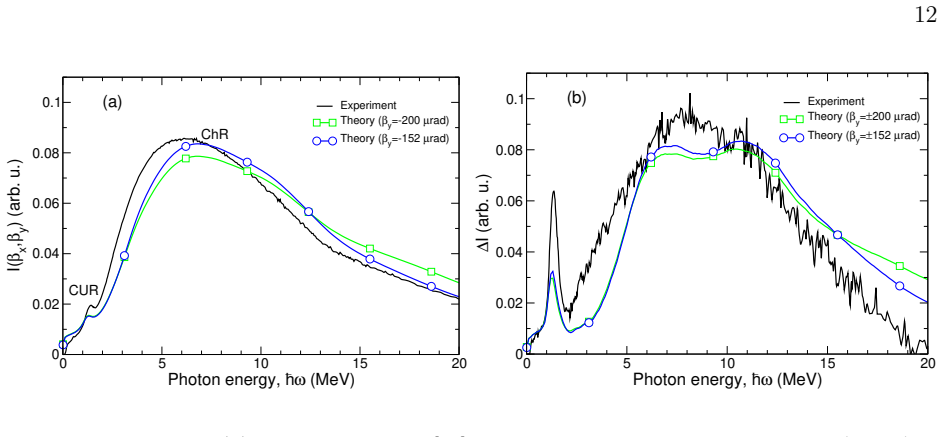
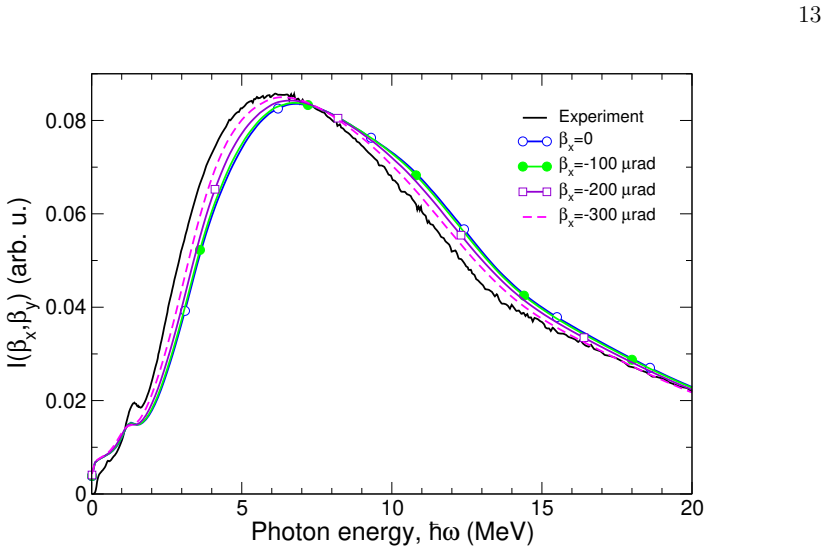
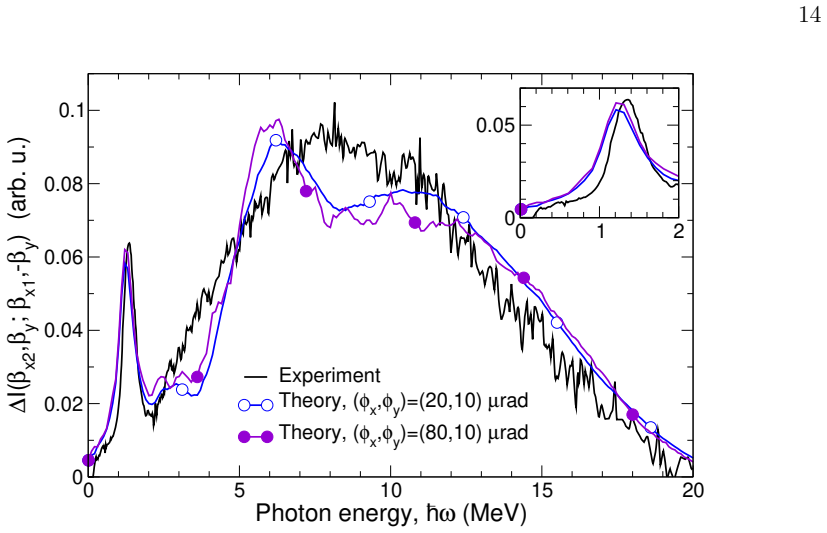
The radiation intensity from channeling and crystalline undulator processes in the diamond hetero-crystal is significantly affected by the angular divergence of the incident 855 MeV electron beam, its orientation with respect to the target, the direction of detection, and the choice of doping profiles. Detailed simulations using experimentally determined boron concentration profiles and the MBNExplorer software package reproduce the experimental observations with good accuracy, while remaining discrepancies are discussed with possible explanations.
What carries the argument
The MBNExplorer software package for simulating relativistic particle trajectories and radiation emission, incorporating measured boron doping profiles to define the periodic undulator structure in the diamond crystal.
If this is right
- Precise control of beam angular divergence is required to maximize channeling radiation output.
- Different boron doping profiles produce measurable variations in undulator radiation intensity.
- Detector placement selects which radiation components are observed most clearly.
- Accounting for orientation and alignment improves quantitative agreement between simulation and experiment.
- Optimization of crystalline undulator designs must incorporate these experimental sensitivities to reach target gamma-ray performance.
Where Pith is reading between the lines
- Including additional quantum corrections in the trajectory modeling may resolve some of the noted spectral discrepancies.
- The demonstrated sensitivity to beam parameters implies that specialized low-divergence beamlines will be needed for practical crystalline undulator operation.
- The same analysis framework could be applied to other host crystals or doping periods to extend the accessible range of radiation energies.
- Routine post-fabrication mapping of doping profiles should become standard to enable reliable radiation predictions.
Load-bearing premise
The boron doping profiles measured during MPCVD fabrication accurately represent the actual periodic structure in the crystal, and the MBNExplorer software correctly models all relevant classical and quantum aspects of electron trajectories and radiation emission without missing important effects.
What would settle it
A measurement of the radiation spectrum using a beam with near-zero angular divergence and precise alignment to the crystal planes, compared directly to simulation predictions for the exact measured doping profile; a mismatch larger than experimental uncertainties would indicate the model is incomplete.
Figures


read the original abstract
In this study, we present a comprehensive quantitative analysis of the radiation emitted by 855 MeV electrons propagating through an oriented diamond hetero-crystal. The crystal consists of two distinct segments: (i) a straight single-crystal diamond substrate, and (ii) a diamond layer that is periodically doped with boron atoms. The doping profiles were derived from precise experimental measurements of boron concentration obtained during the layer fabrication via Microwave Plasma Chemical Vapor Deposition (MPCVD). Our study systematically investigates the channelling and the crystalline undulator radiation, accounting for the different doping profiles in the undulating region. The simulations were conducted using the advanced MBNExplorer software package, which enables detailed modeling of particle trajectories and radiation emission. We report on good agreement with experiment and discuss remaining discrepancies providing possible explanations for them. The results obtained show that the radiation intensity is significantly affected by a range of factors, including the angular divergence of the incident beam, its orientation with respect to the target, the direction in which the emitted radiation is detected, and the choice of the doping profiles. These findings are important for optimising the design of crystalline undulators as novel gamma radiation light sources.
Editorial analysis
A structured set of objections, weighed in public.
Referee Report
Summary. The manuscript presents simulations of 855 MeV electron channeling and crystalline undulator radiation in a diamond hetero-crystal using the MBNExplorer package. The crystal comprises a straight substrate and a periodically boron-doped layer whose concentration profiles are taken directly from MPCVD fabrication measurements. The authors systematically vary beam angular divergence, crystal orientation, radiation detection angle, and doping profile details, reporting good quantitative agreement with experimental radiation spectra while discussing residual discrepancies and their possible origins. The central conclusion is that radiation intensity is highly sensitive to these experimental conditions, with implications for crystalline undulator design.
Significance. If the reported agreement is robust, the work would be significant for the development of crystalline undulators as compact gamma-ray sources. It supplies concrete evidence that beam divergence, orientation, detection geometry, and doping profile fidelity must be controlled to high precision, and it demonstrates a simulation framework capable of incorporating measured fabrication data. Such sensitivity analysis and direct experiment-simulation comparison are valuable for guiding future device optimization in accelerator physics.
major comments (3)
- [§2] §2 (Crystal fabrication and doping profiles): The statement that doping profiles are 'derived from precise experimental measurements' during MPCVD is load-bearing for the claimed agreement, yet the text provides no post-growth verification (SIMS, TEM, or X-ray rocking-curve data) confirming that the input boron concentration functions accurately reproduce the actual periodic lattice distortion (period, amplitude, smoothness) in the crystal used for the beam test. Without this, the sensitivity analysis to doping profile choice cannot be fully grounded.
- [§3] §3 (MBNExplorer methodology): The claim of 'advanced' modeling that treats 'classical and quantum aspects' of trajectories and radiation emission lacks any benchmark against analytic channeling-radiation formulas, known undulator spectra, or independent Monte-Carlo codes at 855 MeV. This validation step is essential to establish that the reported good agreement is not an artifact of untested approximations in multiple scattering, dechanneling, or photon emission modules.
- [Results section] Results section (quantitative comparison): The abstract and discussion assert 'good agreement' between simulation and measured radiation intensity, but no quantitative metrics (relative discrepancy, χ², or overlap integrals), experimental error bars, or simulation uncertainty bands are supplied. This omission makes it impossible to assess whether the remaining discrepancies are within expected uncertainties or indicate missing physics, directly affecting the strength of the sensitivity conclusions.
minor comments (2)
- [Figures] Figure captions should explicitly state the exact beam divergence, orientation angle, and detection direction used for each panel to allow direct comparison with the sensitivity analysis in the text.
- [Results section] A short table summarizing the key input parameters (divergence, doping amplitude, detection angle) and the corresponding radiation intensity changes would improve readability of the multi-parameter study.
Simulated Author's Rebuttal
We thank the referee for the detailed and constructive comments. We address each major point below and will revise the manuscript to strengthen the presentation while maintaining the integrity of the reported results. The sensitivity analysis and experiment-simulation comparison remain central to the work.
read point-by-point responses
-
Referee: §2 (Crystal fabrication and doping profiles): The statement that doping profiles are 'derived from precise experimental measurements' during MPCVD is load-bearing for the claimed agreement, yet the text provides no post-growth verification (SIMS, TEM, or X-ray rocking-curve data) confirming that the input boron concentration functions accurately reproduce the actual periodic lattice distortion (period, amplitude, smoothness) in the crystal used for the beam test. Without this, the sensitivity analysis to doping profile choice cannot be fully grounded.
Authors: The boron concentration profiles were taken directly from the in-situ measurements performed during the MPCVD growth process by the crystal fabrication team, as stated in the manuscript. We agree that independent post-growth verification (e.g., SIMS or X-ray rocking curves) on the exact beam-test sample would provide additional confirmation of the lattice distortion parameters. Such data are not available to us for this specific crystal. In the revised manuscript we will expand §2 to explicitly state the source of the profiles, note the absence of additional post-growth characterization for the tested sample, and emphasize that the observed quantitative agreement with the measured radiation spectra (including the sensitivity to profile variations) provides indirect support for the fidelity of the input functions. We will also discuss the practical difficulties of obtaining such verification for the precise undulator period and amplitude in the doped layer. revision: partial
-
Referee: §3 (MBNExplorer methodology): The claim of 'advanced' modeling that treats 'classical and quantum aspects' of trajectories and radiation emission lacks any benchmark against analytic channeling-radiation formulas, known undulator spectra, or independent Monte-Carlo codes at 855 MeV. This validation step is essential to establish that the reported good agreement is not an artifact of untested approximations in multiple scattering, dechanneling, or photon emission modules.
Authors: We acknowledge that an explicit benchmark subsection would improve the methodology presentation. The MBNExplorer framework has been validated in multiple prior publications for electron channeling and radiation at energies near 1 GeV, including direct comparisons with analytic channeling-radiation formulas and other Monte-Carlo implementations. In the revised manuscript we will add a concise validation paragraph in §3 that cites these earlier benchmarks and, where feasible, presents a short comparison for simplified 855 MeV channeling cases against known analytic limits. This addition will clarify that the multiple-scattering, dechanneling, and photon-emission modules employed here are consistent with established results. revision: yes
-
Referee: Results section (quantitative comparison): The abstract and discussion assert 'good agreement' between simulation and measured radiation intensity, but no quantitative metrics (relative discrepancy, χ², or overlap integrals), experimental error bars, or simulation uncertainty bands are supplied. This omission makes it impossible to assess whether the remaining discrepancies are within expected uncertainties or indicate missing physics, directly affecting the strength of the sensitivity conclusions.
Authors: We accept this observation and will revise the Results section (and update the abstract and discussion) to include quantitative measures of agreement. Specifically, we will report relative discrepancies for the main spectral peaks, incorporate available experimental error bars from the original measurements, and provide estimates of simulation uncertainty arising from finite statistics and parameter variations. These additions will allow a clearer assessment of whether residual differences fall within expected uncertainties and will reinforce the robustness of the sensitivity conclusions. revision: yes
Circularity Check
No circularity: simulations use independent experimental doping profiles as input and compare outputs to separate radiation measurements
full rationale
The paper obtains boron doping profiles directly from MPCVD fabrication measurements and feeds them into MBNExplorer to compute electron trajectories and emitted radiation spectra. These computed spectra are then compared to independent experimental radiation data. No step reduces a claimed prediction to a fitted parameter by construction, no self-citation is invoked as the sole justification for a uniqueness theorem or ansatz that forces the result, and the central claim of agreement remains externally falsifiable against the measured radiation intensities. The derivation chain therefore stays self-contained against external benchmarks.
Axiom & Free-Parameter Ledger
axioms (1)
- domain assumption High-energy electrons follow classical trajectories in the periodic crystal potential for channeling and radiation calculations
Reference graph
Works this paper leans on
-
[1]
Lindhard, Influence of crystal lattice on motion of energetic charged particles,K
J. Lindhard, Influence of crystal lattice on motion of energetic charged particles,K. Dan. Vidensk. Selsk. Mat. Fys. Medd.34, 1 (1965). (https://gymarkiv.sdu.dk/MFM/kdvs/mfm\ %2030-39/mfm-34-14.pdf)
1965
-
[2]
U. I. Uggerhøj, The interaction of relativistic particles with strong crystalline fields,Rev. Mod. Phys.,77, 1131-1171 (2005) (https://doi.org/10.1103/RevModPhys.77.1131)
-
[3]
Biryukov, Yu.A
V.M. Biryukov, Yu.A. Chesnokov and V.I. Kotov.Crystal Channeling and its Application at High-Energy Accelerators.(Springer Science & Business Media, 2013)
2013
-
[4]
A. V. Korol, A. V. Solov’yov, and Walter Greiner,Channeling and Radiation in Periodically Bent Crystals (2nd ed.),(Springer Series on Atomic, Optical, and Plasma Physics, vol. 69. Springer-Verlag, Heidelberg, New York, Dordrecht, London, 2014)
2014
-
[5]
W. Scandale and A.M. Taratin, Channeling and volume reflection of high-energy charged particles in short bent crystals. Crystal assisted collimation of the accelerator beam halo, Phys. Rep.815, 1-107 (2019) (https://doi.org/10.1016/j.physrep.2019.04.003)
-
[6]
Korol and A.V
A.V. Korol and A.V. Solov’yov,Novel Light Sources beyond Free Electron Lasers(Springer Nature Switzerland AG, 2022)
2022
-
[7]
A. Mazzolari, M. Romagnoni, R. Camattari, E. Bagli, L. Bandiera, G. Germogli, V. Guidi, and G. Cavoto, Bent crystals for efficient beam steering of multi TeV-particle beams,Eur. Phys. J. C78, 720 (2018). (https://doi.org/10.1140/epjc/s10052-018-6196-z)
-
[8]
A.G. Afonin, V.T. Baranov, V.M. Biryukov, M.B.H. Breese, V.N. Chepegin, Yu.A. Ches- nokov, V. Guidi, Yu.M. Ivanov, V.I. Kotov, G. Martinelli, W. Scandale6, M. Stefancich, V.I. Terekhov, D. Trbojevic, E.F. Troyanov, and D. Vincenzi, High-Efficiency Beam Extraction and Collimation Using Channeling in Very Short Bent Crystals,Phys. Rev. Lett.87, 094802 (2001...
-
[9]
W. Scandale, G. Arduini, F. Cerutti, M. Garattini, S. Gilardoni, A. Masi, D. Mirarchi, S. Montesano, S. Petrucci, S. Redaelli, R. Rossi, D. Breton, L. Burmistrov, S. Dubos, J. Maalmi, A. Natochii, V. Puill, A. Stocchi, D. Sukhonos, E. Bagli, L. Bandiera, V. Guidi, A. Mazzolari, M. Romagnoni, F. Murtas, F. Addesa, G. Cavoto, F. Iacoangeli, F. Galluccio, A....
-
[10]
DOI 10.1140/epjc/ s10052-022-10942-5
A. Sytov, G. Kube, L. Bandiera, P. Cirrone, H. Ehrlichmann, V. Guidi, V. Haurylavets, M. Romagnoni, M. Soldani, M. Stanitzki, M. Tamisari, V. Tikhomirov, K. Wittenburg, and A. Mazzolari, First design of a crystal-based extraction of 6 GeV electrons for the DESY II Booster Synchrotron,Eur. Phys. J. C82, 197 (2022) (https://doi.org/10.1140/epjc/ s10052-022-10115-4)
-
[11]
G.B. Sushko, A.V. Korol, and A.V. Solov’yov, Extremely brilliant crystal-based light sources, Europ. Phys. J. D76, 166 (2022) (https://doi.org/10.1140/epjd/s10053-022-00502-7)
-
[12]
A.V. Korol and A.V. Solov’yov, Atomistic modeling and characterizaion of light sources based on small-amplitude short-period periodically bent crystals,Nucl. Inctrum. Meth. B537, 1 (2023) (https://doi.org/10.1016/j.nimb.2023.01.012)
-
[13]
Sushko, A.V
G.B. Sushko, A.V. Korol, and A.V. Solov’yov, Intenseγ-ray light sources based on oriented single crystals,Phys. Rec. Accel. Beams27, 100703 (2024) (https://doi.org/10.1103/ PhysRevAccelBeams.27.100703)
2024
-
[14]
A.V. Korol, A.V. Solov’yov, and Walter Greiner, Coherent radiation of an ultrarelativistic charged particle channeled in a periodically bent crystal,J. Phys. G: Nucl. Part. Phys.24, L45-L53 (1998) (https://doi.org/10.1088/0954-3899/24/5/001)
-
[15]
A.V. Korol, A.V. Solov’yov, and Walter Greiner, Channeling of Positrons through Periodically Bent Crystals: On the Feasibility of Crystalline Undulator and Gamma-Laser,Int. J. Mod. Phys. E13, 867-916 (2004) (https://doi.org/10.1142/S0218301304002557)
-
[16]
M. A. Kumakhov, On the theory of electromagnetic radiation of charged particles in a crystal. Phys. Lett.57A, 17 (1976) (https://doi.org/10.1016/0375-9601(76)90438-2)
-
[17]
Connell, J
S.H. Connell, J. H¨ artwig, A. Masvaure, D. Mavunda, and T.N. Tran Thi, Towards a crystal undulator. In: Engelbrecht, C., Karataglidis, S. (eds.), Proceedings of the 59th Annual Con- ference of the South African Institute of Physics (SAIP2014), pp. 169–174. (University of Jo- hannesburg, Johannesburg, 2015) (https://events.saip.org.za/event/34/attachments...
2015
-
[18]
Morse, D
Thu Nhi Tran Thi, J. Morse, D. Caliste, B. Fernandez, D. Eon, J. H¨ artwig, C. Barbay, C. Mer-Calfati, N. Tranchant, J.C. Arnault, T.A. Lafford, and J. Baruchel, Synchrotron Bragg diffraction imaging characterization of synthetic diamond crystals for optical and electronic power device applications,J. Appl. Cryst.50, 561-569 (2017) (https://doi.org/10.110...
2017
-
[19]
H. Backe, W. Lauth, P. Klag, and T. N. Tran Caliste, Planar channelling of 855 MeV electrons in a boron-doped (110) diamond undulator - a case study,Nucl. Instrum. Meth. A1073, 170236 (2025) (https://doi.org/10.1016/j.nima.2025.170236)
-
[20]
H. Backe, J. Baruchel, S. B´ enichou, R. Dowek, D. Eon, P. Everaere, L. Kirste, P. Klag, W. Lauth, P. Straˇ n´ ak, and T. N. Tran Caliste, Observation of narrow-bandγradiation from a boron-doped diamond superlattice with an 855 MeV electron beam - with prospects arXiv:2504.17988 (2025) (https://doi.org/10.48550/arXiv.2504.17988)
work page internal anchor Pith review Pith/arXiv arXiv doi:10.48550/arxiv.2504.17988 2025
-
[21]
A. V. Korol and A. V. Solov’yov, Electron and positron channelling and photon emission processes in boron doped periodically bent diamond.Nucl. Instrum. Meth. A,1083, 171160 (2026) (https://doi.org/10.1016/j.nima.2025.171160)
-
[22]
G. B. Sushko, V. G. Bezchastnov, I. A. Solov’yov, A. V. Korol, W. Greiner, and A. V. Solov’yov, Simulation of ultra-relativistic electrons and positrons channelling in crystals with MBN Explorer.J. Comp. Phys.252, 404 (2013) (https://doi.org/10.1016/j.jcp.2013. 06.028)
-
[23]
A. V. Korol, G. B. Sushko, A. V. Solov’yov, All-atom relativistic molecular dynamics simu- lations of channelling and radiation processes in oriented crystals.Europ. Phys. J. D75, 107 (2021) (https://doi.org/10.1140/epjd/s10053-021-00111-w)
-
[24]
I. A. Solov’yov, A. V. Yakubovich, P. V. Nikolaev, I. Volkovets, and A. V. Solov’yov, Meso- BioNano Explorer – A universal program for multiscale computer simulations of complex molecular structure and dynamics.J. Comp. Phys.33, 2412 (2012). (https://doi.org/10. 1002/jcc.23086)
2012
-
[25]
G. B. Sushko, A. V. Korol, A. V. Solov’yov, Atomistic modeling of the channelling process with and without account for ionising collisions: A comparative study.Nucl. Instrum. Methods B 569, 165911 (2025) (https://doi.org/10.1016/j.nimb.2025.165911)
-
[26]
F. Brunet, P. Germi, M. Pernet, A. Deneuville, E. Gheeraert, F. Laugier, M. Burdin, and G. Rolland, The effect of boron doping on the lattice parameter of homoepitaxial diamond 20 films,Diamond Rel. Mat.7, 869-873 (1998) (https://doi.org/10.1016/S0925-9635(97) 00316-6)
-
[27]
V.V. Brazhkin, E.A. Ekimov, A.G. Lyapin, S.V. Popova, A.V. Rakhmanina, S.M. Stishov, V.M. Lebedev, Y. Katayama, and K. Kato, Lattice parameters and thermal expansion of superconducting boron-doped diamonds,Phys. Rev. B74, 140502 (2006) (https://doi. org/10.1103/PhysRevB.74.140502)
-
[28]
Backpropagation through time and the brain.Current Opinion in Neurobiology, 55:82–89, 2019
T. Wojewoda, P. Achatz, L. Ort´ ega, F. Omn´ es, C. Marcenat, E. Bourgeois, X. Blase, F. Jo- mard, E. Bustarret, Doping-induced anisotropic lattice strain in homoepitaxial heavily boron- doped diamond,Diamond Rel. Mat.17, 1302-1306 (2008) (https://doi.org/10.1016/j. diamond.2008.01.040)
work page doi:10.1016/j 2008
-
[29]
L. Vegard, Die Konstitution der Mischkristalle und die Raumf¨ ullung der Atome,Z. Physik5, 17-26 (1921) (https://doi.org/10.1007/BF01349680)
-
[30]
G. Rojas-Lorenzo, J. Rubayo-Soneira, M. M´ arquez-Mijares, A.V. Korol, and A.V. Solov’yov, Multiple scattering of 855 MeV electrons in amorphous and crystalline silicon: Simulations versus experiment,Nucl. Instrum. Meth. B556165515 (2024) (https://doi.org/10.1016/ j.nimb.2024.165515)
-
[31]
P.E. Iba˜ nez-Almaguer, G. Rojas-Lorenzo, M. M´ arquez-Mijares, J. Rubayo-Soneira, G.B. Sushko, A.V. Korol, and A.V. Solov’yov, Simulation of deflection and photon emission of ultra-relativistic electrons and positrons in a quasi-mosaic bent silicon crystal,J. Phys. B: At. Mol. Opt. Phys.57, 175203 (2024) (https://doi.org/10.1088/1361-6455/ad6b65)
-
[32]
G. Moli` ere, Theorie der Streuung schneller geladener Teilchen I: Einzelstreuung am abgeschirmten Coulomb-Feld.Z. f. Naturforsch A2, 133-145 (1947) (https://www. degruyterbrill.com/document/doi/10.1515/zna-1948-0203/html)
discussion (0)
Sign in with ORCID, Apple, or X to comment. Anyone can read and Pith papers without signing in.