Recognition: unknown
Stabilisation of NV centres in diamond nanopillars at low temperature
Pith reviewed 2026-05-07 07:28 UTC · model grok-4.3
The pith
Alumina coating stabilizes single NV centers in diamond nanopillars under laser exposure in vacuum at low temperature.
A machine-rendered reading of the paper's core claim, the machinery that carries it, and where it could break.
Core claim
NV centers embedded in alumina-coated diamond nanopillars exhibit stable single photon emission characteristics, with negligible change in purity and brightness, during non-resonant 522 nm laser exposure in high vacuum at 6 K. In contrast, oxygen-terminated nanopillars show degradation in single photon purity under similar high intensity exposure at low temperature. This establishes alumina surface passivation as effective for maintaining NV performance in photonic nanostructures under harsh environmental conditions.
What carries the argument
The alumina surface passivation layer applied to diamond nanopillars, which protects near-surface NV centers from photo-induced degradation in vacuum.
Load-bearing premise
The difference in stability is due to the alumina coating rather than any uncontrolled differences in sample fabrication or experimental conditions between the coated and uncoated nanopillars.
What would settle it
Measuring the same set of nanopillars before and after applying the alumina coating, or fabricating coated and uncoated pillars in parallel under identical conditions and observing consistent stability only in the coated ones.
Figures

read the original abstract
Degradation of near surface nitrogen vacancy (NV) centers in diamond under optical illumination has restricted their deployment in applications such as scanning NV magnetomety, particularly under harsh environment such as low temperatures and vacuum. Previously, alumina passivation of planar diamond samples has been shown to reduce the degradation of near surface ensemble NV centers in vacuum. Here, we expand this study to incorporate photonic nanostructures by analyzing the single photon emission characteristics of NV centers embedded in an array of alumina-coated diamond nanopillars in high vacuum and low temperature (6K, high vacuum) environments under non-resonant (522 nm) laser exposure. We find that, in contrast to the oxygen-terminated diamond nanopillars, NV centers in the alumina-coated nanopillars demonstrate negligible change in the single photon purity and brightness over the course of laser exposure in vacuum. At low temperature, NV centers under alumina termination demonstrate stable single photon emission, whereas under oxygen termination the single photon purity degrades under high intensity laser exposure. Alumina surface passivation is therefore shown as a viable path toward the realization of robust NV-diamond based nanoscale sensing under non-ambient atmospheric environments, including using diamond scanning probes.
Editorial analysis
A structured set of objections, weighed in public.
Referee Report
Summary. The manuscript reports experimental measurements of single-photon emission from near-surface NV centers embedded in diamond nanopillars at 6 K in high vacuum under 522 nm non-resonant illumination. It claims that alumina-coated nanopillars exhibit stable single-photon purity and brightness over extended laser exposure, in contrast to oxygen-terminated nanopillars which show degradation in purity (and to a lesser extent brightness) under high-intensity illumination. The authors conclude that alumina surface passivation provides a viable route to robust NV-based nanoscale sensing in non-ambient environments, including diamond scanning probes, extending prior work on planar samples to photonic nanostructures.
Significance. If the stability difference can be unambiguously attributed to the alumina coating, the result would be significant for NV quantum sensing applications. Nanopillars are key for scanning-probe geometries, and the demonstration of stable single-photon emission at low temperature and in vacuum addresses a known limitation for near-surface NVs. The work provides a practical surface-engineering approach that could improve device yield and performance in harsh environments.
major comments (2)
- [Abstract and experimental results] The central claim requires that the only systematic difference between the alumina-coated and oxygen-terminated cohorts is the surface termination itself. The manuscript does not report whether the two arrays were fabricated from the same diamond substrate in a single run, nor does it provide SEM or AFM data confirming that pillar height, diameter, taper angle, and NV implantation depth (energy/dose) are statistically equivalent between the sets. Without such controls, differences in NV-to-surface distance or local electric-field environment could produce the observed contrast independently of the chemical identity of the termination (see abstract and results discussion of stability under 522 nm exposure).
- [Results and methods] The reported qualitative differences in single-photon purity and brightness lack supporting quantitative details required to assess robustness. The text does not state the number of NV centers measured per condition, does not include error bars or standard deviations on the time-dependent traces, and provides no statistical test of the difference between coated and uncoated samples. In addition, full methods (exact ALD parameters, RIE conditions, implantation details) and representative raw time traces or histograms are not supplied, leaving the central experimental contrast difficult to evaluate.
minor comments (2)
- [Figures] Figure captions should explicitly label which traces correspond to alumina-coated versus oxygen-terminated pillars and include scale bars for any SEM images of pillar geometry.
- [Text] Ensure consistent use of terminology (e.g., 'single-photon purity' versus 'g^(2)(0)' or 'antibunching') throughout the text and abstract.
Simulated Author's Rebuttal
We thank the referee for their careful reading of our manuscript and for the constructive comments, which have strengthened the presentation of our results. We address each major comment below and have revised the manuscript to incorporate additional controls, quantitative details, and methodological information.
read point-by-point responses
-
Referee: [Abstract and experimental results] The central claim requires that the only systematic difference between the alumina-coated and oxygen-terminated cohorts is the surface termination itself. The manuscript does not report whether the two arrays were fabricated from the same diamond substrate in a single run, nor does it provide SEM or AFM data confirming that pillar height, diameter, taper angle, and NV implantation depth (energy/dose) are statistically equivalent between the sets. Without such controls, differences in NV-to-surface distance or local electric-field environment could produce the observed contrast independently of the chemical identity of the termination (see abstract and results discussion of stability under 522 nm exposure).
Authors: We agree that explicit confirmation of fabrication equivalence is necessary to attribute the observed stability differences to the surface termination. The alumina-coated and oxygen-terminated nanopillar arrays were fabricated from the same diamond substrate in a single processing run, with NV implantation performed prior to the differing surface-termination steps. We have added this information to the Methods section. We have also included representative SEM images together with statistical comparisons (means and standard deviations) of pillar height, diameter, and taper angle in a new supplementary figure, confirming that the geometric parameters and implantation conditions are statistically equivalent between the two cohorts. These controls support the conclusion that the contrast in single-photon stability arises from the alumina passivation. revision: yes
-
Referee: [Results and methods] The reported qualitative differences in single-photon purity and brightness lack supporting quantitative details required to assess robustness. The text does not state the number of NV centers measured per condition, does not include error bars or standard deviations on the time-dependent traces, and provides no statistical test of the difference between coated and uncoated samples. In addition, full methods (exact ALD parameters, RIE conditions, implantation details) and representative raw time traces or histograms are not supplied, leaving the central experimental contrast difficult to evaluate.
Authors: We acknowledge that the original manuscript presented the stability data in a primarily qualitative manner and omitted several quantitative and methodological details. In the revised manuscript we now state the number of NV centers measured per condition, include error bars (standard error of the mean) on the time-dependent traces, and report a two-sample t-test confirming the statistical significance of the difference in stability between the alumina-coated and oxygen-terminated samples. The Methods section has been expanded with the exact ALD deposition parameters, RIE etch conditions, and ion-implantation details. Representative raw time traces and histograms are provided in the supplementary information. These additions allow a more rigorous assessment of the experimental contrast. revision: yes
Circularity Check
Purely experimental report with no derivation chain or fitted predictions
full rationale
The manuscript reports direct experimental comparisons of single-photon emission stability for NV centers in alumina-coated versus oxygen-terminated diamond nanopillars under 522 nm illumination at 6 K in high vacuum. No equations, models, ansatzes, or predictions appear in the provided text; claims rest on measured photon statistics, brightness, and purity changes over laser exposure time. The central conclusion that alumina passivation stabilizes NV emission is therefore grounded in raw observational contrast rather than any self-referential reduction, fitted parameter, or self-citation chain. This is the expected outcome for a fabrication-and-measurement study with no theoretical derivation component.
Axiom & Free-Parameter Ledger
Reference graph
Works this paper leans on
-
[1]
Stabilisation of NV centres in diamond nanopillars at low temperature
Degradation of near surface nitrogen vacancy (NV) centers in diamond under optical illumination has restricted their deployment in applications such as scanning NV magnetomety, particularly under harsh environment such as low temperatures and vacuum. Previously, alumina passivation of planar diamond samples has been shown to reduce the degradation of near...
work page internal anchor Pith review Pith/arXiv arXiv 2026
-
[2]
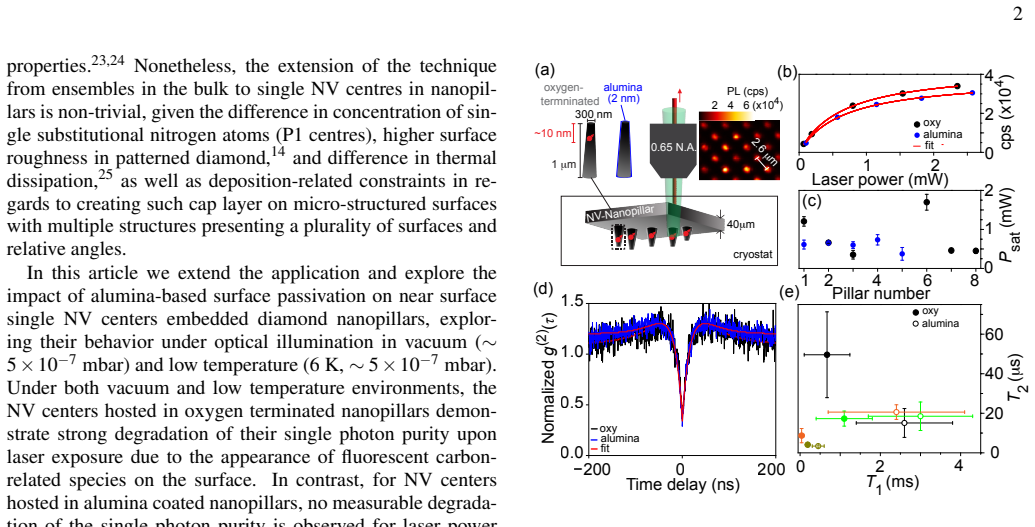
The properties of NVs under optical illumination were analyzed in ambient, vacuum (∼5×10 −7 mbar), and low temperature (6 K,∼5×10 −7 mbar) environments. To se- lect an appropriate optical illumination intensity for laser ex- posure experiments, PL saturation measurements were per- formed on selected nanopillars under different surface con- ditions (Fig. 1...
2000
-
[3]
Normalizedg (2)(τ)data for Nanopillar-9 (NP9) at differ- ent laser exposure times under (a) oxygen and (b) alumina termina- tions
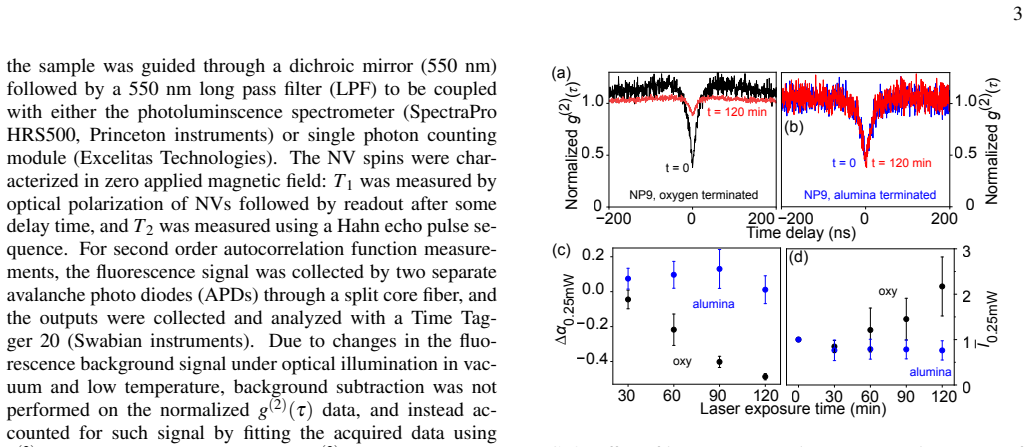
Effect of laser exposure under vacuum at a laser power of 0.25 mW. Normalizedg (2)(τ)data for Nanopillar-9 (NP9) at differ- ent laser exposure times under (a) oxygen and (b) alumina termina- tions. With reference to their values att=0 ns, we show the time evolution under laser exposure of (c) the absolute change in single photon purity (∆α 0.25 mW) and (d...
2000
-
[4]
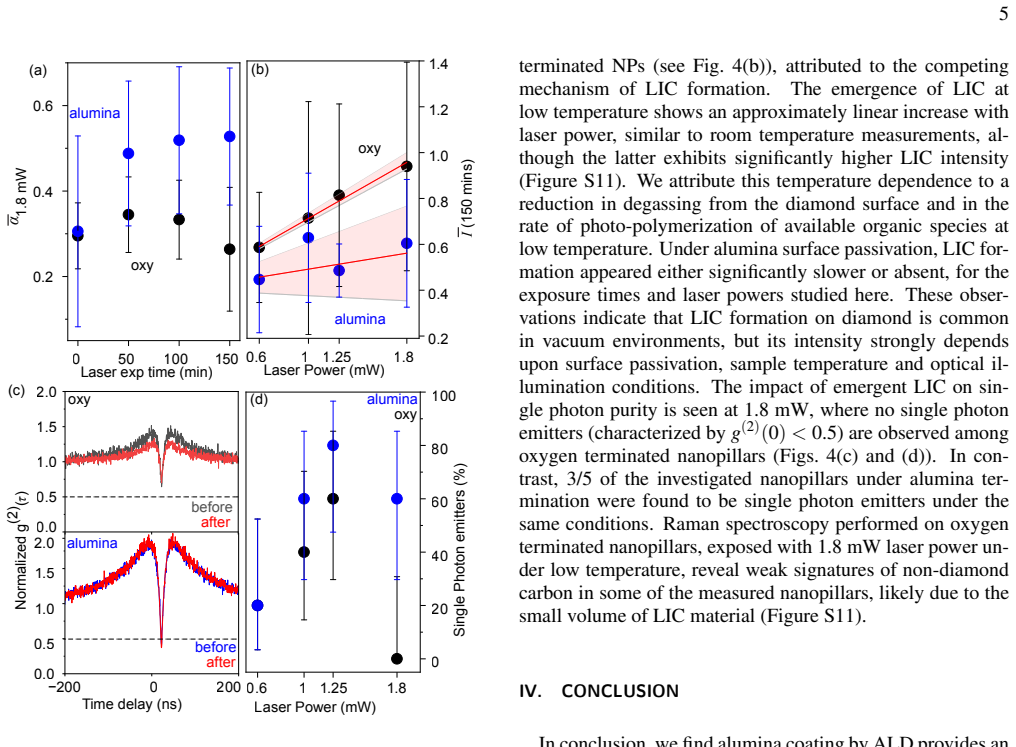
At low temperature, optical illumination produced negligible change inαfor oxygen terminated nanopillars (up to 1.8 mW), and a modest increase inαin the case of alu- mina coating. In contrast to the room temperature vacuum behaviour, where it was observed that the fluorescence back- ground grew due to LIC formation, these changes were ac- companied by are...
discussion (0)
Sign in with ORCID, Apple, or X to comment. Anyone can read and Pith papers without signing in.