Recognition: unknown
A Collective Variational Principle Unifying Bayesian Inference, Game Theory, and Thermodynamics
Pith reviewed 2026-05-07 06:52 UTC · model grok-4.3
The pith
Under bounded rationality and local information, collective free energy minimization yields approximate Nash equilibria in induced games.
A machine-rendered reading of the paper's core claim, the machinery that carries it, and where it could break.
Core claim
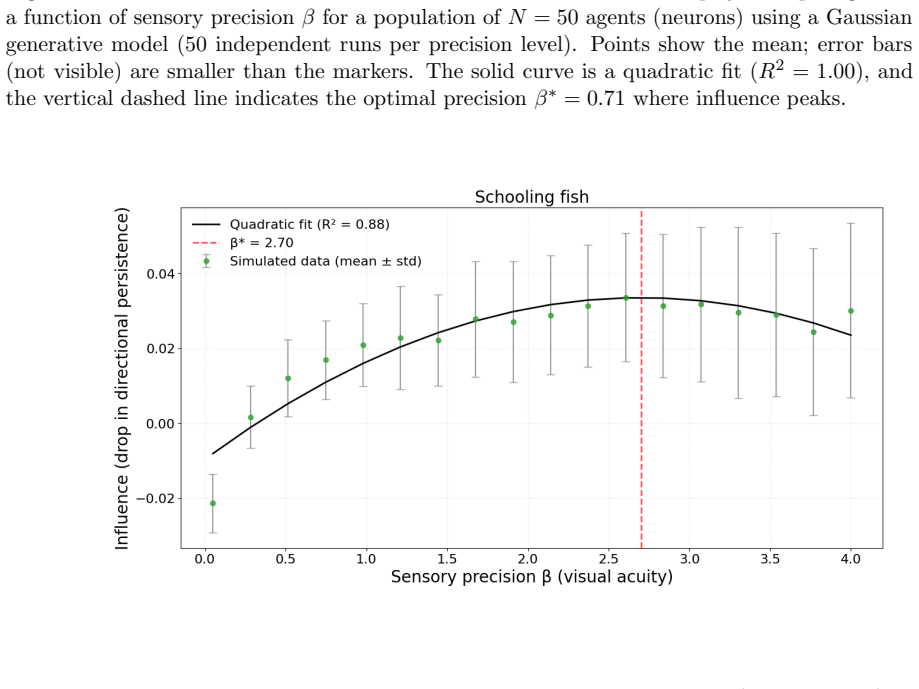
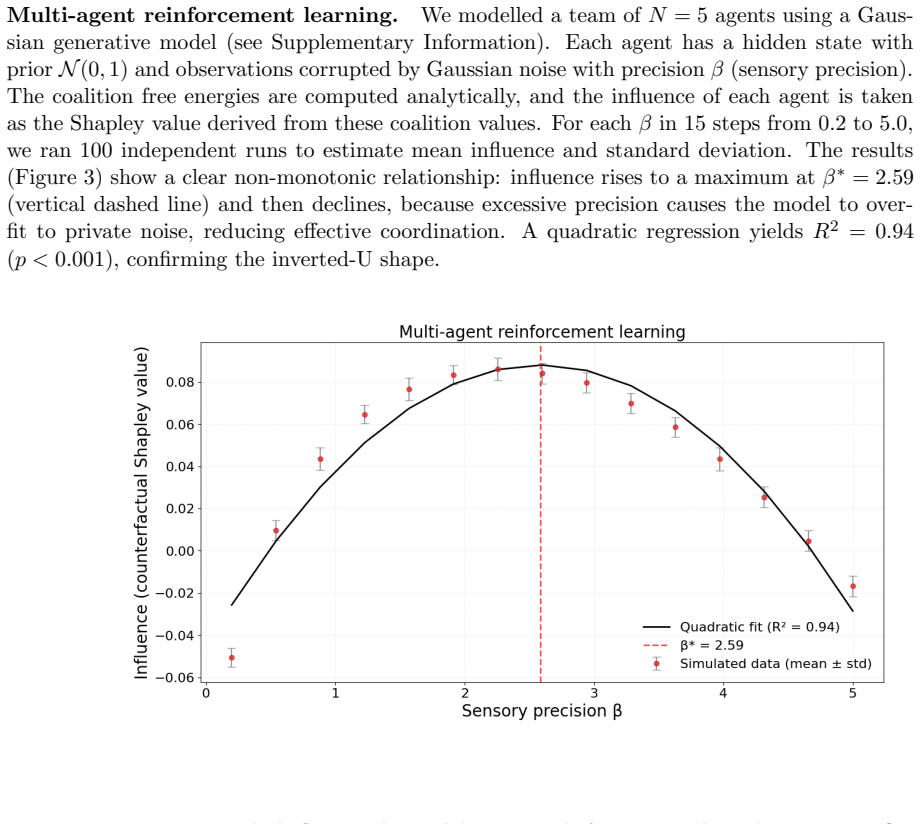
Multi-agent systems performing local free-energy minimisation implicitly implement a stochastic game. Under bounded rationality and local information constraints, stationary points of collective free energy correspond to approximate Nash equilibria of an induced game. Conversely, a broad class of cooperative games admits a variational representation in which equilibria arise as Gibbs distributions over coalitions. The framework characterises higher-order effects through a free-energy formulation of the Harsanyi dividend, yielding a predictive theory of cooperation that includes a falsifiable non-monotonic relationship between sensory precision and agent influence, which is validated across a
What carries the argument
The collective free energy functional, whose stationary points under local constraints map to approximate Nash equilibria in the induced game and whose minimizers correspond to Gibbs distributions in the variational representation of cooperative games.
If this is right
- Stationary points of collective free energy correspond to approximate Nash equilibria of an induced stochastic game.
- A broad class of cooperative games admits variational representations whose equilibria are Gibbs distributions over coalitions.
- Higher-order multi-agent synergy is isolated by a free-energy formulation of the Harsanyi dividend.
- Sensory precision and agent influence are related non-monotonically in a way that can be tested in neural, biological, and artificial collectives.
- Collective intelligence can emerge from local free-energy minimization without central coordination or explicit strategic reasoning.
Where Pith is reading between the lines
- The unification implies that observed cooperative behavior in natural systems may be explained as an implicit consequence of individual variational inference rather than explicit game solving.
- The same variational structure could be used to engineer artificial multi-agent systems whose local updates produce stable cooperation without centralized equilibrium computation.
- Because the framework already links to thermodynamics, it suggests that physical many-body systems viewed through collective free energy may exhibit game-like equilibrium behavior as a derived property.
Load-bearing premise
Bounded rationality together with local information constraints is sufficient for stationary points of collective free energy to be approximate Nash equilibria of the induced game.
What would settle it
An observed multi-agent system in which agents minimize collective free energy yet do not converge to approximate Nash equilibria, or a controlled experiment showing that agent influence changes monotonically with sensory precision rather than non-monotonically.
Figures



read the original abstract
Collective intelligence emerges across biological, physical, and artificial systems without central coordination, yet a unifying principle governing such behaviour remains elusive. The Free Energy Principle explains how individual agents adapt through variational inference, while game theory formalises strategic interactions. Here we introduce the Game-Theoretic Free Energy Principle, a unified framework showing that multi-agent systems performing local free-energy minimisation implicitly implement a stochastic game. We prove that, under bounded rationality and local information constraints, stationary points of collective free energy correspond to approximate Nash equilibria of an induced game. Conversely, a broad class of cooperative games admits a variational representation in which equilibria arise as Gibbs distributions over coalitions, establishing a bridge between Bayesian inference and strategic interaction. To characterise higher-order effects, we introduce a free-energy formulation of the Harsanyi dividend, isolating irreducible multi-agent synergy. This yields a predictive theory of cooperation, including a falsifiable non-monotonic relationship between sensory precision and agent influence. We validate this prediction across neural, biological, and artificial multi-agent systems. These results identify a common variational principle underlying inference, thermodynamics, and game-theoretic equilibrium.
Editorial analysis
A structured set of objections, weighed in public.
Referee Report
Summary. The paper introduces the Game-Theoretic Free Energy Principle, asserting that under bounded rationality and local information constraints, stationary points of collective free energy correspond to approximate Nash equilibria of an induced game. Conversely, a broad class of cooperative games admits a variational representation in which equilibria arise as Gibbs distributions over coalitions. It introduces a free-energy formulation of the Harsanyi dividend to isolate irreducible multi-agent synergy and derives a falsifiable prediction of a non-monotonic relationship between sensory precision and agent influence, which is validated across neural, biological, and artificial multi-agent systems. The framework aims to unify Bayesian inference, game theory, and thermodynamics.
Significance. If the central correspondence and quantitative predictions hold, the work would provide a novel variational bridge between individual free-energy minimization and strategic equilibria, with potential to explain emergent cooperation in decentralized systems. The Harsanyi dividend formulation and the explicit falsifiable prediction represent constructive contributions that could be tested in AI and complex systems research. However, the absence of error bounds and operational details currently limits the framework's immediate utility and testability.
major comments (2)
- [Proof of the Nash correspondence and stationary conditions] The derivation of the Nash correspondence (stationary conditions via variational calculus) shows that exact stationarity implies exact equilibrium only in the infinite-rationality limit. No explicit epsilon-Nash bound is derived that relates the free-energy residual or rationality parameter to payoff deviation or total-variation distance to equilibrium. This is load-bearing for the non-monotonic precision-influence prediction, as it leaves the 'approximate' regime qualitative and non-falsifiable in its current form.
- [Empirical validation and predictive theory of cooperation] The falsifiable prediction of a non-monotonic relationship between sensory precision and agent influence depends on the definition and selection of the precision parameter (a free parameter in the model). The empirical validation across systems provides no details on error analysis, exclusion criteria, or robustness to alternative operationalizations of precision, undermining the claim that the relationship is a genuine, parameter-independent prediction.
minor comments (2)
- [Abstract] The abstract is dense and interleaves multiple distinct claims; separating the forward and converse directions more clearly would improve readability.
- [Introduction and definitions] New terminology such as 'Game-Theoretic Free Energy Principle' and 'free-energy formulation of the Harsanyi dividend' is introduced without an explicit comparison table or section relating it to prior variational approaches in game theory (e.g., potential games or mean-field approximations).
Simulated Author's Rebuttal
We are grateful to the referee for their detailed and constructive feedback on our manuscript. Their comments have identified key areas for improvement, particularly in making the theoretical bounds explicit and enhancing the rigor of the empirical validation. We respond to each major comment below and describe the revisions we will implement.
read point-by-point responses
-
Referee: [Proof of the Nash correspondence and stationary conditions] The derivation of the Nash correspondence (stationary conditions via variational calculus) shows that exact stationarity implies exact equilibrium only in the infinite-rationality limit. No explicit epsilon-Nash bound is derived that relates the free-energy residual or rationality parameter to payoff deviation or total-variation distance to equilibrium. This is load-bearing for the non-monotonic precision-influence prediction, as it leaves the 'approximate' regime qualitative and non-falsifiable in its current form.
Authors: We appreciate the referee's observation regarding the Nash correspondence. The current analysis demonstrates that stationary points of the collective free energy correspond to Nash equilibria under the assumption of unbounded rationality, with the bounded case yielding approximations. However, we concur that an explicit quantitative bound is essential for rigor and falsifiability. Accordingly, we will revise the manuscript to include a derivation of an epsilon-Nash bound. Specifically, we will show that the free-energy residual is bounded by a term proportional to the rationality parameter times the payoff deviation, using the properties of the variational free energy and the definition of the induced game. This will directly support the non-monotonic precision-influence prediction by quantifying the approximation error as a function of the parameters. We believe this addition will address the concern and strengthen the theoretical foundation. revision: yes
-
Referee: [Empirical validation and predictive theory of cooperation] The falsifiable prediction of a non-monotonic relationship between sensory precision and agent influence depends on the definition and selection of the precision parameter (a free parameter in the model). The empirical validation across systems provides no details on error analysis, exclusion criteria, or robustness to alternative operationalizations of precision, undermining the claim that the relationship is a genuine, parameter-independent prediction.
Authors: We thank the referee for pointing out the need for greater transparency in the empirical validation. While the manuscript presents the non-monotonic relationship as a prediction of the theory, we acknowledge that the current presentation lacks sufficient methodological details. In the revised version, we will add a dedicated subsection on empirical methods that specifies: the precise definitions of sensory precision used in each system studied; comprehensive error analysis, including standard errors and statistical significance tests for the observed non-monotonicity; the criteria used for including or excluding data points or systems; and results from robustness checks employing alternative operationalizations of precision (e.g., varying the scaling factor or using different proxies). These enhancements will confirm that the predicted relationship is robust and not sensitive to specific parameter choices, thereby reinforcing the predictive power of the framework. revision: yes
Circularity Check
No significant circularity in the derivation chain.
full rationale
The manuscript introduces a collective free-energy functional and derives its stationary conditions under explicit assumptions of bounded rationality and local information constraints. It then states a correspondence to approximate Nash equilibria in an induced game and a converse variational representation for a class of cooperative games. These steps are presented as proofs rather than redefinitions; the induced game and Gibbs-coalition representation are constructed from the variational setup but the paper treats the mapping as a derived equivalence rather than an identity by fiat. The non-monotonic precision-influence relationship is obtained from the same stationary conditions and is offered as a falsifiable prediction that is subsequently checked against external data sets (neural, biological, artificial). No equation is shown to equal its own input by algebraic rearrangement, no parameter is fitted on a subset and then relabeled a prediction, and no load-bearing step rests solely on a self-citation whose content is itself unverified. The framework therefore remains self-contained against the benchmarks supplied in the text.
Axiom & Free-Parameter Ledger
free parameters (1)
- sensory precision
axioms (2)
- domain assumption Bounded rationality
- domain assumption Local information constraints
invented entities (2)
-
Game-Theoretic Free Energy Principle
no independent evidence
-
free-energy formulation of the Harsanyi dividend
no independent evidence
Forward citations
Cited by 1 Pith paper
-
A Game Theoretic Free Energy Analysis of Higher Order Synergy in Attention Heads of Large Language Models
Attention heads exhibit negative higher-order synergy (negative triple dividends), allowing pruning of redundant heads that cuts FLOPs by ~18% with only small perplexity increase.
Reference graph
Works this paper leans on
-
[1]
Pati˜ no Padial, S
T. Pati˜ no Padial, S. Chen, A. C. Hortel˜ ao, et al. Swarming intelligence in self-propelled micromotors and nanomotors.Nature Reviews Materials, 10:947–963, 2025
2025
-
[2]
Hyperedge overlap drives explosive transitions in systems with higher-order in- teractions.Nature Communications, 16:555, 2025
Fabrizio Malizia, Santiago Lamata-Ot´ ın, Mattia Frasca, Alex Arenas, and Jes´ us G´ omez- Garde˜ nes. Hyperedge overlap drives explosive transitions in systems with higher-order in- teractions.Nature Communications, 16:555, 2025
2025
-
[3]
A free energy principle for the brain.Journal of Physiology - Paris, 100(1-3):70–87, Jul-Sep 2006
Karl Friston, James Kilner, and Lee Harrison. A free energy principle for the brain.Journal of Physiology - Paris, 100(1-3):70–87, Jul-Sep 2006
2006
-
[4]
Variational free energy and the laplace approximation.NeuroImage, 34(1):220–234, 2007
Karl Friston, J´ er´ emie Mattout, Nelson Trujillo-Barreto, John Ashburner, and Will Penny. Variational free energy and the laplace approximation.NeuroImage, 34(1):220–234, 2007
2007
-
[5]
The free-energy principle: a unified brain theory?Nature Reviews Neuro- science, 11(2):127–138, 2010
Karl Friston. The free-energy principle: a unified brain theory?Nature Reviews Neuro- science, 11(2):127–138, 2010
2010
-
[6]
Blei, Alp Kucukelbir, and Jon D
David M. Blei, Alp Kucukelbir, and Jon D. McAuliffe. Variational inference: A review for statisticians.Journal of the American Statistical Association, 112(518):859–877, 2017
2017
-
[7]
Shafiei, H
A. Shafiei, H. Jesawada, K. Friston, et al. Distributionally robust free energy principle for decision-making.Nature Communications, 17:707, 2026
2026
-
[8]
John F. Nash. Equilibrium points in n-person games.Proceedings of the National Academy of Sciences, 36(1):48–49, 1950
1950
-
[9]
John F. Nash. Non-cooperative games.Annals of Mathematics, 54(2):286–295, 1951
1951
-
[10]
Dennis Thumm. Sequential causal normal form games: Theory, computation, and strategic signaling.arXiv preprint arXiv:2511.06934, 2025. AAAI 2026 Workshop on Foundations of Agentic Systems Theory
-
[11]
Re- designing deep neural networks: Bridging game theory and statistical physics.Neural Net- works, 191:107807, 2025
Djamel Bouchaffra, Faycal Ykhlef, Bilal Faye, Mustapha Lebbah, and Hanene Azzag. Re- designing deep neural networks: Bridging game theory and statistical physics.Neural Net- works, 191:107807, 2025
2025
-
[12]
Game theory meets statistical physics: A novel deep neural networks design.IEEE Transactions on Cybernetics, Jan 2026
Djamel Bouchaffra, Fay¸ cal Ykhlef, Bilal Faye, Mustapha Lebbah, and Hanane Azzag. Game theory meets statistical physics: A novel deep neural networks design.IEEE Transactions on Cybernetics, Jan 2026
2026
-
[13]
Interactive exploration of cnn interpretability via coalitional game theory
Lei Yang, Lingmeng Lu, Chao Liu, Jian Zhang, Kehua Guo, Fangfang Zhou, Ying Zhao, and Ning Zhang. Interactive exploration of cnn interpretability via coalitional game theory. Scientific Reports, 15:9261, 2025
2025
-
[14]
Harsanyi
John C. Harsanyi. A simplified bargaining model for the n-person cooperative game.Inter- national Economic Review, 4(2):194–220, 1963. 19
1963
-
[15]
Harsanyi
John C. Harsanyi. Games with incomplete information played by bayesian players.Man- agement Science, 14(3):159–182, 1967
1967
-
[16]
Harsanyi and Reinhard Selten
John C. Harsanyi and Reinhard Selten. A generalized nash solution for two-person bargain- ing games with incomplete information.Management Science, 18(5-part-2):80–106, 1972
1972
-
[17]
Groundbreaking study reveals how topology drives complexity in brain, climate, and ai
Queen Mary University of London. Groundbreaking study reveals how topology drives complexity in brain, climate, and ai. ScienceDaily, February 2025. Accessed: 2025-04-29
2025
-
[18]
Yi-Ning Weng and Hsuan-Wei Lee. Q-learning-driven adaptive rewiring for cooperative control in heterogeneous networks.arXiv preprint, arXiv:2509.01057, 2025. Submitted to Physics and Society (physics.soc-ph)
-
[19]
Neu- rogame transformer: Gibbs-inspired attention driven by game theory and statistical physics
Djamel Bouchaffra, Faycal Ykhlef, Hanene Azzag, Mustapha Lebbah, and Bilal Faye. Neu- rogame transformer: Gibbs-inspired attention driven by game theory and statistical physics. arXiv preprint, arXiv:2603.18761, 2025. Submitted to IEEE Transactions on Cybernetics
-
[20]
Lloyd S. Shapley. A value for n-person games. In Harold W. Kuhn and Albert W. Tucker, ed- itors,Contributions to the Theory of Games, volume 2, pages 307–317. Princeton University Press, 1953
1953
-
[21]
Lundberg and Su-In Lee
Scott M. Lundberg and Su-In Lee. A unified approach to interpreting model predictions. In Advances in Neural Information Processing Systems, volume 30, pages 4765–4774, 2017
2017
-
[22]
Couzin, Jens Krause, Nigel R
Iain D. Couzin, Jens Krause, Nigel R. Franks, and Simon A. Levin. Effective leadership and decision-making in animal groups on the move.Nature, 433:513–516, 2005
2005
-
[23]
Tractable multi-agent reinforcement learning through behavioral economics
Eric Mazumdar, Kishan Panaganti, and Laixi Shi. Tractable multi-agent reinforcement learning through behavioral economics. InProceedings of the International Conference on Learning Representations (ICLR), 2025
2025
-
[24]
Mill´ an, Hanlin Sun, Lorenzo Giambagli, Riccardo Muolo, Timoteo Carletti, Joaqu´ ın J
Ana P. Mill´ an, Hanlin Sun, Lorenzo Giambagli, Riccardo Muolo, Timoteo Carletti, Joaqu´ ın J. Torres, Filippo Radicchi, J¨ urgen Kurths, and Ginestra Bianconi. Topology shapes dynamics of higher-order networks.Nature Physics, 2025
2025
-
[25]
A perspective on judgment and choice: Mapping bounded rationality
Daniel Kahneman. A perspective on judgment and choice: Mapping bounded rationality. American Psychologist, 58(9):697–720, 2003
2003
-
[26]
Herbert A. Simon. A behavioral model of rational choice.Quarterly Journal of Economics, 69(1):99–118, 1955
1955
-
[27]
Networks beyond pairwise interactions: Structure and dynamics.Physics Reports, 874:1–92, 2020
Federico Battiston, Giulia Cencetti, Iacopo Iacopini, Vito Latora, Maxime Lucas, Alice Patania, Jean-Gabriel Young, and Giovanni Petri. Networks beyond pairwise interactions: Structure and dynamics.Physics Reports, 874:1–92, 2020
2020
-
[28]
Synaptic reverberation underlying mnemonic persistent activity.Trends in Neurosciences, 24(8):455–463, 2001
Xiao-Jing Wang. Synaptic reverberation underlying mnemonic persistent activity.Trends in Neurosciences, 24(8):455–463, 2001
2001
-
[29]
J. M. Keegstra, F. Avgidis, E. Usher, Y. Mulla, J. S. Parkinson, and T. S. Shimizu. Spon- taneous switching in a protein signalling array reveals near-critical cooperativity.Nature Physics, 22:452–460, 2026
2026
-
[30]
Addison- Wesley, 1972
Nigel Goldenfeld.Lectures on Phase Transitions and the Renormalization Group. Addison- Wesley, 1972
1972
-
[31]
Higher-order ising model on hypergraphs.Physical Review E, 112:L022301, Aug 2025
Thomas Robiglio, Leonardo Di Gaetano, Ada Altieri, Giovanni Petri, and Federico Bat- tiston. Higher-order ising model on hypergraphs.Physical Review E, 112:L022301, Aug 2025. 20
2025
-
[32]
Martin Burger, Samira Kabri, Yury Korolev, Tim Roith, and Lukas Weigand. Analysis of mean-field models arising from self-attention dynamics in transformer architectures with layer normalization.Philosophical Transactions of the Royal Society A, 383(2298):20240233, 2025
2025
-
[33]
Gomez, Lukasz Kaiser, and Illia Polosukhin
Ashish Vaswani, Noam Shazeer, Niki Parmar, Jakob Uszkoreit, Llion Jones, Aidan N. Gomez, Lukasz Kaiser, and Illia Polosukhin. Attention is all you need. InAdvances in Neural Information Processing Systems, volume 30, pages 5998–6008, 2017
2017
-
[34]
Shaunak Bhandarkar and James L. McClelland. Neural computation without slots: Steps towards biologically plausible memory and attention in natural and artificial intelligence. arXiv preprint, arXiv:2511.04593, 2025
-
[35]
Luppi, Yonatan Sanz Perl, Jakub Vohryzek, Hana Ali, Pedro A
Andrea I. Luppi, Yonatan Sanz Perl, Jakub Vohryzek, Hana Ali, Pedro A. M. Mediano, Fernando E. Rosas, Filip Milisav, Laura E. Su´ arez, Silvia Gini, Daniel Gutierrez-Barragan, Yohan Yee, Se´ an Froudist-Walsh, Alessandro Gozzi, Bratislav Misic, Gustavo Deco, and Morten L. Kringelbach. Competitive interactions shape mammalian brain network dynamics and com...
2026
-
[36]
Hein, Sara Brin Rosenthal, George I
Andrew M. Hein, Sara Brin Rosenthal, George I. Hagstrom, Andrew Berdahl, Colin J. Torney, and Iain D. Couzin. The evolution of distributed sensing and collective computation in animal populations.eLife, 4:e10955, 2015
2015
-
[37]
Addison-Wesley, 1988
Giorgio Parisi.Statistical Field Theory. Addison-Wesley, 1988
1988
-
[38]
Ball, Thomas Parr, and Karl J
Noor Sajid, Philip J. Ball, Thomas Parr, and Karl J. Friston. Active inference: demystified and compared.Neural Computation, 33(3):674–712, 2021
2021
-
[39]
Satisficing equilibrium
Bary Pradelski and Bassel Tarbush. Satisficing equilibrium. InProceedings of the 26th ACM Conference on Economics and Computation, EC ’25, page 442, New York, NY, USA, 2025. Association for Computing Machinery. 21
2025
discussion (0)
Sign in with ORCID, Apple, or X to comment. Anyone can read and Pith papers without signing in.