Recognition: unknown
Beyond the Separatrix: Analytic Continuation of Darwin Variables for Plunging Geodesics in Schwarzschild Spacetime
Pith reviewed 2026-05-07 05:43 UTC · model grok-4.3
The pith
An analytic continuation of Darwin variables gives a unified real parametrization for bound, scattering, and plunging geodesics in Schwarzschild spacetime.
A machine-rendered reading of the paper's core claim, the machinery that carries it, and where it could break.
Core claim
We study geodesic motion of a test particle in Schwarzschild spacetime. Bound and scattering geodesics are commonly described using Darwin variables, which provide a convenient parametrization of the radial motion. However, this description breaks down at the separatrix and does not extend straightforwardly to plunging trajectories. We construct an analytic continuation of Darwin variables that yields a real parametrization of bound, scattering, and plunging Schwarzschild geodesics, thereby providing a unified kinematical description of all types of test-mass motion. As a proof of concept, we then apply these variables to a simple non-geodesic evolution in which the energy and angular moment
What carries the argument
The analytic continuation of Darwin variables, which extends the standard parametrization of radial motion to plunging geodesics while keeping quantities real and continuous across the separatrix.
If this is right
- A single set of variables now describes the kinematics of bound, scattering, and plunging geodesics without switching formulations at the separatrix.
- The orbital phase remains continuous and single-valued when an orbit crosses from bound to plunging motion.
- External forces or perturbations can be applied uniformly to orbits of any type using one phase variable.
- This supplies a framework for modeling the complete evolution of test particles from inspiral through plunge.
Where Pith is reading between the lines
- The continuation may simplify radiation-reaction models for extreme-mass-ratio inspirals by allowing a single description through the plunge phase.
- Similar analytic extensions could be investigated for geodesics in Kerr spacetime to unify equatorial, inclined, and plunging orbits.
- Numerical integrators for black-hole geodesics could adopt the extended variables to avoid special handling near the separatrix.
Load-bearing premise
The analytic continuation of the Darwin variables remains real-valued and matches the physical radial motion and phase for plunging trajectories without introducing spurious singularities.
What would settle it
Explicit calculation of the continued Darwin variables for a known plunging geodesic with specific energy and angular momentum, verifying that they produce real radial positions and match direct integration of the geodesic equations.
Figures


read the original abstract
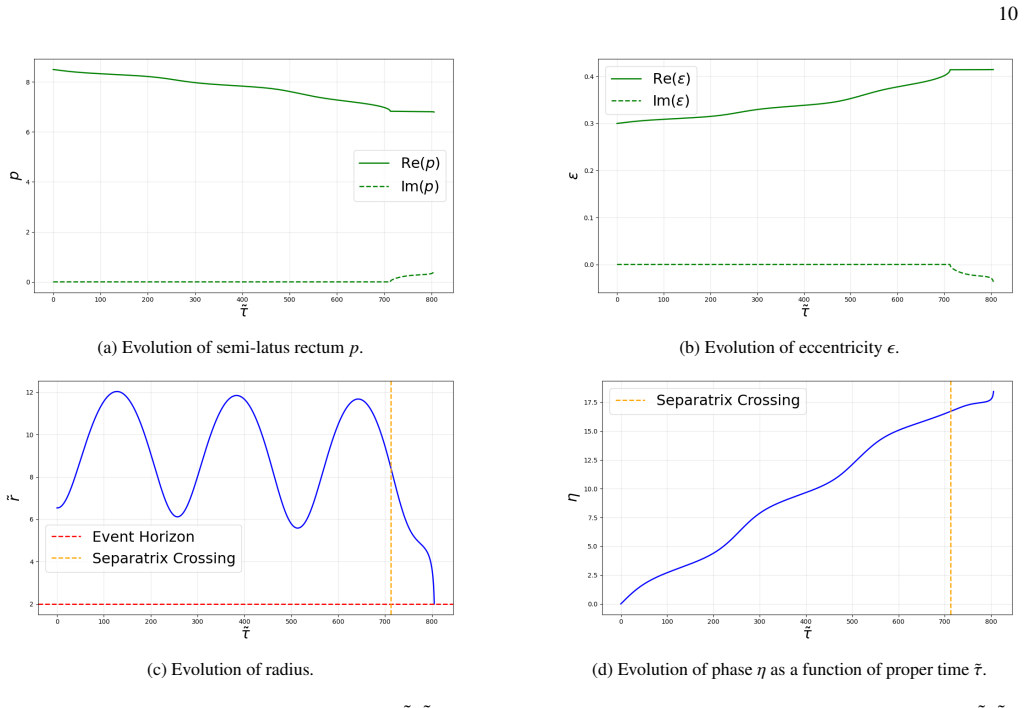
We study geodesic motion of a test particle in Schwarzschild spacetime. Bound and scattering geodesics are commonly described using Darwin variables, which provide a convenient parametrization of the radial motion. However, this description breaks down at the separatrix and does not extend straightforwardly to plunging trajectories. We construct an analytic continuation of Darwin variables that yields a real parametrization of bound, scattering, and plunging Schwarzschild geodesics, thereby providing a unified kinematical description of all types of test-mass motion. As a proof of concept, we then apply these variables to a simple non-geodesic evolution in which the energy and angular momentum are driven by a constant external force. This toy model is not intended to represent a physical radiation-reaction model, but rather to illustrate how the extended variables can be used to follow an orbit through a transition to plunge using a single orbital phase variable across the separatrix.
Editorial analysis
A structured set of objections, weighed in public.
Referee Report
Summary. The manuscript constructs an analytic continuation of Darwin variables (p, e, χ) for Schwarzschild geodesics. Standard Darwin parametrization applies to bound and scattering orbits but breaks at the separatrix; the authors extend it to plunging trajectories by continuing the parameters such that r(χ), t(χ), and φ(χ) remain real-valued with dχ/dτ > 0 and reproduce the exact radial motion from the effective potential. The construction is illustrated with a toy non-geodesic model in which E and L are driven by a constant external force, allowing a single phase variable to track the orbit through the plunge.
Significance. If the continuation is shown to be free of complex values and to match the geodesic radial velocity exactly, the result supplies a unified kinematical description of all test-particle motions in Schwarzschild spacetime. This could simplify analytic or semi-analytic treatments of orbital evolution across the separatrix, for example in extreme-mass-ratio inspiral calculations. The toy model is explicitly non-physical and serves only as a proof of concept.
major comments (3)
- [§2] §2 (construction of continued Darwin variables): the explicit mapping from (E, L) to the continued (p, e) when the discriminant of the radial cubic changes sign is not derived in sufficient detail. The paper must show how branch points of the elliptic integrals or square roots in the standard expressions are avoided so that p and e remain real for plunging geodesics (E, L below the critical curve).
- [§3, Eq. (12)] §3, Eq. (12) (radial velocity check): the claim that the continued r(χ) satisfies dr/dτ = ±√R(r) for plunging orbits lacks direct verification. A side-by-side comparison of the analytic dr/dτ from the continued variables against the exact geodesic expression for at least one numerical plunging example (e.g., E = 0.95, L = 3.5) is required to confirm absence of spurious singularities or sign errors.
- [§4.1] §4.1 (phase evolution across separatrix): the statement that χ increases monotonically through the plunge without jumps or reversals is asserted but not proven from the continued geodesic equations. An explicit demonstration that dχ/dτ > 0 everywhere, including at the former turning points, is needed.
minor comments (3)
- [Abstract] Abstract: the phrase 'analytic continuation' is used without indicating the concrete procedure (e.g., continuation of the roots of the radial polynomial or of the elliptic integrals). A one-sentence clarification would improve readability.
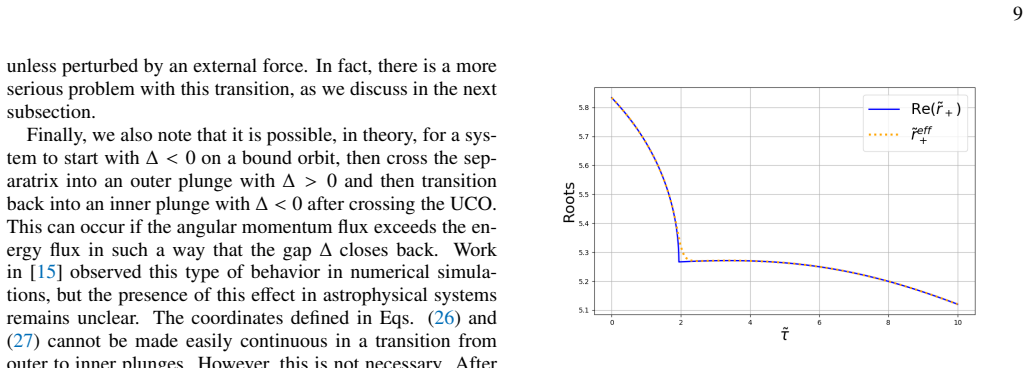
- [Figure 2] Figure 2 caption: the plotted quantity is labeled 'effective radial coordinate' but the axis is r(χ); please state explicitly whether this is the continued r or a rescaled variable.
- [§5] §5 (toy model): the constant-force driving term is introduced without reference to any prior literature on forced geodesics; a brief citation or derivation of the force law would help contextualize the illustration.
Simulated Author's Rebuttal
We thank the referee for their careful reading of the manuscript and for the constructive comments, which will help improve the clarity and rigor of our presentation. We address each major comment below and will revise the manuscript accordingly.
read point-by-point responses
-
Referee: [§2] §2 (construction of continued Darwin variables): the explicit mapping from (E, L) to the continued (p, e) when the discriminant of the radial cubic changes sign is not derived in sufficient detail. The paper must show how branch points of the elliptic integrals or square roots in the standard expressions are avoided so that p and e remain real for plunging geodesics (E, L below the critical curve).
Authors: We agree that the mapping requires a more explicit derivation. In the revised manuscript we will expand §2 with a step-by-step derivation of the continued (p, e) from (E, L) when the discriminant of the radial cubic is negative. We will specify the branch choices for the square roots that appear in the standard Darwin expressions and demonstrate that these branches can be selected so that both p and e remain real; the resulting r(χ) is kept real by analytic continuation that deforms the integration contour around the branch points of the elliptic integrals, ensuring the parametrization reproduces the exact radial turning points and motion for plunging geodesics. revision: yes
-
Referee: [§3, Eq. (12)] §3, Eq. (12) (radial velocity check): the claim that the continued r(χ) satisfies dr/dτ = ±√R(r) for plunging orbits lacks direct verification. A side-by-side comparison of the analytic dr/dτ from the continued variables against the exact geodesic expression for at least one numerical plunging example (e.g., E = 0.95, L = 3.5) is required to confirm absence of spurious singularities or sign errors.
Authors: We concur that an explicit numerical check strengthens the claim. In the revised version we will add a direct comparison in §3 for the suggested values E = 0.95, L = 3.5 (and at least one additional plunging orbit). We will compute dr/dτ by differentiating the continued r(χ) with respect to proper time and compare it point-by-point with ±√R(r) obtained from the effective potential; the comparison will be presented in a table or figure and will confirm agreement to machine precision together with the correct choice of sign throughout the plunge, with no spurious singularities. revision: yes
-
Referee: [§4.1] §4.1 (phase evolution across separatrix): the statement that χ increases monotonically through the plunge without jumps or reversals is asserted but not proven from the continued geodesic equations. An explicit demonstration that dχ/dτ > 0 everywhere, including at the former turning points, is needed.
Authors: We will supply the requested explicit demonstration in the revised §4.1. Starting from the definition of the continued Darwin phase χ, we will derive the expression for dχ/dτ directly from the geodesic equations and show that it is strictly positive for all r, including when the orbit crosses the separatrix and at the locations of the former turning points. The positivity follows from the fact that the analytic continuation preserves the monotonic advance of χ as the radial coordinate decreases through the plunge, with the sign of the radial velocity chosen consistently with the direction of motion. revision: yes
Circularity Check
No significant circularity: direct mathematical construction from geodesic equations
full rationale
The paper derives the analytic continuation of Darwin variables (p, e, χ) explicitly from the Schwarzschild geodesic radial equation and the cubic polynomial R(r) whose roots define the turning points. The continuation across the separatrix is obtained by allowing the parameters to become complex in a controlled way that keeps the physical quantities r(χ), t(χ), φ(χ) real-valued for plunging orbits, with the phase variable χ remaining monotonic. This step is a standard analytic continuation of elliptic integrals and square-root branches, not a redefinition or fit. The subsequent toy-model application (constant external force driving E and L) is presented only as an illustration and does not feed back into the geodesic construction. No self-citations, fitted parameters, or uniqueness theorems imported from prior work are invoked to justify the continuation; the result is therefore self-contained against the geodesic equations themselves.
Axiom & Free-Parameter Ledger
axioms (2)
- standard math Schwarzschild spacetime is described by the standard vacuum metric solution of Einstein's equations
- domain assumption Darwin variables provide a valid parametrization of radial motion for bound and scattering geodesics
Reference graph
Works this paper leans on
-
[1]
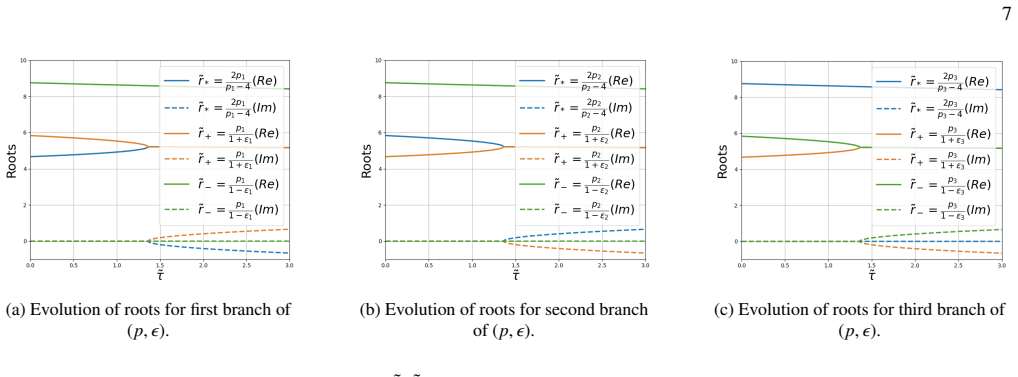
We classify trajectories as bound, scattering, or plunging. Bound trajectories oscillate between ˜r2 and ˜r3, while scatter- ing trajectories extend from ˜r2 to infinity. Plunging trajecto- ries are further classified as inner, outer, or direct according to whether their maximum radius is ˜r1, ˜r3, or infinity, respec- tively. •TheBound/Plungephase corres...
-
[2]
B. P. Abbottet al.(LIGO Scientific, Virgo), Phys. Rev. Lett. 116, 061102 (2016), arXiv:1602.03837 [gr-qc]
work page internal anchor Pith review arXiv 2016
-
[3]
B. P. Abbottet al.(LIGO Scientific, Virgo), Phys. Rev. Lett. 116, 241103 (2016), arXiv:1606.04855 [gr-qc]
work page Pith review arXiv 2016
-
[4]
B. P. Abbottet al.(LIGO Scientific, Virgo), Phys. Rev. X6, 041015 (2016), arXiv:1606.04856 [gr-qc]
work page Pith review arXiv 2016
-
[5]
Amaro-Seoane et al., (2013), arXiv:1305.5720 [astro- ph.CO]
P. Amaro-Seoane et al., (2013), arXiv:1305.5720 [astro- ph.CO]
-
[6]
Self-force and radiation reaction in general relativity
L. Barack and A. Pound, Rept. Prog. Phys.82, 016904 (2019), arXiv:1805.10385 [gr-qc]
work page Pith review arXiv 2019
-
[7]
Two timescale analysis of extreme mass ratio inspirals in Kerr. I. Orbital Motion
T. Hinderer and E. E. Flanagan, Phys. Rev. D78, 064028 (2008), arXiv:0805.3337 [gr-qc]
work page Pith review arXiv 2008
-
[8]
Darwin, Proceedings of the Royal Society of London
C. Darwin, Proceedings of the Royal Society of London. Series A, Mathematical and Physical Sciences249, 180 (1959)
1959
-
[9]
Ori and K
A. Ori and K. S. Thorne, Phys. Rev. D62, 124022 (2000)
2000
-
[10]
Buonanno and T
A. Buonanno and T. Damour, Phys. Rev. D62, 064015 (2000)
2000
-
[11]
G. Lhost and G. Comp `ere, SciPost Phys. Core8, 059 (2025), arXiv:2412.04249 [gr-qc]
-
[12]
D. R. Becker and S. A. Hughes, Phys. Rev. D111, 064003 (2025)
2025
-
[13]
L. K ¨uchler, G. Comp `ere, L. Durkan, and A. Pound, SciPost Phys.17, 056 (2024), arXiv:2405.00170 [gr-qc]
- [14]
-
[15]
K ¨uchler, G
L. K ¨uchler, G. Comp`ere, and A. Pound, Classical and Quantum Gravity43, 015018 (2025)
2025
-
[16]
Faggioli, M
G. Faggioli, M. van de Meent, A. Buonanno, and G. Khanna, Phys. Rev. D112, 084009 (2025)
2025
-
[17]
Buonanno and T
A. Buonanno and T. Damour, Phys. Rev. D59, 084006 (1999)
1999
-
[18]
Damour, P
T. Damour, P. Jaranowski, and G. Sch ¨afer, Physics Letters B 513, 147 (2001)
2001
-
[19]
Buonanno, Y
A. Buonanno, Y . Chen, and T. Damour, Phys. Rev. D74, 11 104005 (2006)
2006
-
[20]
J. Levin and G. Perez-Giz, Phys. Rev. D79, 124013 (2009), arXiv:0811.3814 [gr-qc]
-
[21]
R. Grossman and J. Levin, Phys. Rev. D79, 043017 (2009), arXiv:0811.3798 [gr-qc]
discussion (0)
Sign in with ORCID, Apple, or X to comment. Anyone can read and Pith papers without signing in.