Recognition: unknown
Computing Equilibrium beyond Unilateral Deviation
Pith reviewed 2026-05-07 06:25 UTC · model grok-4.3
The pith
Equilibria that minimize average or maximum gains from coalitional deviations always exist and admit an algorithm whose complexity matches a proven lower bound.
A machine-rendered reading of the paper's core claim, the machinery that carries it, and where it could break.
Core claim
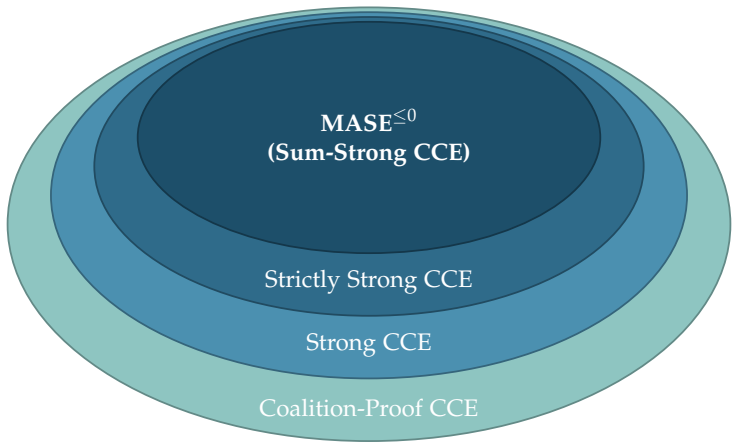
We introduce solution concepts that minimize the average gain, weighted-average gain, or maximum-within-coalition gain obtainable by any deviating coalition, rather than requiring these gains to be zero. For the average-gain and maximum-gain objectives we prove a lower bound on the complexity of computing such an equilibrium and present an algorithm that matches this bound. We use the framework to solve the Exploitability Welfare Frontier, the maximum attainable social welfare subject to a given exploitability (the maximum gain over all unilateral deviations).
What carries the argument
Minimization of the average (or maximum) gain from a deviating coalition, used as the objective for selecting a stable strategy profile.
If this is right
- The proposed equilibria exist in every finite game.
- They can be computed in time matching the proven lower bound for both average-gain and maximum-gain objectives.
- The minimum-gain version of the same minimization problem is computationally intractable.
- The same algorithmic framework directly yields the maximum social welfare attainable under any given bound on unilateral exploitability.
Where Pith is reading between the lines
- The approach supplies a computationally tractable stability notion in games where exact strong Nash equilibria do not exist.
- The explicit construction of the Exploitability Welfare Frontier makes the efficiency-stability tradeoff quantifiable for mechanism-design purposes.
Load-bearing premise
Minimizing the average or maximum gain from coalitional deviations produces a meaningful stability notion in finite games whose representation allows efficient evaluation of coalition payoffs.
What would settle it
A concrete finite game in which the proposed algorithm returns a profile whose average coalitional deviation gain is strictly larger than the minimum achievable gain, or an instance whose solution time exceeds the stated lower bound.
Figures


read the original abstract
Most familiar equilibrium concepts, such as Nash and correlated equilibrium, guarantee only that no single player can improve their utility by deviating unilaterally. They offer no guarantees against profitable coordinated deviations by coalitions. Although the literature proposes solution concepts that provide stability against multilateral deviations (\emph{e.g.}, strong Nash and coalition-proof equilibrium), these generally fail to exist. In this paper, we study an alternative solution concept that minimizes coalitional deviation incentives, rather than requiring them to vanish, and is therefore guaranteed to exist. Specifically, we focus on minimizing the average gain of a deviating coalition, and extend the framework to weighted-average and maximum-within-coalition gains. In contrast, the minimum-gain analogue is shown to be computationally intractable. For the average-gain and maximum-gain objectives, we prove a lower bound on the complexity of computing such an equilibrium and present an algorithm that matches this bound. Finally, we use our framework to solve the \emph{Exploitability Welfare Frontier} (EWF), the maximum attainable social welfare subject to a given exploitability (the maximum gain over all unilateral deviations).
Editorial analysis
A structured set of objections, weighed in public.
Referee Report
Summary. The manuscript introduces a family of coalitional equilibrium concepts that always exist by minimizing the average (or weighted-average or maximum-within-coalition) gain obtainable by any joint deviation of a coalition. It proves that the analogous minimum-gain version is computationally intractable, establishes a lower bound on the complexity of computing average-gain and maximum-gain equilibria, and supplies a matching algorithm. The same framework is applied to compute the Exploitability Welfare Frontier (maximum social welfare subject to a bound on unilateral exploitability).
Significance. If the complexity results hold under the stated representation, the work supplies a tractable stability notion that accounts for coalitional deviations while guaranteeing existence, filling a gap left by strong Nash and coalition-proof equilibria. The tight lower/upper bounds for the average-gain and max-gain objectives, together with the EWF application, constitute a solid technical contribution. The paper correctly notes that the minimum-gain variant is intractable and separates the objectives cleanly.
major comments (2)
- [§4] §4 (Complexity of Average-Gain and Max-Gain Equilibria): The polynomial-time algorithm and matching lower bound presuppose that, for any coalition S and any joint deviation, the resulting payoff vector (or gain) for S can be evaluated in time polynomial in the input size. In an explicit normal-form representation this requires either enumerating 2^n coalitions or solving an |S|-player subgame whose size is exponential in |S|; neither is efficient for n>4. The reduction establishing the lower bound must be checked to confirm it is stated only in an oracle or succinct-game model; if so, the abstract and §1 must explicitly delimit the input model, as this assumption is load-bearing for the headline claim that the algorithm 'matches this bound'.
- [Definition 3.1 and Theorem 3.2] Definition 3.1 and Theorem 3.2: The existence proof for average-gain equilibria is by finiteness and minimization over a compact set, but the manuscript should state whether the minimization is over pure or mixed strategy profiles and whether the algorithm returns a pure or mixed equilibrium; this affects both the complexity claim and the EWF application in §6.
minor comments (3)
- [Abstract] Abstract: The sentence 'we prove a lower bound on the complexity … and present an algorithm that matches this bound' should name the bound (e.g., Ω(n) oracle queries) for immediate clarity.
- [§3] Notation: The symbol for 'average gain' is introduced without an explicit equation number in the first paragraph of §3; adding a displayed equation would aid readability.
- [§2] Related work: The discussion of strong Nash and coalition-proof equilibrium could usefully cite the known non-existence results (e.g., Bernheim et al. 1987) to sharpen the contrast with the new concept.
Simulated Author's Rebuttal
We thank the referee for the careful reading and constructive comments. We address each major point below and will revise the manuscript to improve clarity on the computational model and the strategy spaces involved.
read point-by-point responses
-
Referee: [§4] §4 (Complexity of Average-Gain and Max-Gain Equilibria): The polynomial-time algorithm and matching lower bound presuppose that, for any coalition S and any joint deviation, the resulting payoff vector (or gain) for S can be evaluated in time polynomial in the input size. In an explicit normal-form representation this requires either enumerating 2^n coalitions or solving an |S|-player subgame whose size is exponential in |S|; neither is efficient for n>4. The reduction establishing the lower bound must be checked to confirm it is stated only in an oracle or succinct-game model; if so, the abstract and §1 must explicitly delimit the input model, as this assumption is load-bearing for the headline claim that the algorithm 'matches this bound'.
Authors: We agree that the input model requires explicit statement. Our results are developed in the oracle model (standard in algorithmic game theory for coalitional settings), where an oracle returns the payoff vector or gain for any coalition S and any joint deviation of S in time polynomial in the input size. The lower-bound reduction is from a hard problem in this oracle/succinct representation model and does not apply to explicit normal-form games with n>4. We will revise the abstract and Section 1 to delimit the assumed input model and add a short discussion of the oracle assumption at the beginning of Section 4. revision: yes
-
Referee: [Definition 3.1 and Theorem 3.2] Definition 3.1 and Theorem 3.2: The existence proof for average-gain equilibria is by finiteness and minimization over a compact set, but the manuscript should state whether the minimization is over pure or mixed strategy profiles and whether the algorithm returns a pure or mixed equilibrium; this affects both the complexity claim and the EWF application in §6.
Authors: We thank the referee for this observation. The existence argument in Theorem 3.2 relies on minimization of a continuous objective over the compact set of mixed-strategy profiles (the product of simplices). Definition 3.1 likewise defines the equilibrium concept over mixed strategies. The algorithm of Section 4 returns a mixed equilibrium. We will make these statements explicit in the revised Definition 3.1 and Theorem 3.2 and will add a brief note on the implications for the EWF computation in Section 6. revision: yes
Circularity Check
No circularity in equilibrium definition or complexity bounds
full rationale
The paper defines the new equilibrium concept directly as any strategy profile minimizing the average (or max-within-coalition) gain over coalitional deviations; this is an explicit optimization objective, not a fitted parameter or self-referential quantity. The claimed lower bound on computational complexity and the matching algorithm are established as independent results for this objective via standard reductions and algorithmic constructions. No load-bearing self-citations, uniqueness theorems from prior author work, or ansatzes smuggled via citation appear in the derivation chain. The results remain self-contained once the input representation (allowing efficient coalition-payoff evaluation) is fixed, with no reduction of the central claims to their own inputs by construction.
Axiom & Free-Parameter Ledger
axioms (1)
- domain assumption The underlying game is a finite normal-form game whose payoff functions are known and can be evaluated for any coalition.
invented entities (1)
-
Average-gain coalitional equilibrium (and its max-gain and weighted variants)
no independent evidence
Reference graph
Works this paper leans on
-
[1]
Learning in non-convex games with an optimization oracle
Naman Agarwal, Alon Gonen, and Elad Hazan. Learning in non-convex games with an optimization oracle. In Conference on Learning Theory (COLT), 2019
2019
-
[2]
Optimistic mirror descent either converges to Nash or to strong coarse correlated equilibria in bimatrix games
Ioannis Anagnostides, Gabriele Farina, Ioannis Panageas, and Tuomas Sandholm. Optimistic mirror descent either converges to Nash or to strong coarse correlated equilibria in bimatrix games. In Neural Information Processing Systems (NeurIPS), 2022
2022
-
[3]
Ioannis Anagnostides, Gabriele Farina, Tuomas Sandholm, and Brian Hu Zhang. A polynomial-time algorithm for variational inequalities under the Minty condition. arXiv preprint arXiv:2504.03432, 2025
-
[4]
Computational complexity: a modern approach
Sanjeev Arora and Boaz Barak. Computational complexity: a modern approach. Cambridge University Press, 2009
2009
-
[5]
Acceptable points in General Cooperative n -person Games, pages 287--324
Robert Aumann. Acceptable points in General Cooperative n -person Games, pages 287--324. Princeton University Press, 01 1959. doi:10.1090/fic/023/01
-
[6]
Subjectivity and correlation in randomized strategies
Robert J Aumann. Subjectivity and correlation in randomized strategies. Journal of mathematical Economics, 1 0 (1): 0 67--96, 1974
1974
-
[7]
On the evolution of behavioral heterogeneity in individuals and populations
Carl T Bergstrom and Peter Godfrey-Smith. On the evolution of behavioral heterogeneity in individuals and populations. Biology and Philosophy, 13 0 (2): 0 205--231, 1998
1998
-
[8]
Coalition-proof Nash equilibria I
B Douglas Bernheim, Bezalel Peleg, and Michael D Whinston. Coalition-proof Nash equilibria I . concepts. Journal of economic theory, 42 0 (1): 0 1--12, 1987
1987
-
[9]
On the computational complexity of decision problems about multi-player Nash equilibria
Marie Louisa T lb ll Berthelsen and Kristoffer Arnsfelt Hansen. On the computational complexity of decision problems about multi-player Nash equilibria. Theory of Computing Systems, 66 0 (3): 0 519--545, 2022
2022
-
[10]
The myth of the folk theorem
Christian Borgs, Jennifer Chayes, Nicole Immorlica, Adam Tauman Kalai, Vahab Mirrokni, and Christos Papadimitriou. The myth of the folk theorem. Games and Economic Behavior, 70 0 (1): 0 34--43, 2010
2010
-
[11]
Prediction, learning, and games
Nicolo Cesa-Bianchi and G \'a bor Lugosi. Prediction, learning, and games. Cambridge university press, 2006
2006
-
[12]
Settling the complexity of two-player Nash equilibrium
Xi Chen and Xiaotie Deng. Settling the complexity of two-player Nash equilibrium. In Symposium on Foundations of Computer Science (FOCS), 2006
2006
-
[13]
On the performance of approximate equilibria in congestion games
George Christodoulou, Elias Koutsoupias, and Paul G Spirakis. On the performance of approximate equilibria in congestion games. Algorithmica, 61 0 (1): 0 116--140, 2011
2011
-
[14]
New complexity results about Nash equilibria
Vincent Conitzer and Tuomas Sandholm. New complexity results about Nash equilibria. Games and Economic Behavior, 63 0 (2): 0 621--641, 2008
2008
-
[15]
Approximate Nash equilibria with near optimal social welfare
Artur Czumaj, Michail Fasoulakis, and Marcin Jurdzinski. Approximate Nash equilibria with near optimal social welfare. In International Joint Conference on Artificial Intelligence (IJCAI), 2015
2015
-
[16]
The complexity of computing a Nash equilibrium
Constantinos Daskalakis, Paul W Goldberg, and Christos H Papadimitriou. The complexity of computing a Nash equilibrium. Communications of the ACM, 52 0 (2): 0 89--97, 2009
2009
-
[17]
Inapproximability results for approximate Nash equilibria
Argyrios Deligkas, John Fearnley, and Rahul Savani. Inapproximability results for approximate Nash equilibria. In International Conference on Web and Internet Economics (WINE), 2016
2016
-
[18]
Graph theory, volume 173
Reinhard Diestel. Graph theory, volume 173. Springer Nature, 2025
2025
-
[19]
Polymatrix games with joint constraints
B Curtis Eaves. Polymatrix games with joint constraints. SIAM Journal on Applied Mathematics, 24 0 (3): 0 418--423, 1973
1973
-
[20]
Fundamental problems on bounded-treewidth graphs: The real source of hardness
Bar s Can Esmer, Jacob Focke, D \'a niel Marx, and Pawe Rz a \.z ewski. Fundamental problems on bounded-treewidth graphs: The real source of hardness. In International Colloquium on Automata, Languages and Programming (ICALP), 2024
2024
-
[21]
On the verification and computation of strong Nash equilibrium
Nicola Gatti, Marco Rocco, and Tuomas Sandholm. On the verification and computation of strong Nash equilibrium. In International Conference on Autonomous Agents and MultiAgent Systems (AAMAS), 2013
2013
-
[22]
Existence of correlated equilibria
Sergiu Hart and David Schmeidler. Existence of correlated equilibria. Mathematics of Operations Research, 14 0 (1): 0 18--25, 1989
1989
-
[23]
Introduction to online convex optimization
Elad Hazan et al. Introduction to online convex optimization. Foundations and Trends in Optimization , 2 0 (3-4): 0 157--325, 2016
2016
-
[24]
Strategic cooperation in cost sharing games
Martin Hoefer. Strategic cooperation in cost sharing games. International Journal of Game Theory, 42 0 (1): 0 29--53, 2013
2013
-
[25]
Strong equilibrium in congestion games
Ron Holzman and Nissan Law-Yone. Strong equilibrium in congestion games. Games and economic behavior, 21 0 (1-2): 0 85--101, 1997
1997
-
[26]
Equilibria of polymatrix games
Joseph T Howson Jr. Equilibria of polymatrix games. Management Science, 18 0 (5-part-1): 0 312--318, 1972
1972
-
[27]
On the complexity of k-SAT
Russell Impagliazzo and Ramamohan Paturi. On the complexity of k-SAT . Journal of Computer and System Sciences, 62 0 (2): 0 367--375, 2001
2001
-
[28]
Correlated equilibria in graphical games
Sham Kakade, Michael Kearns, John Langford, and Luis Ortiz. Correlated equilibria in graphical games. In ACM Conference on Electronic Commerce, 2003
2003
-
[29]
On the max-min fair stochastic allocation of indivisible goods
Yasushi Kawase and Hanna Sumita. On the max-min fair stochastic allocation of indivisible goods. In AAAI Conference on Artificial Intelligence (AAAI), 2020
2020
-
[30]
Kearns, Michael L
Michael J. Kearns, Michael L. Littman, and Satinder Singh. Graphical models for game theory. In Conference on Uncertainty in Artificial Intelligence (UAI), 2001
2001
-
[31]
Known algorithms on graphs of bounded treewidth are probably optimal
Daniel Lokshtanov, D \'a niel Marx, and Saket Saurabh. Known algorithms on graphs of bounded treewidth are probably optimal. In ACM-SIAM Symposium on Discrete Algorithms (SODA), 2011
2011
-
[32]
Luce and Howard Raiffa
Duncan R.. Luce and Howard Raiffa. Games and Decisions. wiley, 1957
1957
-
[33]
Strategically zero-sum games: the class of games whose completely mixed equilibria cannot be improved upon
Herv \'e Moulin and J-P Vial. Strategically zero-sum games: the class of games whose completely mixed equilibria cannot be improved upon. International Journal of Game Theory, 7 0 (3-4): 0 201--221, 1978
1978
-
[34]
Equilibrium points in n -person games
John F Nash. Equilibrium points in n -person games. Proceedings of the national academy of sciences, 36 0 (1): 0 48--49, 1950
1950
-
[35]
On the existence of strong Nash equilibria
Rabia Nessah and Guoqiang Tian. On the existence of strong Nash equilibria. Journal of Mathematical Analysis and Applications, 414 0 (2): 0 871--885, 2014
2014
-
[36]
Algorithmic game theory
Noam Nisan, Tim Roughgarden, Eva Tardos, and Vijay V Vazirani. Algorithmic game theory. Cambridge university press, 2007
2007
-
[37]
Computing correlated equilibria in multi-player games
Christos H Papadimitriou and Tim Roughgarden. Computing correlated equilibria in multi-player games. Journal of the ACM (JACM), 55 0 (3): 0 1--29, 2008
2008
-
[38]
The economics of welfare
Arthur Pigou. The economics of welfare. Routledge, 2017
2017
-
[39]
Efficient equilibria in polymatrix coordination games
Mona Rahn and Guido Sch \"a fer. Efficient equilibria in polymatrix coordination games. In International Symposium on Mathematical Foundations of Computer Science (MFCS), 2015
2015
-
[40]
A class of games possessing pure-strategy Nash equilibria
Robert W Rosenthal. A class of games possessing pure-strategy Nash equilibria. International Journal of Game Theory, 2 0 (1): 0 65--67, 1973
1973
-
[41]
Strong and correlated strong equilibria in monotone congestion games
Ola Rozenfeld and Moshe Tennenholtz. Strong and correlated strong equilibria in monotone congestion games. In International Workshop on Internet and Network Economics, pages 74--86. Springer, 2006
2006
-
[42]
Online non-convex learning: Following the perturbed leader is optimal
Arun Sai Suggala and Praneeth Netrapalli. Online non-convex learning: Following the perturbed leader is optimal. In Algorithmic Learning Theory (ALT), 2020
2020
-
[43]
An optimization approach for approximate Nash equilibria
Haralampos Tsaknakis and Paul G Spirakis. An optimization approach for approximate Nash equilibria. In International workshop on web and internet economics. Springer, 2007
2007
-
[44]
van Megen , G
F.J.C. van Megen , G. Facchini, P.E.M. Borm, and S.H. Tijs. Strong Nash equilibria and the potential maimizer. Center discussion paper, Operations Research, 1996
1996
-
[45]
Market structure and equilibrium
Heinrich Von Stackelberg. Market structure and equilibrium. Springer Science & Business Media, 2010
2010
discussion (0)
Sign in with ORCID, Apple, or X to comment. Anyone can read and Pith papers without signing in.