Recognition: unknown
Lottery BP: Unlocking Quantum Error Decoding at Scale
Pith reviewed 2026-05-09 20:42 UTC · model grok-4.3
The pith
Introducing randomness into belief propagation decoding raises accuracy for topological quantum codes by 2 to 8 orders of magnitude.
A machine-rendered reading of the paper's core claim, the machinery that carries it, and where it could break.
Core claim
Lottery BP introduces randomness during belief propagation decoding, improving accuracy over standard BP by 2 to 8 orders of magnitude for topological codes. Syndrome vote serves as a pre-processing step to handle multi-round measurement errors by compressing syndromes. The PolyQec architecture implements Lottery BP as a local decoder paired with ordered statistics decoding as global, reducing the need for the costly global step by 3 to 5 orders of magnitude while remaining configurable for different codes and check types.
What carries the argument
Lottery BP, the decoder that introduces randomness into belief propagation iterations to enhance convergence and accuracy on quantum error correction codes.
If this is right
- Real-time decoding becomes possible for large-scale quantum systems with millions of qubits.
- The backlog problem from accumulating syndromes is mitigated, increasing the time available for decoding.
- Hybrid decoding architectures can scale better by relying on fast local decoding most of the time.
- The modular simulator allows rapid development and testing of new decoding methods on GPUs.
- Configurable designs support both surface/toric codes and X/Z checks in a unified way.
Where Pith is reading between the lines
- If randomness reliably helps BP, similar stochastic elements might improve other iterative algorithms in quantum decoding.
- Reduced reliance on global decoding could simplify hardware requirements for quantum processors.
- Further tests on bivariate bicycle codes and other code families would confirm the broad applicability.
- Integration with neural network decoders might yield even higher performance combinations.
Load-bearing premise
That introducing randomness during BP decoding will reliably boost accuracy across a broad set of codes without introducing new failure modes or excessive computational cost.
What would settle it
A benchmark on a large surface code instance or under a different error model where Lottery BP shows no accuracy gain or slower performance than plain BP.
Figures






read the original abstract
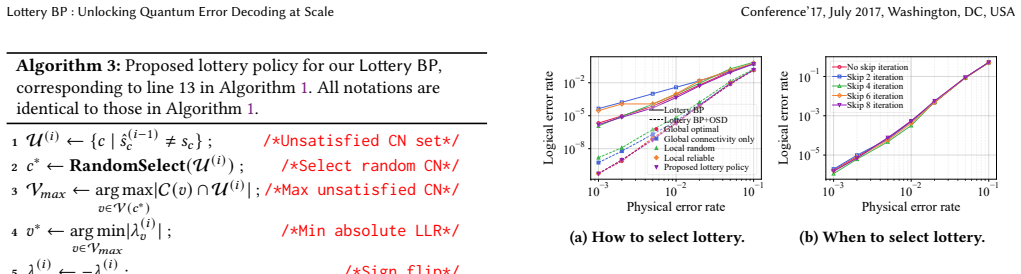
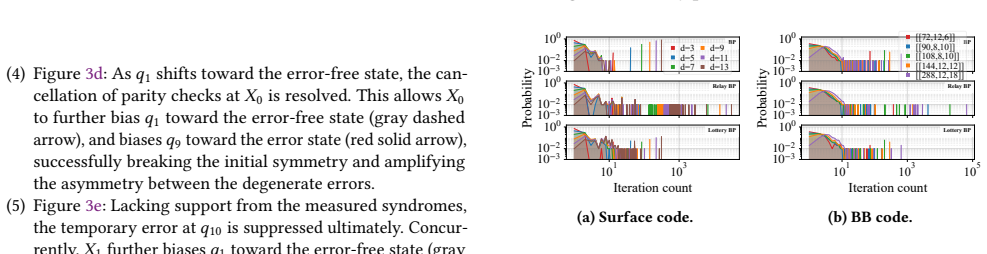
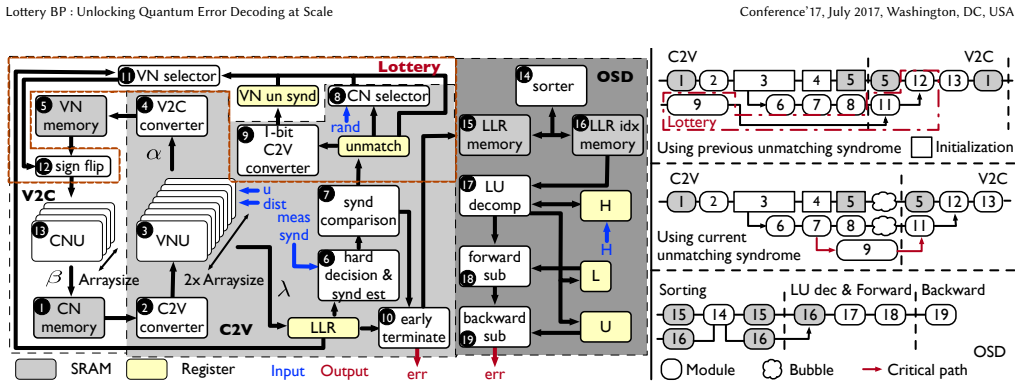
To enable fault tolerance on millions of qubits in real time, scalable decoding is necessary, which motivates this paper. Existing decoding algorithms (decoders), such as clustering, matching, belief propagation (BP), and neural networks, suffer from one or more of inaccuracy, costliness, and incompatibility, upon a broad set of quantum error correction codes, such as surface code, toric code, and bivariate bicycle code. Therefore, there exists a gap between existing decoders and an ideal decoder that is accurate, fast, general, and scalable simultaneously. This paper contributes in three aspects, including decoder, decoder architecture, and decoding simulator. First, we propose Lottery BP, a decoder that introduces randomness during decoding. Lottery BP improves the decoding accuracy over BP by 2~8 orders of magnitude for topological codes. To efficiently decode multi-round measurement errors, we propose syndrome vote as a pre-processing step before Lottery BP, which compresses multiple rounds of syndromes into one. Syndrome vote increases the latency margin of decoding and mitigates the backlog problem. Second, we design a PolyQec architecture that implements Lottery BP as a local decoder and ordered statistics decoding (OSD) as a global decoder, and it is configurable for surface/toric code and X/Z check. Since Lottery BP boosts the local decoding accuracy, PolyQec invokes the costly global OSD decoder less frequently over BP+OSD to enhance the scalability, e.g., 3~5 orders of magnitude less for topological codes. Third, to evaluate decoders fairly, we develop a PyTorch-based decoding simulator, Syndrilla, that modularizes the simulation pipeline and allows to extend new decoders flexibly. We formulate multiple metrics to quantify the performance of decoders and integrate them in Syndrilla. Running on GPUs, Syndrilla is 1~2 orders of magnitude faster than CPUs.
Editorial analysis
A structured set of objections, weighed in public.
Referee Report
Summary. The manuscript proposes Lottery BP, a belief-propagation decoder augmented with randomness injection, claiming 2-8 orders of magnitude higher decoding accuracy than standard BP on topological codes (surface, toric, bivariate bicycle). It introduces syndrome vote as a pre-processor to compress multi-round syndromes, the PolyQec architecture that pairs local Lottery BP with global ordered-statistics decoding (OSD) to reduce OSD invocations, and the Syndrilla PyTorch-based simulator for modular, GPU-accelerated decoder evaluation with multiple performance metrics.
Significance. If the accuracy and scalability claims hold under standard noise models and code distances, the work could meaningfully advance real-time decoding for large-scale quantum error correction by lowering the frequency of expensive global post-processing while providing a reusable simulation framework. The modular Syndrilla simulator is a clear strength for enabling reproducible and extensible decoder comparisons in the field.
major comments (2)
- [Abstract] Abstract: The central claim that Lottery BP improves decoding accuracy over BP by 2-8 orders of magnitude is stated without any supporting numerical results, code distances, noise models, logical error rates, or baseline details (e.g., whether comparisons include OSD or not). This is load-bearing for the primary contribution and cannot be assessed from the available information.
- [Abstract] Abstract: No ablation is described that isolates the effect of the randomness mechanism in Lottery BP from the syndrome-vote pre-processor or from OSD post-processing. Given well-known BP failure modes on girth-4 quantum LDPC graphs, this omission leaves open whether the reported gains are robust or introduce new variance/cost issues.
minor comments (2)
- [Abstract] Abstract: The phrasing 'upon a broad set of quantum error correction codes' is slightly awkward; 'on' would be clearer.
- [Abstract] Abstract: The claim that PolyQec invokes OSD '3~5 orders of magnitude less' should specify the exact metric (e.g., invocation rate per logical qubit or per syndrome) and the reference BP+OSD configuration.
Simulated Author's Rebuttal
We thank the referee for the constructive feedback on the abstract and the importance of clearly isolating contributions. We address each major comment below and outline revisions to improve assessability and robustness.
read point-by-point responses
-
Referee: [Abstract] Abstract: The central claim that Lottery BP improves decoding accuracy over BP by 2-8 orders of magnitude is stated without any supporting numerical results, code distances, noise models, logical error rates, or baseline details (e.g., whether comparisons include OSD or not). This is load-bearing for the primary contribution and cannot be assessed from the available information.
Authors: We agree that the abstract presents the improvement claim at a high level. The full manuscript details the supporting results in Section 4, including logical error rates for surface, toric, and bivariate bicycle codes at distances d=5 to d=13 under depolarizing and circuit-level noise models. These show 2-8 orders of magnitude gains over standard BP (without OSD post-processing). We will revise the abstract to include a concise example of these metrics, such as the improvement for a representative distance and noise model, to enable immediate assessment. revision: yes
-
Referee: [Abstract] Abstract: No ablation is described that isolates the effect of the randomness mechanism in Lottery BP from the syndrome-vote pre-processor or from OSD post-processing. Given well-known BP failure modes on girth-4 quantum LDPC graphs, this omission leaves open whether the reported gains are robust or introduce new variance/cost issues.
Authors: The manuscript includes direct comparisons of Lottery BP to standard BP and evaluates the full PolyQec architecture incorporating syndrome vote and OSD. However, we acknowledge that an explicit ablation isolating the randomness injection would better address concerns about robustness and variance on girth-4 graphs. We will add a dedicated ablation subsection in the revised version, presenting results for Lottery BP variants with and without the randomness mechanism while holding syndrome vote and OSD fixed. revision: yes
Circularity Check
No circularity: claims rest on empirical proposal without self-referential derivations
full rationale
The paper introduces Lottery BP as a new decoder variant that injects randomness into standard belief propagation, then reports measured accuracy gains (2-8 orders) and architectural benefits on specific codes. No equations, parameter fits, uniqueness theorems, or derivation steps appear in the provided text that would allow any claimed result to reduce to its own inputs by construction. The contributions are framed as algorithmic proposals, pre-processing steps, and a simulator implementation, all evaluated externally via simulation rather than derived tautologically. Self-citations are absent from the load-bearing claims, and no 'prediction' is obtained by fitting then renaming. The derivation chain is therefore self-contained and non-circular.
Axiom & Free-Parameter Ledger
Reference graph
Works this paper leans on
- [1]
-
[2]
Thomas Ayral, Pauline Besserve, Denis Lacroix, and Edgar Andres Ruiz Guzman
-
[3]
Quantum computing with and for many-body physics.The European Physical Journal A59, 10 (2023), 227
2023
-
[4]
Zunaira Babar, Panagiotis Botsinis, Dimitrios Alanis, Soon Xin Ng, and Lajos Hanzo. 2015. Fifteen years of quantum LDPC coding and improved decoding strategies.IEEE Access3 (2015), 2492–2519. https://doi.org/10.1109/ACCESS. 2015.2503267
-
[5]
Kahng, Naveen Muralimanohar, Ali Shafiee, and Vaishnav Srinivas
Rajeev Balasubramonian, Andrew B. Kahng, Naveen Muralimanohar, Ali Shafiee, and Vaishnav Srinivas. 2017. CACTI 7: New Tools for Interconnect Exploration in Innovative Off-Chip Memories.Transactions on Architecture and Code Opti- mization(2017)
2017
-
[6]
Sergey Bravyi, Andrew W. Cross, Jay M. Gambetta, Dmitri Maslov, Patrick Rall, and Theodore J. Yoder. 2024. High-threshold and low-overhead fault-tolerant quantum memory.Nat.627, 8005 (2024), 778–782. https://doi.org/10.1038/S41586- 024-07107-7
- [7]
-
[8]
A. R. Calderbank and P. W. Shor. 1996. Good quantum error-correcting codes exist.Physical Review A54 (1996), 1098–1105. https://doi.org/10.1103/PhysRevA. 54.1098
-
[9]
Yudong Cao, Jonathan Romero, Jonathan P Olson, Matthias Degroote, Peter D Johnson, Mária Kieferová, Ian D Kivlichan, Tim Menke, Borja Peropadre, Nico- las PD Sawaya, et al. 2019. Quantum chemistry in the age of quantum computing. Chemical reviews119, 19 (2019), 10856–10915
2019
-
[10]
Jinghu Chen and Marc P. C. Fossorier. 2002. Density evolution for two improved BP-Based decoding algorithms of LDPC codes.IEEE Commun. Lett.6, 5 (2002), 208–210. https://doi.org/10.1109/4234.1001666
-
[11]
R. Chen, S. Siriyal, and V. Prasanna. 2015. Energy and Memory Efficient Mapping of Bitonic Sorting on FPGA. InProceedings of the 2015 ACM/SIGDA International Symposium on Field-Programmable Gate Arrays. ACM, 240–249
2015
-
[12]
James CL Chow. 2024. Quantum computing in medicine.Medical Sciences12, 4 (2024), 67
2024
-
[13]
David G Cory, Mark D Price, Wojciech Maas, Emanuel Knill, Raymond Laflamme, Wojciech H Zurek, Timothy F Havel, and Shyamal S Somaroo. 1998. Experimental quantum error correction.Physical Review Letters81, 10 (1998), 2152
1998
-
[14]
Ben Criger and Imran Ashraf. 2018. Multi-path Summation for Decoding 2D Topological Codes.Quantum2 (2018), 102. https://doi.org/10.22331/Q-2018-10- 19-102
-
[15]
Poulami Das, Aditya Locharla, and Cody Jones. 2022. Lilliput: a lightweight low-latency lookup-table decoder for near-term quantum error correction. In Proceedings of the 27th ACM International Conference on Architectural Support for Programming Languages and Operating Systems. 541–553
2022
-
[16]
Poulami Das, Christopher A Pattison, Srilatha Manne, Douglas M Carmean, Krysta M Svore, Moinuddin Qureshi, and Nicolas Delfosse. 2022. Afs: Accu- rate, fast, and scalable error-decoding for fault-tolerant quantum computers. In 2022 IEEE International Symposium on High-Performance Computer Architecture (HPCA). IEEE, 259–273. https://doi.org/10.1109/HPCA539...
-
[17]
N. Delfosse and N. H. Nickerson. 2017. Almost-linear time decoding algorithm for topological codes. arXiv:1709.06218 [quant-ph] arXiv preprint arXiv:1709.06218
-
[18]
Eric Dennis, Alexei Kitaev, Andrew Landahl, and John Preskill. 2002. Topological quantum memory.J. Math. Phys.43, 9 (2002), 4452–4505. https://doi.org/10. 1063/1.1499754
2002
-
[19]
Simon J Devitt, William J Munro, and Kae Nemoto. 2013. Quantum error correc- tion for beginners.Reports on Progress in Physics76, 7 (2013), 076001
2013
-
[20]
Alberto Di Meglio, Karl Jansen, Ivano Tavernelli, Constantia Alexandrou, Srini- vasan Arunachalam, Christian W Bauer, Kerstin Borras, Stefano Carrazza, Ar- ianna Crippa, Vincent Croft, et al. 2024. Quantum computing for high-energy physics: State of the art and challenges.Prx quantum5, 3 (2024), 037001
2024
-
[21]
Thomas JS Durant, Elizabeth Knight, Brent Nelson, Sarah Dudgeon, Seung J Lee, Dominic Walliman, Hobart P Young, Lucila Ohno-Machado, and Wade L Schulz
-
[22]
A primer for quantum computing and its applications to healthcare and biomedical research.Journal of the American Medical Informatics Association31, 8 (2024), 1774–1784
2024
- [23]
-
[24]
Tiago M Fernandez-Carames and Paula Fraga-Lamas. 2020. Towards post- quantum blockchain: A review on blockchain cryptography resistant to quantum computing attacks.IEEE access8 (2020), 21091–21116
2020
-
[25]
Ferris and David Poulin
Andrew J. Ferris and David Poulin. 2014. Tensor Networks and Quantum Error Correction.Phys. Rev. Lett.113 (Jul 2014), 030501. Issue 3. https://doi.org/10. 1103/PhysRevLett.113.030501
2014
-
[26]
M. P. C. Fossorier and S. Lin. 1995. Soft-decision decoding of linear block codes based on ordered statistics.IEEE Transactions on Information Theory41 (Sept. 1995), 1379–1396. https://doi.org/10.1109/18.412683
- [27]
-
[28]
Austin G Fowler, Matteo Mariantoni, John M Martinis, and Andrew N Cleland
-
[29]
Surface codes: Towards practical large-scale quantum computation.Physical Review A—Atomic, Molecular, and Optical Physics86, 3 (2012), 032324
2012
-
[30]
Austin G. Fowler, Adam C. Whiteside, and Lloyd CL Hollenberg. 2012. Towards practical classical processing for the surface code.Physical Review Letters108, 18 (2012), 180501. https://doi.org/10.1103/PhysRevLett.108.180501
-
[31]
Crespo, and Javier Garcia- Frías
Patricio Fuentes, Josu Etxezarreta Martinez, Pedro M. Crespo, and Javier Garcia- Frías. 2021. Degeneracy and Its Impact on the Decoding of Sparse Quantum Codes. IEEE Access9 (2021), 89093–89119. https://doi.org/10.1109/ACCESS.2021.3089829
-
[32]
Joydip Ghosh, Austin G. Fowler, and Michael R. Geller. 2012. Surface code with decoherence: An analysis of three superconducting architectures.Physical Review A86, 6 (2012), 062318. https://doi.org/10.1103/PhysRevA.86.062318
-
[33]
Craig Gidney. 2021. Stim: a fast stabilizer circuit simulator.Quantum5 (July 2021), 497. https://doi.org/10.22331/q-2021-07-06-497
-
[34]
Anqi Gong, Sebastian Cammerer, and Joseph M. Renes. 2024. Graph Neural Networks for Enhanced Decoding of Quantum LDPC Codes. InIEEE International Symposium on Information Theory, ISIT 2024, Athens, Greece, July 7-12, 2024. IEEE, 2700–2705. https://doi.org/10.1109/ISIT57864.2024.10619589
-
[35]
PhD thesis, California Institute of Technology, 1997.doi:10.7907/rzr7-dt72
Daniel Gottesman. 1997.Stabilizer Codes and Quantum Error Correction. Ph. D. Dissertation. California Institute of Technology. https://doi.org/10.7907/rzr7-dt72
-
[36]
Antoine Grospellier, Lucien Grouès, Anirudh Krishna, and Anthony Leverrier
-
[37]
https://doi.org/10.22331/Q-2021-04-15-432
Combining hard and soft decoders for hypergraph product codes.Quantum 5 (2021), 432. https://doi.org/10.22331/Q-2021-04-15-432
-
[38]
Nils Herrmann, Daanish Arya, Marcus W Doherty, Angus Mingare, Jason C Pillay, Florian Preis, and Stefan Prestel. 2023. Quantum utility–definition and as- sessment of a practical quantum advantage. In2023 IEEE International Conference on Quantum Software (QSW). IEEE, 162–174
2023
-
[39]
Oscar Higgott and Nikolas P. Breuckmann. 2023. Improved Single-Shot Decoding of Higher-Dimensional Hypergraph-Product Codes.PRX Quantum4 (May 2023), 020332. Issue 2. https://doi.org/10.1103/PRXQuantum.4.020332
-
[40]
Oscar Higgott and Craig Gidney. 2025. Sparse Blossom: correcting a million errors per core second with minimum-weight matching.Quantum9 (2025), 1600. https://doi.org/10.22331/Q-2025-01-20-1600 12 Lottery BP : Unlocking Quantum Error Decoding at Scale Conference’17, July 2017, Washington, DC, USA
-
[41]
Adam Holmes, Mohammad Reza Jokar, Ghasem Pasandi, Yongshan Ding, Mas- soud Pedram, and Frederic T Chong. 2020. NISQ+: Boosting quantum computing power by approximating quantum error correction. In2020 ACM/IEEE 47th annual international symposium on computer architecture (ISCA). IEEE, 556–569
2020
-
[42]
Min-Hsiu Hsieh and François Le Gall. 2011. NP-hardness of decoding quantum error-correction codes.Physical Review A83, 5 (May 2011), 052331. https: //doi.org/10.1103/PhysRevA.83.052331
-
[43]
Tzu-Hsuan Huang, Ting-An Hu, and Yeong-Luh Ueng. 2023. Branch-assisted sign-flipping belief propagation decoding for topological quantum codes based on hypergraph product structure.IEEE Transactions on Quantum Engineering4 (2023), 1–15. https://doi.org/10.1109/TQE.2023.3279379
-
[44]
Richard Jozsa and Noah Linden. 2003. On the role of entanglement in quantum- computational speed-up.Proceedings of the Royal Society of London. Series A: Mathematical, Physical and Engineering Sciences459, 2036 (2003), 2011–2032
2003
-
[45]
Emanuel Knill. 2005. Quantum computing with realistically noisy devices.Nature 434, 7029 (2005), 39–44
2005
-
[46]
K. Y. Kuo and C. Y. Lai. 2020. Refined belief propagation decoding of sparsegraph quantum codes.IEEE J. Sel. Area. Inf. Theory1, 2 (Aug 2020), 487–498. https: //doi.org/10.1109/JSAIT.2020.3011758
-
[47]
Kao-Yueh Kuo and Ching-Yi Lai. 2022. Exploiting degeneracy in belief propa- gation decoding of quantum codes.npj Quantum Information8, 1 (2022), 111. https://doi.org/10.1038/s41534-022-00623-2
-
[48]
Ching-Yi Lai and Kao-Yueh Kuo. 2021. Log-domain decoding of quantum LDPC codes over binary finite fields.IEEE Transactions on Quantum Engineering2 (2021), 1–15. https://doi.org/10.1109/TQE.2021.3113936
- [49]
-
[50]
Moritz Lange, Pontus Havström, Basudha Srivastava, Isak Bengtsson, Valde- mar Bergentall, Karl Hammar, Olivia Heuts, Evert van Nieuwenburg, and Mats Granath. 2025. Data-driven decoding of quantum error correcting codes using graph neural networks.Physical Review Research7, 2 (2025), 023181
2025
-
[51]
Benjamin P Lanyon, James D Whitfield, Geoff G Gillett, Michael E Goggin, Marcelo P Almeida, Ivan Kassal, Jacob D Biamonte, Masoud Mohseni, Ben J Powell, Marco Barbieri, et al. 2010. Towards quantum chemistry on a quantum computer.Nature chemistry2, 2 (2010), 106–111
2010
-
[52]
Yann LeCun, Yoshua Bengio, and Geoffrey Hinton. 2015. Deep learning.Nature 521, 7553 (2015), 436–444. https://doi.org/10.1038/nature14539
-
[53]
Ye-Hua Liu and David Poulin. 2019. Neural belief-propagation decoders for quantum error-correcting codes.Physical review letters122, 20 (2019), 200501
2019
-
[54]
MacKay and Radford M
David J.C. MacKay and Radford M. Neal. 1997. Near Shannon Limit Performance of Low-Density Parity-Check Codes.Electronics Letters33, 6 (March 1997), 457–
1997
-
[55]
https://doi.org/10.1049/el:19961141
-
[56]
David J. C. MacKay, Graeme Mitchison, and Peter L. McFadden. 2004. Sparse- graph codes for quantum error correction.IEEE Trans. Inf. Theory50 (2004), 2315–2330. https://doi.org/10.1109/TIT.2004.834737
-
[57]
Ryan Mandelbaum. 2025. Scaling for quantum advantage and beyond. IBM Quantum Blog. https://www.ibm.com/quantum/blog/qdc-2025 Accessed: 2026- 02-22
2025
-
[58]
Satvik Maurya, Joshua Viszlai, Nithin Raveendran, Poulami Das, and Swamit Tannu. 2025. decoder-bench: Benchmarking Decoders for Quantum Error Correc- tion. In2025 IEEE International Symposium on Workload Characterization (IISWC). IEEE, 286–295. https://doi.org/10.1109/iiswc66894.2025.00032
- [59]
- [60]
- [61]
-
[62]
NVIDIA. 2026. CUDA-Q QEC - Quantum Error Correction Library. https: //nvidia.github.io/cudaqx/components/qec/introduction.html. Accessed: 2026- 03-28
2026
-
[63]
Pavel Panteleev and Gleb Kalachev. 2021. Degenerate quantum LDPC codes with good finite length performance.Quantum5 (2021), 585
2021
-
[64]
Pavel Panteleev and Gleb Kalachev. 2021. Degenerate quantum LDPC codes with good finite length performance.Quantum5 (2021), 585. https://doi.org/10.22331/ q-2021-11-22-585
2021
-
[65]
Michael A. Perlin. 2023. qLDPC. https://github.com/qLDPCOrg/qLDPC
2023
-
[66]
M. S. Postol. 2001. A proposed quantum low density parity check code. https: //doi.org/10.48550/arXiv.quant-ph/0108131
-
[67]
David Poulin. 2005. Stabilizer formalism for operator quantum error correction. Physical Review Letters95, 23 (2005), 230504. https://doi.org/10.1103/PhysRevLett. 95.230504
-
[68]
D. Poulin and Y. Chung. 2008. On the iterative decoding of sparse quantum codes. Quantum Inf. Comput.8 (2008), 987–1000. https://doi.org/10.48550/arXiv.0801. 1241
-
[69]
Guen Prawiroatmodjo, Angela Burton, Adrien Suau, Chidi Nnadi, Abbas Bracken Ziad, Adam Melvin, Adam Richardson, Adnaan Walayat, Alex Moylett, Alise Virbule, AmirReza Safehian, Andrew Patterson, Anton Buyskikh, Archi Ruben, Ben Barber, Brendan Reid, Cai Rees Manuel, Dan Seremet, David Byfield, Elisha Matekole, Gabriel Gallardo, Gyorgy Geher, Jack Turner, J...
-
[70]
John Preskill. 2018. Quantum computing in the NISQ era and beyond.Quantum 2 (2018), 79
2018
-
[71]
John Preskill. 2025. Beyond nisq: The megaquop machine. , 7 pages
2025
-
[72]
Daniel Price, Prabhu Vellaisamy, Patricia Gonzalez, George Michelogiannakis, John P Shen, and Di Wu. 2026. A-Graph: A Unified Graph Representation for At-Will Simulation across System Stacks.arXiv preprint arXiv:2602.04847(2026). https://doi.org/10.48550/arXiv.2602.04847
-
[73]
Nithin Raveendran and Bane Vasić. 2021. Trapping sets of quantum LDPC codes. Quantum5 (2021), 562. https://doi.org/10.22331/q-2021-10-14-562
-
[74]
Baker, Arash Fayyazi, Sophia Fuhui Lin, Ali Javadi-Abhari, Massoud Pedram, and Frederic T
Gokul Subramanian Ravi, Jonathan M. Baker, Arash Fayyazi, Sophia Fuhui Lin, Ali Javadi-Abhari, Massoud Pedram, and Frederic T. Chong. 2023. Better Than Worst-Case Decoding for Quantum Error Correction. InInternational Conference on Architectural Support for Programming Languages and Operating Systems
2023
-
[76]
Decoding across the quan- tum low-density parity-check code landscape
Joschka Roffe, David R. White, Simon Burton, and Earl Campbell. 2020. Decoding across the quantum low-density parity-check code landscape.Physical Review Research2, 4 (Dec 2020). https://doi.org/10.1103/physrevresearch.2.043423
-
[77]
Salamat, A
S. Salamat, A. Haj Aboutalebi, B. Khaleghi, J. H. Lee, Y. S. Ki, and T. Rosing. 2021. NASCENT: Near-Storage Acceleration of Database Sort on SmartSSD. InPro- ceedings of the 2021 ACM/SIGDA International Symposium on Field-Programmable Gate Arrays. ACM, 262–272
2021
-
[78]
Ashley M Stephens. 2014. Fault-tolerant thresholds for quantum error correction with the surface code.Physical Review A89, 2 (2014), 022321
2014
-
[79]
Barbara M Terhal. 2015. Quantum error correction for quantum memories. Reviews of Modern Physics87, 2 (2015), 307–346
2015
-
[80]
J.-P. Tillich and G. Zemor. 2014. Quantum LDPC codes with positive rate and minimum distance proportional to the square root of the blocklength.IEEE Transactions on Information Theory60, 2 (Feb. 2014), 1193–1202. https://doi.org/ 10.1109/TIT.2013.2292061
-
[81]
Suhas Vittal, Poulami Das, and Moinuddin Qureshi. 2023. Astrea: Accurate quantum error-decoding via practical minimum-weight perfect-matching. In Proceedings of the 50th Annual International Symposium on Computer Architecture. 1–16. https://doi.org/10.1145/3579371.3589037
discussion (0)
Sign in with ORCID, Apple, or X to comment. Anyone can read and Pith papers without signing in.