Recognition: unknown
EPITIME: A Computational Framework for Integral Epidemic Models with Structure-Preserving Discretizations
Pith reviewed 2026-05-09 20:29 UTC · model grok-4.3
The pith
EPITIME framework uses non-standard discretizations to simulate integral epidemic models while preserving positivity, boundedness, and long-term behavior for any time step.
A machine-rendered reading of the paper's core claim, the machinery that carries it, and where it could break.
Core claim
The EPITIME framework applies non-standard finite difference discretizations to age-of-infection and information-dependent integral epidemic models, ensuring that the numerical solutions retain positivity, boundedness, invariant regions, and the correct long-term asymptotic behavior independently of the chosen time step, while achieving first-order convergence.
What carries the argument
Non-standard finite difference discretizations that enforce the qualitative properties of the continuous integral models.
If this is right
- Numerical solutions stay non-negative and bounded no matter how large the time step becomes.
- Long-term behavior of the discrete models matches that of the continuous equations.
- The framework supports inverse reconstruction of infectivity kernels directly from incidence data.
- Behavioral dynamics can be examined under varying memory kernels without numerical artifacts.
Where Pith is reading between the lines
- Larger time steps become viable in practice, which could reduce computational cost for long-horizon epidemic forecasts.
- The modular code structure might allow straightforward coupling with stochastic or spatial extensions of the same models.
- Similar preservation techniques could apply to other renewal-type equations arising in ecology or population dynamics.
Load-bearing premise
The non-standard finite difference schemes preserve positivity, boundedness, invariant regions, and correct asymptotics for arbitrary time steps in the age-of-infection and information-dependent models.
What would settle it
A single numerical run of the discretized age-of-infection model that yields a negative value or leaves the invariant region when a large time step is used.
Figures




read the original abstract
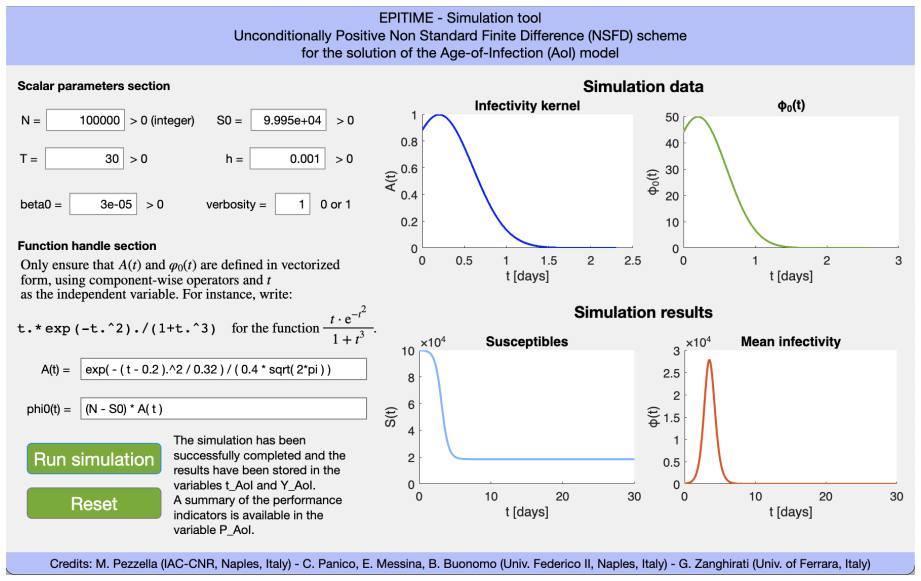
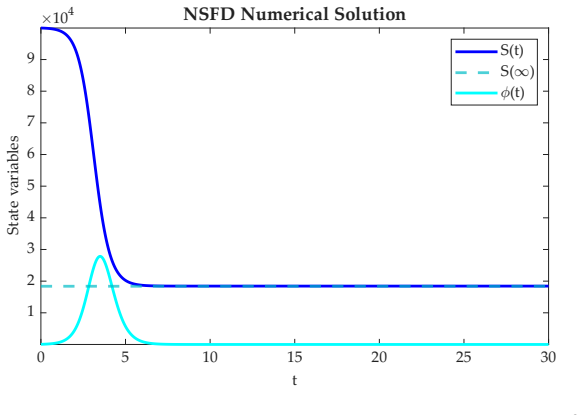
We present EPITIME (EPidemic Integral models TIMe profile Explorer), a computational framework for the simulation of two classes of integral epidemic models: an age of infection model and an information dependent behavioural model. The framework combines structure preserving Non-Standard Finite Difference discretizations with modular implementations in MATLAB and Python, together with routines for parameter handling, input validation, performance assessment, and graphical interaction. The proposed methods preserve key qualitative properties of the continuous problems, including positivity, boundedness, invariant regions, and correct long term behaviour, independently of the time step. We outline the numerical schemes for both model classes and their main analytical properties, including first order convergence. We then describe the software architecture and illustrate its use through numerical experiments on asymptotic behaviour, inverse reconstruction of an infectivity kernel from COVID 19 incidence data, and behavioural dynamics under different memory kernels. Overall, EPITIME provides a reliable and accessible computational environment for the numerical study of renewal epidemic models.
Editorial analysis
A structured set of objections, weighed in public.
Referee Report
Summary. The manuscript introduces EPITIME, a computational framework for simulating two classes of integral epidemic models (age-of-infection renewal equations and information-dependent behavioral models) via non-standard finite difference (NSFD) discretizations. It asserts that these schemes preserve positivity, boundedness, invariant regions, and correct long-term asymptotics independently of the time step size, with first-order convergence, and provides modular MATLAB/Python implementations together with examples on asymptotic behavior, infectivity kernel reconstruction from COVID-19 incidence data, and behavioral dynamics under different memory kernels.
Significance. If the claimed structure-preserving properties can be rigorously established, the framework would offer a practical and reliable environment for studying renewal-type epidemic models without artificial time-step restrictions, supporting long-term simulations and data-driven analyses in mathematical epidemiology. The open implementations and concrete numerical demonstrations enhance accessibility and reproducibility.
major comments (2)
- [Abstract] Abstract: The headline claim that the NSFD schemes preserve positivity, boundedness, invariant regions, and correct long-term behaviour independently of the time step is asserted without supporting derivations. The outline of the discretizations for the convolution terms with infectivity and memory kernels is sketched, but no explicit discrete comparison argument, Lyapunov function, or positivity proof is supplied that rules out sign changes or overshoot for arbitrary Δt > 0 and non-monotone kernels. This is load-bearing for the central contribution.
- [Numerical schemes section] Numerical schemes and convergence statements: First-order convergence is stated but no truncation-error analysis, consistency proof for the integral operators, or numerical verification (e.g., observed order tables across Δt values) is provided to substantiate the rate.
minor comments (1)
- The software-architecture description would benefit from explicit pseudocode or flow diagrams for the input-validation and performance-assessment routines to improve usability and reproducibility.
Simulated Author's Rebuttal
We thank the referee for their thorough review and valuable suggestions. We agree that additional details are needed to rigorously support the central claims regarding the structure-preserving properties and convergence of the NSFD schemes. Below, we provide point-by-point responses and indicate the revisions we will make to the manuscript.
read point-by-point responses
-
Referee: [Abstract] Abstract: The headline claim that the NSFD schemes preserve positivity, boundedness, invariant regions, and correct long-term behaviour independently of the time step is asserted without supporting derivations. The outline of the discretizations for the convolution terms with infectivity and memory kernels is sketched, but no explicit discrete comparison argument, Lyapunov function, or positivity proof is supplied that rules out sign changes or overshoot for arbitrary Δt > 0 and non-monotone kernels. This is load-bearing for the central contribution.
Authors: We acknowledge this point and recognize that the manuscript currently outlines the schemes and states the preservation properties without providing the full supporting derivations. In the revised version, we will expand the relevant sections to include explicit proofs. Specifically, we will present a discrete comparison argument for positivity and boundedness that holds for arbitrary time steps Δt > 0. For the convolution integrals with possibly non-monotone kernels, we will derive the preservation of invariant regions using a suitable discrete Lyapunov function approach. We will also demonstrate the correct long-term asymptotics by showing that the discrete equilibria match the continuous ones and are attractive independently of Δt. These additions will directly address the load-bearing claims in the abstract. revision: yes
-
Referee: [Numerical schemes section] Numerical schemes and convergence statements: First-order convergence is stated but no truncation-error analysis, consistency proof for the integral operators, or numerical verification (e.g., observed order tables across Δt values) is provided to substantiate the rate.
Authors: We agree that the convergence rate requires more substantiation. We will add a truncation-error analysis in the Numerical schemes section, including a consistency proof for the discretized integral operators based on the NSFD approach. Furthermore, we will include numerical verification through tables of observed convergence orders computed across a range of Δt values for both model classes and various kernel functions. This will confirm the first-order accuracy and provide empirical support for the theoretical claims. revision: yes
Circularity Check
No circularity: framework applies standard NSFD to integral models without self-referential reduction
full rationale
The manuscript describes a software framework that implements Non-Standard Finite Difference schemes for two classes of integral epidemic models (age-of-infection renewal and information-dependent behavioural). It states that the discretizations preserve positivity, boundedness, invariant regions and long-term behaviour independently of the time step, and reports first-order convergence. These properties are presented as consequences of the chosen NSFD rules applied to the continuous models; no derivation reduces a claimed prediction to a fitted parameter, a self-defined quantity, or a load-bearing self-citation whose validity is presupposed by the present work. The paper cites prior NSFD literature as external foundation rather than invoking an internal uniqueness theorem or ansatz that would collapse the argument. The central contribution is therefore the modular implementation and numerical illustration, not a closed logical loop.
Axiom & Free-Parameter Ledger
Reference graph
Works this paper leans on
-
[1]
Brauer, C
F. Brauer, C. Castillo-Chavez, and Z. Feng.Mathematical Models in Epidemiology. Springer New York, 2019
2019
-
[2]
Springer, New York, 2015
Maia Martcheva.An Introduction to Mathematical Epidemiology, volume 61 ofTexts in Applied Mathematics. Springer, New York, 2015
2015
-
[3]
W. O. Kermack and A. G. McKendrick. A contribution to the mathematical theory of epidemics. Proceedings of the Royal Society of London. Series A, Containing Papers of a Mathematical and Physical Character, 115(772):700–721, 1927
1927
-
[4]
Breda, O
D. Breda, O. Diekmann, W. F. de Graaf, A. Pugliese, and R. Vermiglio. On the formulation of epidemic models (an appraisal of Kermack and McKendrick).Journal of Biological Dynamics, 6:103–117, 2012
2012
-
[5]
Diekmann, M
O. Diekmann, M. Gyllenberg, and J. A. J. Metz. Finite Dimensional State Representation of Linear and Nonlinear Delay Systems.Journal of Dynamics and Differential Equations, 30(4):1439–1467, 2018
2018
-
[6]
Odo Diekmann, Hisashi Inaba, and Horst R. Thieme. Mathematical epidemiology of infectious diseases: an ongoing challenge.Japan Journal of Industrial and Applied Mathematics, 2025
2025
-
[7]
Springer, New York, NY, 2013
Piero Manfredi and Alberto d’Onofrio, editors.Modeling the Interplay Between Human Behavior and the Spread of Infectious Diseases. Springer, New York, NY, 2013
2013
-
[8]
Z. Bai. Global dynamics of a SEIR model with information dependent vaccination and periodically varying transmission rate.Mathematical Methods in the Applied Sciences, 38(11):2403–2410, 2014
2014
-
[9]
An integral renewal equation approach to behavioural epidemic models with information index.Journal of Mathematical Biology, 90(8), 2025
Bruno Buonomo, Eleonora Messina, Claudia Panico, and Antonia Vecchio. An integral renewal equation approach to behavioural epidemic models with information index.Journal of Mathematical Biology, 90(8), 2025
2025
-
[10]
Buonomo, E
B. Buonomo, E. Messina, and C. Panico. Minimal epidemic models with information index: from compartmental to integral formulation.Bollettino dell’Unione Matematica Italiana, 2025
2025
-
[11]
Information–related changes in contact patterns may trig- ger oscillations in the endemic prevalence of infectious diseases.Journal of Theoretical Biology, 256(3):473–478, 2009
Alberto d’Onofrio and Piero Manfredi. Information–related changes in contact patterns may trig- ger oscillations in the endemic prevalence of infectious diseases.Journal of Theoretical Biology, 256(3):473–478, 2009
2009
-
[12]
Mickens.Nonstandard Finite Difference Schemes: Methodology And Applications
Ronald E. Mickens.Nonstandard Finite Difference Schemes: Methodology And Applications. World Scientific, 2020
2020
-
[13]
A non-standard numerical scheme for an age-of-infection epidemic model.Journal of Computational Dynamics, 9(2):239–252, 2022
Eleonora Messina, Mario Pezzella, and Antonia Vecchio. A non-standard numerical scheme for an age-of-infection epidemic model.Journal of Computational Dynamics, 9(2):239–252, 2022
2022
-
[14]
Lubuma and Yibeltal A
Jean M.-S. Lubuma and Yibeltal A. Terefe. A nonstandard volterra difference equation for the sis epidemiological model.Revista de la Real Academia de Ciencias Exactas, Físicas y Naturales. Serie A. Matemáticas, 109(2):597–602, 2014. 22
2014
-
[15]
Software.https://cdlab.uniud.it/software
CDLab – Computational Dynamics Laboratory. Software.https://cdlab.uniud.it/software. Department of Mathematics, Computer Science and Physics, University of Udine. Accessed: 2026- 03-23
2026
-
[16]
Diekmann and H
O. Diekmann and H. Inaba. A systematic procedure for incorporating separable static heterogeneity into compartmental epidemic models.Journal of Mathematical Biology, 86(2):29, 2023
2023
-
[17]
F. Bai. An age-of-infection model with both symptomatic and asymptomatic infections.Journal of Mathematical Biology, 86(5), 2023
2023
-
[18]
Brauer and J
F. Brauer and J. Watmough. Age of infection epidemic models with heterogeneous mixing.Journal of Biological Dynamics, 3(2):324–330, 2009
2009
-
[19]
A long-time behavior preserving numer- ical scheme for age-of-infection epidemic models with heterogeneous mixing.Applied Numerical Mathematics, 200:344–357, 2024
Eleonora Messina, Mario Pezzella, and Antonia Vecchio. A long-time behavior preserving numer- ical scheme for age-of-infection epidemic models with heterogeneous mixing.Applied Numerical Mathematics, 200:344–357, 2024. New Trends in Approximation Methods and Numerical Analysis (FAATNA20>22)
2024
-
[20]
Nonlocal finite difference discretization of a class of renewal equation models for epidemics.Mathematical Biosciences and Engineering, 20(7):11656–11675, 2023
Eleonora Messina, Mario Pezzella, and Antonia Vecchio. Nonlocal finite difference discretization of a class of renewal equation models for epidemics.Mathematical Biosciences and Engineering, 20(7):11656–11675, 2023
2023
-
[21]
F. Brauer. Age-of-infection and the final size relation.Mathematical Biosciences and Engineering, 5:681, 2008
2008
-
[22]
High order positivity-preserving numerical methods for a non-local photochemical model.ESAIM: M2AN, 59(3):1763–1790, 2025
Mario Pezzella. High order positivity-preserving numerical methods for a non-local photochemical model.ESAIM: M2AN, 59(3):1763–1790, 2025
2025
-
[23]
Buonomo, E
B. Buonomo, E. Messina, C. Panico, and A. Vecchio. A stable numerical method for integral epidemic models with behavioral changes in contact patterns.Electronic Transactions on Numerical Analysis, 61:137–156, 2024
2024
-
[24]
Yihong Song and Christopher T. H. Baker. Perturbation theory for discrete Volterra equations. Journal of Difference Equations and Applications, 9(10):969–987, 2003
2003
-
[25]
F. Brauer. The Kermack–McKendrick epidemic model revisited.Mathematical Biosciences, 198(2):119–131, 2005
2005
-
[26]
Davis and Philip Rabinowitz.Methods of Numerical Integration
Philip J. Davis and Philip Rabinowitz.Methods of Numerical Integration. Computer Science and Applied Mathematics. Academic Press (Elsevier), New York, NY, USA, 2nd edition, 1984
1984
-
[27]
Messina, M
E. Messina, M. Pezzella, and A. Vecchio. Asymptotic solutions of non-linear implicit Volterra discrete equations.Journal of Computational and Applied Mathematics, 425:115068, 2023
2023
-
[28]
Frank P. Pijpers. A non-parametric method for determining epidemiological reproduction numbers. Journal of Mathematical Biology, 82(5), 2021
2021
-
[29]
Integral model of COVID-19 spread and mitigation in uk: Identification of transmission rate.Mathematical Modelling and Analysis, 27(4):573–589, 2022
Natali Hritonenko, Caroline Satsky, and Yuri Yatsenko. Integral model of COVID-19 spread and mitigation in uk: Identification of transmission rate.Mathematical Modelling and Analysis, 27(4):573–589, 2022
2022
-
[30]
Sparse identification of delay equations with distributed memory, 2025
Dimitri Breda, Muhammad Tanveer, and Jianhong Wu. Sparse identification of delay equations with distributed memory, 2025
2025
-
[31]
Coronavirus italia – dati di incidenza.https://lab24.ilsole24ore.com/ coronavirus, 2025
Il Sole 24 Ore. Coronavirus italia – dati di incidenza.https://lab24.ilsole24ore.com/ coronavirus, 2025. Accessed: 30 August 2025
2025
-
[32]
Population on 1 january.https://ec.europa.eu/eurostat/databrowser/view/ tps00001/, 2025
Eurostat. Population on 1 january.https://ec.europa.eu/eurostat/databrowser/view/ tps00001/, 2025. Dataset code TPS00001. Accessed: 23 December 2025
2025
-
[33]
G. G. Lorentz.Bernstein Polynomials. Chelsea Publishing Company, 1986
1986
-
[34]
G. K. Aldis and M. G. Roberts. An integral equation model for the control of a smallpox outbreak. Mathematical Biosciences, 195(1):1–22, 2005. 23
2005
-
[35]
Vaccinating behaviour, information, and the dynamics of SIR vaccine preventable diseases.Theoretical Population Biology, 71(3):301–317, 2007
Alberto D’Onofrio, Piero Manfredi, and Ernesto Salinelli. Vaccinating behaviour, information, and the dynamics of SIR vaccine preventable diseases.Theoretical Population Biology, 71(3):301–317, 2007
2007
-
[36]
Oscillations and hysteresis in an epidemic model with information-dependent imperfect vaccination.Mathematics and Computers in Simulation, 162:97– 114, 2019
Bruno Buonomo and Rossella Della Marca. Oscillations and hysteresis in an epidemic model with information-dependent imperfect vaccination.Mathematics and Computers in Simulation, 162:97– 114, 2019
2019
-
[37]
Bauch, Samit Bhattacharyya, Alberto D’Onofrio, Piero Manfredi, Matjaž Perc, Nicola Perra, Marcel Salathé, and Dawei Zhao
Zhi Wang, Chris T. Bauch, Samit Bhattacharyya, Alberto D’Onofrio, Piero Manfredi, Matjaž Perc, Nicola Perra, Marcel Salathé, and Dawei Zhao. Statistical physics of vaccination.Physics Reports, 664:1–113, 2016. 24
2016
discussion (0)
Sign in with ORCID, Apple, or X to comment. Anyone can read and Pith papers without signing in.