Recognition: unknown
The LISA Astrophysics MBHcatalogues Project: A comparison of predictions of simulated massive black hole binaries
Pith reviewed 2026-05-09 20:51 UTC · model grok-4.3
The pith
LISA merger rates for massive black holes differ substantially across galaxy formation models based on seeding and simulation resolution.
A machine-rendered reading of the paper's core claim, the machinery that carries it, and where it could break.
Core claim
The project compares various theoretical predictions of massive black hole merger rates from about 20 semi-analytical models and cosmological simulations, quantifies the spread among them, and evaluates the astrophysical uncertainties affecting LISA event rates. Delays from the dynamical hardening phase of black hole binaries are incorporated into the rate calculations. The expected LISA merger rates are presented, with emphasis on their dependence on assumptions such as the black hole seeding model and the resolution of the cosmological simulations.
What carries the argument
Ensemble of ~20 models of galaxy and black hole evolution with post-merger dynamical delays added to compute coalescence rates for LISA.
If this is right
- Merger rates in the LISA band are sensitive to the choice of massive black hole seeding mechanism.
- Higher-resolution simulations produce different merger rate predictions than lower-resolution ones.
- Accounting for the time required for black hole pairs to harden and coalesce lowers the predicted rates.
- The range of rates across models indicates the level of uncertainty in LISA forecasts from current astrophysics.
Where Pith is reading between the lines
- The large spread suggests that LISA observations could help discriminate among seeding models if the rates can be measured accurately.
- Future improvements in modeling dynamical friction and stellar interactions could reduce the uncertainties in these predictions.
- Connecting these rate predictions to the observed population of massive black holes in local galaxies could provide additional tests.
Load-bearing premise
That the selected set of about twenty models adequately represents the range of possible outcomes from uncertainties in black hole formation and galaxy evolution.
What would settle it
A measured LISA merger rate for massive black holes that lies well outside the range covered by all the models in the comparison would indicate that the models do not fully capture the relevant astrophysics.
Figures







read the original abstract
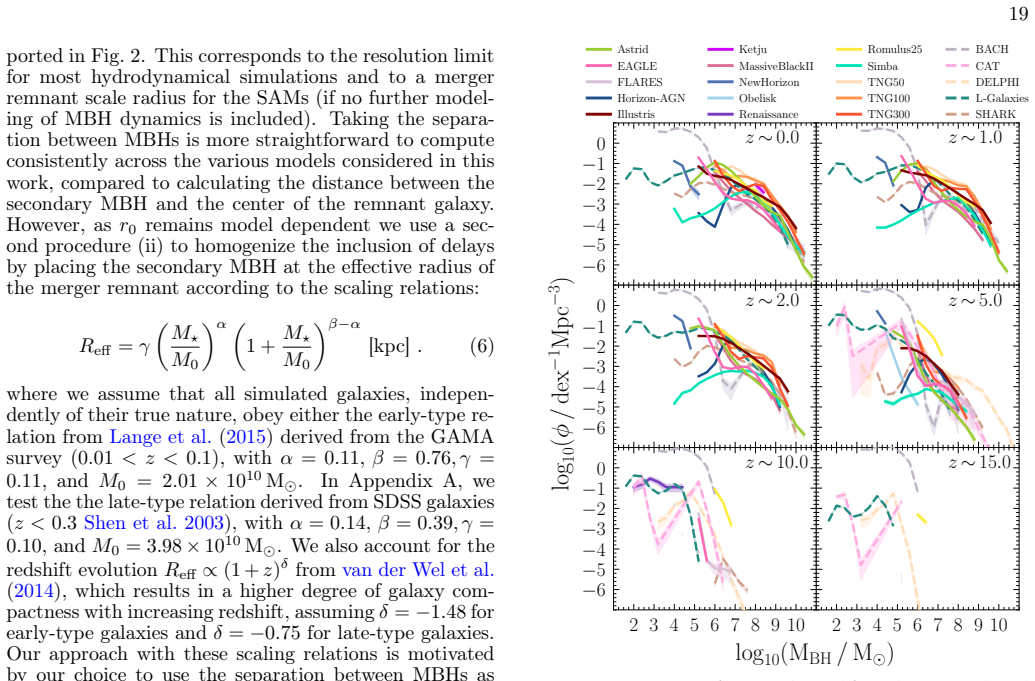
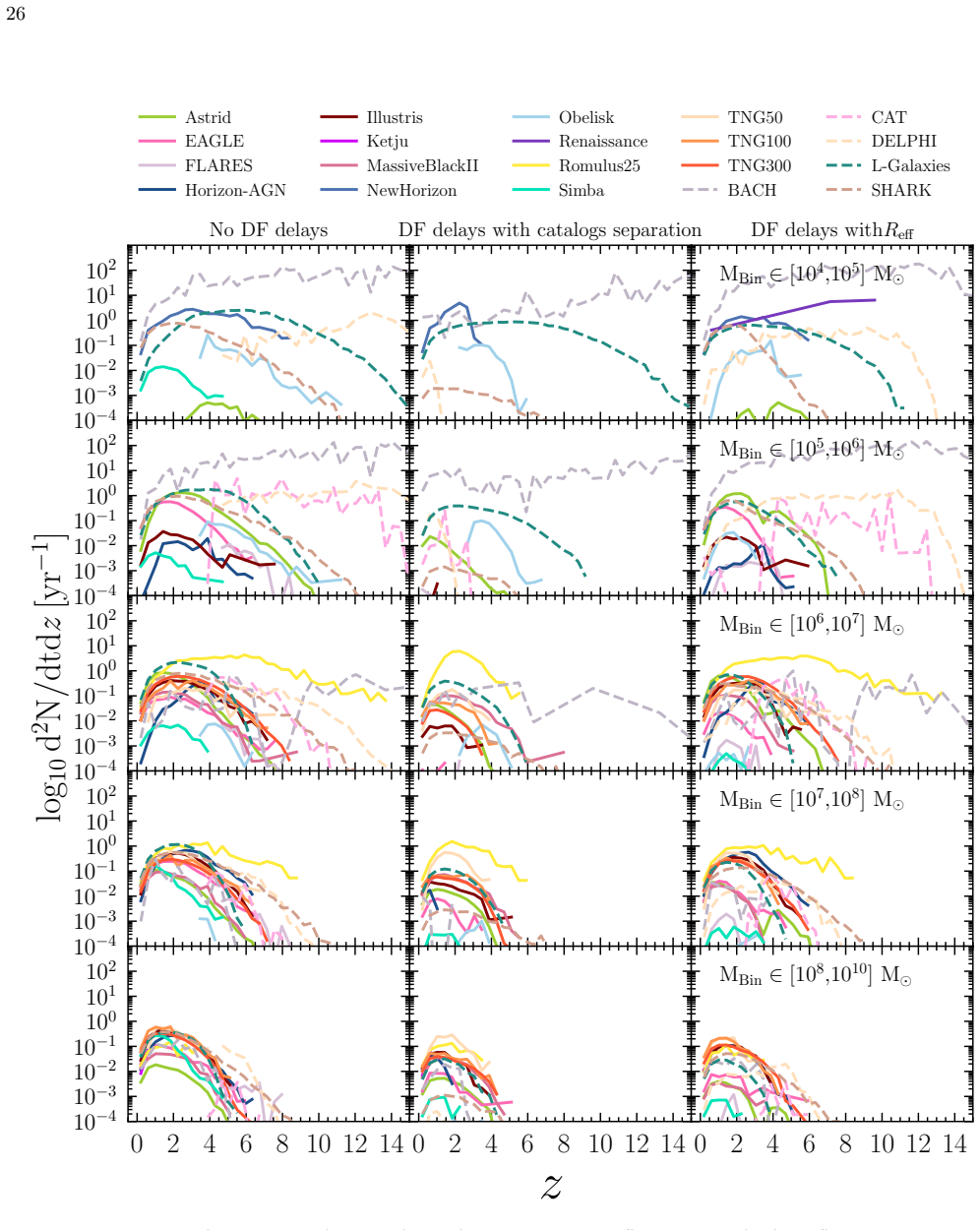
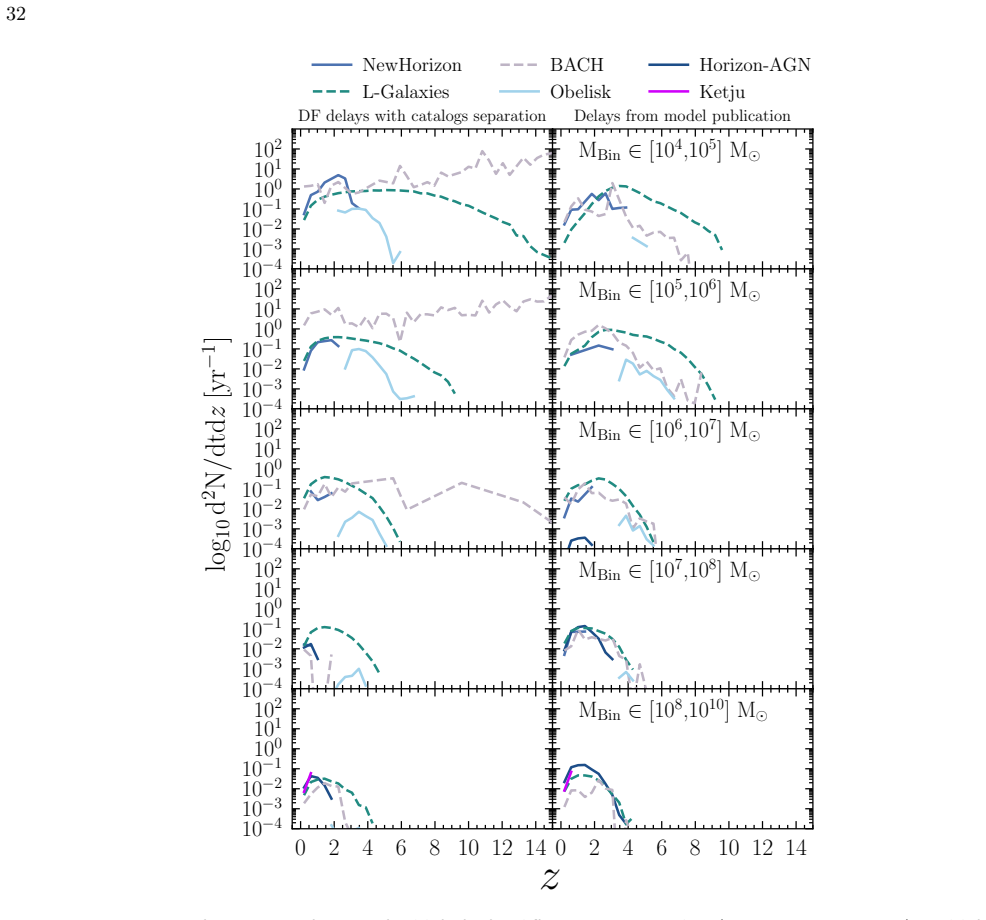
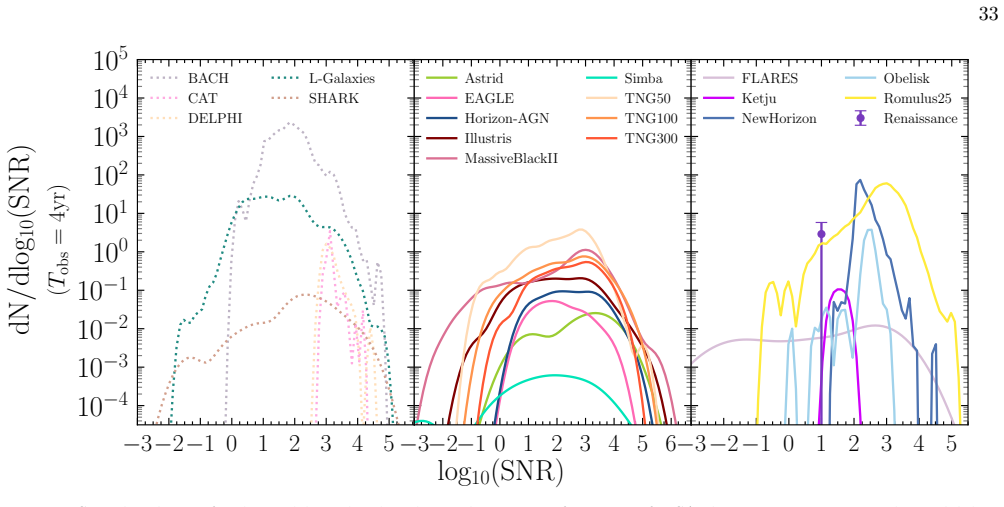
In the hierarchical paradigm of galaxy formation, central massive black holes (MBHs) are expected to coalesce after the merger of their host galaxies. One of the main goals of the Laser Interferometer Space Antenna (LISA) is to constrain the origin and growth of MBHs through their merger rates and mass distribution. Predicting MBH merger rates requires not only tracing their statistical population from large to small physical scales (kpc to sub-pc) but also modelling their formation, accretion, dynamics, mergers, and their galactic physical processes across cosmic time. This project is the result of a large collaborative effort undertaken by the LISA Astrophysics Working Group, bringing together its collective expertise on MBH formation, evolution, and modelling, to build a comprehensive understanding of MBH merger rates across cosmic time. The project compares various theoretical predictions of MBH merger rates, quantifies the spread, and evaluates the global astrophysical uncertainties of the LISA event rates. To build a unique and complete view, our work is based on about 20 semi-analytical models and cosmological simulations from the literature, all employing distinct approaches to modelling MBH and galaxy physics. To compute the merger rates, we also incorporate delays arising from the dynamical phase of MBH hardening to coalescence. We present the expected LISA merger rates given current galaxy formation models and discuss how the merger rate depends on model assumptions, such as the seeding model and the resolution of cosmological simulations.
Editorial analysis
A structured set of objections, weighed in public.
Referee Report
Summary. The paper compares MBH binary merger rate predictions for LISA from ~20 semi-analytical models and cosmological simulations drawn from the literature. It incorporates dynamical delays from the hardening phase and quantifies the spread in rates arising from differences in seeding, growth, and resolution assumptions.
Significance. If the models can be shown to share a consistent treatment of dynamical delays, the work would provide a useful community benchmark for the range of LISA event rates under current galaxy-formation models, directly supporting mission science planning and interpretation of future detections.
major comments (2)
- [Abstract and methods description of delays] The abstract states that dynamical delays are incorporated across the models, yet no table, figure, or dedicated subsection quantifies the adopted hardening timescales, prescriptions (analytic vs. N-body), or reference formulas used in each of the ~20 models. Without this, the reported spread cannot be cleanly attributed to astrophysical uncertainties rather than methodological differences in the final-parsec phase.
- [Discussion of model assumptions and rate dependence] The central claim that the collection of models 'sufficiently spans the full range of astrophysical uncertainties' rests on the assumption of uniform delay treatment; a direct test (e.g., recomputing a subset of rates with a common delay formula) is needed to confirm that the variance is not inflated by inconsistent dynamical modeling.
minor comments (1)
- [Introduction] Clarify in the introduction whether any models omit delays entirely or rescale them, and provide a reference list or table mapping each model to its source publication and key physics choices.
Simulated Author's Rebuttal
We thank the referee for their thoughtful review and constructive suggestions. We address the major comments point by point below and have revised the manuscript accordingly to improve the description of dynamical delays and clarify the scope of our uncertainty quantification.
read point-by-point responses
-
Referee: [Abstract and methods description of delays] The abstract states that dynamical delays are incorporated across the models, yet no table, figure, or dedicated subsection quantifies the adopted hardening timescales, prescriptions (analytic vs. N-body), or reference formulas used in each of the ~20 models. Without this, the reported spread cannot be cleanly attributed to astrophysical uncertainties rather than methodological differences in the final-parsec phase.
Authors: We agree with the referee that a more detailed description of the dynamical delay prescriptions is necessary to properly interpret the spread in merger rates. In the revised manuscript, we have added a dedicated subsection in Section 2 (Methods) that describes how delays are incorporated, and we include a new Table 1 that summarizes for each model the type of prescription used (analytic, N-body calibrated, etc.), the specific formula or reference, and the typical range of hardening timescales applied. This addition will allow the community to better distinguish between astrophysical and methodological contributions to the rate uncertainties. revision: yes
-
Referee: [Discussion of model assumptions and rate dependence] The central claim that the collection of models 'sufficiently spans the full range of astrophysical uncertainties' rests on the assumption of uniform delay treatment; a direct test (e.g., recomputing a subset of rates with a common delay formula) is needed to confirm that the variance is not inflated by inconsistent dynamical modeling.
Authors: We appreciate this point and acknowledge that the models employ varying treatments of the final-parsec problem. Our study compiles the merger rate predictions as they are presented in the respective literature papers, each incorporating their own dynamical modeling. Performing a direct test by recomputing rates with a uniform delay prescription would require significant additional computational effort and access to the internal codes of all participating models, which is not practical for this comparative project. Instead, we have revised the discussion section to explicitly note that the reported spread encompasses both variations in seeding, growth, and resolution as well as differences in dynamical delay implementations. We argue that the primary astrophysical uncertainties are still captured by the diversity in the models' galaxy formation physics, but we now qualify our claim to reflect this caveat. revision: partial
Circularity Check
No circularity: aggregation of independent external models
full rationale
The paper compiles LISA merger rate predictions from ~20 distinct semi-analytical models and cosmological simulations drawn from the literature, each employing separate treatments of MBH seeding, growth, and dynamics. No new equations, fitted parameters, or derivations are introduced that reduce to the paper's own inputs by construction; dynamical delays are incorporated from the source models without renormalization or self-referential adjustment. The central results therefore rest on external benchmarks rather than self-citation chains or definitional loops, satisfying the criteria for a self-contained comparison.
Axiom & Free-Parameter Ledger
axioms (2)
- domain assumption In the hierarchical paradigm of galaxy formation, central massive black holes coalesce after the merger of their host galaxies.
- domain assumption Dynamical delays arising from the MBH hardening phase to coalescence can be incorporated into merger-rate calculations across models.
Reference graph
Works this paper leans on
-
[1]
2019, MNRAS, 485, 2694, doi:10.1093/mnras/stz551
Amarantidis, S., Afonso, J., Messias, H., et al. 2019, MNRAS, 485, 2694, doi:10.1093/mnras/stz551
-
[2]
2018, Living Reviews in Relativity, 21, 4, doi:10.1007/s41114-018-0013-8
Amaro-Seoane, P. 2018, Living Reviews in Relativity, 21, 4, doi:10.1007/s41114-018-0013-8
-
[3]
Amaro-Seoane, P., Aoudia, S., Babak, S., et al. 2013, GW Notes, 6, 4, doi:10.48550/arXiv.1201.3621
-
[4]
Laser Interferometer Space Antenna
Amaro-Seoane, P., Audley, H., Babak, S., et al. 2017, arXiv e-prints, arXiv:1702.00786, doi:10.48550/arXiv.1702.00786
work page internal anchor Pith review Pith/arXiv arXiv doi:10.48550/arxiv.1702.00786 2017
-
[5]
2023, Living Reviews in Relativity, 26, 2, doi: 10.1007/s41114-022-00041-y
Amaro-Seoane, P., Andrews, J., Arca Sedda, M., et al. 2023, Living Reviews in Relativity, 26, 2, doi:10.1007/s41114-022-00041-y Anglés-Alcázar, D., Davé, R., Faucher-Giguère, C.-A., Özel, F., &
-
[6]
Hopkins, P. F. 2017a, MNRAS, 464, 2840, doi:10.1093/mnras/stw2565 Anglés-Alcázar, D., Faucher-Giguère, C.-A., Kereš, D., et al. 2017b, MNRAS, 470, 4698, doi:10.1093/mnras/stx1517
-
[7]
The Merger Rates and Mass Assembly Histories of Dark Matter Haloes in the Two
Angulo, R. E., & White, S. D. M. 2010, MNRAS, 405, 143, doi:10.1111/j.1365-2966.2010.16459.x
-
[8]
Antonini, F., Barausse, E., & Silk, J. 2015, ApJ, 812, 72, doi:10.1088/0004-637X/812/1/72
-
[9]
2016, MNRAS, 455, 35, doi:10.1093/mnras/stv2265 36
Arca-Sedda, M. 2016, MNRAS, 455, 35, doi:10.1093/mnras/stv2265 36
-
[10]
2015, ApJ, 806, 220, doi:10.1088/0004-637X/806/2/220
Arca-Sedda, M., Capuzzo-Dolcetta, R., Antonini, F., & Seth, A. 2015, ApJ, 806, 220, doi:10.1088/0004-637X/806/2/220
-
[11]
2023, Living Reviews in Relativity, 26, 5, doi:10.1007/s41114-023-00045-2
Auclair, P., Bacon, D., Baker, T., et al. 2023, Living Reviews in Relativity, 26, 5, doi:10.1007/s41114-023-00045-2
-
[12]
Aumer, M., White, S. D. M., Naab, T., & Scannapieco, C. 2013, MNRAS, 434, 3142, doi:10.1093/mnras/stt1230
-
[13]
Babak, S., Hewitson, M., & Petiteau, A. 2021, arXiv e-prints, arXiv:2108.01167, doi:10.48550/arXiv.2108.01167
-
[14]
V: Extreme mass-ratio inspirals
Babak, S., Gair, J., Sesana, A., et al. 2017, Phys. Rev. D, 95, 103012, doi:10.1103/PhysRevD.95.103012
-
[15]
Barausse, E. 2012, MNRAS, 423, 2533, doi:10.1111/j.1365-2966.2012.21057.x
-
[16]
Barausse, E., Dey, K., Crisostomi, M., et al. 2023, Phys. Rev. D, 108, 103034, doi:10.1103/PhysRevD.108.103034
-
[17]
2020, ApJ, 904, 16, doi:10.3847/1538-4357/abba7f
Barausse, E., Dvorkin, I., Tremmel, M., Volonteri, M., & Bonetti, M. 2020, ApJ, 904, 16, doi:10.3847/1538-4357/abba7f
-
[18]
, archivePrefix = "arXiv", eprint =
Barausse, E., Morozova, V., & Rezzolla, L. 2012, ApJ, 758, 63, doi:10.1088/0004-637X/758/1/63
-
[19]
Bardeen, J. M. 1970, Nature, 226, 64, doi:10.1038/226064a0
-
[20]
J., et al., 2017, @doi [MNRAS] 10.1093/mnras/stx1647 , 471, 1088
Barnes, D. J., Kay, S. T., Bahé, Y. M., et al. 2017, MNRAS, 471, 1088, doi:10.1093/mnras/stx1647
-
[21]
Beckmann, R. S., Dubois, Y., Volonteri, M., et al. 2023, MNRAS, 523, 5610, doi:10.1093/mnras/stad1544
-
[22]
Begelman, M. C., Blandford, R. D., & Rees, M. J. 1980, Nature, 287, 307, doi:10.1038/287307a0
-
[23]
Behroozi, P. S., Wechsler, R. H., & Wu, H.-Y. 2013, ApJ, 762, 109, doi:10.1088/0004-637X/762/2/109
-
[24]
2011, The Astrophysical Journal, 742, 13, doi: 10.1088/0004-637X/742/1/13
Bellovary, J., Volonteri, M., Governato, F., et al. 2011, ApJ, 742, 13, doi:10.1088/0004-637X/742/1/13
-
[25]
Berti, E., Cardoso, V., & Will, C. M. 2006, Phys. Rev. D, 73, 064030, doi:10.1103/PhysRevD.73.064030
-
[26]
2008, Galactic Dynamics: Second Edition (Princeton University Press)
Binney, J., & Tremaine, S. 2008, Galactic Dynamics: Second Edition (Princeton University Press)
2008
-
[27]
2022, MNRAS, 512, 3703, doi: 10.1093/mnras/stac648
Bird, S., Ni, Y., Di Matteo, T., et al. 2022, MNRAS, 512, 3703, doi:10.1093/mnras/stac648
-
[28]
Blecha, L., Sijacki, D., Kelley, L. Z., et al. 2016, MNRAS, 456, 961, doi:10.1093/mnras/stv2646 Bogdán, Á., Lovisari, L., Volonteri, M., & Dubois, Y. 2018, ApJ, 852, 131, doi:10.3847/1538-4357/aa9ab5 Bogdán, Á., Goulding, A. D., Natarajan, P., et al. 2024, Nature Astronomy, 8, 126, doi:10.1038/s41550-023-02111-9 Bogdanović, T., Miller, M. C., & Blecha, L....
-
[29]
, year = 1952, month = jan, volume =
Bondi, H. 1952, MNRAS, 112, 195, doi:10.1093/mnras/112.2.195
-
[30]
, year = 1944, month = jan, volume =
Bondi, H., & Hoyle, F. 1944, MNRAS, 104, 273, doi:10.1093/mnras/104.5.273
-
[31]
A robust lower limit to the nHz stochastic background of gravitational waves
Bonetti, M., Sesana, A., Barausse, E., & Haardt, F. 2018, MNRAS, 477, 2599, doi:10.1093/mnras/sty874
-
[32]
Bonetti, M., Sesana, A., Haardt, F., Barausse, E., & Colpi, M. 2019, MNRAS, 486, 4044, doi:10.1093/mnras/stz903
-
[33]
2025, arXiv e-prints, arXiv:2509.12325, doi:10.48550/arXiv.2509.12325
Bonoli, S., Izquierdo-Villalba, D., Spinoso, D., et al. 2025, arXiv e-prints, arXiv:2509.12325, doi:10.48550/arXiv.2509.12325
-
[34]
doi:10.1111/j.1365-2966.2009.15598.x , archivePrefix =
Bonoli, S., Marulli, F., Springel, V., et al. 2009, MNRAS, 396, 423, doi:10.1111/j.1365-2966.2009.14701.x
-
[35]
2014, MNRAS, 437, 1576, doi:10.1093/mnras/stt1990
Bonoli, S., Mayer, L., & Callegari, S. 2014, MNRAS, 437, 1576, doi:10.1093/mnras/stt1990
-
[36]
doi:10.1111/j.1365-2966.2009.15598.x , archivePrefix =
Booth, C. M., & Schaye, J. 2009, MNRAS, 398, 53, doi:10.1111/j.1365-2966.2009.15043.x
-
[37]
Bower, R. G., Schaye, J., Frenk, C. S., et al. 2017, MNRAS, 465, 32, doi:10.1093/mnras/stw2735
-
[38]
doi:10.1111/j.1365-2966.2009.15598.x , archivePrefix =
Lemson, G. 2009, MNRAS, 398, 1150, doi:10.1111/j.1365-2966.2009.15191.x
-
[39]
2020, MNRAS, 497, 3026, doi:10.1093/mnras/staa2027
Obreschkow, D. 2020, MNRAS, 497, 3026, doi:10.1093/mnras/staa2027
-
[40]
2019, The Journal of Open Source Software, 4, 1636, doi:10.21105/joss.01636
Brummel-Smith, C., Bryan, G., Butsky, I., et al. 2019, The Journal of Open Source Software, 4, 1636, doi:10.21105/joss.01636
-
[41]
Bryan, G. L., Norman, M. L., O’Shea, B. W., et al. 2014, ApJS, 211, 19, doi:10.1088/0067-0049/211/2/19
-
[42]
Buscicchio, R., Torrado, J., Caprini, C., et al. 2025, J. Cosmology Astropart. Phys., 2025, 084, doi:10.1088/1475-7516/2025/01/084
-
[43]
2018, MNRAS, 478, 3756, doi:10.1093/mnras/sty1204
Carr, B., & Silk, J. 2018, MNRAS, 478, 3756, doi:10.1093/mnras/sty1204
-
[44]
2023, MNRAS, 523, 758, doi:10.1093/mnras/stad1493
Chakraborty, S., Gallerani, S., Zana, T., et al. 2023, MNRAS, 523, 758, doi:10.1093/mnras/stad1493
-
[45]
1943, ApJ, 97, 255, doi: 10.1086/144517
Chandrasekhar, S. 1943, ApJ, 97, 255, doi:10.1086/144517
-
[46]
Chauhan, G., Lagos, C. d. P., Stevens, A. R. H., et al. 2021, MNRAS, 506, 4893, doi:10.1093/mnras/stab1925
-
[47]
Chen, J., Ivison, R. J., Zwaan, M. A., et al. 2023, MNRAS, 518, 1378, doi:10.1093/mnras/stac2989
-
[48]
Chen, N., Ni, Y., Holgado, A. M., et al. 2022, MNRAS, 514, 2220, doi:10.1093/mnras/stac1432
-
[49]
Chen, P., Wise, J. H., Norman, M. L., Xu, H., & O’Shea, B. W. 2014, ApJ, 795, 144, doi:10.1088/0004-637X/795/2/144
-
[50]
Choi, E., Ostriker, J. P., Naab, T., & Johansson, P. H. 2012, ApJ, 754, 125, doi:10.1088/0004-637X/754/2/125
-
[51]
Colpi, M., Danzmann, K., Hewitson, M., et al. 2024, arXiv e-prints, arXiv:2402.07571, doi:10.48550/arXiv.2402.07571
work page internal anchor Pith review doi:10.48550/arxiv.2402.07571 2024
-
[52]
Crain, R. A., Schaye, J., Bower, R. G., et al. 2015, MNRAS, 450, 1937, doi:10.1093/mnras/stv725
-
[53]
Croton, D. J., Springel, V., White, S. D. M., et al. 2006, MNRAS, 365, 11, doi:10.1111/j.1365-2966.2005.09675.x
-
[54]
Cuadra, J., Armitage, P. J., Alexander, R. D., & Begelman, M. C. 2009, MNRAS, 393, 1423, doi:10.1111/j.1365-2966.2008.14147.x Curyło, M., & Bulik, T. 2024, MNRAS, 528, 1053, doi:10.1093/mnras/stae077 Davé, R., Anglés-Alcázar, D., Narayanan, D., et al. 2019, MNRAS, 486, 2827, doi:10.1093/mnras/stz937
-
[55]
Dayal, P., Ferrara, A., Dunlop, J. S., & Pacucci, F. 2014, MNRAS, 445, 2545, doi:10.1093/mnras/stu1848
-
[56]
Dayal, P., Rossi, E. M., Shiralilou, B., et al. 2019, MNRAS, 486, 2336, doi:10.1093/mnras/stz897
-
[57]
Dayal, P., Volonteri, M., Choudhury, T. R., et al. 2020, MNRAS, 495, 3065, doi:10.1093/mnras/staa1138
-
[58]
Dayal, P., Ferrara, A., Sommovigo, L., et al. 2022, MNRAS, 512, 989, doi:10.1093/mnras/stac537
-
[59]
Dayal, P., Volonteri, M., Greene, J. E., et al. 2024, arXiv e-prints, arXiv:2401.11242, doi:10.48550/arXiv.2401.11242
-
[60]
DeGraf, C., Di Matteo, T., Khandai, N., et al. 2012, MNRAS, 424, 1892, doi:10.1111/j.1365-2966.2012.21294.x
-
[61]
DeGraf, C., Di Matteo, T., Treu, T., et al. 2015, MNRAS, 454, 913, doi:10.1093/mnras/stv2002 del Valle, L., & Escala, A. 2014, ApJ, 780, 84, doi:10.1088/0004-637X/780/1/84 del Valle, L., Escala, A., Maureira-Fredes, C., et al. 2015, ApJ, 811, 59, doi:10.1088/0004-637X/811/1/59 del Valle, L., & Volonteri, M. 2018, MNRAS, 480, 439, doi:10.1093/mnras/sty1815...
-
[62]
doi:10.1111/j.1365-2966.2009.15598.x , archivePrefix =
Dolag, K., Borgani, S., Murante, G., & Springel, V. 2009, MNRAS, 399, 497, doi:10.1111/j.1365-2966.2009.15034.x Dong-Páez, C. A., Volonteri, M., Beckmann, R. S., et al. 2023a, A&A, 676, A2, doi:10.1051/0004-6361/202346435 —. 2023b, A&A, 673, A120, doi:10.1051/0004-6361/202346295 D’Orazio, D. J., & Duffell, P. C. 2021, ApJ, 914, L21, doi:10.3847/2041-8213/ac0621
-
[63]
Dubois, Y., Peirani, S., Pichon, C., et al. 2016, MNRAS, 463, 3948, doi:10.1093/mnras/stw2265
-
[64]
2013, MNRAS, 428, 2885, doi:10.1093/mnras/sts224
Dubois, Y., Pichon, C., Devriendt, J., et al. 2013, MNRAS, 428, 2885, doi:10.1093/mnras/sts224
-
[65]
2014, MNRAS, 440, 2333, doi:10.1093/mnras/stu425
Dubois, Y., Volonteri, M., Silk, J., Devriendt, J., & Slyz, A. 2014, MNRAS, 440, 2333, doi:10.1093/mnras/stu425
-
[66]
2015, MNRAS, 452, 1502, doi:10.1093/mnras/stv1416
Dubois, Y., Volonteri, M., Silk, J., et al. 2015, MNRAS, 452, 1502, doi:10.1093/mnras/stv1416
-
[67]
doi:10.1051/0004-6361/202039429 , arxivId =
Dubois, Y., Beckmann, R., Bournaud, F., et al. 2021, A&A, 651, A109, doi:10.1051/0004-6361/202039429
-
[68]
The Astrophysical Journal , author =
Duffell, P. C., D’Orazio, D., Derdzinski, A., et al. 2020, ApJ, 901, 25, doi:10.3847/1538-4357/abab95
-
[69]
Eisenreich, M., Naab, T., Choi, E., Ostriker, J. P., & Emsellem, E. 2017, MNRAS, 468, 751, doi:10.1093/mnras/stx473
-
[70]
J., Welker, C., Power, C., et al
Elahi, P. J., Welker, C., Power, C., et al. 2018, MNRAS, 475, 5338, doi:10.1093/mnras/sty061 EPTA Collaboration, InPTA Collaboration, Antoniadis, J., et al. 2024, A&A, 685, A94, doi:10.1051/0004-6361/202347433
-
[71]
Farmer, A. J., & Phinney, E. S. 2003, MNRAS, 346, 1197, doi:10.1111/j.1365-2966.2003.07176.x 37
-
[72]
2018, MP-Gadget/MP-Gadget: A tag for getting a DOI,
Feng, Y., Bird, S., Anderson, L., Font-Ribera, A., & Pedersen, C. 2018, MP-Gadget/MP-Gadget: A tag for getting a DOI,
2018
-
[73]
FirstDOI, Zenodo, doi:10.5281/zenodo.1451799
-
[74]
arXiv , Author =:1307.0822 , Journal =
Fiacconi, D., Mayer, L., Roškar, R., & Colpi, M. 2013, ApJ, 777, L14, doi:10.1088/2041-8205/777/1/L14
-
[75]
Ficarra, G., & Lousto, C. O. 2024, arXiv e-prints, arXiv:2406.11985, doi:10.48550/arXiv.2406.11985
-
[76]
2023, MNRAS, 522, 5358, doi:10.1093/mnras/stad1288
Finch, E., Bartolucci, G., Chucherko, D., et al. 2023, MNRAS, 522, 5358, doi:10.1093/mnras/stad1288
-
[77]
2022, ApJ, 929, L13, doi:10.3847/2041-8213/ac63a2
Franchini, A., Lupi, A., & Sesana, A. 2022, ApJ, 929, L13, doi:10.3847/2041-8213/ac63a2
-
[78]
Furtak, L. J., Labbé, I., Zitrin, A., et al. 2024, Nature, 628, 57, doi:10.1038/s41586-024-07184-8 García-Quirós, C., Colleoni, M., Husa, S., et al. 2020, Phys. Rev. D, 102, 064002, doi:10.1103/PhysRevD.102.064002
-
[79]
Genel, S., Vogelsberger, M., Springel, V., et al. 2014, MNRAS, 445, 175, doi:10.1093/mnras/stu1654
-
[80]
Graham, A. W. 2023a, MNRAS, 522, 3588, doi:10.1093/mnras/stad1124 —. 2023b, MNRAS, 518, 6293, doi:10.1093/mnras/stac3173
discussion (0)
Sign in with ORCID, Apple, or X to comment. Anyone can read and Pith papers without signing in.