Recognition: unknown
Joint Accuracy and Confidentiality in Semantic-Aware Secure Remote Reconstruction
Pith reviewed 2026-05-09 19:22 UTC · model grok-4.3
The pith
A joint metric for accurate receiver reconstruction and eavesdropper failure shows separate analysis selects the wrong transmission policies.
A machine-rendered reading of the paper's core claim, the machinery that carries it, and where it could break.
Core claim
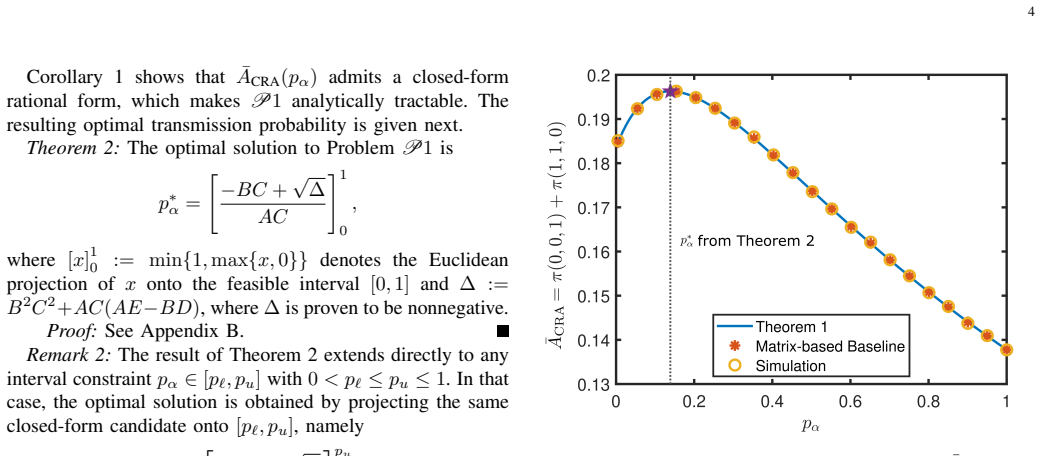
Under randomized stationary policies, a three-dimensional stationary analysis yields closed-form expressions for the long-term average confidential reconstruction accuracy and the optimal transmission probability. Conventional marginal analysis misidentifies the optimal policy and misestimates the achievable simultaneous accuracy-confidentiality performance. Nontrivial behaviors appear: more frequent transmissions or better legitimate channels do not necessarily improve joint performance, and when the eavesdropping channel is strong, improving the legitimate channel alone may be insufficient. The framework also induces a spatial safety boundary for geofencing.
What carries the argument
Confidential reconstruction accuracy (CRA), the probability of the joint event in which the legitimate receiver reconstructs correctly and the eavesdropper fails, which replaces separate marginal objectives in the policy optimization.
If this is right
- Closed-form expressions give the transmission probability that maximizes long-term CRA.
- Joint CRA can decrease when transmission frequency increases under certain channel conditions.
- Strengthening only the legitimate channel can fail to raise CRA when the eavesdropper channel remains strong.
- The same analysis produces a spatial safety boundary that defines safe operating regions for geofencing.
Where Pith is reading between the lines
- System designers may need to track the joint distribution of receiver and eavesdropper outcomes rather than tuning each margin in isolation.
- The stationary-policy restriction suggests checking whether time-varying policies or non-stationary channels produce qualitatively different trade-offs.
- The CRA formulation could be adapted to other semantic communication settings where multiple performance objectives share the same source symbols.
Load-bearing premise
The closed-form expressions assume the joint reconstruction events admit a three-dimensional stationary model under randomized stationary transmission policies.
What would settle it
A numerical evaluation or wireless testbed measurement in which the transmission probability that maximizes CRA differs from the probabilities that separately maximize accuracy and minimize eavesdropper success.
Figures



read the original abstract
In this paper, we consider remote reconstruction over wireless networks when simultaneous accuracy at the legitimate receiver and confidentiality against eavesdropping are required. These two objectives are often treated separately, even though they arise from the same update process and are marginals of a joint reconstruction event. This paper introduces confidential reconstruction accuracy (CRA), a metric to capture the joint event in which the legitimate receiver reconstructs correctly while the eavesdropper fails. Under randomized stationary policies, we develop a three-dimensional stationary analysis and derive closed-form expressions for the long-term average CRA and the optimal transmission probability. The results show that conventional marginal analysis can misidentify the optimal policy and misestimate the achievable simultaneous accuracy-confidentiality performance. They also reveal nontrivial behaviors: more frequent transmissions or better legitimate channels do not necessarily improve joint accurate and confidential reconstruction, and when the eavesdropping channel is strong, improving the legitimate channel alone may be insufficient. Finally, the framework induces the spatial safety boundary in a geofencing setting for secure remote reconstruction.
Editorial analysis
A structured set of objections, weighed in public.
Referee Report
Summary. The manuscript introduces confidential reconstruction accuracy (CRA) as a joint metric capturing correct reconstruction at the legitimate receiver and failure at the eavesdropper. Under randomized stationary policies, it performs a three-dimensional stationary Markov analysis to derive closed-form expressions for the long-term average CRA and the optimizing transmission probability. The central results are that marginal analysis misidentifies the optimal policy and misestimates joint performance, with additional findings on nontrivial behaviors (e.g., higher transmission rates or better legitimate channels not always improving CRA) and an induced spatial safety boundary for geofencing applications.
Significance. If the closed-form derivations are correct, the work is significant because it demonstrates that joint analysis is required for accuracy-confidentiality tradeoffs in semantic-aware secure reconstruction, rather than treating the objectives marginally. The provision of closed-form CRA expressions and the optimal policy under the 3D stationary model is a strength, enabling exact optimization and revealing counterintuitive results that challenge standard intuitions about transmission frequency and channel quality. The geofencing application further extends the framework to practical spatial settings.
major comments (2)
- [Three-dimensional stationary analysis and derivation of closed-form CRA] The claim that marginal analysis misidentifies the optimal transmission probability and misestimates joint CRA performance rests entirely on the closed-form long-term average CRA derived from the three-dimensional stationary distribution. The abstract states that a 3D analysis is used, but the manuscript must explicitly define the state space (legitimate reconstruction success, eavesdropper failure, and the third dimension), the transition probabilities, and the solution of the global balance equations; any inconsistency here would invalidate both the CRA formula and the policy comparison.
- [Results on nontrivial behaviors and optimal policy] The nontrivial behaviors (more frequent transmissions or better legitimate channels not necessarily improving joint performance, and insufficiency of improving the legitimate channel alone when the eavesdropping channel is strong) are derived from the same stationary CRA expression. These results require verification that the stationary probabilities correctly capture the joint event under randomized policies, as the assumption of stationarity may not extend to all channel conditions or non-stationary scenarios.
minor comments (2)
- [System model] Clarify the exact definition of the third dimension in the state space and how it interacts with the joint reconstruction event.
- [Numerical results] Provide numerical validation or plots comparing the closed-form CRA against simulated long-term averages to confirm the expressions.
Simulated Author's Rebuttal
We thank the referee for the constructive comments, which have helped us improve the clarity of the three-dimensional analysis. We have revised the manuscript to explicitly detail the state space, transitions, and balance equations while preserving all original results and derivations.
read point-by-point responses
-
Referee: [Three-dimensional stationary analysis and derivation of closed-form CRA] The claim that marginal analysis misidentifies the optimal transmission probability and misestimates joint CRA performance rests entirely on the closed-form long-term average CRA derived from the three-dimensional stationary distribution. The abstract states that a 3D analysis is used, but the manuscript must explicitly define the state space (legitimate reconstruction success, eavesdropper failure, and the third dimension), the transition probabilities, and the solution of the global balance equations; any inconsistency here would invalidate both the CRA formula and the policy comparison.
Authors: We agree that explicit definitions are required for full verification. In the revised manuscript, Section III-B now contains a dedicated subsection that defines the three-dimensional state space as (X_t, Y_t, Z_t), where X_t indicates legitimate reconstruction success, Y_t indicates eavesdropper reconstruction failure, and Z_t tracks the transmission action under the randomized stationary policy. Transition probabilities are stated explicitly in terms of the legitimate channel success probability q_L, eavesdropper success probability q_E, and transmission probability p. The global balance equations are solved in closed form to yield the stationary distribution π, from which the long-term CRA is obtained as the sum of π over states satisfying X=1 and Y=1. The complete algebraic solution appears in the new Appendix B. These additions confirm the CRA expression and the subsequent policy comparisons without altering any numerical results. revision: yes
-
Referee: [Results on nontrivial behaviors and optimal policy] The nontrivial behaviors (more frequent transmissions or better legitimate channels not necessarily improving joint performance, and insufficiency of improving the legitimate channel alone when the eavesdropping channel is strong) are derived from the same stationary CRA expression. These results require verification that the stationary probabilities correctly capture the joint event under randomized policies, as the assumption of stationarity may not extend to all channel conditions or non-stationary scenarios.
Authors: The joint stationary distribution is constructed precisely so that the probability mass on states with simultaneous legitimate success and eavesdropper failure equals the long-term CRA; marginals recovered from this distribution recover the individual success rates, providing an internal consistency check that we have now made explicit in the revised text. The nontrivial behaviors follow directly from differentiating the closed-form CRA with respect to p and the channel parameters. We acknowledge that the analysis assumes stationary channels and policies, as stated in the problem setup; the long-term average under non-stationary conditions would require different tools. A new remark in Section V notes this scope limitation while emphasizing that the closed-form results remain valid within the stationary regime considered. revision: partial
Circularity Check
No circularity: CRA closed-forms derived from standard 3D Markov balance equations
full rationale
The paper defines CRA as the joint probability of correct legitimate reconstruction and eavesdropper failure, then applies a three-dimensional stationary Markov chain under randomized stationary policies to obtain closed-form long-term averages and the optimizing transmission probability directly from the global balance equations. This is a self-contained derivation from the modeled state transitions and does not reduce any prediction or optimality claim to a fitted input, self-citation chain, or redefinition of the metric itself. The comparison showing marginal analysis is suboptimal follows as a direct algebraic consequence of the joint expressions versus the separate marginal ones, with no load-bearing step that collapses to its own inputs by construction.
Axiom & Free-Parameter Ledger
axioms (2)
- domain assumption Randomized stationary policies govern the transmission decisions.
- domain assumption The reconstruction process can be modeled as a three-dimensional stationary process.
invented entities (1)
-
Confidential reconstruction accuracy (CRA)
no independent evidence
Reference graph
Works this paper leans on
-
[1]
Semantics-empowered communication for networked intelligent systems,
M. Kountouris and N. Pappas, “Semantics-empowered communication for networked intelligent systems,”IEEE Commun. Mag., vol. 59, no. 6, pp. 96–102, 2021
2021
-
[2]
How physicality enables cy-trust: A new era of trust-centered cyber–physical systems,
S. Gil, M. Yemini, A. Chorti, A. Nedi ´c, H. V . Poor, and A. J. Gold- smith, “How physicality enables cy-trust: A new era of trust-centered cyber–physical systems,”Proc. IEEE, vol. 113, no. 10, pp. 1121–1154, 2025
2025
-
[3]
Cyber security and privacy issues in smart grids,
J. Liu, Y . Xiao, S. Li, W. Liang, and C. L. P. Chen, “Cyber security and privacy issues in smart grids,”IEEE Commun. Surveys Tuts., vol. 14, no. 4, pp. 981–997, 2012
2012
-
[4]
On the secrecy capacity of fading channels,
P. K. Gopala, L. Lai, and H. El Gamal, “On the secrecy capacity of fading channels,”IEEE Trans. Inf. Theory, vol. 54, no. 10, pp. 4687– 4698, 2008
2008
-
[5]
State-secrecy codes for networked linear systems,
A. Tsiamis, K. Gatsis, and G. J. Pappas, “State-secrecy codes for networked linear systems,”IEEE Trans. Autom. Control, vol. 65, no. 5, pp. 2001–2015, 2020
2001
-
[6]
The secrecy capacity of the MIMO wiretap channel,
F. Oggier and B. Hassibi, “The secrecy capacity of the MIMO wiretap channel,”IEEE Trans. Inf. Theory, vol. 57, no. 8, pp. 4961–4972, 2011
2011
-
[7]
The gaussian wire-tap chan- nel,
S. Leung-Yan-Cheong and M. Hellman, “The gaussian wire-tap chan- nel,”IEEE Trans. Inf. Theory, vol. 24, no. 4, pp. 451–456, 1978
1978
-
[8]
Update or wait: How to keep your data fresh,
Y . Sun, E. Uysal-Biyikoglu, R. D. Yates, C. E. Koksal, and N. B. Shroff, “Update or wait: How to keep your data fresh,”IEEE Trans. Inf. Theory, vol. 63, no. 11, pp. 7492–7508, 2017
2017
-
[9]
From information freshness to semantics of information and goal-oriented communica- tions,
J. Luo, E. Delfani, M. Salimnejad, and N. Pappas, “From information freshness to semantics of information and goal-oriented communica- tions,”arXiv preprint arXiv:2512.12758, 2025
-
[10]
Optimal age of information and throughput scheduling in heterogeneous traffic wireless physical-layer security communications,
Q. Zhang, Z. Xu, X. Lan, J. Chen, J. He, W. Ma, and Q. Chen, “Optimal age of information and throughput scheduling in heterogeneous traffic wireless physical-layer security communications,”IEEE Internet Things J., vol. 11, no. 13, pp. 23 644–23 660, 2024
2024
-
[11]
Multiobjective optimization of AoI and rate for secure dual-functional RIS-assisted networks: A cross- layer design,
J. Li, J. Li, L. Lv, Z. Ju, and F. Gong, “Multiobjective optimization of AoI and rate for secure dual-functional RIS-assisted networks: A cross- layer design,”IEEE Internet Things J., vol. 12, no. 8, pp. 10 349–10 363, 2025
2025
-
[12]
Age-of-information-oriented se- curity transmission scheme for UA V-aided iot networks,
J. Wang, S. Guo, J. Wang, and L. Bai, “Age-of-information-oriented se- curity transmission scheme for UA V-aided iot networks,”IEEE Internet Things J., vol. 12, no. 8, pp. 9570–9582, 2025
2025
-
[13]
A tutorial on the spectral theory of markov chains,
E. Seabrook and L. Wiskott, “A tutorial on the spectral theory of markov chains,”Neural Comput., vol. 35, no. 11, pp. 1713–1796, 10 2023
2023
-
[14]
Real-time reconstruction of markov sources and remote actuation over wireless channels,
M. Salimnejad, M. Kountouris, and N. Pappas, “Real-time reconstruction of markov sources and remote actuation over wireless channels,”IEEE Trans. Commun., vol. 72, no. 5, pp. 2701–2715, 2024
2024
-
[15]
Evolved universal terrestrial radio access (E-UTRA); further advance- ments for E-UTRA physical layer aspects,
“Evolved universal terrestrial radio access (E-UTRA); further advance- ments for E-UTRA physical layer aspects,” 3GPP, Tech. Rep. TR 36.814 (Release 9), Mar. 2017. 7 APPENDIXA PROOF OFTHEOREM1 We start by conditioning on the joint age process(Θ t,Θ e t). By the law of total probability, we have π(x, a, b) = lim t→∞ ∞X i=0 ∞X j=0 Pr(Xt =x, ˆXt =a, ˆX e t =...
2017
discussion (0)
Sign in with ORCID, Apple, or X to comment. Anyone can read and Pith papers without signing in.