Recognition: unknown
Unraveling the Bott spiral
Pith reviewed 2026-05-09 19:13 UTC · model grok-4.3
The pith
A homotopy model maps free fermionic SPTs to interacting ones via a twisted Atiyah-Bott-Shapiro orientation and computes the Bott spiral.
A machine-rendered reading of the paper's core claim, the machinery that carries it, and where it could break.
Core claim
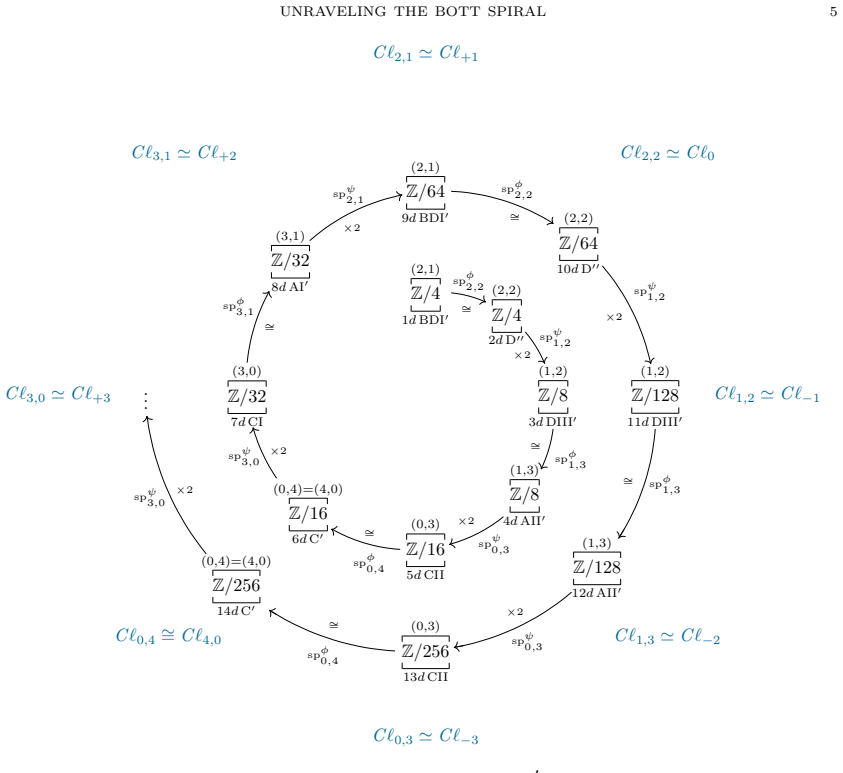
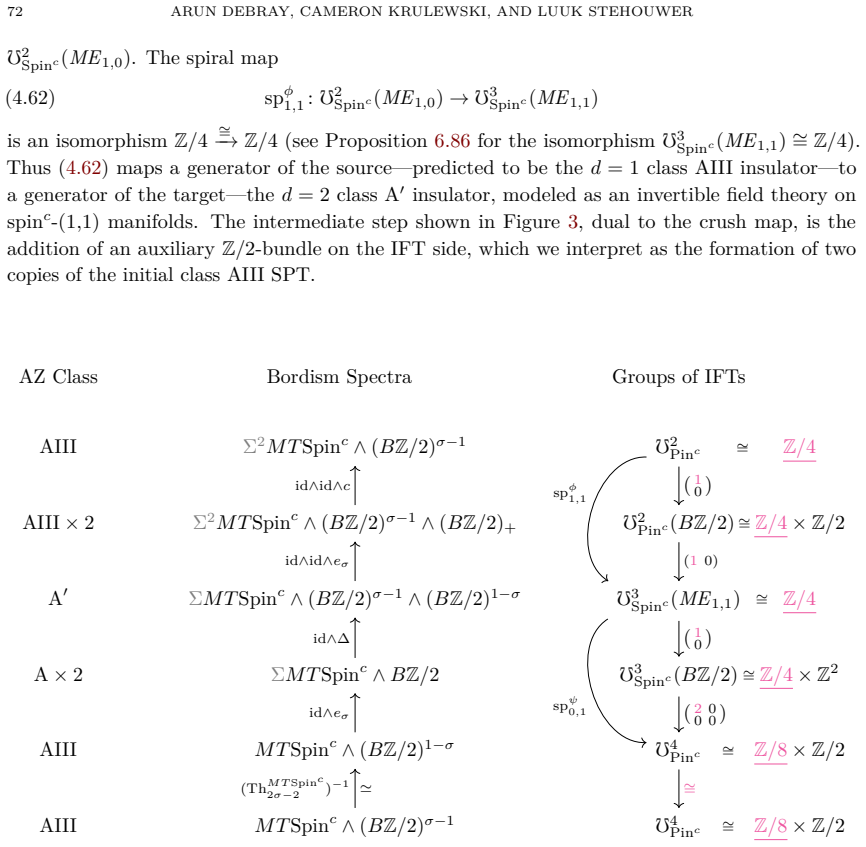
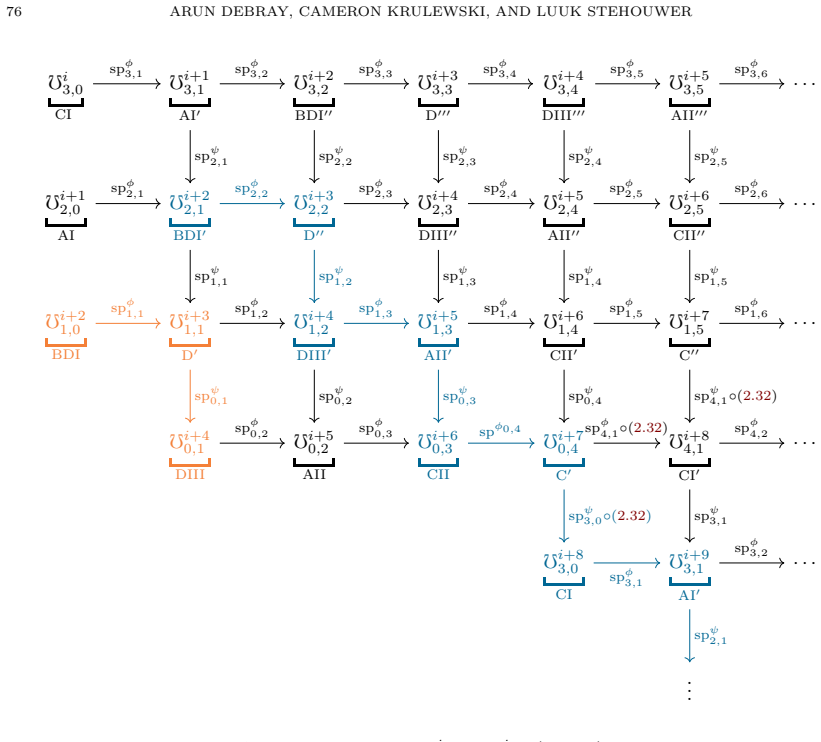
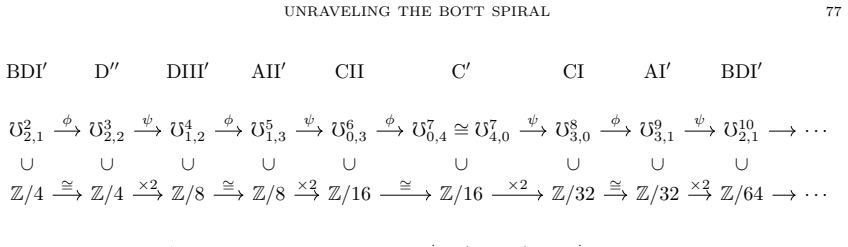
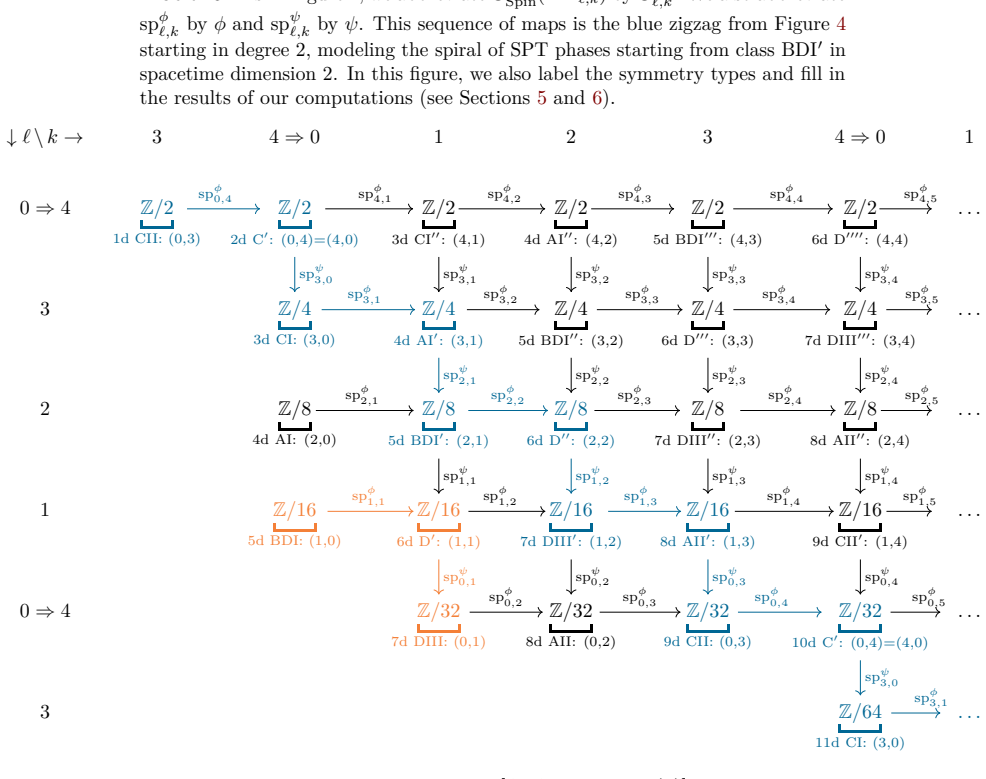
We construct and compute a homotopy-theoretic model for the Bott spiral of symmetry-protected topological phases studied by Queiroz-Khalaf-Stern. We model free and interacting fermionic SPTs using K-theory and reflection-positive invertible field theories, respectively, and define a twisted generalization of the Atiyah-Bott-Shapiro orientation to produce a free-to-interacting map. We also define and compute spiral maps of IFTs to model dimensional reduction, answering a question of Hason-Komargodski-Thorngren. Our analysis uses a novel 4-periodic description of a sector of the twisted ko-homology of elementary abelian 2-groups.
What carries the argument
The twisted generalization of the Atiyah-Bott-Shapiro orientation, which produces the free-to-interacting map between K-theory and the homotopy theory of reflection-positive invertible field theories, together with the spiral maps that implement dimensional reduction.
If this is right
- The free-to-interacting map relates K-theory classes of fermionic phases to classes in the homotopy theory of reflection-positive invertible field theories.
- Spiral maps of invertible field theories give explicit rules for how phases transform under dimensional reduction in the interacting regime.
- Invertible field theories are sensitive to symmetry data beyond the Altland-Zirnbauer class, so some phases that look equivalent in K-theory may be distinguished when interactions are included.
- The periodicity structure that survives on the interacting side is controlled by the isomorphism between two extraspecial groups of order 32.
- Computations rely on a 4-periodic description of a sector of twisted ko-homology for elementary abelian 2-groups.
Where Pith is reading between the lines
- The extra symmetry data required by invertible field theories suggests that some experimentally realized phases may split into distinct interacting classes even when their free approximations coincide.
- The same spiral maps could be used to predict how phases behave when the physical system is reduced to lower dimensions in a laboratory setting.
- The underlying group isomorphism may point to algebraic structures that control periodicity in other topological invariants outside this specific spiral.
Load-bearing premise
The specification of an Altland-Zirnbauer class alone does not give enough data to define the symmetry type for an invertible field theory, and the remnant of Bott periodicity on the interacting side depends on an isomorphism of two extraspecial groups of order 32.
What would settle it
An explicit low-dimensional calculation of the classification of interacting SPTs for a fixed symmetry type that produces a different group from the one obtained by applying the twisted orientation map to the corresponding K-theory class.
Figures





read the original abstract
We construct and compute a homotopy-theoretic model for the Bott spiral of symmetry-protected topological phases (SPTs) studied by Queiroz--Khalaf--Stern. We model free and interacting fermionic SPTs using K-theory and reflection-positive invertible field theories (IFTs), resp., and define a twisted generalization of the Atiyah--Bott--Shapiro orientation to produce a free-to-interacting map. We also define and compute spiral maps of IFTs to model dimensional reduction in this context, answering a question of Hason--Komargodski--Thorngren. Our analysis highlights two general aspects of homotopical free-to-interacting maps. First, IFTs are more sensitive than K-theory is to the input symmetry data; in particular, the specification of an Altland--Zirnbauer class is insufficient information to define symmetry type for an IFT. Second, the remnant of Bott periodicity on the interacting side relies on an isomorphism of two extraspecial groups of order 32. Our computations use a novel 4-periodic description of a sector of the twisted ko-homology of elementary abelian 2-groups.
Editorial analysis
A structured set of objections, weighed in public.
Referee Report
Summary. The manuscript constructs a homotopy-theoretic model for the Bott spiral of symmetry-protected topological phases (SPTs) using K-theory for free fermionic SPTs and reflection-positive invertible field theories (IFTs) for interacting ones. It defines a twisted generalization of the Atiyah-Bott-Shapiro orientation to produce a free-to-interacting map and introduces spiral maps of IFTs to model dimensional reduction, answering a question of Hason-Komargodski-Thorngren. The analysis highlights that Altland-Zirnbauer classes are insufficient to define symmetry type for IFTs and that the remnant of Bott periodicity on the interacting side relies on an isomorphism of two extraspecial groups of order 32, with computations based on a novel 4-periodic description of twisted ko-homology of elementary abelian 2-groups.
Significance. If the constructions hold, this provides a rigorous homotopy-theoretic bridge between free and interacting SPT classifications, with explicit maps that could facilitate further computations in the field. The novel 4-periodic ko-homology description and the sensitivity of IFTs to symmetry data beyond AZ classes are technical contributions that strengthen the mathematical foundations for studying the Bott spiral. The work ships explicit constructions using standard homotopy tools and addresses open questions on dimensional reduction.
major comments (1)
- [Abstract] Abstract: The central claim that the remnant of Bott periodicity relies on an isomorphism of two extraspecial groups of order 32 is presented as an output of the analysis, but this appears to be a load-bearing step for the free-to-interacting map and the computed spiral maps. The manuscript must explicitly show (in the section deriving the IFT periodicity) how the isomorphism induces the claimed periodicity in the IFT category without additional assumptions, as failure here would mean the computed maps do not model the Queiroz-Khalaf-Stern Bott spiral.
minor comments (1)
- [Introduction] The abstract is highly technical and dense; consider adding a short non-technical overview paragraph at the start of the introduction to clarify the physical motivation for readers outside homotopy theory.
Simulated Author's Rebuttal
We thank the referee for their careful reading of the manuscript and for identifying the need to strengthen the explicit connection between the extraspecial group isomorphism and the IFT periodicity. We have revised the paper accordingly to address this point directly.
read point-by-point responses
-
Referee: [Abstract] Abstract: The central claim that the remnant of Bott periodicity relies on an isomorphism of two extraspecial groups of order 32 is presented as an output of the analysis, but this appears to be a load-bearing step for the free-to-interacting map and the computed spiral maps. The manuscript must explicitly show (in the section deriving the IFT periodicity) how the isomorphism induces the claimed periodicity in the IFT category without additional assumptions, as failure here would mean the computed maps do not model the Queiroz-Khalaf-Stern Bott spiral.
Authors: We agree that the link between the extraspecial group isomorphism and the resulting 4-periodicity in the IFT category requires a more explicit derivation to serve as a load-bearing step. In the revised manuscript we have expanded the relevant section (now Section 4.3, 'Derivation of IFT Periodicity') with a dedicated subsection that walks through the argument in detail: we first recall the two extraspecial groups of order 32 and their explicit isomorphism φ, then show that φ induces an equivalence on the relevant twisted ko-homology groups that commutes with the spiral maps and preserves the reflection-positive structure. This equivalence is constructed directly from the symmetry-type data and the novel 4-periodic description of twisted ko-homology of elementary abelian 2-groups already developed in the paper; no further assumptions are introduced. The free-to-interacting map and the computed spiral maps are thereby shown to reproduce the Queiroz-Khalaf-Stern Bott spiral on the nose. We have also added a brief clarifying sentence to the abstract. revision: yes
Circularity Check
No significant circularity; self-contained mathematical construction
full rationale
The paper defines a homotopy-theoretic model for the Bott spiral using K-theory for free SPTs and reflection-positive IFTs for interacting ones, along with a twisted generalization of the Atiyah-Bott-Shapiro orientation and spiral maps for dimensional reduction. These constructions rely on external inputs from homotopy theory and group theory, including the isomorphism of two extraspecial groups of order 32 as an independent fact (not derived or defined within the paper's equations). The novel 4-periodic description of twisted ko-homology is computed from the model rather than presupposing the target results. No steps reduce by construction to fitted parameters, self-citations, or renamed inputs; the derivation is self-contained against external benchmarks in algebraic topology and group theory.
Axiom & Free-Parameter Ledger
axioms (3)
- domain assumption K-theory classifies free fermionic SPTs and reflection-positive IFTs classify interacting ones
- standard math The Atiyah-Bott-Shapiro orientation admits a twisted generalization
- standard math Two extraspecial groups of order 32 are isomorphic
Reference graph
Works this paper leans on
-
[1]
31 [ABG18] Matthew Ando, Andrew J
https://arxiv.org/abs/1403.4320. 31 [ABG18] Matthew Ando, Andrew J. Blumberg, and David Gepner. Parametrized spectra, multiplicative Thom spectra and the twisted Umkehr map.Geom. Topol., 22(7):3761–3825, 2018.https://arxiv.org/abs/ 1112.2203. 31 [ABK21] David Aasen, Parsa Bonderson, and Christina Knapp. Characterization and classification of fermionic sym...
-
[2]
95 [AHS17] Adhip Agarwala, Arijit Haldar, and Vijay B
https://arxiv.org/abs/2107.02837. 95 [AHS17] Adhip Agarwala, Arijit Haldar, and Vijay B. Shenoy. The tenfold way redux: fermionic systems with N-body interactions.Ann. Physics, 385:469–511, 2017.https://arxiv.org/abs/1606.05483. 3 [AK12] Gilles Abramovici and Pavel Kalugin. Clifford modules and symmetries of topological insulators. International Journal o...
-
[3]
https://arxiv.org/abs/1903.06782. 34, 42 [And64a] D. W. Anderson. The real K-theory of classifying spaces.Proceedings of the National Academy of Sciences of the United States of America, 51(4):634–636, 1964. 96 [And64b] Donald Werner Anderson.A new cohomology theory. PhD thesis, University of California, Berkeley,
-
[4]
Anderson
110 [And69] D.W. Anderson. Universal coefficient theorems for K-theory. 1969. https://faculty.tcu.edu/ gfriedman/notes/Anderson-UCT.pdf. 9, 36, 53 [AP76] J. F. Adams and S. B. Priddy. Uniqueness ofBSO. Math. Proc. Cambridge Philos. Soc., 80(3):475–509,
1969
-
[5]
100, 108, 110, 123 [AS25] Hassan Abdallah and Andrew Salch. Products in spinc-cobordism. Int. Math. Res. Not. IMRN, (18):Paper No. rnaf291, 19, 2025.https://arxiv.org/abs/2407.10045. 119 [Ati61a] M. F. Atiyah. Bordism and cobordism. Proc. Cambridge Philos. Soc., 57:200–208, 1961. 46 [Ati61b] M. F. Atiyah. Thom complexes. Proc. London Math. Soc. (3), 11:29...
-
[6]
https://arxiv.org/abs/2003.12003. 82, 99, 107, 110, 117, 123 [Bal22] William Balderrama.K-theory equivariant with respect to an elementary abelian 2-group.New York J. Math., 28:1531–1553, 2022.https://arxiv.org/abs/2201.03095. 27 [Bay94] Dilip Kumar Bayen. The connective real K-homology of finite groups. PhD thesis, Wayne State University, 1994. 90, 121 [...
-
[7]
3 [CC21] Eyal Cornfeld and Shachar Carmeli. Tenfold topology of crystals: Unified classification of crystalline topological insulators and superconductors.Phys. Rev. Res., 3:013052, Jan 2021.https://arxiv.org/ abs/2009.04486. 3 [CF64] P.E. Conner and E.E. Floyd.Differentiable periodic maps. Ergebnisse der Mathematik und ihrer Grenzgebiete. Springer, 1964....
-
[8]
43 [Cop25] Christian Copetti. ’t Hooft anomalies and defect conformal manifolds: Topological signatures from modulated effective actions. 2025.https://arxiv.org/abs/2507.15466. 7, 45 [COSY20] Clay Córdova, Kantaro Ohmori, Shu-Heng Shao, and Fei Yan. DecoratedZ2 symmetry defects and their time-reversal anomalies.Physical Review D, 102(4), aug 2020.https://...
-
[9]
https://arxiv.org/abs/1803.11183
©2018. https://arxiv.org/abs/1803.11183. 37, 38, 42, 55, 74, 81 [DK70] P. Donovan and M. Karoubi. Graded Brauer groups andK-theory with local coefficients.Inst. Hautes Études Sci. Publ. Math., (38):5–25, 1970. 17, 26, 33, 48 [DK25] Arun Debray and Cameron Krulewski. Smith homomorphisms andspinh structures. Proc. Amer. Math. Soc., 153(2):897–912, 2025.http...
-
[10]
32 [DY23] Arun Debray and Matthew Yu
https://arxiv.org/abs/math/0402082. 32 [DY23] Arun Debray and Matthew Yu. Adams spectral sequences for non-vector-bundle Thom spectra. 2023. https://arxiv.org/abs/2305.01678. 19, 29, 31, 32 [DY24a] Arun Debray and Matthew Yu. Type IIA string theory and tmf with level structure. 2024.https: //arxiv.org/abs/2411.07299. 37, 45 [DY24b] Arun Debray and Matthew...
-
[11]
Onsiteability of Higher-Form Symmetries
https://arxiv.org/abs/2510.23701. 42 [FF26] Gregory Faurot and Giovanni Ferrer. The homotopy 3-type of abelianC∗-algebras. 2026. https: //arxiv.org/abs/2603.29985. 43 [FH20] Daniel S. Freed and Michael J. Hopkins. Invertible phases of matter with spatial symmetry.Adv. Theor. Math. Phys., 24(7):1773–1788, 2020.https://arxiv.org/abs/1901.06419. 35, 61 [FH21...
work page internal anchor Pith review Pith/arXiv arXiv 2026
-
[12]
51 132 ARUN DEBRAY, CAMERON KRULEWSKI, AND LUUK STEHOUWER [Her17] Thorsten Hertl
https://arxiv.org/abs/1306.0389. 51 132 ARUN DEBRAY, CAMERON KRULEWSKI, AND LUUK STEHOUWER [Her17] Thorsten Hertl. Pin bordism in low degrees of classifying spaces. Master’s thesis, University of Göttingen,
-
[13]
52, 58 [HHY22] Sheng-Jie Huang, Chang-Tse Hsieh, and Jiabin Yu
https://thorsten-hertl.github.io/Research/Masterarbeit.pdf. 52, 58 [HHY22] Sheng-Jie Huang, Chang-Tse Hsieh, and Jiabin Yu. Effective field theories of topological crystalline insulators and topological crystals.Phys. Rev. B, 105:045112, Jan 2022.https://arxiv.org/abs/2107. 03409. 61 [HHZ05] P. Heinzner, A. Huckleberry, and M. R. Zirnbauer. Symmetry class...
-
[14]
Topological Elliptic Genera I -- The mathematical foundation
https://arxiv.org/abs/2412.02298. 94 [Mac66] E. A. M. MacAlpine. Duality in a twisted homology theory.Bull. Amer. Math. Soc., 72:1051–1054,
work page internal anchor Pith review Pith/arXiv arXiv
-
[15]
Ring spectra which are Thom complexes
29 [Mah79] Mark Mahowald. Ring spectra which are Thom complexes. Duke Math. J., 46(3):549–559, 1979. 105 UNRAVELING THE BOTT SPIRAL 135 [Mah82] Mark Mahowald. The image ofJ in the EHP sequence. Ann. of Math. (2), 116(1):65–112, 1982. Correction inAnnals of Mathematics, 120:399–400, 1984. 85, 96 [Mal11] Arjun Malhotra.The Gromov-Lawson-Rosenberg conjecture...
-
[16]
https://arxiv.org/abs/1505.06341. 15, 62, 63 [Mil63] John W. Milnor. Spin structures on manifolds. Enseign. Math. (2), 9:198–203, 1963. 42 [Mil24] Keith Mills. The structure of the spinh bordism spectrum.Proc. Amer. Math. Soc., 152(8):3605–3616,
-
[17]
15, 104, 109, 110, 122, 123 [Miy25] Jin Miyazawa
https://arxiv.org/abs/2306.17709. 15, 104, 109, 110, 122, 123 [Miy25] Jin Miyazawa. Localization of a KO∗(pt)-valued index and the orientability of thePin−(2) monopole moduli space.Algebr. Geom. Topol., 25(2):887–918, 2025.https://arxiv.org/abs/2109.10579. 51 [MK12] Jack Morava and Nitu Kitchloo. The Baker-Richter spectrum as cobordism of quasitoric manifolds
-
[18]
With an appendix by Nitu Kitchloo.https://arxiv.org/abs/1201.3127. 45 [MM76] M. Mahowald and R. James Milgram. Operations which detect Sq4 in connectiveK-theory and their applications. Quart. J. Math. Oxford Ser. (2), 27(108):415–432, 1976. 58, 110 [MNN15] Akhil Mathew, Niko Naumann, and Justin Noel. On a nilpotence conjecture of J. P. May.J. Topol., 8(4)...
-
[19]
https://arxiv.org/abs/2101.00426. 42 [Oga22a] Yoshiko Ogata. An invariant of symmetry protected topological phases with on-site finite group symmetry for two-dimensional fermion systems.Comm. Math. Phys., 395(1):405–457, 2022.https: //arxiv.org/abs/2110.04672. 42 [Oga22b] Yoshiko Ogata. Classification of symmetry protected topological phases in quantum sp...
-
[20]
53, 54 [RNQ+24] Xing-Yu Ren, Shang-Qiang Ning, Yang Qi, Qing-Rui Wang, and Zheng-Cheng Gu
https://arxiv.org/abs/1408.1581. 53, 54 [RNQ+24] Xing-Yu Ren, Shang-Qiang Ning, Yang Qi, Qing-Rui Wang, and Zheng-Cheng Gu. Stacking group structure of fermionic symmetry-protected topological phases.Phys. Rev. B, 110:235117, Dec 2024. https://arxiv.org/abs/2310.19058. 61 [Ros12] Achim Rosch. Unwinding of a one-dimensional topological superconductor.Phys....
-
[21]
2, 3, 4 UNRAVELING THE BOTT SPIRAL 137 [RW14] Oscar Randal-Williams
https://arxiv.org/abs/0912.2157. 2, 3, 4 UNRAVELING THE BOTT SPIRAL 137 [RW14] Oscar Randal-Williams. Homology of the moduli spaces and mapping class groups of framed,r-Spin and Pin surfaces.J. Topol., 7(1):155–186, 2014.https://arxiv.org/abs/1001.5366. 81 [RWG14] Oscar Randal-Williams and Mark Grant. Vector bundle for prescribed Stiefel-Whitney classes, ...
-
[22]
Interacting topological phases and modular invariance.Phys
15, 57, 62 [RZ12] Shinsei Ryu and Shou-Cheng Zhang. Interacting topological phases and modular invariance.Phys. Rev. B, 85:245132, Jun 2012.https://arxiv.org/abs/1202.4484. 10, 15, 60, 61, 62 [SAC21] Daniel Sheinbaum and Omar Antolín Camarena. Crystallographic interacting topological phases and equivariant cohomology: to assume or not to assume.J. High En...
-
[23]
61 [SAC25] Daniel Sheinbaum and Omar Antolín Camarena
https://arxiv.org/abs/2007.06595. 61 [SAC25] Daniel Sheinbaum and Omar Antolín Camarena. Failure of the crystalline equivalence principle for weak free fermions.Phys. Rev. B, 111:L081118, Feb 2025.https://arxiv.org/abs/2408.07203. 61, 64 [Sal23] A. Salch. The Steenrod algebra is self-injective, and the Steenrod algebra is not self-injective. 2023. https:/...
-
[24]
38, 55, 74 [TW79] Laurence Taylor and Bruce Williams
https://arxiv.org/abs/1811.12654. 38, 55, 74 [TW79] Laurence Taylor and Bruce Williams. Surgery spaces: formulae and structure. InAlgebraic topology, Waterloo, 1978 (Proc. Conf., Univ. Waterloo, Waterloo, Ont., 1978), volume 741 ofLecture Notes in Math., pages 170–195. Springer, Berlin, 1979. 96 [TW21] Ryan Thorngren and Yifan Wang. Anomalous symmetries e...
-
[25]
Fermion Path Integrals And Topological Phases
117 [Wil73b] W. Stephen Wilson. A new relation on the Stiefel-Whitney classes of spin manifolds.Illinois J. Math., 17:115–127, 1973. 100 [Wit16] Edward Witten. Fermion path integrals and topological phases.Rev. Mod. Phys., 88:035001, Jul 2016. https://arxiv.org/abs/1508.04715. 55, 74 [WS14] Chong Wang and T. Senthil. Interacting fermionic topological insu...
work page Pith review arXiv 1973
-
[26]
https://arxiv.org/abs/2310.19266. 61 [ZNQG25] Jian-Hao Zhang, Shang-Qiang Ning, Yang Qi, and Zheng-Cheng Gu. Construction and classification of crystalline topological superconductor and insulators in three-dimensional interacting fermion systems. Phys. Rev. X, 15:031029, Jul 2025.https://arxiv.org/abs/2204.13558. 61 [ZWY+20] Jian-Hao Zhang, Qing-Rui Wang...
work page internal anchor Pith review Pith/arXiv arXiv 2025
discussion (0)
Sign in with ORCID, Apple, or X to comment. Anyone can read and Pith papers without signing in.