Recognition: unknown
Dynamical analysis of r-Chialvo neuron map with cosine memristive
Pith reviewed 2026-05-09 18:58 UTC · model grok-4.3
The pith
A cosine-based memristor added to the reduced Chialvo neuron map produces diverse codimension-one and two bifurcations along with multistable attractors and multi-chimera states in networks.
A machine-rendered reading of the paper's core claim, the machinery that carries it, and where it could break.
Core claim
Incorporating the cosine memristor into the reduced Chialvo neuron map yields a discrete system whose equilibria are found analytically and numerically; the map undergoes Neimark-Sacker bifurcation under explicit parameter conditions and exhibits antimonotonicity together with codimension-one and codimension-two bifurcations including period-doubling, saddle-node, generalized period-doubling, cusp-point, fold-flip, and resonances of ratios 1:1 through 1:4. Numerical exploration further shows multistable coexistence of a stable limit cycle, a period-five attractor, and a chaotic attractor with distinct basins, and the ring-star network extension produces imperfect synchronization, clustered,
What carries the argument
The cosine-based memristor, whose nonlinear current-voltage relation supplies electromagnetic modulation to the Chialvo map and thereby generates the observed bifurcation structures and multistable regimes.
If this is right
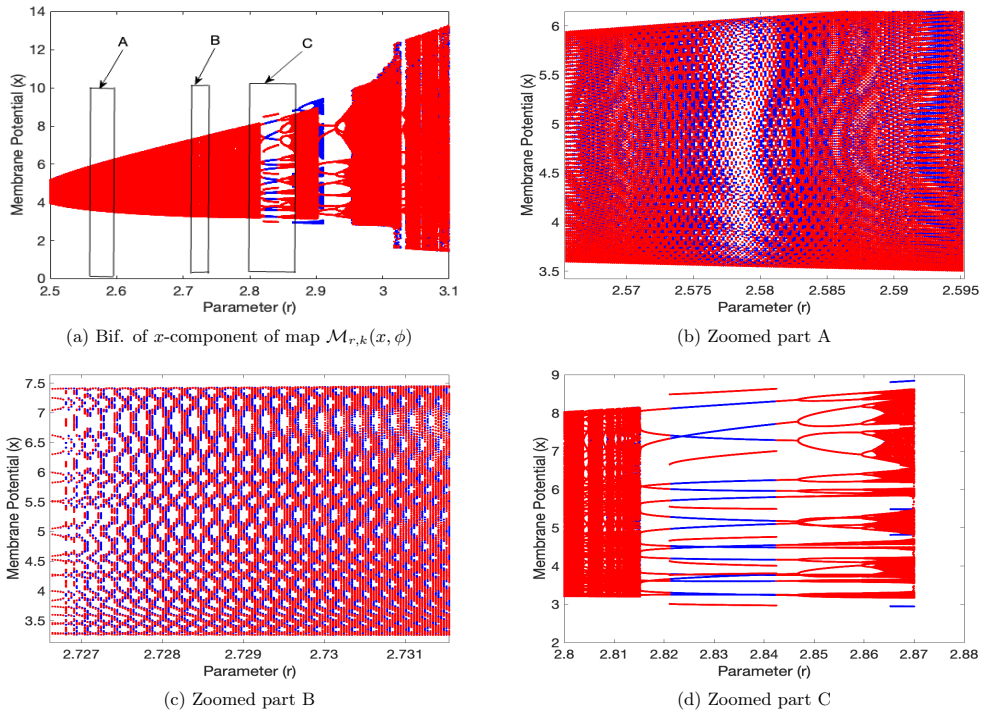
- Antimonotonicity appears through paired forward and backward bifurcation diagrams.
- Resonance structures at ratios 1:1, 1:2, 1:3, and 1:4 arise for specific parameter intervals.
- Three distinct attractors coexist with separate basins of attraction in the single-map phase space.
- The ring-star network produces imperfect synchronization, clustered patterns, and multi-chimera states.
- These collective patterns have not appeared in previous Chialvo-based network studies.
Where Pith is reading between the lines
- The construction suggests that discrete memristive maps can serve as minimal models for electromagnetic effects without requiring high-dimensional continuous differential equations.
- Ring-star topology may be useful for exploring how local electromagnetic coupling shapes synchronization in larger neural graphs.
- Parameter sweeps that locate the period-five and chaotic basins could be tested against experimental recordings of neurons under applied magnetic fields.
- Similar cosine-memristor additions to other low-dimensional maps might reveal shared bifurcation sequences across neuron models.
Load-bearing premise
The cosine memristor faithfully models electromagnetic modulation in neurons and the chosen numerical grids capture every relevant attractor without discretization artifacts.
What would settle it
Observation that a continuous neuron model with an analogous cosine memristive term fails to produce the reported multistable attractors or multi-chimera states in the ring-star topology would contradict the claim that the discrete map captures the essential dynamics.
Figures




read the original abstract
In this work, we construct a novel two-dimensional discrete neuron map by incorporating a cosine-based memristor into the reduced Chialvo neuron map to examine the dynamical analysis of electromagnetic modulation. The nonlinear current-voltage characteristics of the memristor enrich the neuron map's behavior, leading to diverse firing regimes, stability behaviors, and chaotic attractors. This study begins to establish the equilibrium points using both analytical and numerical methods. Additionally, we determine the conditions on parameters under which the proposed map exhibits a Neimark-Sacker bifurcation. Further, the numerical study reveals the antimonotonicity structure through the forward and backward bifurcation diagrams. The model exhibits a wide range of codimension-one and codimension-two bifurcation patterns, including Neimark-Sacker, period-doubling, saddle-node, generalized period-doubling, cusp-point, fold-flip, and various resonance structures (1:1, 1:2, 1:3, and 1:4). We also observe that the coexistence of multistable attractors including a stable limit cycle, a period-five attractor, and a chaotic attractor, along with their respective basins of attraction. Furthermore, we extend this analysis to the network of neurons under the ring-star configuration and discuss several spatiotemporal patterns. This network investigation reveals complex collective patterns, including imperfect synchronization, clustered patterns, and multi-chimera state phenomena, which have not been previously observed in existing Chialvo-based studies. These results highlight the potential of the discrete memristor-based neuron map for advancing theoretical neurodynamics and offer a robust framework for investigating low-dimensional yet dynamically rich neuron systems.
Editorial analysis
A structured set of objections, weighed in public.
Referee Report
Summary. The manuscript constructs a two-dimensional discrete neuron map by adding a cosine-based memristor to the reduced Chialvo map. Equilibria are obtained analytically and numerically; explicit conditions for the Neimark-Sacker bifurcation are derived. Numerical forward/backward bifurcation diagrams are used to exhibit antimonotonicity together with codimension-one and codimension-two bifurcations (period-doubling, saddle-node, generalized period-doubling, cusp-point, fold-flip, and 1:1–1:4 resonances). Multistability is reported, with basins shown for a stable limit cycle, a period-5 attractor, and a chaotic attractor. The model is extended to a ring-star network, where simulations display imperfect synchronization, clustered patterns, and multi-chimera states not previously seen in Chialvo-based networks.
Significance. If the numerical bifurcation classifications and basin computations prove robust, the work supplies a concrete, low-dimensional example of how a cosine memristor can generate a broad palette of local and global bifurcations plus collective network phenomena in a discrete neuron model. The analytical treatment of equilibria and the Neimark-Sacker condition supplies a verifiable foundation, while the numerical exploration of higher-codimension points and multistability offers a useful template for studying electromagnetic modulation effects.
major comments (3)
- [Numerical bifurcation analysis] The identification of codimension-two bifurcations (cusp-point, fold-flip, generalized period-doubling, and resonances 1:1–1:4) rests on visual inspection of forward and backward bifurcation diagrams. No computation of normal-form coefficients, verification of nondegeneracy conditions, or use of continuation software is reported. In discrete maps such points are easily misclassified when parameter increments are coarse or attractors are sensitive to initial conditions.
- [Multistability and basins] The basins of attraction for the coexisting stable limit cycle, period-five orbit, and chaotic attractor are presented without stating the initial-condition grid resolution, number of iterations used for classification, or any search for additional hidden attractors. This information is required to confirm that the reported multistability is complete and not an artifact of the chosen sampling.
- [Network dynamics] The ring-star network section claims imperfect synchronization, clustered patterns, and multi-chimera states, yet supplies no quantitative synchronization diagnostics (e.g., order parameter, pairwise correlation) nor a systematic scan over memristor strength and coupling parameters. The distinction between these regimes therefore remains qualitative.
minor comments (2)
- [Introduction] A direct comparison of the bifurcation structure with the original (non-memristive) Chialvo map would clarify which features are genuinely introduced by the cosine memristor.
- [Numerical methods] The manuscript should state the numerical integrator, step size, and software employed for all bifurcation diagrams and basin plots so that the results can be reproduced.
Simulated Author's Rebuttal
We thank the referee for the thorough review and valuable suggestions. We have prepared point-by-point responses to the major comments and will revise the manuscript accordingly to address the concerns raised.
read point-by-point responses
-
Referee: [Numerical bifurcation analysis] The identification of codimension-two bifurcations (cusp-point, fold-flip, generalized period-doubling, and resonances 1:1–1:4) rests on visual inspection of forward and backward bifurcation diagrams. No computation of normal-form coefficients, verification of nondegeneracy conditions, or use of continuation software is reported. In discrete maps such points are easily misclassified when parameter increments are coarse or attractors are sensitive to initial conditions.
Authors: We agree that additional rigor would strengthen the claims regarding codimension-two bifurcations. In the revised manuscript, we will provide more details on the numerical setup, including the specific parameter step sizes used (Δa = 0.001, Δb = 0.0005) and the range of initial conditions tested to confirm the attractors. While deriving full normal-form coefficients for this two-dimensional map is analytically cumbersome and was not included originally, the forward and backward bifurcation diagrams, combined with phase portraits, provide consistent evidence for the identified bifurcations. We will add a brief discussion acknowledging the limitations of purely numerical classification and note that these observations align with known behaviors in memristive neuron maps. revision: partial
-
Referee: [Multistability and basins] The basins of attraction for the coexisting stable limit cycle, period-five orbit, and chaotic attractor are presented without stating the initial-condition grid resolution, number of iterations used for classification, or any search for additional hidden attractors. This information is required to confirm that the reported multistability is complete and not an artifact of the chosen sampling.
Authors: Thank you for highlighting this omission. We will revise the manuscript to include the necessary details: the basins were computed on a 1000 × 1000 grid over the (x,y) plane, with each trajectory iterated for 5000 steps to classify the attractor type based on the final state. We also performed additional searches using 100 random initial conditions outside the grid and found no other coexisting attractors. These specifications will be added to the figure captions and methods section to ensure reproducibility and completeness of the multistability analysis. revision: yes
-
Referee: [Network dynamics] The ring-star network section claims imperfect synchronization, clustered patterns, and multi-chimera states, yet supplies no quantitative synchronization diagnostics (e.g., order parameter, pairwise correlation) nor a systematic scan over memristor strength and coupling parameters. The distinction between these regimes therefore remains qualitative.
Authors: We acknowledge that the network analysis was primarily visual and qualitative. In the revision, we will incorporate quantitative diagnostics, including the Kuramoto order parameter for synchronization and average pairwise correlation coefficients across neurons. Furthermore, we will present a parameter scan varying the memristor parameter and coupling strength to map out the boundaries between imperfect synchronization, clustered states, and multi-chimera regimes. This will provide a more systematic and objective characterization of the collective dynamics. revision: yes
Circularity Check
No circularity: standard analytic/numeric analysis of a constructed map
full rationale
The paper defines a new 2D map by adding a cosine memristor to the Chialvo model, derives equilibria and Neimark-Sacker conditions directly from the map equations, then uses forward/backward bifurcation diagrams and basin plots to classify other codim-1/2 bifurcations and multistability. No equation reduces a claimed bifurcation or attractor to a fitted parameter or self-citation by construction; the numerical exploration is independent of the analytic steps and does not rename or smuggle prior results.
Axiom & Free-Parameter Ledger
free parameters (1)
- memristor strength and cosine parameters
axioms (1)
- domain assumption The reduced Chialvo map captures essential neuron firing dynamics
Reference graph
Works this paper leans on
-
[1]
Neural excitability, spiking and bursting.International journal of bifurcation and chaos, 10(06):1171–1266, 2000
Eugene M Izhikevich. Neural excitability, spiking and bursting.International journal of bifurcation and chaos, 10(06):1171–1266, 2000
2000
-
[2]
A quantitative description of membrane current and its application to conduction and excitation in nerve.The Journal of physiology, 117(4):500, 1952
Alan L Hodgkin and Andrew F Huxley. A quantitative description of membrane current and its application to conduction and excitation in nerve.The Journal of physiology, 117(4):500, 1952
1952
-
[3]
Mathematical models of threshold phenomena in the nerve membrane.The bulletin of mathematical biophysics, 17(4):257–278, 1955
Richard FitzHugh. Mathematical models of threshold phenomena in the nerve membrane.The bulletin of mathematical biophysics, 17(4):257–278, 1955
1955
-
[4]
Voltage oscillations in the barnacle giant muscle fiber.Biophysical journal, 35(1):193–213, 1981
Catherine Morris and Harold Lecar. Voltage oscillations in the barnacle giant muscle fiber.Biophysical journal, 35(1):193–213, 1981
1981
-
[5]
A model of neuronal bursting using three coupled first order differential equations.Proceedings of the Royal society of London
James L Hindmarsh and RM Rose. A model of neuronal bursting using three coupled first order differential equations.Proceedings of the Royal society of London. Series B. Biological sciences, 221(1222):87–102, 1984
1984
-
[6]
Dynamical systems in neuroscience.MIT Press, page 111, July 2007
E Izhikevich. Dynamical systems in neuroscience.MIT Press, page 111, July 2007
2007
-
[7]
Generic excitable dynamics on a two-dimensional map.Chaos, Solitons & Fractals, 5(3-4):461–479, 1995
Dante R Chialvo. Generic excitable dynamics on a two-dimensional map.Chaos, Solitons & Fractals, 5(3-4):461–479, 1995
1995
-
[8]
Memristor-the missing circuit element.IEEE Transactions on circuit theory, 18(5):507–519, 1971
Leon Chua. Memristor-the missing circuit element.IEEE Transactions on circuit theory, 18(5):507–519, 1971
1971
-
[9]
Hongli Cao, Yu Wang, Santo Banerjee, Yinghong Cao, and Jun Mou. A discrete Chialvo–Rulkov neuron network coupled with a novel memristor model: Design, Dynamical analysis, DSP implementation and its application.Chaos, Solitons & Fractals, 179:114466, 2024
2024
-
[10]
Spatiotemporal dynamics and synchronization in a memristive Chialvo neural network.Nonlinear Dynamics, 113(9):10365–10377, 2025
Huihai Wang, Hanqi Chen, Kehui Sun, Wanting Zhu, and Zhao Yao. Spatiotemporal dynamics and synchronization in a memristive Chialvo neural network.Nonlinear Dynamics, 113(9):10365–10377, 2025
2025
-
[11]
Discrete memristor hyperchaotic maps.IEEE Transactions on Circuits and Systems I: Regular Papers, 68(11):4534–4544, 2021
Han Bao, Zhongyun Hua, Houzhen Li, Mo Chen, and Bocheng Bao. Discrete memristor hyperchaotic maps.IEEE Transactions on Circuits and Systems I: Regular Papers, 68(11):4534–4544, 2021
2021
-
[12]
A discrete memristor model and its application in Hénon map
Yuexi Peng, Kehui Sun, and Shaobo He. A discrete memristor model and its application in Hénon map. Chaos, Solitons & Fractals, 137:109873, 2020
2020
-
[13]
Fei Yu, Huifeng Chen, Xinxin Kong, Qiulin Yu, Shuo Cai, Yuanyuan Huang, and Sichun Du. Dynamic analysis and application in medical digital image watermarking of a new multi-scroll neural network with quartic nonlinear memristor.The European Physical Journal Plus, 137(4):434, 2022
2022
-
[14]
A new mix chaotic circuit based on memristor–memcapacitor.The European Physical Journal Plus, 138(1):78, 2023
Yixin Chen, Jun Mou, Hadi Jahanshahi, Zhisen Wang, and Yinghong Cao. A new mix chaotic circuit based on memristor–memcapacitor.The European Physical Journal Plus, 138(1):78, 2023
2023
-
[15]
Dynamical effects of memristive electromagnetic induction on a 2D Wilson neuron model.Cognitive Neurodynamics, 18(2):645–657, 2024
Quan Xu, Kai Wang, Yufan Shan, Huagan Wu, Mo Chen, and Ning Wang. Dynamical effects of memristive electromagnetic induction on a 2D Wilson neuron model.Cognitive Neurodynamics, 18(2):645–657, 2024
2024
-
[16]
Complex synchronization in memristor-coupled Chialvo Neurons.The European Physical Journal Special Topics, pages 1–15, 2025
Lili Wang, Hao Gao, Chunbiao Li, Qianyuan Tang, and Dante Chialvo. Complex synchronization in memristor-coupled Chialvo Neurons.The European Physical Journal Special Topics, pages 1–15, 2025
2025
-
[17]
New chaotic memristive cellular neural network and its application in secure communication system.Chaos, Solitons & Fractals, 141:110316, 2020
Chunbo Xiu, Ruxia Zhou, and Yuxia Liu. New chaotic memristive cellular neural network and its application in secure communication system.Chaos, Solitons & Fractals, 141:110316, 2020. 27
2020
-
[18]
Fei Yu, Hui Shen, Zinan Zhang, Yuanyuan Huang, Shuo Cai, and Sichun Du. Dynamics analysis, hardware implementation and engineering applications of novel multi-style attractors in a neural network under electromagnetic radiation.Chaos, Solitons & Fractals, 152:111350, 2021
2021
-
[19]
Memcapacitor-coupled Chebyshev hyperchaotic map.International Journal of Bifurcation and Chaos, 32(12):2250180, 2022
Xingce Liu, Jun Mou, Huizhen Yan, and Xiuguo Bi. Memcapacitor-coupled Chebyshev hyperchaotic map.International Journal of Bifurcation and Chaos, 32(12):2250180, 2022
2022
-
[20]
Dynamical effects of electromag- netic flux on chialvo neuron map: nodal and network behaviors.International Journal of Bifurcation and Chaos, 32(09):2230020, 2022
Sishu Shankar Muni, Hammed Olawale Fatoyinbo, and Indranil Ghosh. Dynamical effects of electromag- netic flux on chialvo neuron map: nodal and network behaviors.International Journal of Bifurcation and Chaos, 32(09):2230020, 2022
2022
-
[21]
Study of reduced Chialvo map with electromagnetic flux: Dynamics and network behavior.Applied Mathematics and Computation, 509:129650, 2026
Ajay Kumar and VVMS Chandramouli. Study of reduced Chialvo map with electromagnetic flux: Dynamics and network behavior.Applied Mathematics and Computation, 509:129650, 2026
2026
-
[22]
Multi-chimera states in a higher order network of FitzHugh–Nagumo oscillators.The European Physical Journal Special Topics, 233(4):779–786, 2024
Zhen Wang, Mingshu Chen, Xiaojian Xi, Huaigu Tian, and Rui Yang. Multi-chimera states in a higher order network of FitzHugh–Nagumo oscillators.The European Physical Journal Special Topics, 233(4):779–786, 2024
2024
-
[23]
Three fingerprints of memristor.IEEE Transactions on Circuits and Systems I: Regular Papers, 60:3008–3021, 2013
Shyam Prasad Adhikari, Maheshwar Prasad Sah, Hyongsuk Kim, and Leon Ong Chua. Three fingerprints of memristor.IEEE Transactions on Circuits and Systems I: Regular Papers, 60:3008–3021, 2013
2013
-
[24]
Global stability and Neimark-Sacker bifurcation of a host-parasitoid model.International Journal of Systems Science, 48(6):1194–1202, 2017
Qamar Din. Global stability and Neimark-Sacker bifurcation of a host-parasitoid model.International Journal of Systems Science, 48(6):1194–1202, 2017
2017
-
[25]
Dynamics of 2D delayed Homographic Ricker map.International Journal of Dynamics and Control, 13(2):52, 2025
VVMS Chandramouli et al. Dynamics of 2D delayed Homographic Ricker map.International Journal of Dynamics and Control, 13(2):52, 2025
2025
-
[26]
Antimonotonicity: inevitable reversals of period-doubling cascades.Physics Letters A, 162(3):249–254, 1992
Silvina P Dawson, Celso Grebogi, James A Yorke, Ittai Kan, and Hüseyin Koçak. Antimonotonicity: inevitable reversals of period-doubling cascades.Physics Letters A, 162(3):249–254, 1992
1992
-
[27]
KOCAREV, K
Lj. KOCAREV, K. S. HALLE, K. ECKERT, and L. O. CHUA. Experimental observation of an- timonotonicity in chua’s circuit.International Journal of Bifurcation and Chaos, 03(04):1051–1055, 1993
1993
-
[28]
Kuznetsov and Hil G
Yuri A. Kuznetsov and Hil G. E. Meijer.Numerical bifurcation analysis of maps, volume 34 ofCambridge Monographs on Applied and Computational Mathematics. Cambridge University Press, Cambridge, 2019. From theory to software
2019
-
[29]
A next generation neural mass model with neuromodulation.Journal of Computational Neuroscience, pages 1–21, 2026
Damien Depannemaecker, Chloé Duprat, Gabriele Casagrande, Marisa Saggio, Anastasios Polykarpos Athanasiadis, Marianna Angiolelli, Carola Sales Carbonell, Huifang Wang, Spase Petkoski, Pierpaolo Sorrentino, et al. A next generation neural mass model with neuromodulation.Journal of Computational Neuroscience, pages 1–21, 2026
2026
-
[30]
Discrete hybrid izhikevich neuron model: Nodal and network behaviours considering electromagnetic flux coupling
Sishu Shankar Muni, Karthikeyan Rajagopal, Anitha Karthikeyan, and Sundaram Arun. Discrete hybrid izhikevich neuron model: Nodal and network behaviours considering electromagnetic flux coupling. Chaos, Solitons & Fractals, 155:111759, 2022
2022
-
[31]
Global bifurcations organizing weak chimeras in three symmetrically coupled Kuramoto oscillators with inertia.Journal of Nonlinear Science, 35(2):45, 2025
Peter Ashwin and Christian Bick. Global bifurcations organizing weak chimeras in three symmetrically coupled Kuramoto oscillators with inertia.Journal of Nonlinear Science, 35(2):45, 2025
2025
-
[32]
Metric framework of coherent activity patterns identification in spiking neuronal networks.Chaos, Solitons & Fractals, 203:117645, 2026
Daniil Radushev, Olesia Dogonasheva, Boris Gutkin, and Denis Zakharov. Metric framework of coherent activity patterns identification in spiking neuronal networks.Chaos, Solitons & Fractals, 203:117645, 2026
2026
-
[33]
Firing patterns of Izhikevich neuron model under electric field and its synchronization patterns.The European Physical Journal Special Topics, 231(22):4017–4023, 2022
Gayathri Vivekanandhan, Ibrahim Ismael Hamarash, Ahmed M Ali Ali, Shaobo He, and Kehui Sun. Firing patterns of Izhikevich neuron model under electric field and its synchronization patterns.The European Physical Journal Special Topics, 231(22):4017–4023, 2022. 10 Appendix 28 (a)r= 2 (b)r= 2.8 (c)r= 3 (d)r= 5 Figure 22: Fixed points of the mapMr,k(x, ϕ)corr...
2022
discussion (0)
Sign in with ORCID, Apple, or X to comment. Anyone can read and Pith papers without signing in.