Recognition: unknown
High-Speed Vision Improves Zero-Shot Semantic Understanding of Human Actions
Pith reviewed 2026-05-09 19:45 UTC · model grok-4.3
The pith
Higher frame rates produce more separable semantic representations for rapid human actions in zero-shot settings.
A machine-rendered reading of the paper's core claim, the machinery that carries it, and where it could break.
Core claim
Using kendo as a representative domain of rapid and subtle motion, the authors demonstrate that video at 120 Hz produces more distinct semantic representations than the same scenes downsampled to 60 Hz or 30 Hz when processed by a fixed pre-trained video-language model followed by LLM-based pairwise reasoning; nearest-class prototype accuracy and interpretability both increase with frame rate under both full and partial observation conditions.
What carries the argument
A training-free pipeline that extracts semantic embeddings from video at controlled frame rates with a pre-trained video-language model and then applies large-language-model reasoning to compare action pairs.
If this is right
- Higher temporal resolution supplies more stable semantic features for fast actions in training-free recognition.
- Tracking-derived joint information remains useful for semantic comparison even when only partial body views are available.
- Zero-shot pipelines for human action understanding can benefit directly from high-speed sensors without retraining the underlying models.
- Semantic separability for rapid motions improves measurably when frame rate rises from 30 Hz to 120 Hz.
Where Pith is reading between the lines
- Standard 30 fps video may systematically under-represent the temporal cues needed for zero-shot understanding of quick motions.
- Robotic systems interacting with humans in sports or fast physical tasks could gain from high-speed cameras even if their language models stay frozen.
- The same resolution effect might appear in other domains with fine-grained timing, such as medical motion analysis or industrial safety monitoring.
Load-bearing premise
The pre-trained video-language model and downstream LLM preserve and correctly interpret temporal dynamics that only become semantically meaningful once the frame rate is high enough.
What would settle it
Running the same kendo clips at 120 Hz, 60 Hz, and 30 Hz and finding that nearest-class prototype separability does not increase, or actually decreases, at the higher rates would falsify the central claim.
Figures

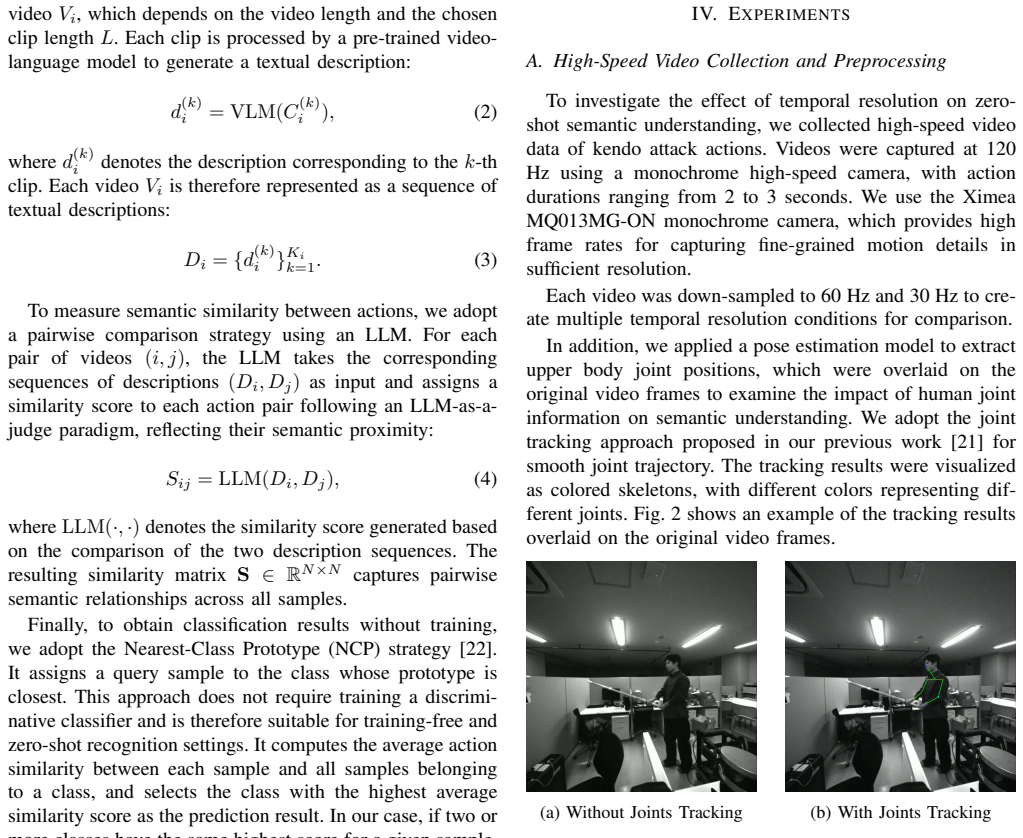


read the original abstract
Understanding human actions from visual observations is essential for human--robot interaction, particularly when semantic interpretation of unfamiliar or hard-to-annotate actions is required. In scenarios such as rapid and less common activities, collecting sufficient labeled data for supervised learning is challenging, making zero-shot approaches a practical alternative for semantic understanding without task-specific training. While recent advances in large-scale pretrained models enable such zero-shot reasoning, the impact of temporal resolution, especially for rapid and fine-grained motions, remains underexplored. In this study, we investigate how temporal resolution affects zero-shot semantic understanding of high-speed human actions. Using kendo as a representative case of rapid and subtle motion patterns, we propose a training-free pipeline that combines a pre-trained video-language model for semantic representation with large language model-based reasoning for pairwise action comparison. Through controlled experiments across multiple frame rates (120 Hz, 60 Hz, and 30 Hz), we show that higher temporal resolution significantly improves semantic separability in zero-shot settings. We further analyze the role of tracking-based human joint information under both full and partial observation scenarios. Quantitative evaluation using a nearest-class prototype strategy demonstrates that high-speed video provides more stable and interpretable semantic representations for fast actions. These findings highlight the importance of temporal resolution in training-free action recognition and suggest that high-speed perception can enhance semantic understanding capabilities.
Editorial analysis
A structured set of objections, weighed in public.
Referee Report
Summary. The manuscript claims that higher temporal resolution in video input (120 Hz vs. 60 Hz vs. 30 Hz) improves zero-shot semantic separability of rapid human actions such as kendo. It introduces a training-free pipeline that extracts representations from a pre-trained video-language model and uses an LLM for pairwise reasoning, then evaluates via a nearest-class prototype strategy. Additional analysis examines the contribution of tracking-derived joint information under full and partial observation conditions. The central result is that high-speed video yields more stable and interpretable semantic representations for fast motions.
Significance. If the result holds after addressing input-sampling confounds, the work would provide empirical support for the value of high temporal resolution in training-free zero-shot action understanding, a setting relevant to human-robot interaction where labeled data for rare fast actions is scarce. The controlled multi-rate experiments and use of nearest-class prototypes constitute a clear, falsifiable test rather than a fitted model. Generalization beyond the kendo domain and verification that gains are not artifacts of sampling density remain open questions that would determine broader impact.
major comments (3)
- [§4] §4 (Experimental Setup): The description of VLM input preparation does not specify whether a fixed number of frames or a fixed temporal duration is used when downsampling to 60 Hz and 30 Hz. If clip duration is held constant, the 120 Hz condition supplies more frames and therefore denser motion cues within the model's receptive field; this directly confounds the attribution of improved nearest-class prototype separability to 'temporal resolution' rather than sampling density.
- [§5] §5 (Quantitative Evaluation): The nearest-class prototype results are reported without error bars, standard deviations across runs, or statistical significance tests. Because the central claim rests on comparative separability across frame rates, the absence of these measures leaves open whether observed differences are reliable or sensitive to prototype construction details and data partitioning.
- [§3.2] §3.2 (Pipeline Description): The claim that the pre-trained VLM 'preserves and the LLM reliably reasons over temporal dynamics' at higher frame rates is not accompanied by a control that isolates resolution from other high-speed effects (e.g., reduced motion blur). Without such a control, the interpretation that gains stem specifically from finer temporal dynamics remains under-supported.
minor comments (2)
- [Abstract] Abstract: The phrase 'quantitative evaluation using a nearest-class prototype strategy demonstrates...' does not name the concrete metric (accuracy, cosine similarity, etc.) or the number of classes/actions involved, making the strength of the reported improvement difficult to gauge from the summary alone.
- [§4] The manuscript would benefit from an explicit statement of the total number of video clips, the exact train/test split (if any), and any exclusion criteria applied to the kendo recordings.
Simulated Author's Rebuttal
We thank the referee for the insightful comments, which help improve the clarity and rigor of our work. Below we respond to each major comment and indicate the revisions we will implement.
read point-by-point responses
-
Referee: [§4] §4 (Experimental Setup): The description of VLM input preparation does not specify whether a fixed number of frames or a fixed temporal duration is used when downsampling to 60 Hz and 30 Hz. If clip duration is held constant, the 120 Hz condition supplies more frames and therefore denser motion cues within the model's receptive field; this directly confounds the attribution of improved nearest-class prototype separability to 'temporal resolution' rather than sampling density.
Authors: We agree this detail is important for interpreting the results. Our setup fixes the temporal duration of the clips (e.g., the time span of each kendo action sequence remains the same). Lower frame rates are generated by subsampling the original 120 Hz footage, resulting in fewer frames but the same time coverage. The higher number of frames at 120 Hz is thus the direct result of higher temporal resolution. We will revise the Experimental Setup section to clearly state that clip duration is constant and explain that this denser sampling is the intended variable under study. revision: yes
-
Referee: [§5] §5 (Quantitative Evaluation): The nearest-class prototype results are reported without error bars, standard deviations across runs, or statistical significance tests. Because the central claim rests on comparative separability across frame rates, the absence of these measures leaves open whether observed differences are reliable or sensitive to prototype construction details and data partitioning.
Authors: We acknowledge the lack of variability measures. To address this, we will rerun the nearest-class prototype evaluation over multiple random selections of prototypes and data splits, reporting means and standard deviations. We will also add statistical tests to verify the significance of differences between frame rates. revision: yes
-
Referee: [§3.2] §3.2 (Pipeline Description): The claim that the pre-trained VLM 'preserves and the LLM reliably reasons over temporal dynamics' at higher frame rates is not accompanied by a control that isolates resolution from other high-speed effects (e.g., reduced motion blur). Without such a control, the interpretation that gains stem specifically from finer temporal dynamics remains under-supported.
Authors: This is a substantive concern. While our study uses real high-speed video where motion blur decreases with frame rate, we did not include an explicit control experiment to decouple these factors. We will modify the language in §3.2 to avoid overclaiming specificity to temporal dynamics alone and add a limitations paragraph discussing this potential confound and how it could be addressed in future work with additional controls. revision: partial
Circularity Check
No circularity in empirical comparison of frame rates
full rationale
The paper reports a training-free experimental pipeline that feeds video clips at controlled frame rates (120 Hz, 60 Hz, 30 Hz) into a fixed pre-trained video-language model, extracts representations, and evaluates zero-shot separability via nearest-class prototypes and LLM pairwise reasoning. No equations, fitted parameters, or derivations are presented; the central claim rests on direct side-by-side measurement of the same actions under different sampling rates. No self-citations are invoked as load-bearing uniqueness theorems or ansatzes, and the evaluation metric is externally defined rather than constructed from the paper's own outputs. The derivation chain is therefore self-contained against external benchmarks.
Axiom & Free-Parameter Ledger
axioms (2)
- domain assumption Pre-trained video-language models capture semantically useful temporal information that scales with frame rate.
- domain assumption LLM-based pairwise comparison provides a reliable measure of semantic separability.
Reference graph
Works this paper leans on
-
[1]
Spatial temporal graph convolutional networks for skeleton-based action recognition,
S. Yan, Y . Xiong, and D. Lin, “Spatial temporal graph convolutional networks for skeleton-based action recognition,” inProceedings of the AAAI Conference on Artificial Intelligence, vol. 32, no. 1, 2018
2018
-
[2]
Channel- wise topology refinement graph convolution for skeleton-based action recognition,
Y . Chen, Z. Zhang, C. Yuan, B. Li, Y . Deng, and W. Hu, “Channel- wise topology refinement graph convolution for skeleton-based action recognition,” inProceedings of the IEEE/CVF international confer- ence on computer vision, 2021, pp. 13 359–13 368
2021
-
[3]
Skeleton- based action recognition with shift graph convolutional network,
K. Cheng, Y . Zhang, X. He, W. Chen, J. Cheng, and H. Lu, “Skeleton- based action recognition with shift graph convolutional network,” in Proceedings of the IEEE/CVF conference on computer vision and pattern recognition, 2020, pp. 183–192
2020
-
[4]
Degcn: Deformable graph convolutional networks for skeleton-based action recognition,
W. Myung, N. Su, J.-H. Xue, and G. Wang, “Degcn: Deformable graph convolutional networks for skeleton-based action recognition,”IEEE Transactions on Image Processing, vol. 33, pp. 2477–2490, 2024
2024
-
[5]
Blockgcn: Redefine topology awareness for skeleton-based action recognition,
Y . Zhou, X. Yan, Z.-Q. Cheng, Y . Yan, Q. Dai, and X.-S. Hua, “Blockgcn: Redefine topology awareness for skeleton-based action recognition,” inProceedings of the IEEE/CVF Conference on Com- puter Vision and Pattern Recognition, 2024, pp. 2049–2058
2024
-
[6]
H. Liu, Y . Liu, M. Ren, H. Wang, Y . Wang, and Z. Sun, “Revealing key details to see differences: A novel prototypical perspective for skeleton-based action recognition,”arXiv preprint arXiv:2411.18941, 2024
-
[7]
Infogcn: Representation learning for human skeleton-based action recognition,
H.-g. Chi, M. H. Ha, S. Chi, S. W. Lee, Q. Huang, and K. Ramani, “Infogcn: Representation learning for human skeleton-based action recognition,” inProceedings of the IEEE/CVF conference on computer vision and pattern recognition, 2022, pp. 20 186–20 196
2022
-
[8]
Two-stream adaptive graph convolutional networks for skeleton-based action recognition,
L. Shi, Y . Zhang, J. Cheng, and H. Lu, “Two-stream adaptive graph convolutional networks for skeleton-based action recognition,” in Proceedings of the IEEE/CVF Conference on Computer Vision and Pattern Recognition, 2019
2019
-
[9]
Temporal decoupling graph convolutional network for skeleton-based gesture recognition,
J. Liu, X. Wang, C. Wang, Y . Gao, and M. Liu, “Temporal decoupling graph convolutional network for skeleton-based gesture recognition,” IEEE Transactions on Multimedia, vol. 26, pp. 811–823, 2023
2023
-
[10]
Motionclip: Exposing human motion generation to clip space,
G. Tevet, B. Gordon, A. Hertz, A. H. Bermano, and D. Cohen-Or, “Motionclip: Exposing human motion generation to clip space,” in European Conference on Computer Vision (ECCV). Springer, 2022, pp. 358–374
2022
-
[11]
Learning transferable visual models from natural language supervision,
A. Radford, J. W. Kim, C. Hallacy, A. Ramesh, G. Goh, S. Agarwal, G. Sastry, A. Askell, P. Mishkin, J. Clark,et al., “Learning transferable visual models from natural language supervision,” inInternational Conference on Machine Learning. PmLR, 2021, pp. 8748–8763
2021
-
[12]
Pevl: Pose-enhanced vision-language model for fine-grained human action recognition,
H. Zhang, M. C. Leong, L. Li, and W. Lin, “Pevl: Pose-enhanced vision-language model for fine-grained human action recognition,” in Proceedings of the IEEE/CVF Conference on Computer Vision and Pattern Recognition, 2024, pp. 18 857–18 867
2024
-
[13]
Llms are good action recognizers,
H. Qu, Y . Cai, and J. Liu, “Llms are good action recognizers,” in Proceedings of the IEEE/CVF Conference on Computer Vision and Pattern Recognition, 2024, pp. 18 395–18 406
2024
-
[14]
Generative action description prompts for skeleton-based action recognition,
W. Xiang, C. Li, Y . Zhou, B. Wang, and L. Zhang, “Generative action description prompts for skeleton-based action recognition,” in Proceedings of the IEEE/CVF International Conference on Computer Vision, 2023, pp. 10 276–10 285
2023
-
[15]
Training-free zero- shot temporal action detection with vision-language models,
C. Han, H. Wang, J. Kuang, L. Zhang, and J. Gui, “Training-free zero- shot temporal action detection with vision-language models,”arXiv preprint arXiv:2501.13795, 2025
-
[16]
Text-enhanced zero-shot action recognition: A training- free approach,
M. Bosetti, S. Zhang, B. Liberatori, G. Zara, E. Ricci, and P. Rota, “Text-enhanced zero-shot action recognition: A training- free approach,” inInternational Conference on Pattern Recognition. Springer, 2024, pp. 327–342
2024
-
[17]
The wisdom of crowds: Temporal progressive attention for early action prediction,
A. Stergiou and D. Damen, “The wisdom of crowds: Temporal progressive attention for early action prediction,” inProceedings of the IEEE/CVF Conference on Computer Vision and Pattern Recognition, 2023, pp. 14 709–14 719
2023
-
[18]
Rich action-semantic consistent knowledge for early action prediction,
X. Liu, J. Yin, D. Guo, and H. Liu, “Rich action-semantic consistent knowledge for early action prediction,”IEEE Transactions on Image Processing, vol. 33, pp. 479–492, 2023
2023
-
[19]
Motion generation for a sword-fighting robot based on quick detection of opposite player’s initial motions,
A. Namiki and F. Takahashi, “Motion generation for a sword-fighting robot based on quick detection of opposite player’s initial motions,” Journal of Robotics and Mechatronics, vol. 27, no. 5, pp. 543–551, 2015
2015
-
[20]
Strikes-thrusts activity recognition using wrist sensor towards pervasive kendo support system,
M. Takata, Y . Nakamura, Y . Torigoe, M. Fujimoto, Y . Arakawa, and K. Yasumoto, “Strikes-thrusts activity recognition using wrist sensor towards pervasive kendo support system,” in2019 IEEE International Conference on Pervasive Computing and Communications Workshops (PerCom Workshops), 2019, pp. 243–248
2019
-
[21]
Marker-less kendo motion prediction using high-speed dual-camera system and lstm method,
Y . Cao and Y . Yamakawa, “Marker-less kendo motion prediction using high-speed dual-camera system and lstm method,” in2022 IEEE/ASME International Conference on Advanced Intelligent Mecha- tronics (AIM), 2022, pp. 159–164
2022
-
[22]
Distance-based image classification: Generalizing to new classes at near-zero cost,
T. Mensink, J. Verbeek, F. Perronnin, and G. Csurka, “Distance-based image classification: Generalizing to new classes at near-zero cost,” IEEE Transactions on Pattern Analysis and Machine Intelligence, vol. 35, no. 11, pp. 2624–2637, 2013
2013
-
[23]
InternVideo2.5: Empowering video MLLMs with long and rich context modeling.arXiv:2501.12386, 2025
Y . Wang, X. Li, Z. Yan, Y . He, J. Yu, X. Zeng, C. Wang, C. Ma, H. Huang, J. Gao,et al., “Internvideo2. 5: Empowering video mllms with long and rich context modeling,”arXiv preprint arXiv:2501.12386, 2025
discussion (0)
Sign in with ORCID, Apple, or X to comment. Anyone can read and Pith papers without signing in.