Recognition: unknown
Spectral Duality and Reset-Neutral Distributions in Random Walks with Multi-Site Geometric Resetting
Pith reviewed 2026-05-09 18:51 UTC · model grok-4.3
The pith
Spectral duality on reset sites creates distributions where the coupling constant in reset random walks stays independent of the resetting rate.
A machine-rendered reading of the paper's core claim, the machinery that carries it, and where it could break.
Core claim
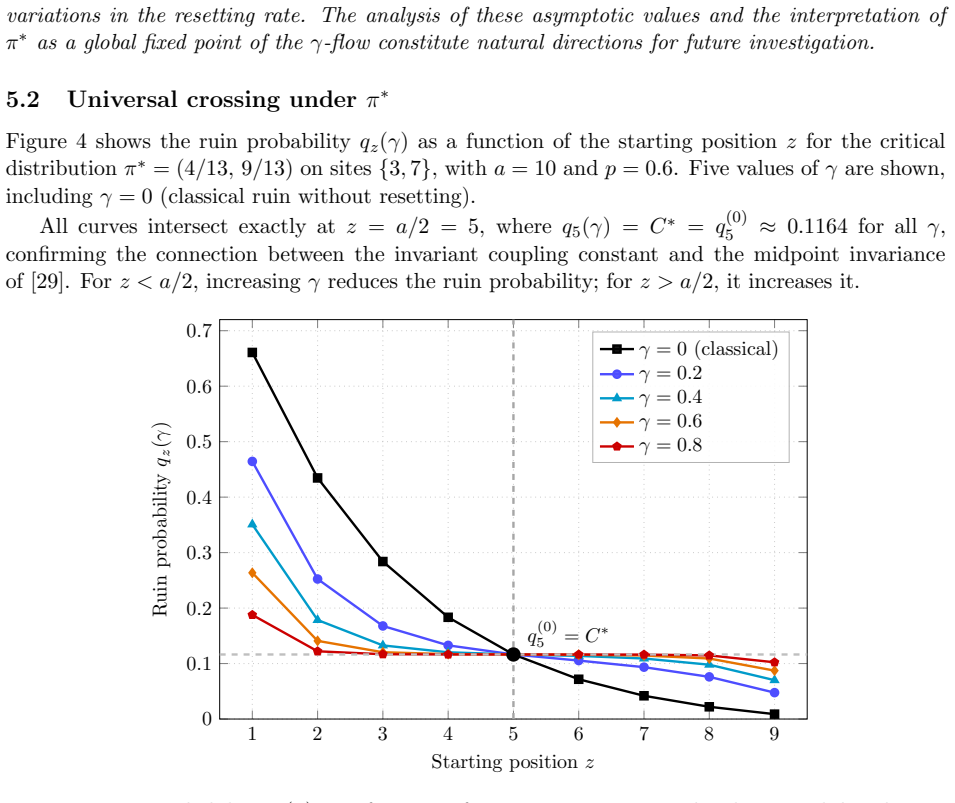
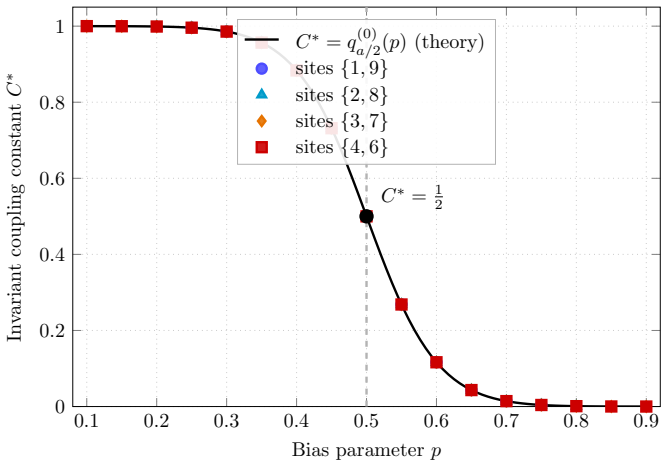
For any absorbed Markov chain admitting a spectral decomposition, a reset-neutral distribution π* exists such that C(π*,γ) is independent of γ whenever there is an involution σ on the reset sites and ν-independent weights κ(z) satisfying B_ν(z) = κ(z) A_ν(σ(z)) for every spectral mode ν. In the biased random walk this condition reduces to the geometric symmetry z_i + z_i' = a for each pair of reset sites, and the invariant value is always C* = q_{a/2}^{(0)}, the ruin probability from the midpoint with no resetting.
What carries the argument
The spectral duality condition: an involution σ on the reset sites together with rate-independent weights κ(z) such that the spectral coefficients obey B_ν(z) = κ(z) A_ν(σ(z)) for all modes ν.
If this is right
- The ruin probability loses all dependence on the resetting rate when the neutral distribution is used.
- The neutral coupling constant is invariably the classical midpoint ruin probability, independent of bias and number of sites.
- The result applies for every interval length a, every bias p in (0,1), and any number m of reset sites.
- Reset distributions partition into phases separated by the neutral distribution, with monotone behavior on each side.
Where Pith is reading between the lines
- The same duality criterion could identify neutral resetting policies in other absorbed birth-death chains or queueing models.
- Continuous-space limits of the construction may yield analogous neutral points for Brownian motion with multi-site resetting.
- Numerical optimization of reset distributions to minimize sensitivity to γ would naturally select configurations near the neutral surface.
Load-bearing premise
The absorbed Markov chain admits a spectral decomposition via Doob symmetrization and the duality relation holds for some involution on the reset sites.
What would settle it
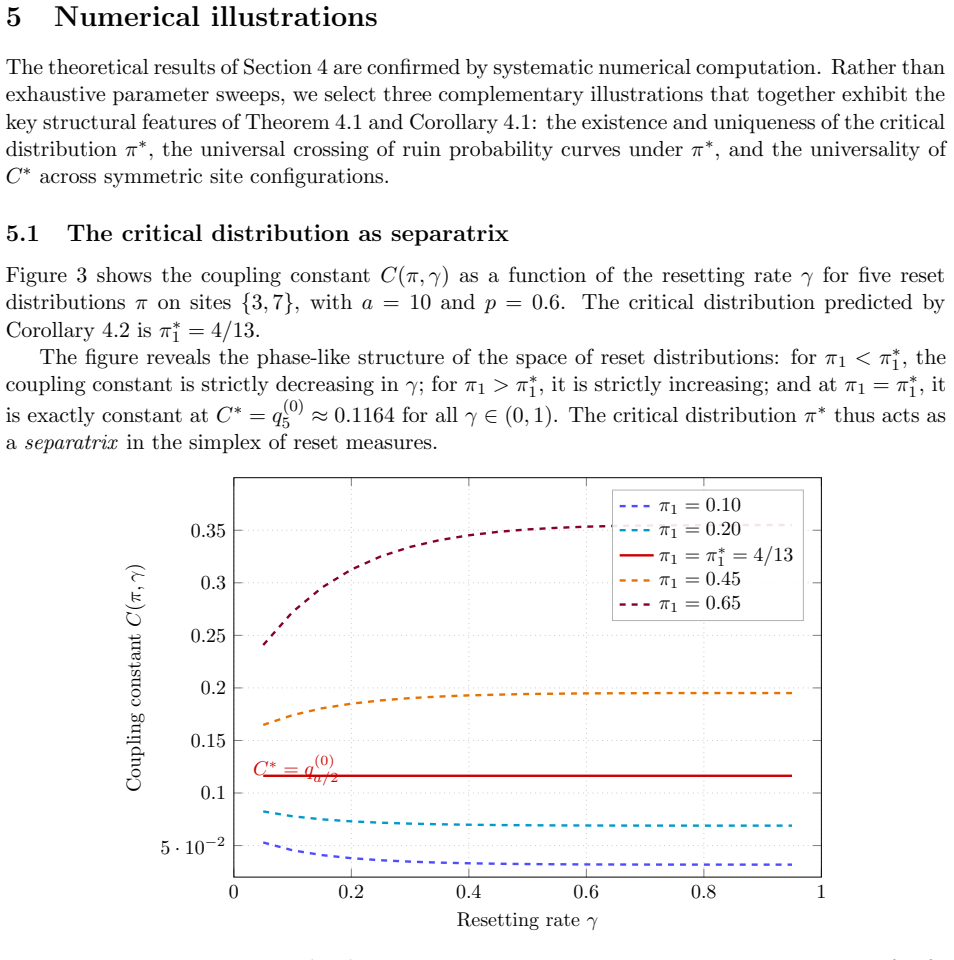
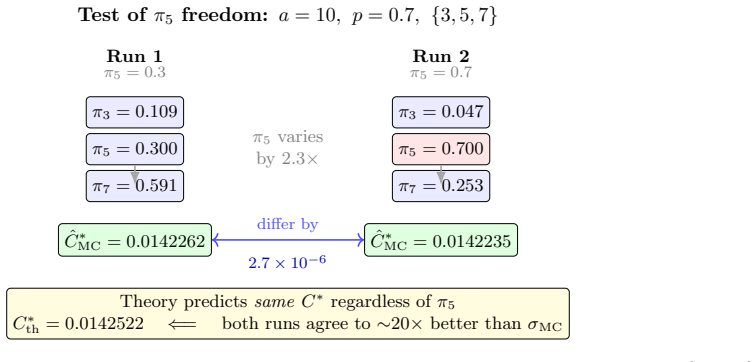
Numerical computation of C(π,γ) for reset sites that violate z + z' = a should show clear dependence on γ, while the same computation for symmetric pairs should remain flat across γ values.
Figures


read the original abstract
We study the gambler's ruin problem for a biased random walk on $\{0,1,\dots,a\}$ under multi-site geometric resetting: at each time step, the walker is reset with probability $\gamma\in(0,1)$ to a random position drawn from a distribution $\pi$ over $m$ interior sites. Using renewal theory, we derive an exact closed-form expression for the ruin probability $q_z(\gamma)$, showing that the effect of $\pi$ is fully encoded in a single scalar quantity, the \emph{coupling constant} $C(\pi,\gamma)=\bar{u}_\pi/\bar{s}_\pi$. A spectral analysis via Doob symmetrization reveals the structure of this coupling. Our main result is a general criterion -- valid for any absorbed Markov chain admitting a spectral decomposition -- for the existence of a \emph{reset-neutral} distribution $\pi^*$ such that $C(\pi^*,\gamma)$ is independent of $\gamma$. This occurs under a spectral duality condition: there exists an involution $\sigma$ on the reset sites and $\nu$-independent weights $\kappa(z)$ such that $B_\nu(z) = \kappa(z)\,A_\nu(\sigma(z))$ for all spectral modes $\nu$. When this condition holds, the invariant value is $C^* = q_{a/2}^{(0)}$, the classical ruin probability from the midpoint, independent of the choice of symmetric reset sites or resetting rate. For the biased random walk, the condition reduces to the geometric symmetry $z_i + z_i' = a$. This result holds for any $a$, any number of reset sites $m$, and any bias $p\in(0,1)$. Both analytical and Monte Carlo simulations confirm the theory with high precision, including tests of spectrally neutral sites. Numerical results also reveal a phase-like structure in the space of reset distributions, with $\pi^*$ acting as a separatrix between monotone regimes.
Editorial analysis
A structured set of objections, weighed in public.
Referee Report
Summary. The paper studies the gambler's ruin problem for a biased random walk on {0,1,...,a} with multi-site geometric resetting at rate γ to a distribution π over m interior sites. Using renewal theory, it derives an exact closed-form for the ruin probability q_z(γ) in which the reset distribution enters only through a scalar coupling constant C(π,γ) = ū_π / s̄_π. A spectral analysis via Doob symmetrization yields a general sufficient criterion, valid for any absorbed Markov chain admitting a spectral decomposition, for the existence of a reset-neutral distribution π* such that C(π*,γ) is independent of γ: there must exist an involution σ on the reset sites and ν-independent weights κ(z) satisfying B_ν(z) = κ(z) A_ν(σ(z)) for all spectral modes ν. When the condition holds, C* equals the classical midpoint ruin probability q_{a/2}^{(0)}. For the biased walk the duality reduces to the geometric pairing z_i + z_i' = a. The claims are supported by both the closed-form derivation and Monte Carlo simulations that also reveal a phase-like structure in the space of reset distributions.
Significance. If the central claims hold, the work supplies a broadly applicable sufficient condition for reset-neutrality in absorbed chains that admit Doob symmetrization, together with an explicit closed-form expression for the ruin probability and a concrete reduction to the classical midpoint probability. The combination of renewal theory for the exact expression and spectral duality for the γ-independence is technically elegant and identifies a separatrix in the space of reset distributions. The Monte Carlo confirmation for the biased walk and the verification that the duality condition is satisfied by the geometric pairing add concrete support. These elements together advance the understanding of resetting mechanisms in stochastic processes.
major comments (2)
- [Main result / spectral duality paragraph] The general criterion is stated as sufficient rather than necessary; the manuscript should clarify whether the spectral duality condition is also necessary for C to be γ-independent, or provide a counter-example showing that other mechanisms could cancel the γ-dependence (see the paragraph following the statement of the main result).
- [Numerical results / Monte Carlo confirmation] The Monte Carlo section reports high-precision agreement but does not specify the number of trajectories, the length of each run, or how error bars were computed; without these details it is difficult to assess the statistical support for the phase-like structure and the tests of spectrally neutral sites.
minor comments (3)
- [Spectral analysis section] The notation for the spectral modes A_ν and B_ν is introduced without an explicit reference to the Doob-transformed transition matrix; a brief reminder of the symmetrized operator would improve readability.
- [Abstract and introduction] In the abstract and introduction the phrase 'any absorbed Markov chain admitting a spectral decomposition' should be qualified by the precise technical assumption (Doob symmetrization yielding a self-adjoint operator with discrete spectrum).
- [Numerical figures] Figure captions for the phase diagrams should state the fixed values of a, p, and m used in the simulations.
Simulated Author's Rebuttal
We thank the referee for the positive assessment of our work and for the constructive comments, which help improve the clarity and reproducibility of the manuscript. We address each major comment below.
read point-by-point responses
-
Referee: The general criterion is stated as sufficient rather than necessary; the manuscript should clarify whether the spectral duality condition is also necessary for C to be γ-independent, or provide a counter-example showing that other mechanisms could cancel the γ-dependence (see the paragraph following the statement of the main result).
Authors: We appreciate this suggestion. The main result is deliberately formulated as a sufficient condition derived from the spectral decomposition and the structure of the coupling constant C(π,γ). We do not assert necessity, as other mechanisms (e.g., accidental cancellations in the functional dependence on γ) might exist in principle, though none are apparent from the renewal equation or the Doob symmetrization. In the revised version we will insert a brief clarifying remark immediately after the statement of the main result, explicitly noting that the duality condition is sufficient and that necessity remains an open question outside the scope of the present spectral approach. No counter-example has been identified, but we agree that stating this limitation improves precision. revision: partial
-
Referee: The Monte Carlo section reports high-precision agreement but does not specify the number of trajectories, the length of each run, or how error bars were computed; without these details it is difficult to assess the statistical support for the phase-like structure and the tests of spectrally neutral sites.
Authors: We agree that these implementation details are necessary for reproducibility. In the revised manuscript we will add the following information to the Monte Carlo section and the relevant figure captions: all simulations used 10^6 independent trajectories per parameter point; each trajectory was run for a maximum of 10^5 steps or until absorption or reset; error bars represent the standard error of the mean computed over 100 independent batches of 10^4 trajectories each. These additions will allow readers to assess the statistical support for the reported phase-like structure and the verification of spectrally neutral sites. revision: yes
Circularity Check
No significant circularity; derivation self-contained
full rationale
The paper first obtains an exact closed-form ruin probability q_z(γ) via renewal theory, with the reset distribution π entering only through the scalar coupling C(π,γ) = ū_π / s̄_π. It then applies Doob symmetrization to produce the spectral expansion and isolates the algebraic condition on the eigenvectors (existence of involution σ and ν-independent κ such that B_ν(z) = κ(z) A_ν(σ(z))) that forces all γ-dependent terms to cancel. This condition is introduced as a sufficient criterion, not as a definition of the target quantity; when it holds, C* equals the classical midpoint ruin probability q_{a/2}^{(0)} by direct substitution. For the biased gambler's ruin the condition reduces to the geometric pairing z_i + z_i' = a, which is independently verifiable by plugging the known eigenvectors into the duality relation. No parameter is fitted to data and then relabeled a prediction, no ansatz is smuggled via self-citation, and the central claim remains a conditional mathematical statement rather than a tautology. Simulations are presented only as numerical confirmation.
Axiom & Free-Parameter Ledger
axioms (1)
- domain assumption The absorbed Markov chain admits a spectral decomposition.
Reference graph
Works this paper leans on
-
[1]
Pearson, The problem of the random walk,Nature72, 294 (1905)
K. Pearson, The problem of the random walk,Nature72, 294 (1905)
1905
-
[2]
Einstein, ¨Uber die von der molekularkinetischen Theorie der W¨ arme geforderte Bewegung, Ann
A. Einstein, ¨Uber die von der molekularkinetischen Theorie der W¨ arme geforderte Bewegung, Ann. Phys.322, 549 (1905)
1905
-
[3]
de Gennes,Scaling Concepts in Polymer Physics(Cornell University Press, Ithaca, 1979)
P.-G. de Gennes,Scaling Concepts in Polymer Physics(Cornell University Press, Ithaca, 1979)
1979
-
[4]
G. M. Viswanathan et al., L´ evy flight search patterns of wandering albatrosses,Nature381, 413 (1996)
1996
-
[5]
R. N. Mantegna and H. E. Stanley,An Introduction to Econophysics(Cambridge University Press, Cambridge, 2000)
2000
-
[6]
Lov´ asz, Random walks on graphs: A survey, inCombinatorics, Paul Erd˝ os is Eighty, Vol
L. Lov´ asz, Random walks on graphs: A survey, inCombinatorics, Paul Erd˝ os is Eighty, Vol. 2 (J´ anos Bolyai Mathematical Society, Budapest, 1993), pp. 353–398
1993
-
[7]
Redner,A Guide to First-Passage Processes(Cambridge University Press, Cambridge, 2001)
S. Redner,A Guide to First-Passage Processes(Cambridge University Press, Cambridge, 2001)
2001
-
[8]
Condamin, O
S. Condamin, O. B´ enichou, V. Tejedor, R. Voituriez, and J. Klafter,Nature450, 77 (2007)
2007
-
[9]
Feller,An Introduction to Probability Theory and Its Applications, Vol
W. Feller,An Introduction to Probability Theory and Its Applications, Vol. I, 3rd ed. (Wiley, New York, 1968)
1968
-
[10]
Asmussen,Applied Probability and Queues, 2nd ed
S. Asmussen,Applied Probability and Queues, 2nd ed. (Springer, New York, 2003)
2003
-
[11]
Asmussen and H
S. Asmussen and H. Albrecher,Ruin Probabilities, 2nd ed. (World Scientific, Singapore, 2010)
2010
-
[12]
Schuss,Theory and Applications of Stochastic Processes(Springer, New York, 2010)
Z. Schuss,Theory and Applications of Stochastic Processes(Springer, New York, 2010)
2010
-
[13]
Kahneman and A
D. Kahneman and A. Tversky, Prospect theory,Econometrica47, 263 (1979)
1979
-
[14]
M. R. Evans and S. N. Majumdar, Diffusion with stochastic resetting,Phys. Rev. Lett.106, 160601 (2011)
2011
-
[15]
Ku´ smierz and E
L. Ku´ smierz and E. Gudowska-Nowak,Phys. Rev. E92, 052127 (2014)
2014
-
[16]
Reuveni,Phys
S. Reuveni,Phys. Rev. Lett.116, 170601 (2016)
2016
-
[17]
Pal and V
A. Pal and V. V. Prasad,Phys. Rev. E99, 032123 (2019)
2019
-
[18]
Rotbart, S
T. Rotbart, S. Reuveni, and M. Urbakh,Phys. Rev. E92, 060101(R) (2015)
2015
-
[19]
Eliazar and S
I. Eliazar and S. Reuveni,J. Phys. A52, 505003 (2019)
2019
-
[20]
Pal,Front
A. Pal,Front. Phys.8, 87 (2020)
2020
-
[21]
M. R. Evans, S. N. Majumdar, and G. Schehr,J. Phys. A53, 193001 (2020). 20
2020
-
[22]
Villarroel and M
J. Villarroel and M. Montero,J. Stat. Mech.2022, 023205 (2022)
2022
-
[23]
A. Pal, S. Kostinski, and S. Reuveni,J. Phys. A55, 021001 (2022)
2022
-
[24]
Villarroel and M
J. Villarroel and M. Montero,Phys. Rev. E107, 024108 (2023)
2023
-
[25]
Villarroel and M
J. Villarroel and M. Montero,Phys. Rev. E108, 054117 (2023)
2023
-
[26]
Gupta, C
D. Gupta, C. A. Plata, and A. Pal,Phys. Rev. Lett.124, 110608 (2020)
2020
-
[27]
H. Chen, G. Tang, and Z. Hou,Chaos34, 023127 (2024)
2024
-
[28]
De Bruyne, S
B. De Bruyne, S. N. Majumdar, and G. Schehr,J. Stat. Mech.2023, 103203 (2023)
2023
-
[29]
Villarroel and J
J. Villarroel and J. A. Vega Coso, Critical spectral invariants in random walks with geometric resetting,Phys. Rev. E(submitted, 2026)
2026
-
[30]
Bartumeus, J
F. Bartumeus, J. Catalan, U. L. Fulco, M. L. Lyra, and G. M. Viswanathan, Optimizing the encounter rate in biological interactions: L´ evy versus Brownian strategies,Phys. Rev. Lett.88, 097901 (2002)
2002
-
[31]
B´ enichou, C
O. B´ enichou, C. Loverdo, M. Moreau, and R. Voituriez,Rev. Mod. Phys.83, 81 (2011)
2011
-
[32]
J. L. Doob,Stochastic Processes(Wiley, New York, 1953)
1953
-
[33]
J. A. Fill,Ann. Appl. Probab.1, 62 (1991)
1991
-
[34]
L. Miclo,C. R. Acad. Sci. Paris324, 689 (1997)
1997
-
[35]
Lapolla, A
A. Lapolla, A. Godec, and Z. D. Zhang,J. Stat. Phys.190, 119 (2023)
2023
-
[36]
Neri and G
´E. Neri and G. Rotskoff,Phys. Rev. E105, 064137 (2022)
2022
- [37]
-
[38]
Karlin and H
S. Karlin and H. M. Taylor,A First Course in Stochastic Processes(Academic Press, New York, 1968). 21
1968
discussion (0)
Sign in with ORCID, Apple, or X to comment. Anyone can read and Pith papers without signing in.