Recognition: unknown
The NIKA2 Cosmological Legacy Survey in COSMOS: Final 1.2mm and 2mm source catalogs and redshift distribution of dusty star-forming galaxies
Pith reviewed 2026-05-09 19:05 UTC · model grok-4.3
The pith
The redshift distribution of dusty star-forming galaxies from the NIKA2 COSMOS survey matches the SIDES simulation but is inconsistent with four other models.
A machine-rendered reading of the paper's core claim, the machinery that carries it, and where it could break.
Core claim
N2CLS provides a master catalog of 323 mm-selected sources, including 104 detected in both bands. The redshift distribution peaks at 2.8 ± 0.1 for 1.2 mm sources, with 66 galaxies at z > 4. This distribution is consistent with SIDES simulations but statistically inconsistent with four other galaxy evolution models. The survey's homogeneous coverage distinguishes it as the largest contiguous deep mm survey at this depth, and the data products are released as a legacy resource for studying dust-obscured galaxy evolution.
What carries the argument
The compiled redshift distribution of the mm-selected sources, obtained through cross-matching with high-resolution interferometric and radio data, and its statistical comparison to predictions from different galaxy evolution models.
If this is right
- The homogeneous coverage reveals that 25% of sources lack SCUBA2 850 μm counterparts due to non-uniform noise in other surveys.
- Provides a clean sample for studying the physical properties and evolution of high-redshift dusty star-forming galaxies.
- Identifies a significant population of 66 galaxies at redshifts greater than 4.
- Enables direct tests of galaxy formation models using the redshift distribution.
- The released catalogs serve as a legacy dataset for future multi-wavelength studies.
Where Pith is reading between the lines
- The results imply that galaxy evolution models must better account for the dust-obscured star formation rate at z around 3.
- Future mm surveys should prioritize uniform depth to avoid selection biases seen in non-homogeneous maps.
- Additional high-resolution observations could secure redshifts for the remaining unidentified sources and refine the distribution.
- The agreement with SIDES suggests it may be a reliable template for predicting source counts in other fields.
Load-bearing premise
The multi-wavelength counterpart identifications and redshift assignments are accurate and complete enough to reliably compare the observed distribution against the different galaxy evolution models.
What would settle it
Repeating the analysis with a completely independent set of redshift measurements for all sources, particularly the 11 percent without current identifications, and checking if the statistical consistency with SIDES and inconsistency with other models persists.
Figures



read the original abstract
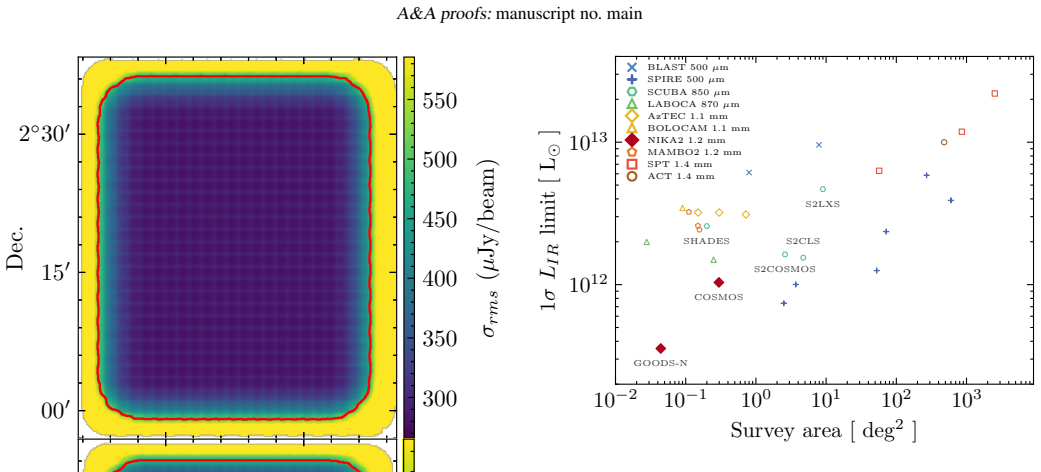
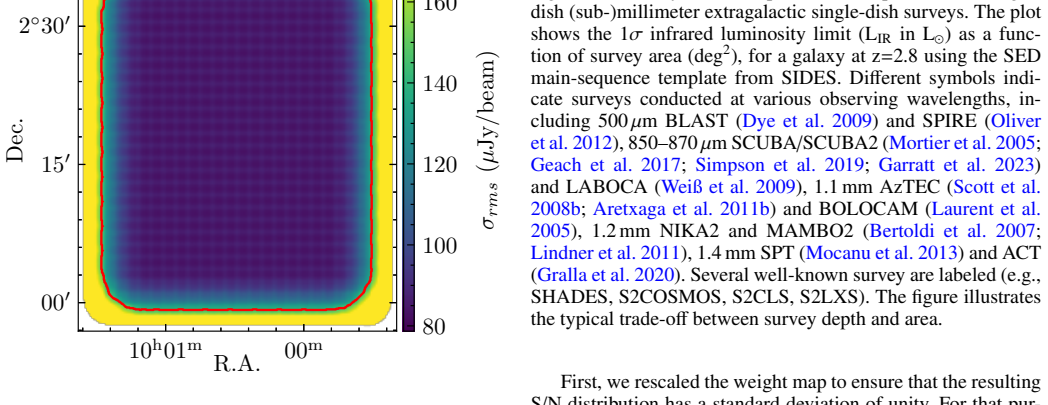
We present the final 1.2mm and 2mm source catalogs and the redshift distribution of the mm-selected population from the NIKA2 Cosmological Legacy Survey (N2CLS) in the COSMOS field. Our aim is to provide a comprehensive dataset for studying the physical properties and evolution of high-redshift DSFGs. N2CLS covers ~1070 arcmin2 with median noise levels of 315$\mu$Jy and 91$\mu$Jy at 1.2 and 2mm, respectively. Sources are extracted with a S/N threshold of 3.9, ensuring >80% purity. Multi-wavelength counterparts are identified using high-resolution interferometric (sub-)mm data (NOEMA, ALMA) and radio observations (VLA, MeerKAT). Redshifts are compiled from spectroscopic and photometric catalogs (e.g., COSMOSWeb). The N2CLS master catalog includes 323 sources detected at >80% purity, with 104 sources detected in both bands, 197 only at 1.2mm, and 22 only at 2mm. Multi-wavelength identifications are secured for ~89% of the sample. The redshift distribution of 1.2mm sources peaks at 2.8$\pm$0.1, consistent with the epoch of peak cosmic star formation. In the total sample, we lack redshift for ~2% of the identified galaxies, plus 34 sources for which no accurate positional proxy is available, preventing the identification of a multi-wavelength counterpart. We identify 66 galaxies at z>4. The observed redshift distribution agrees well with the SIDES simulations, while four other galaxy evolution models are statistically inconsistent with the data. N2CLS is the largest contiguous deep survey to date with this depth and homogeneous coverage. This homogeneous coverage is important, as 25% of N2CLS sources lack a SCUBA2 850 mic counterpart, likely because the strongly non-uniform noise distribution of the SCUBA2 map results in lower sensitivity in parts of the field.The released data products provide a legacy dataset for studying dust-obscured galaxy evolution.
Editorial analysis
A structured set of objections, weighed in public.
Referee Report
Summary. The manuscript presents the final 1.2 mm and 2 mm source catalogs from the NIKA2 Cosmological Legacy Survey (N2CLS) in COSMOS, covering ~1070 arcmin² with median noise levels of 315 μJy and 91 μJy. Sources are extracted at S/N > 3.9 (claimed >80% purity), yielding 323 sources (104 detected in both bands). Multi-wavelength counterparts are identified for ~89% using NOEMA, ALMA, VLA, MeerKAT, and COSMOSWeb data, with redshifts compiled from spectroscopic and photometric catalogs. The redshift distribution of the 1.2 mm sources peaks at z = 2.8 ± 0.1, with 66 sources at z > 4; it agrees with SIDES simulations but is statistically inconsistent with four other galaxy evolution models. The work emphasizes homogeneous coverage and releases the catalogs as a legacy dataset.
Significance. If the purity, completeness, and redshift assignments hold, this constitutes a substantial observational contribution as the largest contiguous deep mm survey at this depth and uniformity. The direct comparison of the observed redshift distribution to multiple models provides a falsifiable test of galaxy evolution scenarios, and the explicit release of data products enables community follow-up on dust-obscured star formation. The note that 25% of sources lack SCUBA-2 850 μm counterparts due to non-uniform noise further highlights the value of the homogeneous NIKA2 coverage.
major comments (3)
- [Source extraction and purity assessment] Source extraction section: the claim that S/N > 3.9 guarantees >80% purity is based on simulations, but only median noise levels are reported rather than a spatially resolved noise map. Local variations across the 1070 arcmin² field could locally degrade purity, which would directly affect the shape of the redshift distribution (including the z > 4 tail) used for the model comparisons.
- [Multi-wavelength counterpart identification] Counterpart identification and redshift compilation: ~11% of sources (34 without positional proxies) plus ~2% of identified sources lack redshifts. The manuscript must quantify whether these incompletenesses are random or preferentially remove high-z objects; otherwise the statistical tests for inconsistency with the four galaxy evolution models rest on an unverified assumption of representativeness.
- [Redshift distribution and model comparisons] Redshift distribution and model comparison section: the statement that the distribution is 'statistically inconsistent' with four models requires explicit description of the test statistic (e.g., KS or χ²), how redshift uncertainties and the 11% incompleteness are propagated, and a sensitivity analysis showing that the SIDES agreement and other-model discrepancies survive these effects.
minor comments (3)
- [Abstract] Abstract: the phrase 'the total sample' is ambiguous; clarify whether the z = 2.8 peak and model comparisons refer to the full 323-source catalog or the 1.2 mm subset.
- [Throughout manuscript] Figure captions and text: ensure all noise values are given with units and that 'DSFG' is defined at first use.
- [Data products and release] Data-release paragraph: specify the exact file formats, column descriptions, and repository location for the released catalogs to maximize usability.
Simulated Author's Rebuttal
We thank the referee for the constructive and detailed comments, which have helped us improve the clarity and robustness of the manuscript. We address each major comment point-by-point below and will revise the paper accordingly.
read point-by-point responses
-
Referee: [Source extraction and purity assessment] Source extraction section: the claim that S/N > 3.9 guarantees >80% purity is based on simulations, but only median noise levels are reported rather than a spatially resolved noise map. Local variations across the 1070 arcmin² field could locally degrade purity, which would directly affect the shape of the redshift distribution (including the z > 4 tail) used for the model comparisons.
Authors: We agree that a spatially resolved noise map strengthens the purity claim. In the revised manuscript we will add the noise map (derived from the jackknife maps already used in the extraction) and re-run the purity simulations on a per-pixel basis. We will show that the fraction of the area where local purity drops below 80% is <5% and that the 66 z>4 sources are not preferentially located in those regions. This will confirm that the redshift distribution shape is robust. revision: yes
-
Referee: [Multi-wavelength counterpart identification] Counterpart identification and redshift compilation: ~11% of sources (34 without positional proxies) plus ~2% of identified sources lack redshifts. The manuscript must quantify whether these incompletenesses are random or preferentially remove high-z objects; otherwise the statistical tests for inconsistency with the four galaxy evolution models rest on an unverified assumption of representativeness.
Authors: We will add a dedicated subsection quantifying the incompleteness. We will compare the 1.2 mm flux, 2 mm flux, and S/N distributions of sources with and without redshifts (and with/without positional proxies) using Kolmogorov-Smirnov tests. We will also perform a worst-case sensitivity test by assigning the highest plausible redshifts (z=6) to the 36 sources lacking redshifts and re-computing the model comparison statistics; the inconsistencies with the four models remain significant. These additions will be included in the revised version. revision: yes
-
Referee: [Redshift distribution and model comparisons] Redshift distribution and model comparison section: the statement that the distribution is 'statistically inconsistent' with four models requires explicit description of the test statistic (e.g., KS or χ²), how redshift uncertainties and the 11% incompleteness are propagated, and a sensitivity analysis showing that the SIDES agreement and other-model discrepancies survive these effects.
Authors: We will explicitly state that we employ a two-sample Kolmogorov-Smirnov test (with Monte-Carlo resampling to incorporate photometric redshift uncertainties) and describe the propagation of the 11% incompleteness via the same worst-case assignment described above. A new sensitivity panel will be added showing that the SIDES agreement and the discrepancies with the other four models are stable under these variations. The revised text will make the statistical procedure fully reproducible. revision: yes
Circularity Check
No circularity: direct observational catalogs and external model comparisons
full rationale
The paper presents source catalogs from NIKA2 1.2mm and 2mm observations in COSMOS, extracted at S/N>3.9, with multi-wavelength counterparts identified via external interferometric and radio data (NOEMA, ALMA, VLA, MeerKAT) and redshifts compiled from independent catalogs (COSMOSWeb and others). The redshift distribution (peaking at 2.8, 66 sources at z>4) is a direct count from these compiled data and is compared to external simulations (SIDES and four other models). No equations, fitted parameters, or predictions reduce to the paper's inputs by construction; no self-citations are load-bearing for the central claims; and the analysis relies on external benchmarks rather than internal self-definition or ansatz smuggling. This is a standard observational catalog paper with no circular derivation chain.
Axiom & Free-Parameter Ledger
free parameters (1)
- S/N detection threshold
axioms (2)
- domain assumption Standard mm/radio source extraction algorithms and multi-wavelength counterpart matching procedures yield reliable identifications for ~89% of sources
- domain assumption Redshifts compiled from spectroscopic and photometric catalogs accurately represent the true distribution of the mm-selected population
Reference graph
Works this paper leans on
-
[1]
PACS Evolutionary Probe (PEP) - A Herschel key program. , keywords =. doi:10.1051/0004-6361/201117107 , archivePrefix =. 1106.3285 , primaryClass =
-
[2]
The Extended Mapping Obscuration to Reionization with ALMA (Ex-MORA) Survey: 5 Source Catalog and Redshift Distribution. , keywords =. doi:10.3847/1538-4357/ae2fda , archivePrefix =. 2408.14546 , primaryClass =
-
[3]
MIGHTEE/COSMOS-3D: the discovery of three spectroscopically confirmed radio-selected star-forming galaxies at z = 4.9─5.6. , keywords =. doi:10.1093/mnras/stag473 , archivePrefix =. 2602.05808 , primaryClass =
-
[4]
Wall, J. V. and Jenkins, C. R. , title =. 2012 , publisher =
2012
-
[5]
Errors in Elliptical Gaussian Fits. , keywords =. doi:10.1086/133871 , adsurl =
-
[6]
Euclid preparation. XVII. Cosmic Dawn Survey: Spitzer Space Telescope observations of the Euclid deep fields and calibration fields. , keywords =. doi:10.1051/0004-6361/202142361 , archivePrefix =. 2110.13928 , primaryClass =
-
[7]
ALMA and JWST Identification of Faint Dusty Star-forming Galaxies up to z 8 and Their Connection with Other Galaxy Populations. , keywords =. doi:10.3847/2041-8213/ae382a , archivePrefix =. 2512.16215 , primaryClass =
-
[8]
The Evolution of the IR Luminosity Function and Dust-obscured Star Formation over the Past 13 Billion Years. , keywords =. doi:10.3847/1538-4357/abdb27 , archivePrefix =. 2101.04734 , primaryClass =
-
[9]
UNIVERSEMACHINE: The correlation between galaxy growth and dark matter halo assembly from z = 0-10. , keywords =. doi:10.1093/mnras/stz1182 , archivePrefix =. 1806.07893 , primaryClass =
-
[10]
The star formation rate and stellar mass limits for submillimetre galaxies implied by recent interferometric observations. , keywords =. doi:10.1093/mnrasl/slt047 , archivePrefix =. 1304.1154 , primaryClass =
-
[11]
What Does a Submillimeter Galaxy Selection Actually Select? The Dependence of Submillimeter Flux Density on Star Formation Rate and Dust Mass. , keywords =. doi:10.1088/0004-637X/743/2/159 , archivePrefix =. 1101.0002 , primaryClass =
-
[12]
Physical properties and evolution of (sub-)millimetre-selected galaxies in the galaxy formation simulation SHARK. , keywords =. doi:10.1093/mnras/staa2861 , archivePrefix =. 2007.09853 , primaryClass =
-
[13]
From the far-ultraviolet to the far-infrared - galaxy emission at 0 z 10 in the SHARK semi-analytic model. , keywords =. doi:10.1093/mnras/stz2427 , archivePrefix =. 1908.03423 , primaryClass =
-
[14]
EAZY: A Fast, Public Photometric Redshift Code
EAZY: A Fast, Public Photometric Redshift Code. , keywords =. doi:10.1086/591786 , archivePrefix =. 0807.1533 , primaryClass =
-
[15]
Accurate photometric redshifts for the CFHT Legacy Survey calibrated using the VIMOS VLT Deep Survey
Accurate photometric redshifts for the CFHT legacy survey calibrated using the VIMOS VLT deep survey. , keywords =. doi:10.1051/0004-6361:20065138 , archivePrefix =. astro-ph/0603217 , primaryClass =
-
[16]
An ALMA survey of submillimeter galaxies in the COSMOS field: Multiwavelength counterparts and redshift distribution. , keywords =. doi:10.1051/0004-6361/201730558 , archivePrefix =. 1708.05748 , primaryClass =
-
[17]
Submm/mm galaxy counterpart identification using a characteristic density distribution. , keywords =. doi:10.1093/mnras/stt155 , archivePrefix =. 1301.6171 , primaryClass =
-
[18]
Millimeter imaging of submillimeter galaxies in the COSMOS field: redshift distribution. , keywords =. doi:10.1051/0004-6361/201219368 , archivePrefix =. 1205.6470 , primaryClass =
-
[19]
doi:10.5281/zenodo.7520530 , url =
Beelen, Alexandre , title =. doi:10.5281/zenodo.7520530 , url =
-
[20]
astropy/photutils: 1.5.0. doi:10.5281/zenodo.6825092 , version =
-
[21]
The evolving far-IR galaxy luminosity function and dust-obscured star formation rate density out to z≃5. , keywords =. doi:10.1093/mnras/stx1843 , archivePrefix =. 1706.00426 , primaryClass =
-
[22]
An ALMA survey of the SCUBA-2 CLS UDS field: physical properties of 707 sub-millimetre galaxies. , keywords =. doi:10.1093/mnras/staa769 , archivePrefix =. 1910.07524 , primaryClass =
-
[23]
An ALMA Survey of Submillimeter Galaxies in the Extended Chandra Deep Field South: The Redshift Distribution and Evolution of Submillimeter Galaxies. , keywords =. doi:10.1088/0004-637X/788/2/125 , archivePrefix =. 1310.6363 , primaryClass =
-
[24]
2005, ARA&A, 43, 727, doi: 10.1146/annurev.astro.43.072103.150606
Dusty Infrared Galaxies: Sources of the Cosmic Infrared Background. , keywords =. doi:10.1146/annurev.astro.43.072103.150606 , archivePrefix =. astro-ph/0507298 , primaryClass =
-
[25]
Submillimeter galaxies. , keywords =. doi:10.1016/S0370-1573(02)00134-5 , archivePrefix =. astro-ph/0202228 , primaryClass =
-
[26]
Unveiling the hidden Universe with JWST: the contribution of dust-obscured galaxies to the stellar mass function at z 3 - 8. , keywords =. doi:10.1093/mnras/stae754 , archivePrefix =. 2310.03787 , primaryClass =
-
[27]
Bridging optically dark and Lyman-break galaxies with GOODS-ALMA
The hidden side of cosmic star formation at z > 3. Bridging optically dark and Lyman-break galaxies with GOODS-ALMA. , keywords =. doi:10.1051/0004-6361/202245100 , archivePrefix =. 2210.03135 , primaryClass =
-
[28]
Optically Faint Massive Balmer Break Galaxies at z > 3 in the CANDELS/GOODS Fields. , keywords =. doi:10.3847/1538-4357/ab14f2 , archivePrefix =. 1806.04152 , primaryClass =
-
[29]
S-COSMOS: The Spitzer Legacy Survey of the Hubble Space Telescope ACS 2 deg ^ 2 COSMOS Field I: Survey Strategy and First Analysis. , keywords =. doi:10.1086/517885 , archivePrefix =. astro-ph/0701318 , primaryClass =
-
[30]
A dominant population of optically invisible massive galaxies in the early Universe. , keywords =. doi:10.1038/s41586-019-1452-4 , archivePrefix =. 1908.02372 , primaryClass =
-
[31]
Characterization of SCUBA-2 450 m and 850 m selected galaxies in the COSMOS field. , keywords =. doi:10.1093/mnras/stt1673 , archivePrefix =. 1302.2619 , primaryClass =
-
[32]
The SCUBA-2 Cosmology Legacy Survey: 850 m maps, catalogues and number counts. , keywords =. doi:10.1093/mnras/stw2721 , archivePrefix =. 1607.03904 , primaryClass =
-
[33]
SCUBA-2 Ultra Deep Imaging EAO Survey (STUDIES). V. Confusion-limited Submillimeter Galaxy Number Counts at 450 m and Data Release for the COSMOS Field. , keywords =. doi:10.3847/1538-4357/ad53c1 , archivePrefix =. 2405.20616 , primaryClass =
-
[34]
The SCUBA-2 Cosmology Legacy Survey: ALMA Resolves the Bright-end of the Sub-millimeter Number Counts. , keywords =. doi:10.1088/0004-637X/807/2/128 , archivePrefix =. 1505.05152 , primaryClass =
-
[35]
An ALMA survey of submillimetre galaxies in the Extended Chandra Deep Field South: high-resolution 870 m source counts. , keywords =. doi:10.1093/mnras/stt196 , archivePrefix =. 1210.0249 , primaryClass =
-
[36]
A., Karim, A., Smail, I., et al
An ALMA Survey of Submillimeter Galaxies in the Extended Chandra Deep Field South: Source Catalog and Multiplicity. , keywords =. doi:10.1088/0004-637X/768/1/91 , archivePrefix =. 1304.4266 , primaryClass =
-
[37]
SCUBA: a common-user submillimetre camera operating on the James Clerk Maxwell Telescope. , keywords =. doi:10.1046/j.1365-8711.1999.02111.x , archivePrefix =. astro-ph/9809122 , primaryClass =
-
[38]
SCUBA-2: the 10 000 pixel bolometer camera on the James Clerk Maxwell Telescope. , keywords =. doi:10.1093/mnras/sts612 , archivePrefix =. 1301.3650 , primaryClass =
-
[39]
The Large Apex Bolometer Camera Survey of the Extended Chandra Deep Field South. , keywords =. doi:10.1088/0004-637X/707/2/1201 , archivePrefix =. 0910.2821 , primaryClass =
-
[40]
AzTEC millimetre survey of the COSMOS field - I. Data reduction and source catalogue. , keywords =. doi:10.1111/j.1365-2966.2008.12989.x , archivePrefix =. 0801.2779 , primaryClass =
-
[41]
AzTEC millimetre survey of the COSMOS field - III. Source catalogue over 0.72 deg ^ 2 and plausible boosting by large-scale structure. , keywords =. doi:10.1111/j.1365-2966.2011.18989.x , archivePrefix =. 1105.0890 , primaryClass =
-
[42]
Accelerated formation of ultra-massive galaxies in the first billion years. , keywords =. doi:10.1038/s41586-024-08094-5 , archivePrefix =. 2309.02492 , primaryClass =
-
[43]
SCUBADive II: Searching for z>4 Dust-Obscured Galaxies via F150W-Dropouts in COSMOS-Web. arXiv e-prints , keywords =. doi:10.48550/arXiv.2505.09703 , archivePrefix =. 2505.09703 , primaryClass =
-
[44]
2026, A&A, 705, A214, doi: 10.1051/0004-6361/202555947
Overdense fireworks in GOODS-N: Unveiling a record number of massive dusty star-forming galaxies at z 5.2 with the N2CLS. , keywords =. doi:10.1051/0004-6361/202555947 , adsurl =
-
[45]
First measurement of the confusion noise at the IRAM 30 m telescope
NIKA2 Cosmological Legacy Survey. First measurement of the confusion noise at the IRAM 30 m telescope. , keywords =. doi:10.1051/0004-6361/202554530 , adsurl =
-
[46]
The NIKA2 large-field-of-view millimetre continuum camera for the 30 m IRAM telescope. , keywords =. doi:10.1051/0004-6361/201731503 , archivePrefix =. 1707.00908 , primaryClass =
-
[47]
Calibration and performance of the NIKA2 camera at the IRAM 30-m Telescope. , keywords =. doi:10.1051/0004-6361/201936220 , archivePrefix =. 1910.02038 , primaryClass =
-
[48]
Dusty Star-Forming Galaxies at High Redshift
Dusty star-forming galaxies at high redshift. , keywords =. doi:10.1016/j.physrep.2014.02.009 , archivePrefix =. 1402.1456 , primaryClass =
work page Pith review doi:10.1016/j.physrep.2014.02.009 2014
-
[49]
The NIKA2 cosmological legacy survey at 2 mm: catalogs, colors, redshift distributions, and implications for deep surveys. arXiv e-prints , keywords =. doi:10.48550/arXiv.2506.22046 , archivePrefix =. 2506.22046 , primaryClass =
work page internal anchor Pith review Pith/arXiv arXiv doi:10.48550/arxiv.2506.22046
-
[50]
Obscured star formation rate density and main sequence of star-forming galaxies at z > 4
The ALPINE-ALMA [CII] survey. Obscured star formation rate density and main sequence of star-forming galaxies at z > 4. , keywords =. doi:10.1051/0004-6361/202038944 , archivePrefix =. 2007.08384 , primaryClass =
-
[51]
ALMA Lensing Cluster Survey: Deep 1.2 mm Number Counts and Infrared Luminosity Functions at z ≃ 1 8. , keywords =. doi:10.3847/1538-4365/ad5ae2 , archivePrefix =. 2303.01658 , primaryClass =
-
[52]
Dust attenuation properties and obscured star formation at z 4.4-5.8
The ALPINE-ALMA [CII] survey. Dust attenuation properties and obscured star formation at z 4.4-5.8. , keywords =. doi:10.1051/0004-6361/202038163 , archivePrefix =. 2004.10760 , primaryClass =
-
[53]
The SCUBA HAlf Degree Extragalactic Survey - III. Identification of radio and mid-infrared counterparts to submillimetre galaxies. , keywords =. doi:10.1111/j.1365-2966.2007.12044.x , archivePrefix =. astro-ph/0702544 , primaryClass =
-
[54]
A ^ 3 COSMOS: The infrared luminosity function and dust-obscured star formation rate density at 0.5 < z < 6. , keywords =. doi:10.1051/0004-6361/202347048 , archivePrefix =. 2309.15150 , primaryClass =
-
[55]
The ALMA REBELS Survey: the first infrared luminosity function measurement at z 7. , keywords =. doi:10.1093/mnras/stad1259 , archivePrefix =. 2303.11321 , primaryClass =
-
[56]
The nature, luminosity function, and star formation history of dusty galaxies up to z ≃ 6
The ALPINE-ALMA [CII] survey. The nature, luminosity function, and star formation history of dusty galaxies up to z ≃ 6. , keywords =. doi:10.1051/0004-6361/202038487 , archivePrefix =. 2006.04974 , primaryClass =
-
[57]
Shark: introducing an open source, free, and flexible semi-analytic model of galaxy formation. , keywords =. doi:10.1093/mnras/sty2440 , archivePrefix =. 1807.11180 , primaryClass =
-
[58]
A Redshift Survey of the Submillimeter Galaxy Population. , keywords =. doi:10.1086/428082 , archivePrefix =. astro-ph/0412573 , primaryClass =
-
[59]
The Hubble Deep Field North SCUBA Super-map - II. Multiwavelength properties. , keywords =. doi:10.1111/j.1365-2966.2004.08335.x , archivePrefix =. astro-ph/0408376 , primaryClass =
-
[60]
Radio Constraints on the Identifications and Redshifts of Submillimeter Galaxies. , keywords =. doi:10.1086/308226 , archivePrefix =. astro-ph/9907083 , primaryClass =
-
[61]
Deep radio imaging of the SCUBA 8-mJy survey fields: submillimetre source identifications and redshift distribution. , keywords =. doi:10.1046/j.1365-8711.2002.05900.x , archivePrefix =. astro-ph/0206432 , primaryClass =
-
[62]
Survey description and galaxy number counts
NIKA2 Cosmological Legacy Survey. Survey description and galaxy number counts. , keywords =. doi:10.1051/0004-6361/202346579 , archivePrefix =. 2305.07054 , primaryClass =
-
[63]
M., Dudzeviˇ ci¯ ut˙ e, U., Smail, I., et al
An ALMA survey of the SCUBA-2 Cosmology Legacy Survey UKIDSS/UDS field: source catalogue and properties. , keywords =. doi:10.1093/mnras/stz1536 , archivePrefix =. 1903.02602 , primaryClass =
-
[64]
A Submillimeter Perspective on the GOODS Fields (SUPER GOODS). I. An Ultradeep SCUBA-2 Survey of the GOODS-N. , keywords =. doi:10.3847/1538-4357/aa60bb , archivePrefix =. 1702.03002 , primaryClass =
-
[65]
A panchromatic view of N2CLS GOODS-N: The evolution of the dust cosmic density since z 7. , keywords =. doi:10.1051/0004-6361/202452894 , archivePrefix =. 2503.07706 , primaryClass =
-
[66]
2007, ApJS, 172, 1, doi: 10.1086/516585
The Cosmic Evolution Survey (COSMOS): Overview. , keywords =. doi:10.1086/516585 , archivePrefix =. astro-ph/0612305 , primaryClass =
-
[67]
An 850- m SCUBA map of the Groth Strip and reliable source extraction. , keywords =. doi:10.1111/j.1365-2966.2005.08723.x , archivePrefix =. astro-ph/0412267 , primaryClass =
-
[68]
The influence of wavelength, flux, and lensing selection effects on the redshift distribution of dusty, star-forming galaxies. , keywords =. doi:10.1051/0004-6361/201525718 , archivePrefix =. 1502.04710 , primaryClass =
-
[69]
The ALPINE-ALMA [CII] survey: Data processing, catalogs, and statistical source properties. , keywords =. doi:10.1051/0004-6361/202037649 , archivePrefix =. 2002.00962 , primaryClass =
-
[70]
CONCERTO: High-fidelity simulation of millimeter line emissions of galaxies and [CII] intensity mapping. , keywords =. doi:10.1051/0004-6361/202243888 , archivePrefix =. 2204.12827 , primaryClass =
-
[71]
The ALMA Spectroscopic Survey in the HUDF: A Model to Explain Observed 1.1 and 0.85 mm Dust Continuum Number Counts. , keywords =. doi:10.3847/1538-4357/ab76c0 , archivePrefix =. 2002.07180 , primaryClass =
-
[72]
Modeling submillimeter galaxies in cosmological simulations: Contribution to the cosmic star formation density and predictions for future surveys. , keywords =. doi:10.1051/0004-6361/202553981 , archivePrefix =. 2501.19327 , primaryClass =
-
[73]
The impact of clustering and angular resolution on far-infrared and millimeter continuum observations. , keywords =. doi:10.1051/0004-6361/201730866 , archivePrefix =. 1703.08795 , primaryClass =
-
[74]
CONCERTO: Simulating the CO, [CII], and [CI] line emission of galaxies in a 117 deg ^ 2 field and the impact of field-to-field variance. , keywords =. doi:10.1051/0004-6361/202245151 , archivePrefix =. 2212.02235 , primaryClass =
-
[75]
M., Smail, I., Dudzeviˇ ci¯ ut˙ e, U., et al
An ALMA survey of the brightest sub-millimetre sources in the SCUBA-2-COSMOS field. , keywords =. doi:10.1093/mnras/staa1345 , archivePrefix =. 2003.05484 , primaryClass =
-
[76]
Automated Mining of the ALMA Archive in the COSMOS Field (A ^ 3 COSMOS). I. Robust ALMA Continuum Photometry Catalogs and Stellar Mass and Star Formation Properties for 700 Galaxies at z = 0.5-6. , keywords =. doi:10.3847/1538-4365/ab42da , archivePrefix =. 1910.12872 , primaryClass =
-
[77]
Automated Mining of the ALMA Archive in the COSMOS Field (A ^ 3 COSMOS). II. Cold Molecular Gas Evolution out to Redshift 6. , keywords =. doi:10.3847/1538-4357/ab578d , archivePrefix =. 1910.12883 , primaryClass =
-
[78]
The VLA-COSMOS 3 GHz Large Project: Continuum data and source catalog release. , keywords =. doi:10.1051/0004-6361/201628704 , archivePrefix =. 1703.09713 , primaryClass =
-
[79]
The East Asian Observatory SCUBA-2 Survey of the COSMOS Field: Unveiling 1147 Bright Sub-millimeter Sources across 2.6 Square Degrees. , keywords =. doi:10.3847/1538-4357/ab23ff , archivePrefix =. 1912.02229 , primaryClass =
-
[80]
MIGHTEE: total intensity radio continuum imaging and the COSMOS/XMM-LSS Early Science fields. , keywords =. doi:10.1093/mnras/stab3021 , archivePrefix =. 2110.00347 , primaryClass =
discussion (0)
Sign in with ORCID, Apple, or X to comment. Anyone can read and Pith papers without signing in.