Recognition: unknown
Functional Connectivity-Guided Band Selection for Motor Imagery Brain-Computer Interfaces
Pith reviewed 2026-05-09 14:25 UTC · model grok-4.3
The pith
Phase connectivity on four channels can prune frequency bands for motor imagery BCIs while preserving near-baseline accuracy.
A machine-rendered reading of the paper's core claim, the machinery that carries it, and where it could break.
Core claim
Ranking the nine bands of a standard 4-40 Hz filter bank by the effect size of their inter-hemispheric phase connectivity differences (computed with wPLI, PLV, or PLI on four sensorimotor channels) produces a pruned subset that, when used for FBCSP feature extraction and support-vector classification, yields motor-imagery decoding accuracy within a 2 percent equivalence zone of the unpruned nine-band baseline on the BCI Competition IV-2a and OpenBMI datasets while reducing the number of required CSP decompositions by 22.2 percent to 77.8 percent.
What carries the argument
Ranking of the nine filter-bank bands according to the statistical effect size of hemispheric phase-connectivity differences measured by wPLI, PLV, or PLI on four fixed sensorimotor channels, followed by retention of the top K bands as input to FBCSP.
Load-bearing premise
Static phase connectivity differences computed on only four sensorimotor channels during motor imagery are enough to identify the frequency bands that will maximize classification accuracy when features are later extracted from the full electrode set and across separate sessions.
What would settle it
A new subject or session in which the accuracy obtained with the connectivity-selected top-K bands falls more than 2 percent below the full nine-band baseline, or in which random selection of the same number of bands matches the connectivity-guided performance.
Figures



read the original abstract
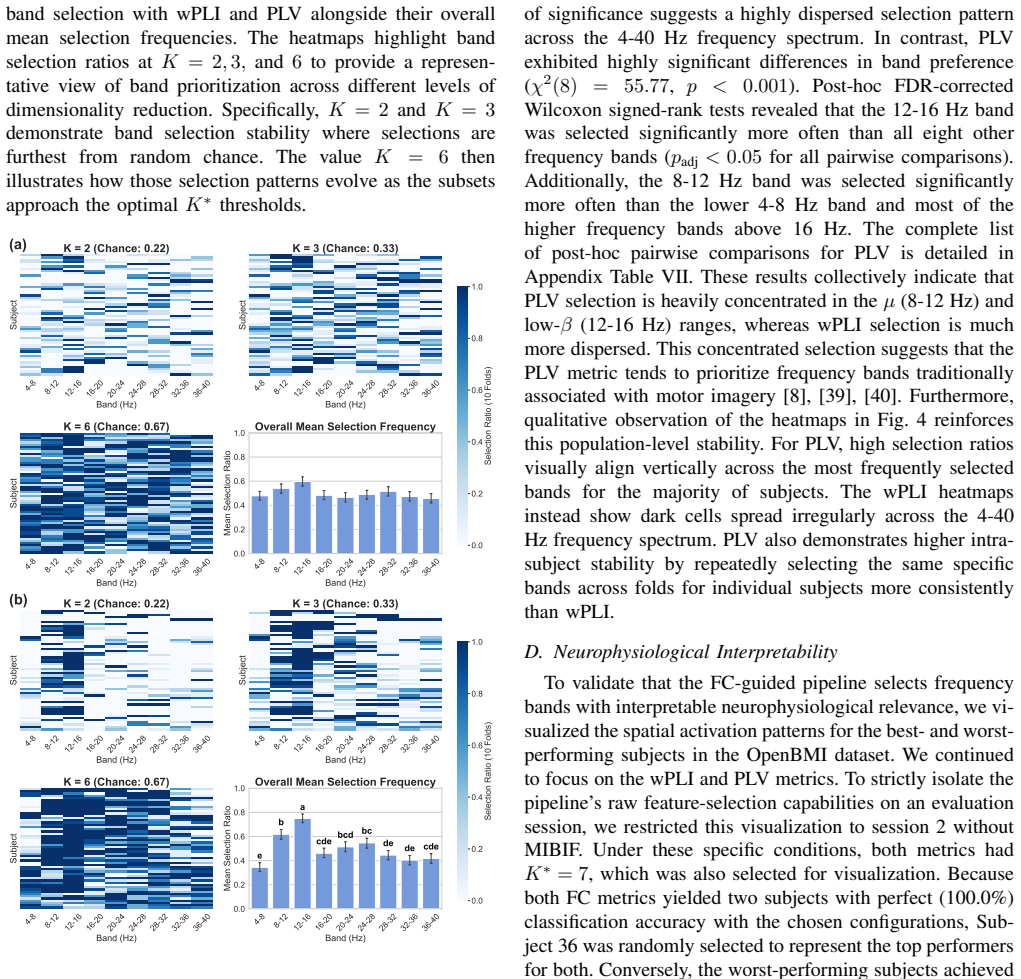
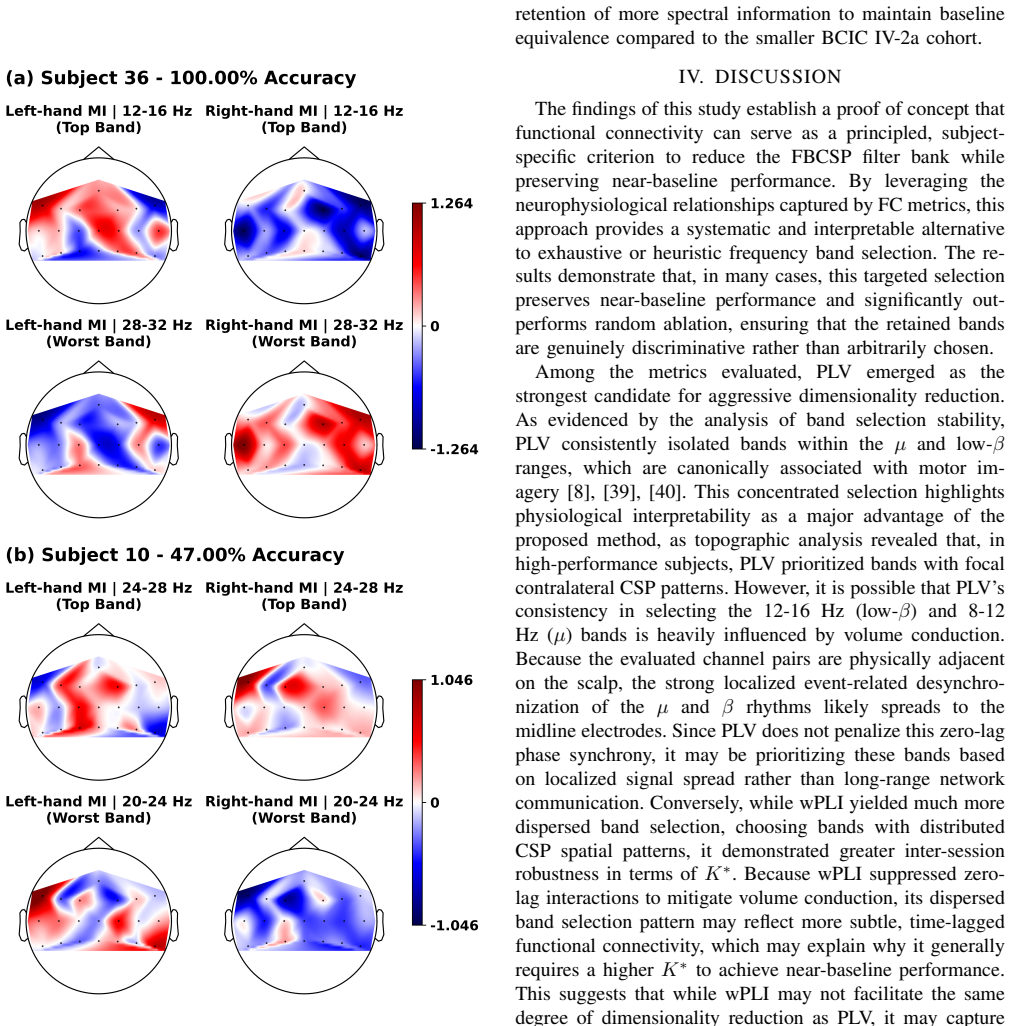
Reliable control in motor imagery brain-computer interfaces (MI-BCIs) requires the precise decoding of user-specific neural rhythms, which vary significantly across individuals. The Common Spatial Pattern (CSP) algorithm is a cornerstone of MI-BCI decoding, yet its performance depends strongly on the spectral range of the input EEG data. Although Filter Bank CSP (FBCSP) extends this as a data-driven decoding framework, its frequency sub-bands are predefined rather than selected using subject-specific physiological criteria. This paper presents a proof-of-concept study of static functional connectivity (FC)-guided band selection for MI-BCI, demonstrated using a conventional FBCSP-based pipeline. The proposed method identifies the most discriminative spectral bands by calculating phase-based connectivity across four sensorimotor channels using wPLI, PLV, and PLI. Nine bands in a 4-40 Hz filter bank are ranked by the effect size of their hemispheric coupling differences and pruned to the top K bands for feature extraction and classification via FBCSP and a Support Vector Regressor. This framework was tested for K values ranging from 1 to 8 across the BCI Competition IV-2a (n = 9) and OpenBMI (n = 54) datasets. Performance was benchmarked against standard nine-band FBCSP and random ablation to determine the minimum number of bands (K*) required to maintain accuracy within a 2% baseline equivalence zone. Results show FC-guided selection can outperform random ablation and achieve near-baseline performance while reducing required CSP fits by 22.2% to 77.8%. PLV enables the most aggressive dimensionality reduction by prioritizing the {\mu} and low-\b{eta} ranges, while wPLI demonstrates superior inter-session robustness by mitigating volume conduction. These findings establish FC-guided selection as a principled and interpretable alternative to heuristic filter bank designs.
Editorial analysis
A structured set of objections, weighed in public.
Referee Report
Summary. The paper proposes a proof-of-concept method for subject-specific frequency band selection in motor imagery BCI using static phase-based functional connectivity (wPLI, PLV, PLI) computed on four sensorimotor channels. Nine fixed bands (4-40 Hz) are ranked by effect size of hemispheric coupling differences; the top K bands are then fed into a standard FBCSP pipeline on the full electrode montage, with classification via SVM. Tested on BCI Competition IV-2a (n=9) and OpenBMI (n=54) for K=1..8, the approach is benchmarked against full nine-band FBCSP and random band ablation, claiming near-baseline accuracy (within 2% equivalence) with 22-78% fewer CSP computations, PLV favoring aggressive reduction and wPLI showing better inter-session stability.
Significance. If the central empirical claim holds, the work supplies a physiologically motivated, interpretable alternative to heuristic filter-bank designs in FBCSP pipelines, with potential to lower computational cost while preserving performance. Credit is due for the use of public datasets, explicit random-ablation controls, and the attempt to link connectivity metrics to dimensionality reduction. The result would be of interest to the MI-BCI community provided the four-channel proxy is shown to be reliable.
major comments (3)
- [Methods] Methods (band-ranking procedure): The headline claim that FC-guided selection on four sensorimotor channels yields bands whose FBCSP performance on the full montage stays within the 2% equivalence zone rests on an untested proxy. No experiment compares the FC-derived ranking against a full-montage criterion such as class-conditional CSP variance, mutual information, or leave-one-session-out accuracy; if the four-channel ranking systematically omits bands carrying discriminative information visible only across the wider array, the reported reduction in CSP fits is not guaranteed to be optimal.
- [Abstract / Results] Abstract and Results: Performance claims are presented without statistical tests, exact per-subject or per-session accuracies, confidence intervals, or a precise definition of how the 2% equivalence zone and subject-specific K* were computed. This absence prevents evaluation of whether the reported outperformance over random ablation is reliable or merely descriptive.
- [Results] Results (inter-session robustness): The assertion that wPLI provides superior inter-session stability compared with PLV/PLI is stated without quantitative session-to-session variability metrics or statistical comparison; the claim is therefore not yet load-bearing for the method's practical advantage.
minor comments (2)
- [Abstract] Notation: the string 'low-ß{eta}' in the abstract is a LaTeX artifact and should be rendered as 'low-beta'.
- [Methods] Methods: the exact formula used to compute the 'effect size of hemispheric coupling differences' (Cohen's d, Hedges' g, etc.) and the precise definition of the four sensorimotor channels should be stated explicitly.
Simulated Author's Rebuttal
We thank the referee for the constructive comments that highlight important aspects of our proof-of-concept study. We address each major point below and have revised the manuscript to improve rigor, clarity, and transparency.
read point-by-point responses
-
Referee: [Methods] Methods (band-ranking procedure): The headline claim that FC-guided selection on four sensorimotor channels yields bands whose FBCSP performance on the full montage stays within the 2% equivalence zone rests on an untested proxy. No experiment compares the FC-derived ranking against a full-montage criterion such as class-conditional CSP variance, mutual information, or leave-one-session-out accuracy; if the four-channel ranking systematically omits bands carrying discriminative information visible only across the wider array, the reported reduction in CSP fits is not guaranteed to be optimal.
Authors: We acknowledge that the four-channel proxy constitutes an untested assumption for optimality. The choice is physiologically motivated by the concentration of motor imagery-related rhythms in sensorimotor areas, enabling a low-channel, subject-specific ranking step prior to full-montage FBCSP. We have added a new paragraph in the Discussion explicitly stating this limitation, providing the physiological rationale, and recommending future validation against full-montage criteria such as CSP variance or mutual information. The random-ablation control remains as evidence that the FC-guided approach outperforms uninformed selection. No new comparative experiments were performed, as they exceed the scope of the current proof-of-concept. revision: partial
-
Referee: [Abstract / Results] Abstract and Results: Performance claims are presented without statistical tests, exact per-subject or per-session accuracies, confidence intervals, or a precise definition of how the 2% equivalence zone and subject-specific K* were computed. This absence prevents evaluation of whether the reported outperformance over random ablation is reliable or merely descriptive.
Authors: We agree that statistical detail and precise definitions were insufficient. The revised Abstract and Results now include: (i) explicit definition of the 2% equivalence zone (accuracy within 2 percentage points of the nine-band baseline) and subject-specific K* (smallest K meeting the criterion per subject); (ii) mean accuracies with standard deviations and 95% confidence intervals; (iii) per-subject and per-session tables (moved to supplementary material); and (iv) paired Wilcoxon signed-rank tests with p-values comparing FC-guided selection against random ablation. These additions allow direct evaluation of reliability. revision: yes
-
Referee: [Results] Results (inter-session robustness): The assertion that wPLI provides superior inter-session stability compared with PLV/PLI is stated without quantitative session-to-session variability metrics or statistical comparison; the claim is therefore not yet load-bearing for the method's practical advantage.
Authors: We have expanded the Results section with quantitative stability metrics. Using the multi-session OpenBMI data, we report Jaccard overlap of selected band sets across sessions and variance of subject-specific K* for each metric. Statistical comparisons (Friedman test followed by post-hoc Wilcoxon tests) confirm wPLI's significantly higher stability relative to PLV and PLI. These metrics and results are now presented to substantiate the claim. revision: yes
Circularity Check
No significant circularity; empirical validation uses external benchmarks
full rationale
The paper proposes ranking nine fixed bands via effect-size differences in phase-based connectivity (wPLI/PLV/PLI) computed on four sensorimotor channels, then feeds the top-K bands into standard FBCSP on the full montage and compares accuracy to the nine-band baseline and random ablation on public datasets. No equations, fitted parameters, or self-citations reduce the reported near-baseline performance or dimensionality reductions to quantities defined by the method itself; the gains are measured directly against independent external references (full FBCSP and random selection). The chain is therefore self-contained and does not exhibit any of the enumerated circularity patterns.
Axiom & Free-Parameter Ledger
axioms (2)
- domain assumption Motor imagery produces detectable hemispheric differences in sensorimotor rhythms that can be captured by phase-based connectivity metrics.
- domain assumption Static connectivity computed on four channels generalizes to the optimal band set for full-array FBCSP classification.
Reference graph
Works this paper leans on
-
[1]
Brain-computer interfaces for communication and control,
J. R. Wolpaw, N. Birbaumer, D. J. McFarland, G. Pfurtscheller, and T. M. Vaughan, “Brain-computer interfaces for communication and control,”Clinical Neurophysiology, vol. 113, pp. 767–791, June 2002
2002
-
[2]
Brain computer interfaces, a review,
L. F. Nicolas-Alonso and J. Gomez-Gil, “Brain computer interfaces, a review,”Sensors (Basel, Switzerland), vol. 12, pp. 1211–1279, Jan. 2012
2012
-
[3]
EEG-based brain-computer inter- faces,
D. J. McFarland and J. R. Wolpaw, “EEG-based brain-computer inter- faces,”Current Opinion in Biomedical Engineering, vol. 4, pp. 194– 200, Dec. 2017
2017
-
[4]
Brain-computer interfaces in medicine,
J. J. Shih, D. J. Krusienski, and J. R. Wolpaw, “Brain-computer interfaces in medicine,”Mayo Clinic Proceedings, vol. 87, pp. 268– 279, Mar. 2012
2012
-
[5]
Where does EEG come from and what does it mean?,
M. X. Cohen, “Where does EEG come from and what does it mean?,” Trends in Neurosciences, vol. 40, pp. 208–218, Apr. 2017
2017
-
[6]
Brain-computer interface (BCI) operation: signal and noise during early training sessions,
D. J. McFarland, W. A. Sarnacki, T. M. Vaughan, and J. R. Wolpaw, “Brain-computer interface (BCI) operation: signal and noise during early training sessions,”Clinical Neurophysiology, vol. 116, pp. 56– 62, Jan. 2005
2005
-
[7]
Contribution of the primary motor cortex to motor imagery: A subthreshold TMS study,
B. Pelgrims, N. Michaux, E. Olivier, and M. Andres, “Contribution of the primary motor cortex to motor imagery: A subthreshold TMS study,”Human Brain Mapping, vol. 32, pp. 1471–1482, Nov. 2010
2010
-
[8]
Event-related dynamics of cortical rhythms: frequency-specific features and functional correlates,
C. Neuper and G. Pfurtscheller, “Event-related dynamics of cortical rhythms: frequency-specific features and functional correlates,”Inter- national Journal of Psychophysiology, vol. 43, pp. 41–58, Dec. 2001
2001
-
[9]
Understanding the role of sensorimotor beta oscillations,
J. Barone and H. E. Rossiter, “Understanding the role of sensorimotor beta oscillations,”Frontiers in Systems Neuroscience, vol. 15, May 2021
2021
-
[10]
Brain-machine interfaces from motor to mood,
M. M. Shanechi, “Brain-machine interfaces from motor to mood,” Nature Neuroscience, vol. 22, pp. 1554–1564, Oct. 2019
2019
-
[11]
Designing optimal spatial filters for single-trial EEG classification in a movement task,
J. Müller-Gerking, G. Pfurtscheller, and H. Flyvbjerg, “Designing optimal spatial filters for single-trial EEG classification in a movement task,”Clinical Neurophysiology, vol. 110, pp. 787–798, May 1999
1999
-
[12]
Mu rhythm (de)synchronization and EEG single-trial classification of different motor imagery tasks,
G. Pfurtscheller, C. Brunner, A. Schlögl, and F. H. Lopes da Silva, “Mu rhythm (de)synchronization and EEG single-trial classification of different motor imagery tasks,”NeuroImage, vol. 31, pp. 153–159, May 2006
2006
-
[13]
EEG-based strategies to detect motor imagery for control and rehabilitation,
K. K. Ang and C. Guan, “EEG-based strategies to detect motor imagery for control and rehabilitation,”IEEE Transactions on Neural Systems and Rehabilitation Engineering, vol. 25, pp. 392–401, Apr. 2017
2017
-
[14]
A review of classification algorithms for EEG- based brain-computer interfaces: a 10 year update,
F. Lotteet al., “A review of classification algorithms for EEG- based brain-computer interfaces: a 10 year update,”Journal of Neural Engineering, vol. 15, p. 031005, Apr. 2018
2018
-
[15]
Review of the BCI competition IV,
M. Tangermannet al., “Review of the BCI competition IV,”Frontiers in Neuroscience, vol. 6, p. 55, July 2012
2012
-
[16]
Performance of EEG motor-imagery based spatial filtering methods: A BCI study on stroke patients,
A. Miladinovi ´cet al., “Performance of EEG motor-imagery based spatial filtering methods: A BCI study on stroke patients,”Procedia Computer Science, vol. 176, pp. 2840–2848, Jan. 2020
2020
-
[17]
Filter bank common spatial pattern algorithm on BCI competition IV datasets 2a and 2b,
K. K. Ang, Z. Y . Chin, C. Wang, C. Guan, and H. Zhang, “Filter bank common spatial pattern algorithm on BCI competition IV datasets 2a and 2b,”Frontiers in Neuroscience, vol. 6, p. 39, Mar. 2012
2012
-
[18]
Filter bank common spatial pattern (FBCSP) in brain-computer interface,
K. K. Ang, Z. Y . Chin, H. Zhang, and C. Guan, “Filter bank common spatial pattern (FBCSP) in brain-computer interface,” in2008 IEEE International Joint Conference on Neural Networks (IEEE World Congress on Computational Intelligence), pp. 2390–2397, June 2008
2008
-
[19]
EEG-driven arm movement decoding: Combining con- nectivity and amplitude features for enhanced brain-computer interface performance,
H. Darvishi, A. Mohammadi, M. H. Maghami, M. Sadeghi, and M. Sawan, “EEG-driven arm movement decoding: Combining con- nectivity and amplitude features for enhanced brain-computer interface performance,”Bioengineering, vol. 12, p. 614, June 2025
2025
-
[20]
EEG dataset and OpenBMI toolbox for three BCI paradigms: an investigation into BCI illiteracy,
M.-H. Leeet al., “EEG dataset and OpenBMI toolbox for three BCI paradigms: an investigation into BCI illiteracy,”GigaScience, vol. 8, p. giz002, May 2019
2019
-
[21]
Brain functional connectivity through phase coupling of neuronal oscillations: A perspective from magnetoencephalography,
L. Marzetti, A. Basti, F. Chella, A. D’Andrea, J. Syrjälä, and V . Pizzella, “Brain functional connectivity through phase coupling of neuronal oscillations: A perspective from magnetoencephalography,” Frontiers in Neuroscience, vol. 13, Sept. 2019
2019
-
[22]
Brain computer interface control via functional connectivity dynamics,
I. Daly, S. J. Nasuto, and K. Warwick, “Brain computer interface control via functional connectivity dynamics,”Pattern Recognition, vol. 45, pp. 2123–2136, June 2012
2012
-
[23]
An improved index of phase-synchronization for electrophysiological data in the presence of volume-conduction, noise and sample-size bias,
M. Vinck, R. Oostenveld, M. van Wingerden, F. Battaglia, and C. M. A. Pennartz, “An improved index of phase-synchronization for electrophysiological data in the presence of volume-conduction, noise and sample-size bias,”NeuroImage, vol. 55, pp. 1548–1565, Apr. 2011
2011
-
[24]
Measuring phase synchrony in brain signals,
J.-P. Lachaux, E. Rodriguez, J. Martinerie, and F. J. Varela, “Measuring phase synchrony in brain signals,”Human Brain Mapping, vol. 8, no. 4, pp. 194–208, 1999
1999
-
[25]
Phase locking value revisited: teaching new tricks to an old dog,
R. Bruña, F. Maestú, and E. Pereda, “Phase locking value revisited: teaching new tricks to an old dog,”Journal of Neural Engineering, vol. 15, p. 056011, July 2018
2018
-
[26]
Phase lag index: Assess- ment of functional connectivity from multi channel EEG and MEG with diminished bias from common sources,
C. J. Stam, G. Nolte, and A. Daffertshofer, “Phase lag index: Assess- ment of functional connectivity from multi channel EEG and MEG with diminished bias from common sources,”Human Brain Mapping, vol. 28, pp. 1178–1193, Nov. 2007
2007
-
[27]
Diverse feature blend based on filter-bank common spatial pattern and brain functional connectivity for multiple motor imagery detection,
H. Wang, X. Xu, Y . Yin, Z. Li, and Z. Zhang, “Diverse feature blend based on filter-bank common spatial pattern and brain functional connectivity for multiple motor imagery detection,”IEEE Access, vol. 8, pp. 168331–168341, Aug. 2020
2020
-
[28]
Common spatial patterns combined with phase synchronization information for classification of EEG signals,
X. Li, H. Fan, H. Wang, and L. Wang, “Common spatial patterns combined with phase synchronization information for classification of EEG signals,”Biomedical Signal Processing and Control, vol. 52, pp. 248–256, July 2019
2019
-
[29]
Functional connectivity and feature fusion enhance multiclass motor-imagery brain-computer interface performance,
I. Siviero, G. Menegaz, and S. F. Storti, “Functional connectivity and feature fusion enhance multiclass motor-imagery brain-computer interface performance,”Sensors, vol. 23, p. 7520, Jan. 2023
2023
-
[30]
Feature extraction of four-class motor imagery EEG signals based on functional brain network,
Q. Aiet al., “Feature extraction of four-class motor imagery EEG signals based on functional brain network,”Journal of Neural Engi- neering, vol. 16, p. 026032, Feb. 2019
2019
-
[31]
MNE-Python,
E. Larsonet al., “MNE-Python,” Aug. 2024
2024
-
[32]
MEG and EEG data analysis with MNE-Python,
A. Gramfortet al., “MEG and EEG data analysis with MNE-Python,” Frontiers in Neuroscience, vol. 7, p. 267, Dec. 2013
2013
-
[33]
mne-connectivity,
A. Liet al., “mne-connectivity,” Mar. 2026
2026
-
[34]
Phase synchrony measure- ment in motor cortex for classifying single-trial EEG during motor imagery,
Y . Wang, B. Hong, X. Gao, and S. Gao, “Phase synchrony measure- ment in motor cortex for classifying single-trial EEG during motor imagery,” in2006 International Conference of the IEEE Engineering in Medicine and Biology Society, pp. 75–78, Aug. 2006
2006
-
[35]
Phase synchrony in subject-specific reactive band of EEG for classification of motor imagery tasks,
V . Gonuguntla, Y . Wang, and K. C. Veluvolu, “Phase synchrony in subject-specific reactive band of EEG for classification of motor imagery tasks,” in2013 35th Annual International Conference of the IEEE Engineering in Medicine and Biology Society (EMBC), pp. 2784–2787, July 2013
2013
-
[36]
Functional connectivity analysis in motor-imagery brain computer interfaces,
N. Leeuwis, S. Yoon, and M. Alimardani, “Functional connectivity analysis in motor-imagery brain computer interfaces,”Frontiers in Human Neuroscience, vol. 15, Oct. 2021
2021
-
[37]
Scikit-learn: Machine learning in Python,
F. Pedregosaet al., “Scikit-learn: Machine learning in Python,”Journal of Machine Learning Research, vol. 12, pp. 2825–2830, 2011
2011
-
[38]
On the interpretation of weight vectors of linear models in multivariate neuroimaging,
S. Haufe, F. Meinecke, K. Görgen, S. Dähne, J.-D. Haynes, B. Blankertz, and F. Bießmann, “On the interpretation of weight vectors of linear models in multivariate neuroimaging,”NeuroImage, vol. 87, pp. 96–110, Feb. 2014
2014
-
[39]
Motor imagery activates primary sensorimotor area in humans,
G. Pfurtscheller and C. Neuper, “Motor imagery activates primary sensorimotor area in humans,”Neuroscience Letters, vol. 239, pp. 65– 68, Dec. 1997
1997
-
[40]
Event-related (de)synchronization (ERD/ERS) during motor imagery tasks: Im- plications for brain-computer interfaces,
Y . Jeon, C. S. Nam, Y .-J. Kim, and M. C. Whang, “Event-related (de)synchronization (ERD/ERS) during motor imagery tasks: Im- plications for brain-computer interfaces,”International Journal of Industrial Ergonomics, vol. 41, pp. 428–436, Sept. 2011
2011
-
[41]
EEG- based brain-computer interfaces using motor-imagery: Techniques and challenges,
N. Padfield, J. Zabalza, H. Zhao, V . Masero, and J. Ren, “EEG- based brain-computer interfaces using motor-imagery: Techniques and challenges,”Sensors, vol. 19, p. 1423, Mar. 2019
2019
-
[42]
Validating deep neural networks for online decoding of motor imagery movements from EEG signals,
Z. Tayebet al., “Validating deep neural networks for online decoding of motor imagery movements from EEG signals,”Sensors, vol. 19, p. 210, Jan. 2019
2019
discussion (0)
Sign in with ORCID, Apple, or X to comment. Anyone can read and Pith papers without signing in.