Recognition: unknown
Optimal network structure for collective performance with strategic information sharing
Pith reviewed 2026-05-09 18:23 UTC · model grok-4.3
The pith
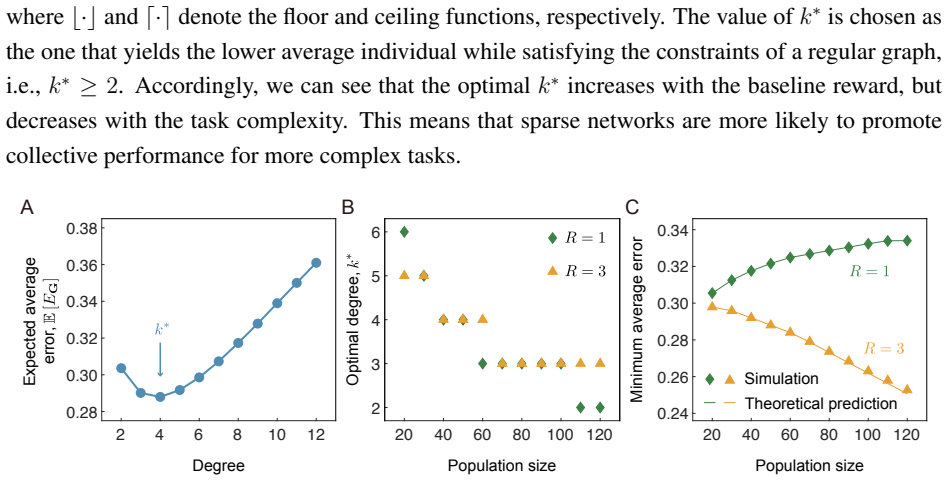
Optimal network structures for collective tasks emerge from balancing strategic information sharing rates with how the network integrates the data.
A machine-rendered reading of the paper's core claim, the machinery that carries it, and where it could break.
Core claim
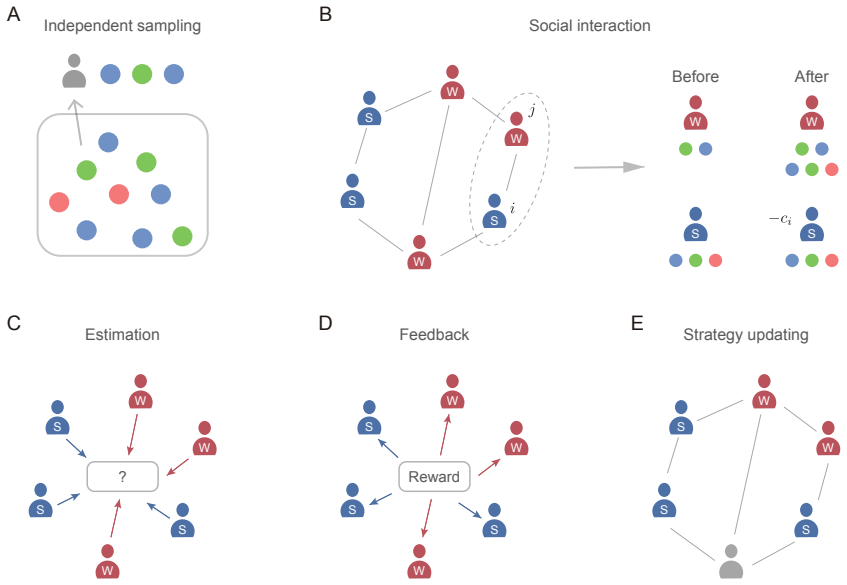
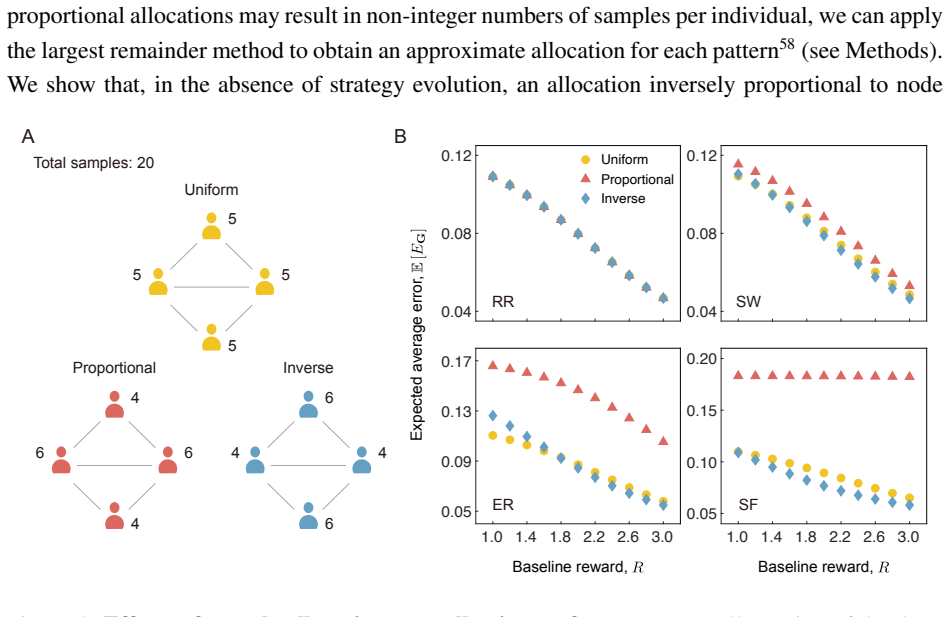
In an evolutionary game on networks, agents sample a fixed number of balls and decide to share or withhold based on the payoff from collective estimation accuracy. The collective performance is maximized by network structures that trade off the rate of information sharing against the method of integrating shared samples, producing an intermediate average degree that optimizes results for each topology type. When the number of samples is allowed to vary, the highest accuracy occurs when individuals with higher degree extract fewer balls.
What carries the argument
Evolutionary game on networks where agents strategically choose to share samples, combined with an analytical framework that computes collective estimation performance from sharing rates and integration rules.
If this is right
- Collective performance reaches its maximum at an intermediate average degree for each network type rather than at minimal or maximal connectivity.
- The optimal structure arises specifically from the trade-off between sharing rate and information integration method.
- Allocating fewer samples to high-degree nodes and more to low-degree nodes increases group accuracy beyond the uniform case.
- Different network topologies each have their own intermediate degree that maximizes performance.
Where Pith is reading between the lines
- Real groups might achieve better joint estimates by deliberately limiting communication channels to moderate levels instead of full connectivity.
- The same trade-off could apply to sensor networks or online platforms where participants have incentives to limit data sharing.
- Lab experiments with human subjects performing similar estimation tasks on varied networks could directly test the predicted performance peaks.
Load-bearing premise
The evolutionary dynamics of sharing decisions and the specific rule for integrating shared samples into a collective estimate are assumed to capture real strategic behavior without additional noise or bias terms.
What would settle it
Measure collective accuracy in a lab experiment where human participants sample colored balls and decide to share on networks with controlled average degrees, checking whether accuracy peaks at an intermediate degree rather than at the extremes.
Figures


read the original abstract
Information sharing between individuals is crucial to improve performance in collective tasks. However, in a competitive world, individuals may be reluctant to share information with the others, and it is still unclear how the presence of strategic behaviors affects the collective performance of a group. In this study, we introduce an evolutionary game modeling the dynamics of individual behaviors in a collective estimation task. The individuals are organized in a network and have to guess the distribution of ball colors in a box. Each of them samples a given number of balls and can strategically decide whether to share or not this information with its neighbors. We develop a framework that allows to investigate analytically how the collective performance depends on the network structure. We find that the optimal network results from a trade-off between the sharing rate and the way the information is integrated in the network. We further reveal that there exists an intermediate average degree for each type of network maximizing the collective performance. In addition to the uniform case, we consider the case of non-homogeneous allocations of the number of individual samples, showing that the largest collective performance is obtained when the number of ball extracted by an individual is inversely proportional to its degree.
Editorial analysis
A structured set of objections, weighed in public.
Referee Report
Summary. The manuscript develops an evolutionary game model on networks in which agents sample ball colors from a distribution and strategically decide whether to share their samples with neighbors. An analytical framework is introduced to express collective estimation performance in terms of network structure, sharing rates, and an information integration rule. The central results are that performance is maximized by a trade-off between sharing rate and integration, that an intermediate average degree optimizes performance for each network class examined, and that non-uniform sample allocation inversely proportional to degree further improves the collective estimate.
Significance. If the derivations are robust, the work supplies a rare closed-form treatment of strategic information sharing on networks and identifies a concrete mechanism (degree-dependent trade-off) that could explain why many empirical social networks exhibit intermediate connectivity. The analytical approach itself is a strength relative to purely simulation-based studies in the field.
major comments (3)
- [§3] §3 (evolutionary dynamics): the interior equilibrium sharing rate is asserted to exist and to be stable for the replicator/imitation update, yet no Jacobian or invasion analysis is supplied to confirm stability once average degree exceeds the reported optimum; without this, the non-monotonic performance peak cannot be guaranteed.
- [Eq. (8)] Eq. (8) (integration step): the variance of the collective estimator is stated to decrease then increase with degree, but the derivation assumes a linear combiner of private and shared samples without bias-correction terms for heterogeneous sample sizes; if the rule is a simple average, the claimed minimum at finite degree is sensitive to the precise functional form and may disappear.
- [§5] §5 (non-homogeneous allocation): optimality of inverse proportionality between samples and degree is derived under fixed sharing decisions, yet the evolutionary game couples allocation and sharing; a joint fixed-point analysis is required to show the allocation remains optimal once sharing rates also evolve.
minor comments (3)
- [Abstract] The abstract and §2 should explicitly list the network ensembles (ER, BA, etc.) for which the intermediate-degree optimum is proven.
- [Figures] Figure captions omit the precise parameter values (payoff scaling, sample size) used to generate the performance curves; add these for reproducibility.
- [Notation] Notation for the sharing threshold and the collective performance metric is introduced without a consolidated table; a symbol glossary would improve clarity.
Simulated Author's Rebuttal
We thank the referee for the detailed and constructive report. The comments highlight important points regarding stability, estimator robustness, and the coupling between allocation and sharing. We address each major comment below and indicate the revisions we will make.
read point-by-point responses
-
Referee: §3 (evolutionary dynamics): the interior equilibrium sharing rate is asserted to exist and to be stable for the replicator/imitation update, yet no Jacobian or invasion analysis is supplied to confirm stability once average degree exceeds the reported optimum; without this, the non-monotonic performance peak cannot be guaranteed.
Authors: We agree that an explicit stability analysis strengthens the claim. In the manuscript we confirmed the interior equilibrium via numerical integration of the replicator dynamics for the reported range of degrees. To address the referee's point rigorously, we have now computed the Jacobian of the mean-field replicator equation at the interior fixed point and verified that the relevant eigenvalue is negative for average degrees up to the performance optimum. Beyond this point the equilibrium loses stability and the system converges to a boundary equilibrium (zero or full sharing), which is consistent with the observed non-monotonic peak. The full Jacobian derivation and eigenvalue analysis will be added to the revised §3. revision: yes
-
Referee: Eq. (8) (integration step): the variance of the collective estimator is stated to decrease then increase with degree, but the derivation assumes a linear combiner of private and shared samples without bias-correction terms for heterogeneous sample sizes; if the rule is a simple average, the claimed minimum at finite degree is sensitive to the precise functional form and may disappear.
Authors: The linear combiner in Eq. (8) is a precision-weighted average that automatically incorporates sample-size heterogeneity; no separate bias-correction term is required because each local estimator remains unbiased. We have re-derived the variance expression under both the weighted rule and a simple (unweighted) average. In both cases the non-monotonic dependence on degree persists, originating from the fundamental trade-off between the sharing rate (which decreases with degree) and the number of independent samples integrated across the network. We will add a short appendix comparing the two combiners and clarifying that the minimum at finite degree is robust within the linear class. revision: partial
-
Referee: §5 (non-homogeneous allocation): optimality of inverse proportionality between samples and degree is derived under fixed sharing decisions, yet the evolutionary game couples allocation and sharing; a joint fixed-point analysis is required to show the allocation remains optimal once sharing rates also evolve.
Authors: The referee correctly notes the coupling. In the original §5 we held sharing rates fixed to isolate the allocation effect. We have since solved the joint evolutionary dynamics in the heterogeneous mean-field limit, obtaining a coupled fixed-point equation for both the degree-dependent sharing probability and the sample allocation. At this joint equilibrium the inverse-proportionality rule for samples remains optimal; the sharing rate adjusts self-consistently but does not alter the allocation optimum. The extended analysis and the resulting fixed-point equations will be incorporated into the revised §5. revision: yes
Circularity Check
No significant circularity; analytical trade-off derivation is self-contained
full rationale
The paper constructs an evolutionary game on networks to obtain equilibrium sharing rates as functions of degree and strategy payoffs, then substitutes these into an explicit expression for collective estimation accuracy (derived from sampling and linear integration rules). The claimed optimum at intermediate average degree is obtained by maximizing this composite function with respect to network parameters; it is not presupposed or fitted but emerges from the model's own dynamics. The inverse-proportional sample allocation is likewise obtained by optimizing the same performance expression under the non-homogeneous constraint. No load-bearing step reduces to a self-citation, a fitted parameter renamed as prediction, or a definitional identity. The framework remains falsifiable by altering the payoff matrix or integration rule, confirming the derivation chain is independent of its target results.
Axiom & Free-Parameter Ledger
free parameters (1)
- sharing threshold or payoff scaling
axioms (2)
- domain assumption Individuals update sharing strategy according to a standard evolutionary game dynamic (e.g., replicator or imitation) based on realized collective performance.
- domain assumption Shared samples are integrated by a fixed aggregation function whose output accuracy depends only on the number and quality of received samples.
Reference graph
Works this paper leans on
-
[1]
Feller, William , title =
-
[2]
1984 , publisher =
Classification and Regression Trees , author =. 1984 , publisher =
1984
-
[3]
2010 , publisher=
Networks: An Introduction , author=. 2010 , publisher=
2010
-
[4]
On the evolution of random graphs , author=. Publ. Math. Inst. Hung. Acad. Sci. , volume=
-
[5]
Albert, R. Rev. Mod. Phys. , month =. doi:10.1103/RevModPhys.74.47 , issn =
-
[6]
Allen, Benjamin and Lippner, Gabor and Chen, Yu-Ting and Fotouhi, Babak and Momeni, Naghmeh and Yau, Shing-Tung and Nowak, Martin A. , doi =. Nature , month =
-
[7]
Almaatouq, Abdullah and Alsobay, Mohammed and Yin, Ming and Watts, Duncan J. , doi =. Proc. Natl Acad. Sci. USA , month =
-
[8]
Almaatouq, Abdullah and Noriega-Campero, Alejandro and Alotaibi, Abdulrahman and Krafft, P. M. and Moussaid, Mehdi and Pentland, Alex , doi =. Proc. Natl Acad. Sci. USA , month =
-
[9]
Alvarez-Rodriguez, Unai and Battiston, Federico and de Arruda, Guilherme Ferraz and Moreno, Yamir and Perc, Matja. Nat. Hum. Behav. , month =. doi:10.1038/s41562-020-01024-1 , issn =
-
[10]
Bala, Venkatesh and Goyal, Sanjeev , doi =. Rev. Econ. Stud. , month =
-
[11]
Emergence of scaling in random networks,
Barab. Science , month =. doi:10.1126/science.286.5439.509 , issn =
-
[12]
and Hammond, Lewis and Hilbe, Christian and Hughes, Edward and Leibo, Joel Z
Barfuss, Wolfram and Flack, Jessica and Gokhale, Chaitanya S. and Hammond, Lewis and Hilbe, Christian and Hughes, Edward and Leibo, Joel Z. and Lenaerts, Tom and Leonard, Naomi and Levin, Simon and. Proc. Natl Acad. Sci. USA , month =. doi:10.1073/pnas.2319948121 , issn =
-
[13]
Barkoczi, Daniel and Galesic, Mirta , doi =. Nat. Commun. , month =
-
[14]
Becker, Joshua and Brackbill, Devon and Centola, Damon , doi =. Proc. Natl Acad. Sci. USA , month =
-
[15]
Trends Cogn
Centola, Damon , doi =. Trends Cogn. Sci. , month =
-
[16]
Centola, Damon and Becker, Joshua and Zhang, Jingwen and Aysola, Jaya and Guilbeault, Douglas and Khoong, Elaine , doi =. Proc. Natl Acad. Sci. USA , month =
-
[17]
Civilini, Andrea and Anbarci, Nejat and Latora, Vito , doi =. Phys. Rev. Lett. , month =
-
[18]
Civilini, Andrea and Sadekar, Onkar and Battiston, Federico and G. Phys. Rev. Lett. , month =. doi:10.1103/PhysRevLett.132.167401 , issn =
-
[19]
COHEN, J. I. , doi =. Nature , month =
-
[20]
Trends Ecol
DALL, S and GIRALDEAU, L and OLSSON, O and MCNAMARA, J and STEPHENS, D , doi =. Trends Ecol. Evol. , month =
-
[21]
and Dyer, John R.G
Faria, Jolyon J. and Dyer, John R.G. and Tosh, Colin R. and Krause, Jens , doi =. Anim. Behav. , month =
-
[22]
Farrell, Simon , doi =. Proc. Natl Acad. Sci. USA , month =
-
[23]
Flack, Andrea and Nagy, M. Science , month =. doi:10.1126/science.aap7781 , issn =
-
[24]
Friedman, Bernard , doi =. Comm. Pure Appl. Math. , month =
-
[25]
Fudenberg, Drew and Imhof, Lorens A. , doi =. J. Econ. Theory , month =
-
[26]
G. J. Behav. Decis. Mak. , month =. doi:10.1002/bdm.1843 , issn =
-
[27]
Guttal, Vishwesha and Couzin, Iain D. , doi =. Proc. Natl Acad. Sci. USA , month =
-
[28]
Harvey, Nigel and Fischer, Ilan , doi =. Organ. Behav. Hum. Decis. Process. , month =
-
[29]
Hong, Lu and Page, Scott E. , doi =. Proc. Natl Acad. Sci. USA , month =
-
[30]
Iacopini, Iacopo and. Phys. Rev. Lett. , month =. doi:10.1103/PhysRevLett.125.248301 , issn =
-
[31]
Iacopini, Iacopo and Milojevi. Phys. Rev. Lett. , month =. doi:10.1103/PhysRevLett.120.048301 , issn =
-
[32]
Ibsen-Jensen, Rasmus and Chatterjee, Krishnendu and Nowak, Martin A. , doi =. Proc. Natl Acad. Sci. USA , month =
-
[33]
Jayles, Bertrand and Kim, Hye-rin and Escobedo, Ram. Proc. Natl Acad. Sci. USA , month =. doi:10.1073/pnas.1703695114 , issn =
-
[34]
Jayles, Bertrand and Sire, Cl. J. R. Soc. Interface , month =. doi:10.1098/rsif.2021.0231 , issn =
-
[35]
Oikos , month =
Jost, Lou , doi =. Oikos , month =
-
[36]
Scott , doi =
Kameda, Tatsuya and Toyokawa, Wataru and Tindale, R. Scott , doi =. Nat. Rev. Psychol. , month =
-
[37]
Latora, Vito and Marchiori, Massimo , doi =. Phys. Rev. Lett. , month =
-
[38]
Lazer, David and Friedman, Allan , doi =. Adm. Sci. Q. , month =
-
[39]
Lorenz, Jan and Rauhut, Heiko and Schweitzer, Frank and Helbing, Dirk , doi =. Proc. Natl Acad. Sci. USA , month =
-
[40]
Mahmoodi, Ali and Bahrami, Bahador and Mehring, Carsten , doi =. Nat. Commun. , month =
-
[41]
McAvoy, Alex and Allen, Benjamin , doi =. J. Math. Biol. , month =
-
[42]
and DeChurch, Leslie A
Mesmer-Magnus, Jessica R. and DeChurch, Leslie A. , doi =. J. Appl. Psychol. , number =
-
[43]
Navajas, Joaquin and Niella, Tamara and Garbulsky, Gerry and Bahrami, Bahador and Sigman, Mariano , doi =. Nat. Hum. Behav. , month =
-
[44]
Nowak, Martin A. , doi =. Science , month =
-
[45]
Ohtsuki, Hisashi and Hauert, Christoph and Lieberman, Erez and Nowak, Martin A. , doi =. Nature , month =
-
[46]
Peeters, Marieke M. M. and van Diggelen, Jurriaan and van den Bosch, Karel and Bronkhorst, Adelbert and Neerincx, Mark A. and Schraagen, Jan Maarten and Raaijmakers, Stephan , doi =. AI Soc. , month =
-
[47]
and Hoelzer, Guy , doi =
Pepper, John W. and Hoelzer, Guy , doi =. Science , month =
-
[48]
and Arbesman, Samuel and Christakis, Nicholas A
Rand, David G. and Arbesman, Samuel and Christakis, Nicholas A. , doi =. Proc. Natl Acad. Sci. USA , month =
-
[49]
and Woolley, Anita Williams , doi =
Riedl, Christoph and Kim, Young Ji and Gupta, Pranav and Malone, Thomas W. and Woolley, Anita Williams , doi =. Proc. Natl Acad. Sci. USA , month =
-
[50]
Sayin, Sercan and Couzin-Fuchs, Einat and Petelski, Inga and G. Science , month =. doi:10.1126/science.adq7832 , issn =
-
[51]
Sheng, Anzhi and Su, Qi and Wang, Long and Plotkin, Joshua B. , doi =. Nat. Comput. Sci. , month =
-
[52]
and Couzin, Iain D
Strandburg-Peshkin, Ariana and Farine, Damien R. and Couzin, Iain D. and Crofoot, Margaret C. , doi =. Science , month =
-
[53]
Szolnoki, Attila and Perc, Matja. New J. Phys. , month =. doi:10.1088/1367-2630/15/5/053010 , issn =
-
[54]
van Dolder, Dennie and van den Assem, Martijn J. , doi =. Nat. Hum. Behav. , month =
-
[55]
Wang, Sheng and Noe, Raymond A. , doi =. Hum. Resour. Manage. Rev. , month =
-
[56]
Wang, Ye and Li, Aming and Wang, Long , doi =. Natl. Sci. Rev. , month =
-
[57]
and Strogatz, Steven H
Watts, Duncan J. and Strogatz, Steven H. , doi =. Nature , month =
-
[58]
and Pentland, Alex and Hashmi, Nada and Malone, Thomas W
Woolley, Anita Williams and Chabris, Christopher F. and Pentland, Alex and Hashmi, Nada and Malone, Thomas W. , doi =. Science , month =
-
[59]
Yaniv, Ilan , doi =. Organ. Behav. Hum. Decis. Process. , month =
-
[60]
Latora, V and Marchiori, M , doi =. New J. Phys. , mendeley-groups =
-
[61]
Vragovi. Phys. Rev. E , mendeley-groups =. doi:10.1103/PhysRevE.71.036122 , issn =
-
[62]
Leonard, Naomi Ehrich and Levin, Simon A , doi =. Collect. Intell. , mendeley-groups =
-
[63]
Su, Qi and McAvoy, Alex and Mori, Yoichiro and Plotkin, Joshua B. , doi =. Nat. Hum. Behav. , mendeley-groups =
-
[64]
Axelrod, Robert and Hamilton, William D. , doi =. Science , mendeley-groups =
-
[65]
and Liu, Yang-Yu and Li, Aming , doi =
Meng, Yao and Cornelius, Sean P. and Liu, Yang-Yu and Li, Aming , doi =. Nat. Commun. , mendeley-groups =
-
[66]
Fotouhi, Babak and Momeni, Naghmeh and Allen, Benjamin and Nowak, Martin A. , doi =. J. R. Soc. Interface , mendeley-groups =
-
[67]
PLoS Comput
Sheng, Anzhi and Li, Aming and Wang, Long , doi =. PLoS Comput. Biol. , mendeley-groups =
-
[68]
2006 , publisher=
Evolutionary Dynamics: Exploring the Equations of Life , author=. 2006 , publisher=
2006
-
[69]
Wang, Guocheng and Su, Qi and Wang, Long , doi =. J. R. Soc. Interface , mendeley-groups =
-
[70]
and Sigmund, Karl , doi =
Hauert, Christoph and Traulsen, Arne and Brandt, Hannelore and Nowak, Martin A. and Sigmund, Karl , doi =. Science , mendeley-groups =
-
[71]
1997 , publisher =
Fair Representation: Meeting the Ideal of One Man, One Vote , author =. 1997 , publisher =
1997
-
[72]
Universality of weak selection , author =. Phys. Rev. E , volume =
-
[73]
Baumann, Fabian and Czaplicka, Agnieszka and Rahwan, Iyad , title =. Sci. Rep. , year =
-
[74]
Hurwicz, Leonid , title =. Am. Econ. Rev. , volume =. 1973 , jstor =
1973
-
[75]
, title =
Brown, Thomas C. , title =. Land Econ. , volume =. 1984 , doi =
1984
-
[76]
Tchernichovski, Ofer and Frey, Seth and Jacoby, Nori and Conley, Dalton , doi =. Proc. Natl Acad. Sci. USA , mendeley-groups =
-
[77]
Sehwag, Udari Madhushani and McAvoy, Alex and Plotkin, Joshua B. , doi =. Proc. Natl Acad. Sci. USA , mendeley-groups =
-
[78]
Tian, Ye and Wang, Long and Bullo, Francesco , title =. SIAM J. Control Optim. , volume =
-
[79]
2023 , author =
Dynamics of opinion formation, social power evolution, and naïve learning in social networks , journal =. 2023 , author =
2023
-
[80]
2018 , author =
Opinion dynamics in social networks with stubborn agents: An issue-based perspective , journal =. 2018 , author =
2018
discussion (0)
Sign in with ORCID, Apple, or X to comment. Anyone can read and Pith papers without signing in.