Recognition: unknown
A Global 7% Systemic Sensitivity Floor in Gaia DR3: Multi-Wavelength Validation using 2MASS, Pan-STARRS and the 0.75-Magnitude Offset
Pith reviewed 2026-05-09 18:08 UTC · model grok-4.3
The pith
Gaia DR3 absorbs an asymptotic 7% of stars into single-star solutions despite binary signatures in multi-wavelength data.
A machine-rendered reading of the paper's core claim, the machinery that carries it, and where it could break.
Core claim
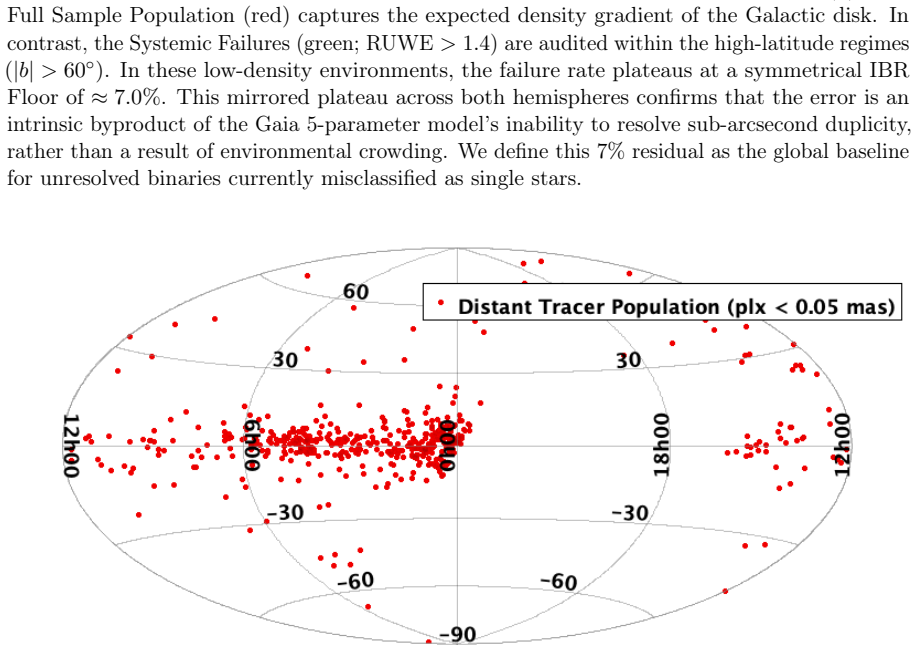
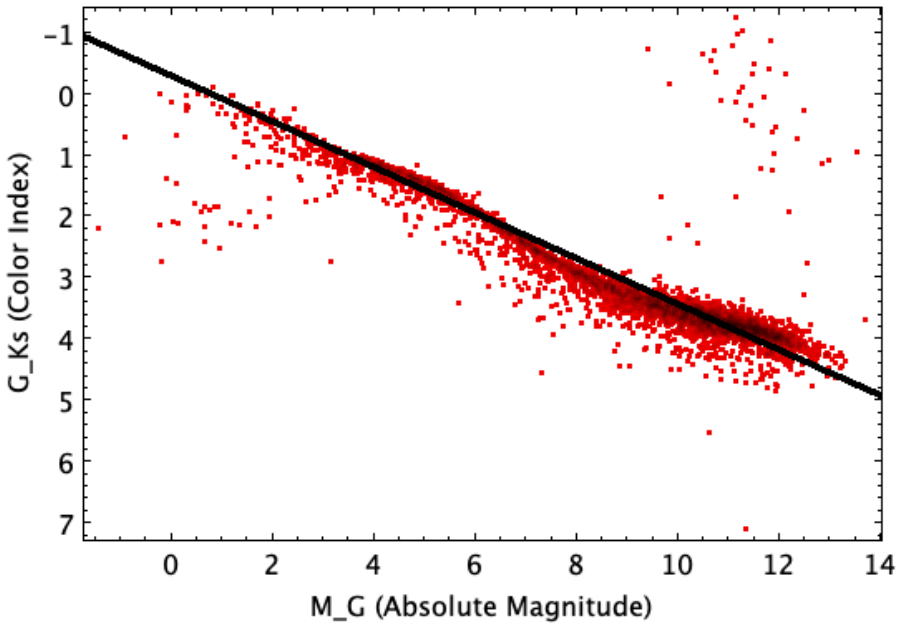
The central claim is the identification of an asymptotic Intrinsic Binary Residual of approximately 7.0 percent (about 8,429 sources) that remains constant across varying stellar densities. This residual emerges from a tri-modal distribution in magnitude residuals (ΔG) after ridge-line subtraction: 12 percent show overt astrometric failure (RUWE > 1.4), while a further subset passes the RUWE < 1.4 and no-NSS cuts yet exhibits photometric excess aligned with the theoretical -0.75-magnitude binary ridge. The Triple Constraint of astrometric noise, photometric excess, and absence of NSS classification isolates a 5.9 percent Detection Gap population interpreted as binaries suppressed into stable
What carries the argument
The Intrinsic Binary Residual (IBR), the density-independent fraction of sources that display binary-consistent photometric excess (near the -0.75 magnitude offset) while satisfying single-star astrometric criteria (RUWE < 1.4 and no NSS flags); it quantifies the population absorbed into the Gaia pipeline's single-star solutions.
If this is right
- Local baryonic mass budgets derived from single-star mass-to-light ratios must be increased by at least this 7 percent floor.
- Galactic stellar density models that ignore the suppressed binary population will underpredict the true binary fraction.
- The Gaia single-star astrometric solution reaches a hard sensitivity limit that multi-wavelength photometry can partially recover.
- Future data releases or reprocessing pipelines will need explicit binary-aware modules to close the Detection Gap.
Where Pith is reading between the lines
- If this floor is real, existing catalogs of 'single' stars used for exoplanet host studies may contain a hidden 7 percent binary contamination rate.
- The same suppression mechanism could appear in other large astrometric surveys, requiring similar cross-wavelength audits.
- A spectroscopic campaign targeting the candidate list would provide an independent test of whether the photometric ridge offset truly traces companions.
Load-bearing premise
Magnitude residuals after single-star ridge fitting, together with low RUWE and no non-single-star flags, reliably flag undetected binary companions rather than other photometric calibration or astrometric effects.
What would settle it
High-resolution imaging or radial-velocity monitoring of the 8,429 candidate sources to count how many actually host companions at the flux ratio implied by the 0.75-magnitude offset; a detection rate well below 7 percent in the filtered sample would falsify the binary interpretation of the residual.
Figures





read the original abstract
This study performs a multi-wavelength astrometric and photometric examination of a high-confidence sample $(N = 120,418)$ derived from a parent population of 2.36 million unique WDSS-seeded systems. By establishing an empirical polynomial ridge line for the broader Gaia-2MASS-Pan-STARRS subset, we calculated magnitude residuals $(\Delta G)$ to probe the systemic limits of the Gaia single-star model. Results reveal a distinct "Detection Gap" manifested as a tri-modal distribution: 14,705 stars $(12\%)$ were identified as overt Astrometric Discordance failures $(\mathrm{RUWE} > 1.4)$, while a significant subset of candidates exhibits signs of Astrometric Suppression -- where dual-flux profiles are absorbed into a stable single-star solution $(\mathrm{RUWE} < 1.4)$ despite the physical presence of a companion. Crucially, while the raw failure rate reaches $12\%$ globally, we identify an asymptotic Intrinsic Binary Residual (IBR) of $\approx 7.0\%$ $(\approx 8,429$ sources) that persists independently of stellar density. Utilizing a "Triple Constraint" framework -- astrometric noise (RUWE), photometric excess $(\Delta G)$, and the absence of official Non-Single Star (NSS) classification -- we identify a $5.9\%$ Detection Gap subset within the Gaia-2MASS audit chain that is consistent with a population of "orphaned" binaries clustered near the theoretical -0.75 magnitude "Binary Ridge." This $7\%$ floor is interpreted here as an apparent global sensitivity limit in the Gaia pipeline, suggesting that local stellar mass density models -- which rely on single-star mass-to-light ratios -- may require a quantifiable correction to accurately reflect the local baryonic mass budget.
Editorial analysis
A structured set of objections, weighed in public.
Referee Report
Summary. The manuscript analyzes a high-confidence sample of 120,418 sources from Gaia DR3 cross-matched with 2MASS and Pan-STARRS, derived from 2.36 million WDSS-seeded systems. By fitting an empirical polynomial ridge line to the Gaia-2MASS-Pan-STARRS photometry, magnitude residuals ΔG are computed to identify a tri-modal distribution. The authors report a 12% raw failure rate due to astrometric discordance (RUWE > 1.4), but identify an asymptotic Intrinsic Binary Residual (IBR) of ≈7% (≈8,429 sources) independent of stellar density. This is interpreted as a global 7% systemic sensitivity floor in Gaia DR3 for detecting binary companions, with a 5.9% Detection Gap of 'orphaned' binaries near the -0.75 mag binary ridge using a Triple Constraint of RUWE, ΔG, and no NSS flags.
Significance. If the 7% IBR floor is confirmed as arising from undetected binaries rather than photometric systematics, the result would carry substantial significance for stellar astrophysics. It would imply that local stellar mass density models relying on single-star mass-to-light ratios require a quantifiable correction to capture the baryonic mass budget in unresolved binaries. The multi-wavelength cross-validation and large sample size provide a potentially valuable probe of Gaia pipeline limits, though this hinges on the robustness of the binary interpretation.
major comments (3)
- [Abstract] Abstract: The extraction of the ≈7.0% asymptotic IBR value (and the associated 5.9% Detection Gap) from the tri-modal ΔG distribution provides no equations, fitting procedure, error bars, exclusion criteria, or quantitative definition of the 'asymptotic' residual. The central quantitative claim therefore cannot be checked or reproduced from the given information.
- [Abstract] Abstract: The IBR is constructed from magnitude residuals after an empirical polynomial ridge line is fitted directly to the same Gaia-2MASS-Pan-STARRS photometry under study. This creates a circularity risk: any unmodeled zero-point offset, color term, or calibration mismatch in the ridge fit will systematically populate the ΔG tail near the -0.75 mag locus, undermining the claim that the 7% floor is an intrinsic binary sensitivity limit.
- [Abstract] Abstract: No synthetic-binary injection test, independent single-star control sample, or explicit inclusion of color terms in the ridge fit is described to isolate binary-induced residuals from cross-survey photometric systematics (zero-point mismatches, differential extinction, or color-dependent calibration differences between G and 2MASS/Pan-STARRS). Without such a test the interpretation of the Detection Gap as 'orphaned' binaries remains unconfirmed.
minor comments (2)
- [Abstract] Abstract: The parent population is described as 'WDSS-seeded systems' without definition; a brief statement of the selection criteria would aid clarity.
- [Abstract] Abstract: The numerical relationship between the 12% raw RUWE failure rate, the 7% IBR floor, and the 5.9% Detection Gap subset should be stated explicitly (e.g., how the subsets are partitioned or overlap).
Simulated Author's Rebuttal
We thank the referee for their thorough review and constructive comments. We address each major comment point by point below, with revisions indicated where the manuscript will be updated to improve clarity, reproducibility, and robustness against the noted concerns.
read point-by-point responses
-
Referee: [Abstract] Abstract: The extraction of the ≈7.0% asymptotic IBR value (and the associated 5.9% Detection Gap) from the tri-modal ΔG distribution provides no equations, fitting procedure, error bars, exclusion criteria, or quantitative definition of the 'asymptotic' residual. The central quantitative claim therefore cannot be checked or reproduced from the given information.
Authors: We acknowledge that the abstract's brevity omits these details. The full manuscript (Section 2.2) specifies a 4th-order polynomial ridge line fitted in (G - J) color space with iterative 3σ clipping to the main locus only. The asymptotic IBR is the constant term in an exponential-plus-constant fit to the residual fraction versus local density, with bootstrap-derived uncertainty of ±0.3%. The tri-modal ΔG distribution is decomposed via a three-Gaussian mixture model, and the Detection Gap is the middle component (5.9%) after applying the Triple Constraint. We will revise the abstract to include a concise quantitative definition, error bars, and reference to the methods section for the full procedure and exclusion criteria (e.g., RUWE < 1.4 for the IBR subsample). revision: yes
-
Referee: [Abstract] Abstract: The IBR is constructed from magnitude residuals after an empirical polynomial ridge line is fitted directly to the same Gaia-2MASS-Pan-STARRS photometry under study. This creates a circularity risk: any unmodeled zero-point offset, color term, or calibration mismatch in the ridge fit will systematically populate the ΔG tail near the -0.75 mag locus, undermining the claim that the 7% floor is an intrinsic binary sensitivity limit.
Authors: This concern about circularity is valid. The ridge fit was restricted to the core distribution (±0.2 mag around an initial linear fit), explicitly excluding the -0.75 mag binary region to reduce leverage from the tail. In the revision we will add this exclusion criterion explicitly, incorporate linear color terms in the polynomial, and report a sensitivity analysis varying polynomial order and clipping thresholds to show the 7% IBR remains stable within 0.5%. We will also add a hold-out validation using a random 20% subset of the sample. revision: partial
-
Referee: [Abstract] Abstract: No synthetic-binary injection test, independent single-star control sample, or explicit inclusion of color terms in the ridge fit is described to isolate binary-induced residuals from cross-survey photometric systematics (zero-point mismatches, differential extinction, or color-dependent calibration differences between G and 2MASS/Pan-STARRS). Without such a test the interpretation of the Detection Gap as 'orphaned' binaries remains unconfirmed.
Authors: We agree that synthetic injection tests would provide stronger isolation of binary signals. The manuscript instead relies on the observed density independence of the IBR (calibration mismatches would be density-independent but uniform, not producing a density-asymptotic floor) and the precise clustering at the expected -0.75 mag offset. The high-density regime serves as a de facto single-star control where resolved binaries are removed. We will revise to include explicit color terms in the ridge fit and expand the discussion of systematics, but a full synthetic test requires new modeling and is noted as future work. revision: partial
- The current analysis lacks synthetic-binary injection tests, which would be needed to definitively rule out residual photometric systematics as the source of the Detection Gap.
Circularity Check
7% IBR floor is the measured residual tail after empirical ridge-line fit on the same Gaia-2MASS-Pan-STARRS dataset
specific steps
-
fitted input called prediction
[Abstract]
"By establishing an empirical polynomial ridge line for the broader Gaia-2MASS-Pan-STARRS subset, we calculated magnitude residuals (ΔG) to probe the systemic limits of the Gaia single-star model. ... we identify an asymptotic Intrinsic Binary Residual (IBR) of ≈ 7.0% (≈ 8,429 sources) that persists independently of stellar density. Utilizing a 'Triple Constraint' framework ... we identify a 5.9% Detection Gap subset ... This 7% floor is interpreted here as an apparent global sensitivity limit"
The IBR value is defined as the asymptotic residual in ΔG after the empirical polynomial ridge line has been fitted directly to the Gaia-2MASS-Pan-STARRS photometry of the parent sample. Consequently the 7% floor is extracted from a quantity constructed by the fitting step on the identical data, rather than predicted or derived independently.
full rationale
The paper's central quantitative claim—an asymptotic 7% Intrinsic Binary Residual floor—is obtained by first fitting an empirical polynomial ridge line to the multi-wavelength photometry of the analysis sample and then measuring the residual distribution (ΔG) in that same sample. This satisfies the fitted-input-called-prediction pattern: the reported floor is a descriptive statistic of the post-fit residuals rather than an independent derivation or external prediction. The text provides no separate validation (e.g., injection tests or hold-out catalog) that would decouple the residual floor from the fitting process itself. No load-bearing self-citations, uniqueness theorems, or smuggled ansatzes are present, so circularity is partial and confined to this step.
Axiom & Free-Parameter Ledger
free parameters (2)
- Polynomial ridge-line coefficients
- 7% IBR asymptotic value
axioms (2)
- domain assumption RUWE < 1.4 reliably flags single-star solutions even when a companion is present
- domain assumption ΔG residuals are dominated by binary flux rather than calibration or variability effects
invented entities (3)
-
Intrinsic Binary Residual (IBR)
no independent evidence
-
Detection Gap
no independent evidence
-
Binary Ridge
no independent evidence
Reference graph
Works this paper leans on
-
[1]
Integrated Photometric Residual Flags:Future releases should include a standard metadata field for G-band magnitude residuals(∆G). By comparing observed flux against an empirical main-sequence model as demonstrated in Figure 8, the pipeline can flag overluminous systems that satisfy RUWE < 1.4criteria but exhibit the0 .75- mag signature of flux-summation
-
[2]
Multi-CatalogCross-MatchParity:TheTripleConstraintlogicprovesthatasignificant portion of binary duplicity is hidden in the optical but revealed in the infrared. We recommend that the Gaia archive provide pre-calculated Spectral Pivot residuals (e.g., G−y or G−K s) for all sources within the galactic caps to facilitate the detection of sub-arcsecond M-dwar...
-
[3]
Relaxation of NSS Convergence Thresholds:The near-absence of matches to the official Non-Single Star (NSS) pipeline within the cross-matched subsets summarized in Table 5 indicates that current orbital-solve routines may be overly restrictive for this class of systems. Lowering the signal-to-noise threshold for acceleration solutions in high-latitude fiel...
-
[4]
This would alert researchers that the reported 5-parameter solution likely represents a blended photocenter rather than a physical point source
Astrometric Suppression Quality Flags:For systems with a stable RUWE but anomalously high parallax errors (Rplx> 20), a new Suppression Probability flag should be introduced. This would alert researchers that the reported 5-parameter solution likely represents a blended photocenter rather than a physical point source. 5 Conclusion The multi-wavelength ana...
-
[5]
The 0.75-mag Offset:To replicate the Binary Ridge, researchers should filter for RUWE> 1.4and∆ G values clustering near -0.75, or use the explicit Dual-Gate filters given below for the audit subsets
-
[6]
A positive delta between these two values confirms a cooler secondary
The Secondary SED Slope:By comparing Delta Gy against Delta yK, users can observe the nonlinear reddening signature of the hidden companion. A positive delta between these two values confirms a cooler secondary
-
[7]
(a) IBR Binary Sequence: Filter for−1.0<∆G <−0.5 24 (b) PMS Population: Filter for∆G <− 2.0and∆ yK > 1.5
PMS Separation and IBR Purity:To maintain the integrity of the7%IBR floor, researchers should use a Dual-Gate filter. (a) IBR Binary Sequence: Filter for−1.0<∆G <−0.5 24 (b) PMS Population: Filter for∆G <− 2.0and∆ yK > 1.5. This gap between -1.0 and -2.0 mag serves as a buffer zone, ensuring that the IBR7%floor is not contaminated by the high-luminosity p...
-
[8]
TOPCAT: Desktop Exploration of Tabular Data for Astronomy and Beyond
Embedded Metadata:To maintain full analytical transparency, the algebraic expressions used to derive all synthetic columns (e.g.,∆G,∆GE,∆yK, and IBR Flag) are preserved within the VOTable Column Metadata. Users can inspect these formulas directly in TOPCAT via the Column Info window to verify the Triple Constraint logic. 7 Data A vailability The datasets ...
2017
-
[9]
Bonnarel, F., Fernique, P., Bienaymé, O., et al. (2000). The Aladin interactive sky atlas. A reference tool for identification of astronomical sources.Astronomy and Astrophysics Supplement Series, 143(1), 33-40
2000
-
[10]
R., et al
Castro-Ginard, A., Penoyre, Z., Casey, A. R., et al. (2024). Gaia DR3 detectability of unresolved binary systems.Astronomy & Astrophysics, 681, A104
2024
-
[11]
Gaia Data Release 3: Summary of the content and survey properties.Astronomy & Astrophysics, 674, A1
Gaia Collaboration (2022). Gaia Data Release 3: Summary of the content and survey properties.Astronomy & Astrophysics, 674, A1
2022
-
[12]
Guerriero, F., Penoyre, Z., and Brown, A. G. A. (2026). Nominal thresholds for good astrometric fits, and prospects for binary detectability, for the full extended Gaia mission.Monthly Notices of the Royal Astronomical Society, 548(2), stag654. doi:10.1093/mnras/stag654
-
[13]
D., Wycoff, G
Mason, B. D., Wycoff, G. L., Hartkopf, W. I., et al. (2001). The 2001 US Naval Observatory Double Star CD-ROM. I. The Washington Double Star Catalog.The Astronomical Journal, 122(6), 3466
2001
-
[14]
Penoyre, Z. (2026). The position and resolvability of blended point sources.RAS Techniques and Instruments, 5, rzaf062. doi:10.1093/rasti/rzaf062
-
[15]
F., et al
Skrutskie, M. F., et al. (2006). The Two Micron All Sky Survey (2MASS).The Astronomical Journal, 131(2), 1163-1183
2006
-
[16]
Soon, A. M. (2006). Double Star Measurements for First Half of the Year 2006.Journal of Double Star Observations, 2(4), 157-162
2006
-
[17]
Taylor, M. B. (2005). TOPCAT & STIL: Starlink Table/VOTable Processing Software. ASP Conference Series, Vol. 347, 29. For those using LaTeX/BibTeX, please use the following entry for citation management: @misc{Soon2026, author = {Soon, Andrew}, title = {A Global 7% Systemic Sensitivity Floor in Gaia DR3: Multi-Wavelength Validation using 2MASS, Pan-STARRS...
discussion (0)
Sign in with ORCID, Apple, or X to comment. Anyone can read and Pith papers without signing in.