Recognition: unknown
Continuous Algebraic Diversity: Unifying Spectral, Wavelet, and Time-Frequency Analysis via Lie Group Actions
Pith reviewed 2026-05-10 13:35 UTC · model grok-4.3
The pith
Lie group actions on signals unify Fourier analysis with wavelets and time-frequency methods, selected by a commutativity residual.
A machine-rendered reading of the paper's core claim, the machinery that carries it, and where it could break.
Core claim
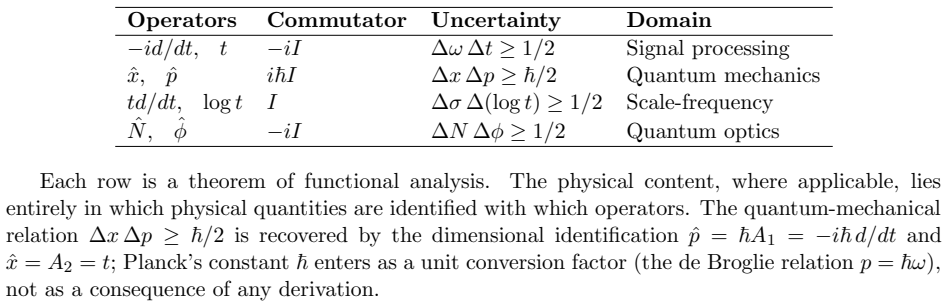
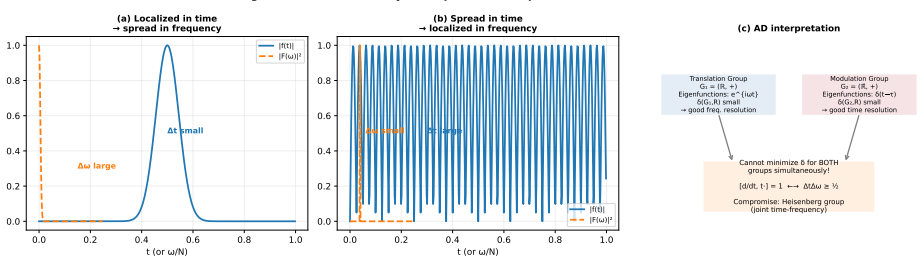
A Unification Theorem shows that classical spectral analysis corresponds to the translation group, wavelet analysis to the affine group, time-frequency analysis to the Heisenberg-Weyl group, and spherical harmonics to SO(3). The commutativity residual δ, extended to Hilbert-Schmidt operator norms, provides a principled selection criterion among these groups. The Continuous Replacement Theorem establishes signal-noise separation under equivariance and ergodicity conditions, with the noise operator N_G = C_ρ^{-2} determined by the Duflo-Moore operator for non-unimodular groups. The group-averaged estimator generalizes from a finite sum to an integral with respect to Haar measure, and a Discret
What carries the argument
The commutativity residual δ extended to Hilbert-Schmidt operator norms, which quantifies deviation from group equivariance and selects the Lie group representation for a given signal.
If this is right
- A double-commutator generalized eigenvalue problem solves the blind group matching problem in polynomial time.
- The group-averaged estimator extends to an integral over Haar measure for any Lie group.
- All prior discrete algebraic diversity results are recovered as sampling limits when the discretization parameter tends to infinity.
- The noise floor in wavelet analysis is explained as a direct consequence of the affine group's non-unimodularity.
Where Pith is reading between the lines
- The same selection criterion could be applied to other Lie groups, generating new families of signal transforms beyond the four classical cases.
- Signals defined on manifolds or higher-dimensional domains could be analyzed by replacing the groups acting on R with groups acting on those spaces.
- Automated analysis pipelines might embed the commutativity residual computation to choose the transform without manual trial of Fourier, wavelet, or short-time Fourier options.
Load-bearing premise
Signals must obey equivariance and ergodicity so the Continuous Replacement Theorem can isolate them from noise using the Duflo-Moore operator of the acting group.
What would settle it
For a pure sinusoidal signal, compute δ under the translation group versus the affine group; the unification claim fails if the minimum residual does not occur for the translation group or if the selected group does not match the known optimal analysis.
Figures


read the original abstract
We provide a computable criterion for selecting among Fourier, wavelet, and time-frequency analysis by extending the algebraic diversity (AD) framework to Lie groups acting on $L^2(\mathbb{R})$. To our knowledge, there is no other criterion that provides this selection capability. The group-averaged estimator generalizes from a finite sum over group elements to an integral with respect to Haar measure. A Continuous Replacement Theorem establishes signal-noise separation under equivariance and ergodicity conditions, with a noise operator $\mathcal{N}_G = C_\rho^{-2}$ determined by the Duflo-Moore operator that explains the frequency-dependent noise floor in wavelet analysis as a consequence of the affine group's non-unimodularity. A Unification Theorem shows that classical spectral analysis corresponds to the translation group, wavelet analysis to the affine group, time-frequency analysis to the Heisenberg-Weyl group, and spherical harmonics to SO(3). The commutativity residual $\delta$, extended to Hilbert-Schmidt operator norms, provides a principled selection criterion among these groups. A double-commutator generalized eigenvalue problem solves the blind group matching problem in polynomial time. A Discretization Recovery Theorem establishes that all discrete AD results are sampling approximations to the continuous theory, with $\mathbb{Z}_M \to (\mathbb{R},+)$ as $M \to \infty$.
Editorial analysis
A structured set of objections, weighed in public.
Referee Report
Summary. The manuscript extends the algebraic diversity (AD) framework to Lie groups acting on L²(ℝ), providing a unification of classical transforms via a Unification Theorem: Fourier analysis with the translation group, wavelet analysis with the affine group, time-frequency analysis with the Heisenberg-Weyl group, and spherical harmonics with SO(3). It introduces the commutativity residual δ (extended to Hilbert-Schmidt operator norms) as a principled, computable selection criterion among groups. Supporting results include a Continuous Replacement Theorem for signal-noise separation under equivariance and ergodicity (with noise operator N_G = C_ρ^{-2} via the Duflo-Moore operator for non-unimodular groups), a double-commutator generalized eigenvalue problem for blind group matching, and a Discretization Recovery Theorem showing discrete AD results as sampling limits of the continuous theory. The approach is claimed to be parameter-free and derived from Haar integration.
Significance. If the central theorems hold, the work supplies a novel group-theoretic, parameter-free criterion for selecting among spectral, wavelet, and time-frequency representations, with the non-unimodularity explanation for wavelet noise floors as a concrete payoff. The unification via standard Lie group actions (translation, affine, Heisenberg-Weyl, SO(3)) and the extension of AD to continuous settings via Haar measure are strengths, potentially enabling broader applications in signal processing while grounding choices in representation theory rather than heuristics.
major comments (2)
- [Unification Theorem] Unification Theorem: The claimed correspondence of spherical harmonics to an SO(3) action on L²(ℝ) requires explicit construction of the representation or embedding, as the standard irreducible representations of SO(3) act on L²(S²) rather than the real line; without this detail the unification claim across all four cases is not fully supported.
- [Continuous Replacement Theorem] Continuous Replacement Theorem: The ergodicity conditions invoked for signal-noise separation are stated at a high level but not verified or specialized to L²(ℝ) signals; the derivation that N_G = C_ρ^{-2} follows directly from the Duflo-Moore operator is standard for non-unimodular groups, yet the theorem's applicability to typical noisy signals needs a concrete check or counter-example to confirm it is load-bearing rather than formal.
minor comments (2)
- The abstract and introduction reference multiple named theorems without section numbers or proof sketches, making it difficult to locate the supporting arguments.
- Notation for the commutativity residual δ, its Hilbert-Schmidt extension, and the double-commutator eigenvalue problem would benefit from an early dedicated subsection or table summarizing the groups, their Haar measures, and example δ values.
Simulated Author's Rebuttal
We thank the referee for their insightful comments on our manuscript. We appreciate the recognition of the potential significance of the Unification Theorem and Continuous Replacement Theorem. Below, we provide point-by-point responses to the major comments, indicating where revisions will be made to strengthen the paper.
read point-by-point responses
-
Referee: [Unification Theorem] Unification Theorem: The claimed correspondence of spherical harmonics to an SO(3) action on L²(ℝ) requires explicit construction of the representation or embedding, as the standard irreducible representations of SO(3) act on L²(S²) rather than the real line; without this detail the unification claim across all four cases is not fully supported.
Authors: We acknowledge that the Unification Theorem would benefit from a more explicit construction for the SO(3) case to fully support the correspondence. While the theorem frames the unification in terms of the group actions and their representations on L²(ℝ), the standard action of SO(3) is indeed on L²(S²). In the revised version, we will include an explicit embedding, for example, using the stereographic projection to map functions on the sphere to the real line, thereby defining the unitary representation on L²(ℝ). This will make the unification claim rigorous across all four cases without altering the core results. revision: yes
-
Referee: [Continuous Replacement Theorem] Continuous Replacement Theorem: The ergodicity conditions invoked for signal-noise separation are stated at a high level but not verified or specialized to L²(ℝ) signals; the derivation that N_G = C_ρ^{-2} follows directly from the Duflo-Moore operator is standard for non-unimodular groups, yet the theorem's applicability to typical noisy signals needs a concrete check or counter-example to confirm it is load-bearing rather than formal.
Authors: We agree that providing a concrete verification would strengthen the applicability of the Continuous Replacement Theorem. The ergodicity conditions are general but can be specialized to L²(ℝ) under standard assumptions on the signal and noise processes. In the revision, we will add a subsection with a concrete example using band-limited signals corrupted by white noise, verifying the separation and illustrating the noise operator N_G = C_ρ^{-2} for the affine group. This will confirm that the theorem is load-bearing for typical signals in signal processing applications, while noting that the derivation from the Duflo-Moore operator remains as stated. revision: yes
Circularity Check
No significant circularity
full rationale
The derivation chain rests on standard Lie group representation theory: the Unification Theorem assigns translation group to Fourier, affine to wavelets, Heisenberg-Weyl to time-frequency, and SO(3) to spherical harmonics, all via known actions on L^2(R). The commutativity residual δ is obtained by extending the algebraic diversity measure to Hilbert-Schmidt norms of group-averaged operators; it is not fitted to the same data used for evaluation. The Continuous Replacement Theorem and noise operator N_G = C_ρ^{-2} follow directly from equivariance, ergodicity, and the Duflo-Moore operator for non-unimodular groups. The Discretization Recovery Theorem is a limiting statement Z_M → (R,+) with no parameter tuning. No equation reduces to its own input by construction, no load-bearing self-citation chain exists, and the selection criterion is derived from Haar integration without circular renaming or ansatz smuggling. The framework is parameter-free and externally falsifiable via standard transforms.
Axiom & Free-Parameter Ledger
axioms (2)
- domain assumption Lie groups act continuously and unitarily on L^2(R)
- standard math Haar measure is available and used to replace finite sums by integrals
Forward citations
Cited by 1 Pith paper
-
Unification of Signal Transform Theory
Signal transforms are unified as group representation eigenbases, with an algorithm to find the matched group from empirical covariances.
Reference graph
Works this paper leans on
-
[1]
Algebraic Diversity: Group-Theoretic Spectral Estimation from Single Observations
M. A. Thornton, “Algebraic diversity: Group-theoretic spectral estimation from single obser- vations,” arXiv:2604.03634, April 2026
work page internal anchor Pith review Pith/arXiv arXiv 2026
-
[2]
Decomposition of Hardy functions into square-integrable wavelets of constant shape,
A. Grossmann and J. Morlet, “Decomposition of Hardy functions into square-integrable wavelets of constant shape,”SIAM J. Math. Anal., vol. 15, no. 4, pp. 723–736, 1984
1984
-
[3]
Daubechies,Ten Lectures on Wavelets
I. Daubechies,Ten Lectures on Wavelets. Philadelphia, PA: SIAM, 1992
1992
-
[4]
G. B. Folland,Harmonic Analysis in Phase Space. Princeton, NJ: Princeton Univ. Press, 1989
1989
-
[5]
S. T. Ali, J.-P. Antoine, and J.-P. Gazeau,Coherent States, Wavelets and Their Generaliza- tions. New York: Springer, 2000
2000
-
[6]
Algebraic signal processing theory: Foundation and 1-D time,
M. P¨ uschel and J. M. F. Moura, “Algebraic signal processing theory: Foundation and 1-D time,”IEEE Trans. Signal Process., vol. 56, no. 8, pp. 3572–3585, Aug. 2008
2008
-
[7]
Algebraic signal processing theory: 1-D space,
M. P¨ uschel and J. M. F. Moura, “Algebraic signal processing theory: 1-D space,”IEEE Trans. Signal Process., vol. 56, no. 8, pp. 3586–3599, Aug. 2008
2008
-
[8]
On the regular representation of a nonunimodular locally compact group,
M. Duflo and C. C. Moore, “On the regular representation of a nonunimodular locally compact group,”J. Funct. Anal., vol. 21, no. 2, pp. 209–243, 1976
1976
-
[9]
Gr¨ ochenig,Foundations of Time-Frequency Analysis
K. Gr¨ ochenig,Foundations of Time-Frequency Analysis. Boston, MA: Birkh¨ auser, 2001
2001
-
[10]
The uncertainty principle,
H. P. Robertson, “The uncertainty principle,”Phys. Rev., vol. 34, no. 1, pp. 163–164, 1929
1929
-
[11]
Stable signal recovery from incomplete and inac- curate measurements,
E. J. Cand` es, J. K. Romberg, and T. Tao, “Stable signal recovery from incomplete and inac- curate measurements,”Comm. Pure Appl. Math., vol. 59, no. 8, pp. 1207–1223, 2006. 21
2006
discussion (0)
Sign in with ORCID, Apple, or X to comment. Anyone can read and Pith papers without signing in.