Recognition: unknown
Coupled Arnol'd cat maps on circulant graphs
Pith reviewed 2026-05-09 18:11 UTC · model grok-4.3
The pith
Coupled Arnol'd cat maps on circulant graphs produce constant Kolmogorov-Sinai entropy regardless of node connectivity.
A machine-rendered reading of the paper's core claim, the machinery that carries it, and where it could break.
Core claim
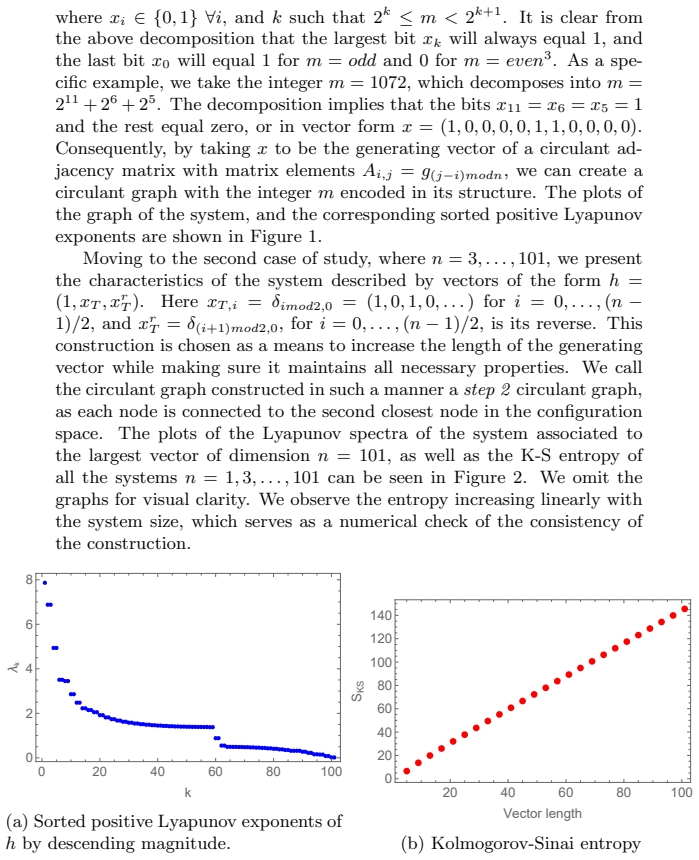
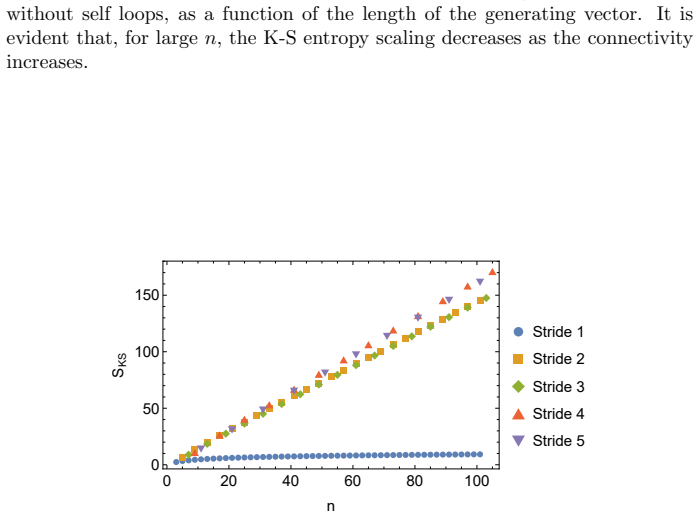
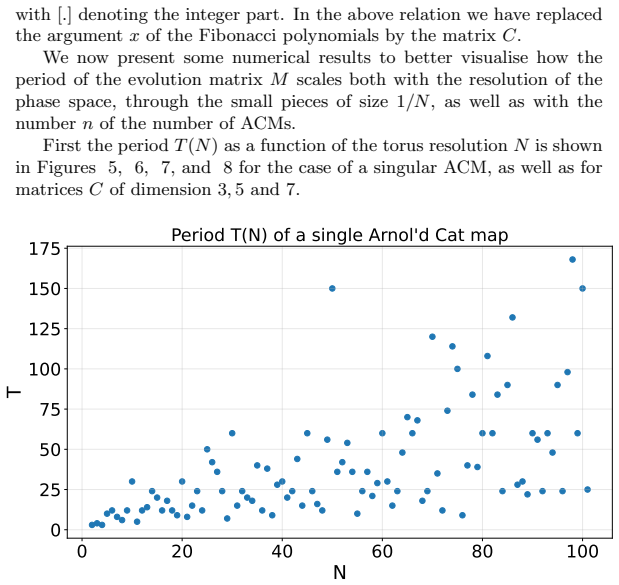
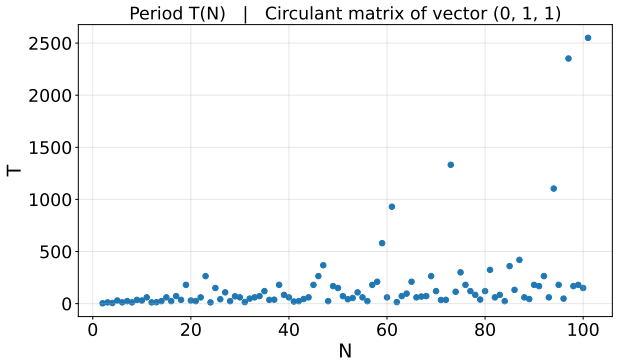
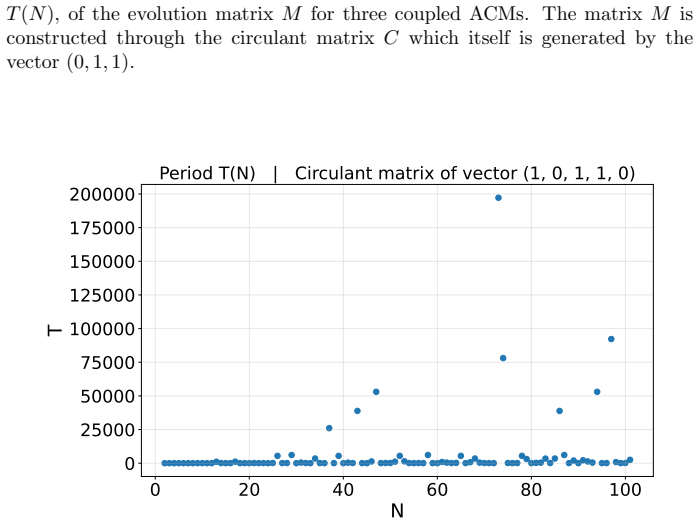
By demanding that the evolution matrix of the coupled system be symplectic, the coupling terms are uniquely fixed and correspond to the adjacency matrix of a circulant graph. The Lyapunov spectrum of the resulting high-dimensional map is computed, and the sum of the positive exponents (the Kolmogorov-Sinai entropy) is found to be independent of the graph degree. This constancy is traced to the translational invariance of the circulant structure. The paper also examines the periods of the evolution matrix when the phase space is discretized to a finite torus.
What carries the argument
The symplectic condition imposed on the block evolution matrix, which selects the unique circulant adjacency matrix that preserves the individual map's chaotic character.
If this is right
- The Kolmogorov-Sinai entropy equals the value for the uncoupled system and does not grow with added edges.
- The full Lyapunov spectrum remains unchanged under any circulant rewiring that preserves the symmetry.
- The periods of the finite-torus map are determined solely by the eigenvalues of the integer evolution matrix.
- Each individual cat map retains its positive Lyapunov exponent after coupling.
Where Pith is reading between the lines
- The same symplectic-construction method could be applied to other area-preserving maps on lattices with similar symmetry.
- Non-circulant graphs lacking translational symmetry might show the expected entropy increase with connectivity, providing a direct contrast.
- The result suggests that entropy calculations in large symmetric networks can be reduced to the single-map case.
Load-bearing premise
Requiring the full evolution matrix to be symplectic uniquely determines a coupling matrix interpretable as a circulant-graph adjacency matrix without adding free parameters or destroying the chaos of each map.
What would settle it
A direct computation of the Lyapunov spectrum for two different circulant connectivities (for example, each node linked to its two nearest neighbors versus its four nearest) that yields a larger sum of positive exponents for the higher-connectivity case would falsify the invariance claim.
Figures




read the original abstract
This paper investigates the chaotic properties of Arnol'd cat maps (ACMs) coupled on the nodes of a circulant graph. By demanding that the system's evolution matrix be symplectic, we determine the coupling matrix, which is naturally interpreted as the adjacency matrix of a circulant graph. Specifically, the study analyses the system's Lyapunov spectra and Kolmogorov-Sinai (K-S) entropy. Numerical simulations yield the counterintuitive result that the entropy production does not increase as the connectivity of the graph increases, due to the translational symmetry of the circulant graph. Moreover, we analyse the spectra of the periods of the evolution matrix on a finite toroidal phase space of the dynamical system.
Editorial analysis
A structured set of objections, weighed in public.
Referee Report
Summary. The manuscript studies coupled Arnold cat maps on the nodes of circulant graphs. Requiring the global evolution matrix to be symplectic determines the off-diagonal coupling blocks, which the authors interpret as the adjacency matrix of a circulant graph. Lyapunov spectra and Kolmogorov-Sinai entropy are computed numerically; the central claim is that entropy production remains independent of graph connectivity owing to translational symmetry. The spectra of periodic points on finite toroidal discretizations are also examined.
Significance. If the symplecticity construction is shown to yield a parameter-free 0-1 circulant coupling that preserves hyperbolicity for arbitrary degree, and if the numerical entropy result is reproducible, the work supplies a concrete example in which symmetry overrides the naive expectation that additional couplings increase entropy production. This could be useful for understanding networked hyperbolic systems and for constructing higher-dimensional symplectic maps with controlled chaos.
major comments (3)
- [Coupling construction and symplecticity condition] The construction of the global evolution matrix M (block-diagonal Arnold cat maps plus circulant coupling) and the imposition of M^T J M = J are central. With O(N^2) independent symplectic conditions but only O(N) free entries in a circulant ansatz, existence of exact 0-1 solutions for general N and degree must be verified explicitly; otherwise the subsequent claim that entropy is independent of connectivity rests on an unproven foundation.
- [Numerical results and entropy computation] The numerical evaluation of Lyapunov spectra and K-S entropy (and the finite-torus period spectra) is reported without error bars, without the explicit matrices used, and without a description of the algorithm or discretization. Because the counterintuitive constancy of entropy is the main result, these omissions make the claim impossible to assess.
- [Lyapunov spectra analysis] It is asserted that the resulting map remains chaotic (positive Lyapunov exponents) for any circulant degree. A concrete check that the spectrum of M stays hyperbolic, independent of the degree, is required; otherwise the entropy-independence statement cannot be separated from possible loss of local hyperbolicity.
minor comments (2)
- [Introduction and setup] The notation for the block form of M and the precise definition of the circulant adjacency should be stated once, early, with an explicit example for small N.
- [Abstract and conclusion] Several sentences in the abstract and conclusion repeat the same claim about translational symmetry; consolidation would improve readability.
Simulated Author's Rebuttal
We thank the referee for the careful reading and constructive comments on our manuscript. We address each major point below and indicate the revisions planned for the next version.
read point-by-point responses
-
Referee: The construction of the global evolution matrix M (block-diagonal Arnold cat maps plus circulant coupling) and the imposition of M^T J M = J are central. With O(N^2) independent symplectic conditions but only O(N) free entries in a circulant ansatz, existence of exact 0-1 solutions for general N and degree must be verified explicitly; otherwise the subsequent claim that entropy is independent of connectivity rests on an unproven foundation.
Authors: We thank the referee for this observation. The circulant symmetry reduces the independent conditions substantially, and the specific symplectic requirement on the off-diagonal blocks yields exactly the 0-1 circulant adjacency matrices we employ; this is implicit in our derivation. To make the foundation explicit, the revised manuscript will include a dedicated verification (for representative N and degrees) together with a short argument in the Fourier basis showing that the symplectic condition holds identically for any such circulant coupling. revision: yes
-
Referee: The numerical evaluation of Lyapunov spectra and K-S entropy (and the finite-torus period spectra) is reported without error bars, without the explicit matrices used, and without a description of the algorithm or discretization. Because the counterintuitive constancy of entropy is the main result, these omissions make the claim impossible to assess.
Authors: We agree that these details are essential for reproducibility. The revised version will supply the explicit block matrices for the reported examples, a precise description of the Lyapunov exponent algorithm (including the orthogonalization procedure), the toroidal discretization parameters, and error bars or convergence diagnostics for the computed K-S entropies. revision: yes
-
Referee: It is asserted that the resulting map remains chaotic (positive Lyapunov exponents) for any circulant degree. A concrete check that the spectrum of M stays hyperbolic, independent of the degree, is required; otherwise the entropy-independence statement cannot be separated from possible loss of local hyperbolicity.
Authors: The referee is correct that hyperbolicity must be confirmed separately. Our existing numerics show strictly positive Lyapunov exponents for the tested degrees. In revision we will add explicit eigenvalue spectra of M across a range of degrees, demonstrating that the spectrum remains outside the unit circle, and we will state clearly whether this is supported by a general argument or by the numerical evidence. revision: partial
Circularity Check
Symplecticity imposes coupling without reducing entropy independence to a tautology
full rationale
The derivation begins from the external requirement that the block-structured evolution matrix M satisfy the symplectic condition M^T J M = J. This fixes the off-diagonal coupling blocks, which the paper then interprets as the adjacency matrix of a circulant graph. The subsequent numerical observation that K-S entropy is independent of graph connectivity is attributed to the translational symmetry already built into the circulant form. Because the entropy result is obtained from explicit simulation rather than by algebraic identity with the symplectic constraint, and because the symplectic condition itself is not derived from the entropy or from any self-citation chain, the argument does not collapse into self-definition or fitted-input prediction. Minor self-citation risk exists only in the background literature on Arnol'd cat maps, but it is not load-bearing for the central claim.
Axiom & Free-Parameter Ledger
axioms (1)
- domain assumption The composite evolution matrix of the coupled system must be symplectic.
Reference graph
Works this paper leans on
-
[1]
Robert Gray. Toeplitz and circulant matrices: A review.Foundations and Trends®in Communications and Information Theory, 2, 10 2001.doi:10.1561/0100000006
-
[2]
Convolutional networks
Ian Goodfellow, Yoshua Bengio, and Aaron Courville. Convolutional networks. InDeep Learning, chapter 9, pages 330–372. MIT Press, Cambridge, MA, USA, 2016
2016
-
[3]
David I Shuman, Sunil K. Narang, Pascal Frossard, Antonio Ortega, and Pierre Vandergheynst. The emerging field of signal processing on graphs: Extending high-dimensional data analysis to networks and other irregular domains.IEEE Signal Processing Magazine, 30(3):83– 98, 2013.doi:10.1109/MSP.2012.2235192
-
[4]
Geometric Deep Learning: Grids, Groups, Graphs, Geodesics, and Gauges
Michael M. Bronstein, Joan Bruna, Taco Cohen, and Petar Veliˇ ckovi´ c. Geometric Deep Learning: Grids, Groups, Graphs, Geodesics, and Gauges.arXiv preprint arXiv:2104.13478, 2021
work page internal anchor Pith review arXiv 2021
-
[5]
Approxi- mately equivariant graph networks
Ningyuan Huang, Ron Levie, and Soledad Villar. Approxi- mately equivariant graph networks. In A. Oh, T. Naumann, A. Globerson, K. Saenko, M. Hardt, and S. Levine, editors, Advances in Neural Information Processing Systems, volume 36, pages 34627–34660. Curran Associates, Inc., 2023. URL:https: //proceedings.neurips.cc/paper_files/paper/2023/file/ 6cde6435...
2023
-
[6]
Yu Cheng, Felix X. Yu, Rogerio S. Feris, Sanjiv Kumar, Alok Choud- hary, and Shi-Fu Chang. An exploration of parameter redundancy in deep networks with circulant projections. In2015 IEEE Inter- national Conference on Computer Vision (ICCV), pages 2857–2865, 2015.doi:10.1109/ICCV.2015.327
-
[7]
Cir- cnn: Accelerating and compressing deep neural networks using block- circulant weight matrices
Caiwen Ding, Siyu Liao, Yanzhi Wang, Zhe Li, Ning Liu, Youwei Zhuo, Chao Wang, Xuehai Qian, Yu Bai, Geng Yuan, Xiaolong Ma, Yipeng Zhang, Jian Tang, Qinru Qiu, Xue Lin, and Bo Yuan. Cir- cnn: Accelerating and compressing deep neural networks using block- circulant weight matrices. In2017 50th Annual IEEE/ACM Inter- national Symposium on Microarchitecture ...
2017
-
[8]
Petkovi´ c, and Dragan Stevanovi´ c
Milan Baˇ si´ c, Marko D. Petkovi´ c, and Dragan Stevanovi´ c. Perfect state transfer in integral circulant graphs.Applied Mathe- matics Letters, 22(7):1117–1121, 2009. URL:https://www. sciencedirect.com/science/article/pii/S089396590900041X, doi:10.1016/j.aml.2008.11.005
-
[9]
Kunihiko Kaneko. Overview of coupled map lattices.Chaos: An Interdisciplinary Journal of Nonlinear Science, 2(3):279–282, 07 1992.arXiv:https://pubs.aip.org/aip/cha/article-pdf/2/ 3/279/18299975/279_1_online.pdf,doi:10.1063/1.165869
-
[10]
Kunihiko Kaneko. Period-doubling of kink-antikink patterns, quasiperiodicity in antiferro-like structures and spatial intermittency 22 in coupled logistic lattice*): Towards a prelude of a “field the- ory of chaos”.Progress of Theoretical Physics, 72(3):480–486, 09 1984.arXiv:https://academic.oup.com/ptp/article-pdf/72/3/ 480/5382010/72-3-480.pdf,doi:10.1...
-
[11]
Prashant M. Gade and Chin-Kun Hu. Synchronous chaos in cou- pled map lattices with small-world interactions.Phys. Rev. E, 62:6409–6413, Nov 2000. URL:https://link.aps.org/doi/10. 1103/PhysRevE.62.6409,doi:10.1103/PhysRevE.62.6409
-
[12]
R. E. Amritkar, P. M. Gade, A. D. Gangal, and V. M. Nandkumaran. Stability of periodic orbits of coupled-map lattices.Phys. Rev. A, 44:R3407–R3410, Sep 1991. URL:https://link.aps.org/doi/10. 1103/PhysRevA.44.R3407,doi:10.1103/PhysRevA.44.R3407
-
[13]
Irene Waller and Raymond Kapral. Spatial and temporal structure in systems of coupled nonlinear oscillators.Phys. Rev. A, 30:2047–2055, Oct 1984. URL:https://link.aps.org/doi/10.1103/PhysRevA. 30.2047,doi:10.1103/PhysRevA.30.2047
-
[14]
Loss of coherence in dynamical networks: Spa- tial chaos and chimera states.Phys
Iryna Omelchenko, Yuri Maistrenko, Philipp H¨ ovel, and Ecke- hard Sch¨ oll. Loss of coherence in dynamical networks: Spa- tial chaos and chimera states.Phys. Rev. Lett., 106:234102, Jun
-
[15]
Spatial Dissipative Structures in Passive Optical Sys- tems
URL:https://link.aps.org/doi/10.1103/PhysRevLett. 106.234102,doi:10.1103/PhysRevLett.106.234102
-
[16]
Aaron M. Hagerstrom, Thomas E. Murphy, Rajarshi Roy, Philipp H¨ ovel, Iryna Omelchenko, and Eckehard Sch¨ oll. Experimental obser- vation of chimeras in coupled-map lattices.Nature Physics, 8(9):658– 661, Sep 2012.doi:10.1038/nphys2372
-
[17]
Wolfram Just. Analytical approach for piecewise linear coupled map lattices.Journal of Statistical Physics, 90(3):727–748, Feb 1998.doi: 10.1023/A:1023272819435
-
[18]
Boris Gutkin and Vladimir Osipov. Classical foundations of many- particle quantum chaos.Nonlinearity, 29(2):325, jan 2016.doi: 10.1088/0951-7715/29/2/325
-
[19]
Minos Axenides, Emmanuel Floratos, and Stam Nicolis. Arnol’d cat map lattices.Phys. Rev. E, 107:064206, Jun 2023. URL: https://link.aps.org/doi/10.1103/PhysRevE.107.064206,doi: 10.1103/PhysRevE.107.064206
-
[20]
Recent advances in physical reser- voir computing: A review.Neural Networks, 115:100–123,
Gouhei Tanaka, Toshiyuki Yamane, Jean Benoit H´ eroux, Ryosho Nakane, Naoki Kanazawa, Seiji Takeda, Hidetoshi Numata, Daiju Nakano, and Akira Hirose. Recent advances in physical reser- voir computing: A review.Neural Networks, 115:100–123,
-
[21]
URL:https://www.sciencedirect.com/science/article/ pii/S0893608019300784,doi:10.1016/j.neunet.2019.03.005
-
[22]
Peng Tao, Kazuyuki Aihara, and Luonan Chen. Brain-inspired chaotic graph backpropagation for combinatorial optimization.IEEE Transactions on Neural Networks and Learning Systems, pages 1–13, 2026.doi:10.1109/TNNLS.2025.3650570. 23
-
[23]
Freeman J. Dyson and Harold Falk. Period of a discrete cat mapping.The American Mathematical Monthly, 99(7):603–614, 1992.arXiv:https://doi.org/10.1080/00029890.1992.11995900, doi:10.1080/00029890.1992.11995900
-
[24]
V. I. Arnold and A. Avez.Ergodic Problems of Classical Mechanics. Advanced Book Classics. Addison-Wesley, Redwood City, CA, 1989
1989
-
[25]
Athanasiu and E.G
G.G. Athanasiu and E.G. Floratos. Coherent states in fi- nite quantum mechanics.Nuclear Physics B, 425(1):343–364,
-
[26]
URL:https://www.sciencedirect.com/science/article/ pii/0550321394901848,doi:10.1016/0550-3213(94)90184-8
-
[27]
Ya. B. Pesin. Characteristic lyapunov exponents and smooth ergodic theory.Russian Mathematical Surveys, 32(4):55–114, 1977.doi: 10.1070/RM1977v032n04ABEH001639
-
[28]
Sinai Ya. G. editor.Dynamical Systems II: Ergodic Theory with Ap- plications to Dynamical Systems and Statistical Mechanics, volume 2 ofEncyclopaedia of Mathematical Sciences. Springer-Verlag, Berlin, Heidelberg, 1989.doi:10.1007/978-3-662-06788-8
-
[29]
Kluwer Academic Publishers, 01 2002.doi:10.1007/978-0-306-48373-8_6
Andreas Philippou.Fibonacci polynomials, pages 152–154. Kluwer Academic Publishers, 01 2002.doi:10.1007/978-0-306-48373-8_6
-
[30]
Statistical Mechanics of Cellular Automata,
Stephen Wolfram. Statistical mechanics of cellular automata.Rev. Mod. Phys., 55:601–644, Jul 1983. URL:https://link.aps. org/doi/10.1103/RevModPhys.55.601,doi:10.1103/RevModPhys. 55.601. 24
discussion (0)
Sign in with ORCID, Apple, or X to comment. Anyone can read and Pith papers without signing in.