Recognition: unknown
Self-acceleration of Hardening Binaries
Pith reviewed 2026-05-09 19:00 UTC · model grok-4.3
The pith
Hardening binaries in a uniform medium accelerate their own center of mass due to orbital asymmetry.
A machine-rendered reading of the paper's core claim, the machinery that carries it, and where it could break.
Core claim
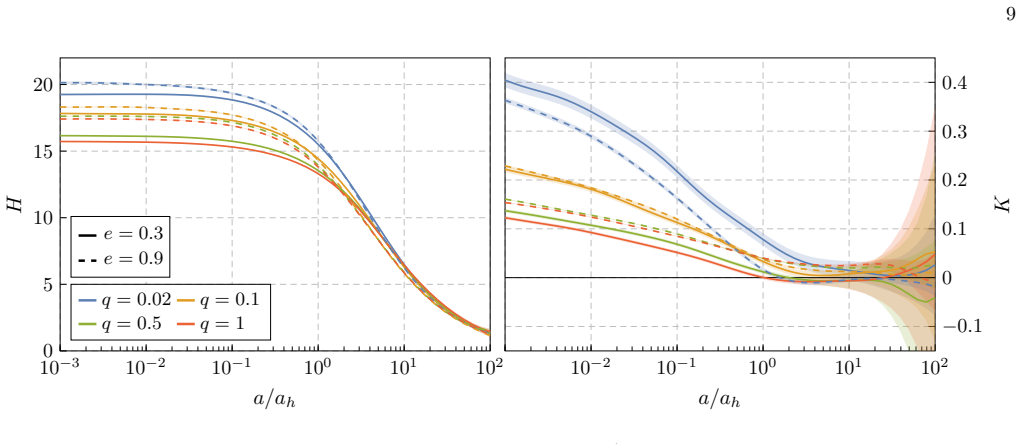
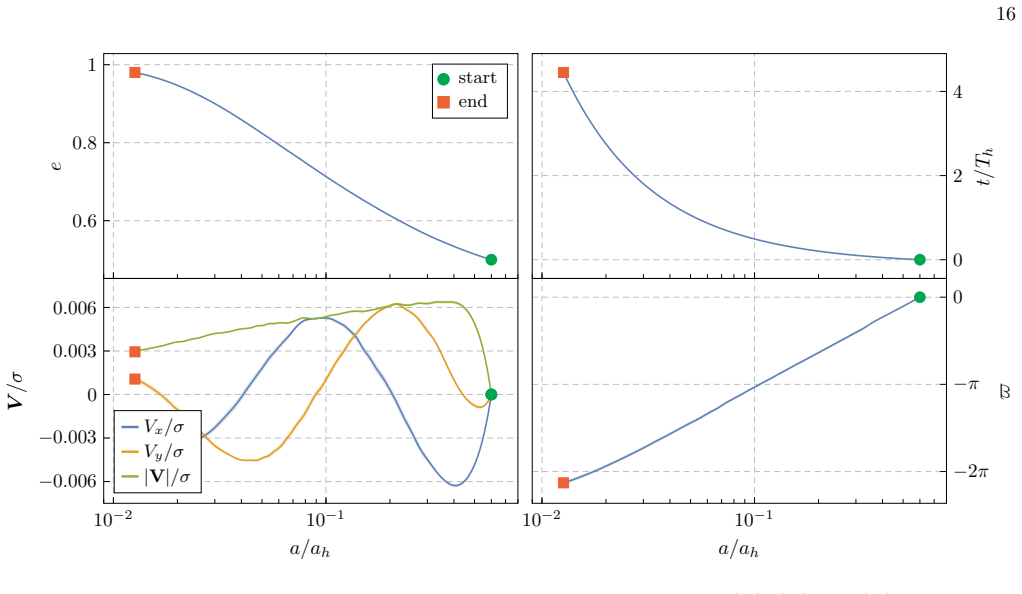
A Keplerian binary immersed in a bath of lighter particles hardens by ejecting them through gravitational slingshots. The medium exerts a net force on the binary's center of mass, induces apsidal precession, and rotates the orbital plane when the center-of-mass velocity has an out-of-plane component. These deterministic effects persist even in a perfectly uniform and isotropic medium because the binary's asymmetry provides the propulsion. The interplay of self-acceleration, precession, and dynamical friction drives the center of mass along an outward spiral. All binaries undergo eccentricity growth once long-lived encounters are included.
What carries the argument
The binary's orbital asymmetry in three-body scatterings, which breaks the symmetry of an otherwise uniform isotropic medium and produces a net force on the center of mass.
If this is right
- The center of mass follows an outward spiral trajectory under the combined influence of self-acceleration and dynamical friction.
- Supermassive black hole binaries reach displacements comparable to the radius of influence and appear offset from galactic centers.
- The enlarged stellar loss cone supplies more stars for ejection and helps resolve the final-parsec problem.
- Eccentricity grows for binaries of all mass ratios once long-lived scatterings are retained.
Where Pith is reading between the lines
- Revised population models for gravitational-wave sources should include center-of-mass motion when predicting merger rates and waveforms.
- The same asymmetry-driven propulsion may operate in other gravitational few-body systems embedded in isotropic baths, such as stellar binaries in dense clusters.
- Observational searches for offset active galactic nuclei could directly test the predicted displacement scale.
Load-bearing premise
Finite-duration three-body scattering experiments accurately capture the secular long-term dynamics in the continuous-medium limit without truncation artifacts or missing higher-order effects.
What would settle it
Long-term N-body simulations that track center-of-mass displacement of a hardening binary in a uniform stellar background without truncating encounters, or observations of spatial offsets between supermassive black holes and their host galaxy centers after mergers.
Figures





read the original abstract
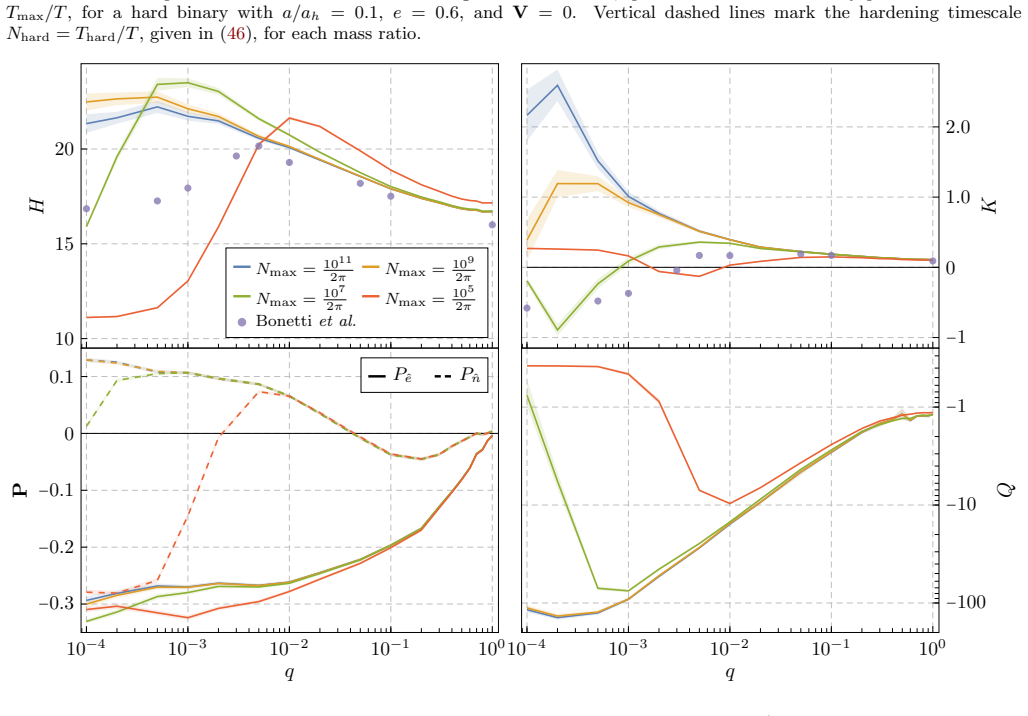
A Keplerian binary immersed in a bath of lighter particles hardens by ejecting them through gravitational slingshots. This process drives, for example, the evolution of supermassive black hole binaries following galaxy mergers, and has long been described with just two parameters: the hardening rate and the eccentricity growth rate. Here we show that the secular dynamics is substantially richer. Combining symmetry arguments with extensive three-body scattering experiments, we demonstrate that the medium exerts a net force on the binary's center of mass (CoM), induces apsidal precession, and rotates the orbital plane when the CoM velocity has an out-of-plane component. Remarkably, these deterministic effects persist even in a perfectly uniform and isotropic medium, as the binary's own asymmetry provides the propulsion. The interplay of self-acceleration, precession, and dynamical friction drives the CoM along an outward spiral. For supermassive black hole binaries, this displacement dominates over Brownian motion and approaches the radius of influence, suggesting they may be significantly offset from their host galaxies' centers. The displacement also enlarges the stellar loss cone, with direct implications for the final-parsec problem. We further show that the previously reported circularization of small-mass-ratio binaries is a numerical artifact of truncating long-lived encounters: all binaries undergo eccentricity growth. Our results enrich the standard picture of binary hardening and have implications in a variety of astrophysical contexts, including gravitational-wave source populations.
Editorial analysis
A structured set of objections, weighed in public.
Referee Report
Summary. The paper claims that a Keplerian binary hardening via gravitational slingshots in a uniform isotropic bath experiences deterministic net force on its center of mass (CoM), apsidal precession, and orbital-plane rotation arising from the binary's intrinsic asymmetry. These effects, combined with dynamical friction, drive the CoM along an outward spiral. The work further asserts that eccentricity grows for all mass ratios, with prior reports of circularization for small mass ratios being artifacts of truncating long-lived encounters in three-body simulations. The claims rest on symmetry arguments plus averaged outcomes from extensive three-body scattering experiments, with implications for supermassive black hole binary offsets, loss-cone dynamics, and the final-parsec problem.
Significance. If the central claims hold, the manuscript would meaningfully expand the standard two-parameter description of binary hardening by introducing secular CoM self-acceleration and precession effects that persist even in idealized media. This could alter predictions for binary displacements relative to galactic centers and gravitational-wave source populations. The correction to the circularization artifact is a clear contribution, and the combination of symmetry reasoning with numerical experiments is a methodological strength.
major comments (3)
- [Methods (three-body scattering)] Methods section on three-body scattering experiments: the manuscript correctly identifies truncation of long-lived encounters as the source of the prior spurious circularization result, yet the same finite-duration cutoff could systematically bias the reported net CoM force, precession rates, and plane rotation. A convergence test varying maximum encounter time (or inclusion of longer-lived trajectories) is required to confirm these secular effects are not truncation artifacts.
- [Symmetry arguments] Symmetry arguments and continuous-medium limit: the claim that deterministic propulsion persists in a perfectly uniform isotropic bath assumes the bath remains unperturbed by the binary. The binary's gravity necessarily induces wakes and local density gradients, so the paper must demonstrate that these self-consistent perturbations do not invalidate the symmetry-based net force or alter the reported rates.
- [Implications section] Implications for SMBH binaries: the assertion that CoM displacement dominates Brownian motion and approaches the radius of influence depends on the magnitude of the self-acceleration. Explicit scaling relations or parameter comparisons (e.g., versus binary mass, hardening rate, or galactic density profile) are needed to substantiate this for realistic systems.
minor comments (2)
- [Figures] Figure captions should explicitly state the mass ratios, encounter duration cutoffs, and number of scatterings used for each panel to allow direct assessment of the numerical support.
- [Abstract] The abstract states 'all binaries undergo eccentricity growth' but does not specify the mass-ratio range explored; this should be clarified for precision.
Simulated Author's Rebuttal
We thank the referee for their insightful and constructive comments, which have helped clarify several aspects of our work. We provide point-by-point responses to the major comments below, indicating where revisions will be made.
read point-by-point responses
-
Referee: Methods section on three-body scattering experiments: the manuscript correctly identifies truncation of long-lived encounters as the source of the prior spurious circularization result, yet the same finite-duration cutoff could systematically bias the reported net CoM force, precession rates, and plane rotation. A convergence test varying maximum encounter time (or inclusion of longer-lived trajectories) is required to confirm these secular effects are not truncation artifacts.
Authors: We appreciate this suggestion. Although our analysis focused on the eccentricity evolution, we recognize the potential for bias in the secular quantities due to the encounter cutoff. To address this, we will perform additional numerical experiments varying the maximum encounter time by factors of 2 and 5 to verify convergence of the net CoM force, precession rates, and plane rotation. The results will be documented in the revised Methods section and a supplementary figure. revision: yes
-
Referee: Symmetry arguments and continuous-medium limit: the claim that deterministic propulsion persists in a perfectly uniform isotropic bath assumes the bath remains unperturbed by the binary. The binary's gravity necessarily induces wakes and local density gradients, so the paper must demonstrate that these self-consistent perturbations do not invalidate the symmetry-based net force or alter the reported rates.
Authors: The symmetry arguments are based on the statistical properties of encounters in an unperturbed isotropic bath, treating particles as test particles. In reality, the binary does induce local perturbations. However, because the hardening is driven by rare, close encounters that dominate the momentum transfer, and the medium is assumed dilute, the average effect remains as calculated. We will revise the discussion to explicitly state the test-particle approximation and note that self-consistent effects would require more advanced simulations, but are not expected to eliminate the net force due to the persistent asymmetry. revision: partial
-
Referee: Implications for SMBH binaries: the assertion that CoM displacement dominates Brownian motion and approaches the radius of influence depends on the magnitude of the self-acceleration. Explicit scaling relations or parameter comparisons (e.g., versus binary mass, hardening rate, or galactic density profile) are needed to substantiate this for realistic systems.
Authors: We agree that more quantitative support is needed. In the revised version, we will add explicit scaling relations in the Implications section. For example, the self-acceleration scales with the hardening rate and binary parameters, leading to a displacement that can exceed the Brownian motion amplitude by an order of magnitude for typical SMBH binary masses and galactic densities, reaching a significant fraction of the influence radius. We will include a parameter study or table comparing these for different systems. revision: yes
Circularity Check
No significant circularity; results rest on independent symmetry arguments and numerical scattering data.
full rationale
The paper derives its claims of CoM self-acceleration, apsidal precession, orbital-plane rotation, and eccentricity growth directly from symmetry considerations plus averaged outcomes of three-body scattering experiments. These experiments serve as the empirical input rather than a fitted parameter renamed as a prediction, and no load-bearing step reduces by construction to a self-citation chain or self-defined quantity. The identification of prior circularization as a truncation artifact is presented as a methodological correction based on the same experimental framework, without circular redefinition of inputs. The derivation chain remains self-contained against external benchmarks of symmetry and scattering statistics.
Axiom & Free-Parameter Ledger
axioms (2)
- standard math Newtonian gravity governs the three-body interactions between the binary and lighter particles
- domain assumption The surrounding medium can be treated as perfectly uniform and isotropic
Reference graph
Works this paper leans on
-
[1]
Physical scales We make use of the empirical relation between the massMof a SMBH and the velocity dispersionσof the stars around it, known asM–σrelation. 3 We use the pa- rameters from [39], according to which the relation takes the form M≈10 8.49M⊙ σ 200 km/s 4.38 .(62) The formation, evolution and merger of SMBH binaries is a complex process involving d...
-
[2]
smooth medium
Brownian motion and terminal velocity As stated in Sec. II A, all our results are valid in the “smooth medium” limit, that is,m→0,n→ ∞, with ρ=mnconstant. A granular medium, composed of stars whose mass ism̸= 0, introduces stochasticity in the evo- lution of the binary [13]. One manifestation is a Brow- nian motion of the binary’s CoM, whose typical veloc...
-
[3]
external
CoM motion and the final parsec problem Efficient stellar hardening of a SMBH binary relies on a continuous supply of stars on low-angular-momentum or- bits, which come close enough to the binary to participate in a three-body interaction and be slingshotted away. Be- cause these stars are ejected after one such interaction, the rate of three-body scatter...
-
[4]
The low- frequency portion of the PTA spectrum is sensitive to en- vironmental effects, such as the interaction of the binary with its stellar background
GW signals A population of inspiraling SMBH binaries is believed to source the stochastic GW background recently de- tected by Pulsar Timing Arrays (PTA) [44–49]. The low- frequency portion of the PTA spectrum is sensitive to en- vironmental effects, such as the interaction of the binary with its stellar background. This part of the signal has indeed been...
-
[5]
Small-mass-ratio binaries Intermediate mass-ratio inspirals (IMRIs,q∼10 −2 − 10−4) and extreme mass-ratio inspirals (EMRIs,q≲ 10−4) are prime targets for LISA [51]. These systems combine small mass ratios with potentially large eccen- tricities, placing them in the regime where our new re- sults are most pronounced: the acceleration parameter Pand the pre...
-
[6]
Any asymmetric binary moving through a medium will, in general, scatter that medium anisotrop- ically and recoil
Binaries in gaseous environments The symmetry argument underlying the CoM force and apsidal precession is not restricted to stellar back- grounds. Any asymmetric binary moving through a medium will, in general, scatter that medium anisotrop- ically and recoil. This suggests that analogous secular effects may operate for binaries embedded in gas, such as s...
-
[7]
At the trap location Rtrap ∼10 3GM•/c2, the midplane density and sound speed areρ∼10 −9g/cm3 andc s ∼231km/s [61, 66], re- spectively
in a Sirko-Goodman disk [65] around an SMBH of massM • = 108M⊙, with accretion rate ˙M• = 0.5 ˙MEdd and viscosity parameterα= 0.01. At the trap location Rtrap ∼10 3GM•/c2, the midplane density and sound speed areρ∼10 −9g/cm3 andc s ∼231km/s [61, 66], re- spectively. Identifyingσ∼c s, the hard-binary scale (4) becomes ah ∼0.25 AU M 60M⊙ q (1 +q) 2 231 km/s...
-
[8]
Other environments In a similar fashion, our results can be applied to other environments. For example, a massive binary evolving within a dark matter spike [69] would experience the same self-acceleration and precession. Whether the dark matter density is ever large enough for these effects to be dynamically important depends on the spike’s pro- file, wh...
-
[9]
As a default setting, we usep= 0.01
Convergence ofRK45 The time step in ourRK45is chosen such that the rela- tive change of the particle’s velocity between consecutive time steps,|∆v|/|v|, does not exceed a given threshold p. As a default setting, we usep= 0.01. We tested con- vergence by varyingpin the range 0.002≤p≤0.05. We focus on the eccentricity growth rateK, which we find to be the e...
-
[10]
VV,Y4, andPiare all symplectic integrators
Other integrators We also tested other numerical routines, including: •Velocity Verlet (VV) [72] and Yoshida 4th order (Y4) [73]; •Pihajoki’s integrator (Pi) [74]; •Bulirsch-Stoer (BS) [75], the same integrator used in [11]. VV,Y4, andPiare all symplectic integrators. However, this property is broken inVVandY4when an adaptive time step is used, which is n...
-
[11]
the star exits the sphere of radiusr sph = 50awith positive energy
-
[12]
the elapsed integration time exceeds a maximum valueT max
-
[13]
Only scatterings satisfying condition 1 are considered re- solved and contribute to the measured rates
the cumulative time spent by the particle inside the sphere of radiusr sph = 50aexceeds 2×10 4 binary orbital periods. Only scatterings satisfying condition 1 are considered re- solved and contribute to the measured rates. Particles removed by conditions 2 or 3 are instead discarded. The first difference between our setup and those works concerns the maxi...
-
[14]
Mean” denotes the average over velocity bins; “worst
When condition 3 is imposed, our results reproduce to resolve. In the restricted three-body problem adopted in this work, long-lived encounters are no more expensive per unit time than short ones. 7 As reported throughout, we typically setN max = 1011/(2π) in our simulations. However, to truly isolate the effect of condition 3, this is the one instance in...
-
[15]
2 0. 3 0. 4 0. 5 0. 6 −0. 02 0
-
[16]
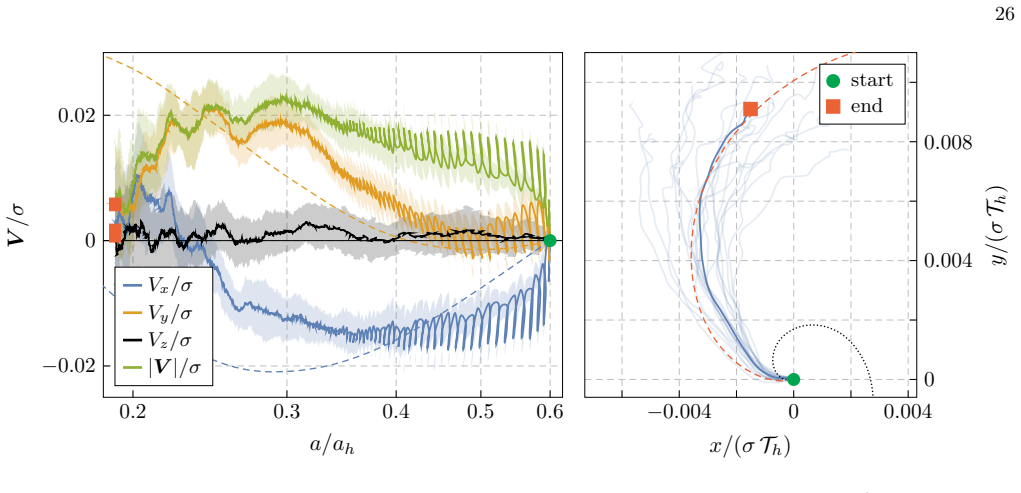
02 a/a h V /σ Vx/σ Vy/σ Vz/σ |V |/σ −0. 004 0 0. 004 0
-
[17]
008 x/ (σ Th) y/ (σ Th) start end FIG. 14. Results of theN-body simulations for a binary with the same parameters as in Figs. 9 and 10 (q= 0.2,e 0 = 0.5, anda 0/ah = 0.6).Left panel: components of the CoM velocity. The solid curves show theN-body ensemble mean over 20 realizations, and the shaded band denotes the 1σscatter across realizations. The dotted ...
-
[18]
M. C. Begelman, R. D. Blandford, and M. J. Rees, Mas- sive black hole binaries in active galactic nuclei, Nature 287, 307 (1980)
1980
-
[19]
D. Merritt and M. Milosavljevic, Massive black hole bi- nary evolution, Living Rev. Rel.8, 8 (2005), arXiv:astro- ph/0410364
-
[20]
W. C. Saslaw, M. J. Valtonen, and S. J. Aarseth, The Gravitational Slingshot and the Structure of Extragalac- tic Radio Sources, Astrophys. J.190, 253 (1974)
1974
- [21]
- [22]
- [23]
- [24]
- [25]
-
[26]
A. Sesana and F. M. Khan, Scattering experiments meet N-body – I. A practical recipe for the evolution of massive black hole binaries in stellar environments, Mon. Not. Roy. Astron. Soc.454, L66 (2015), arXiv:1505.02062 [astro-ph.GA]
-
[27]
A. Rasskazov, G. Fragione, N. W. C. Leigh, H. Tagawa, A. Sesana, A. Price-Whelan, and E. M. Rossi, Hyperve- locity stars from a supermassive black hole–intermediate- mass black hole binary, Astrophys. J.878, 17 (2019), arXiv:1810.12354 [astro-ph.GA]
-
[28]
M. Bonetti, A. Rasskazov, A. Sesana, M. Dotti, F. Haardt, N. W. C. Leigh, M. Arca Sedda, G. Fragione, and E. Rossi, On the eccentricity evolution of massive black hole binaries in stellar backgrounds, Mon. Not. Roy. Astron. Soc.493, L114 (2020), arXiv:2001.02231 [astro- ph.GA]
-
[29]
A. Gualandris, F. M. Khan, E. Bortolas, M. Bonetti, A. Sesana, P. Berczik, and K. Holley-Bockelmann, Ec- centricity evolution of massive black hole binaries from formation to coalescence, Mon. Not. Roy. Astron. Soc. 511, 4753 (2022), arXiv:2201.08646 [astro-ph.GA]
-
[30]
Merritt, Brownian motion of a massive binary, Astro- phys
D. Merritt, Brownian motion of a massive binary, Astro- phys. J.556, 245 (2001), arXiv:astro-ph/0012264
-
[31]
Merritt, Rotational Brownian Motion of a Mas- sive Binary, Astrophys
D. Merritt, Rotational Brownian Motion of a Mas- sive Binary, Astrophys. J.568, 998 (2002), arXiv:astro- ph/0107569
-
[32]
P. Chatterjee, L. Hernquist, and A. Loeb, Effects of Wandering on the Coalescence of Black Hole Bina- ries in Galactic Centers, Astrophys. J.592, 32 (2003), arXiv:astro-ph/0302573
-
[33]
E. Bortolas, A. Gualandris, M. Dotti, M. Spera, and M. Mapelli, Brownian motion of massive black hole bina- ries and the final parsec problem, Mon. Not. Roy. Astron. Soc.461, 1072 (2016), arXiv:1606.06728 [astro-ph.GA]
-
[34]
F. M. Khan, M. A. Mirza, and K. Holley-Bockelmann, Inward bound: the incredible journey of massive black holes as they pair and merge - I. The effect of mass ra- tio in flattened rotating galactic nuclei, Mon. Not. Roy. Astron. Soc.492, 256 (2020), arXiv:1911.07946 [astro- ph.GA]
-
[35]
L. Varisco, E. Bortolas, M. Dotti, and A. Sesana, Stellar hardening of massive black hole binaries: the impact of the host rotation, Mon. Not. Roy. Astron. Soc.508, 1533 (2021), arXiv:2104.14570 [astro-ph.GA]
-
[36]
P. Chatterjee, L. Hernquist, and A. Loeb, Dynamics of a massive black hole at the center of a dense stellar system, Astrophys. J.572, 371 (2002), arXiv:astro-ph/0107287
-
[37]
P. Chatterjee, L. Hernquist, and A. Loeb, Brownian mo- tion in gravitationally-interacting systems, Phys. Rev. Lett.88, 121103 (2002), arXiv:astro-ph/0202257
-
[38]
M. Milosavljevic and D. Merritt, Long term evolution of massive black hole binaries, Astrophys. J.596, 860 (2003), arXiv:astro-ph/0212459
-
[39]
P. Chatterjee, L. Hernquist, and A. Loeb, Effects of wan- dering on the coalescence of black hole binaries in galac- tic centers, Astrophys. J.592, 32 (2003), arXiv:astro- ph/0302573
-
[40]
F. Laun and D. Merritt, Brownian motion of black holes in dense nuclei, Astron. J.133, 533 (2007), arXiv:astro- ph/0408029
-
[41]
P. Berczik, D. Merritt, and R. Spurzem, Long-term evo- lution of massive black hole binaries. 2. Binary evolution in low-density galaxies, Astrophys. J.633, 680 (2005), arXiv:astro-ph/0507260
-
[42]
P. Di Cintio, L. Ciotti, and C. Nipoti, Brownian mo- tion of supermassive black holes in galaxy cores, in Star Clusters: From the Milky Way to the Early Uni- verse, IAU Symposium, Vol. 351, edited by A. Bragaglia, M. Davies, A. Sills, and E. Vesperini (2020) pp. 93–96, arXiv:1908.04283 [astro-ph.GA]
-
[43]
Chandrasekhar, Dynamical Friction
S. Chandrasekhar, Dynamical Friction. I. General Con- siderations: the Coefficient of Dynamical Friction, Astro- phys. J.97, 255 (1943)
1943
-
[44]
J. G. Hills, The effect of low-velocity, low-mass intruders (collisionless gas) on the dynamical evolution of a binary system, Astrophys. J.88, 1269 (1983)
1983
-
[45]
V. Cardoso and C. F. B. Macedo, Drifting through the medium: kicks and self-propulsion of binaries within ac- cretion discs and other environments, Mon. Not. Roy. Astron. Soc.498, 1963 (2020), arXiv:2008.01091 [astro- ph.HE]
-
[46]
M. Milosavljevic and D. Merritt, Formation of galac- tic nuclei, Astrophys. J.563, 34 (2001), arXiv:astro- ph/0103350
-
[47]
T. F. M. Spieksma and G. M. Tomaselli, BBH- stars,https://github.com/thomasspieksma/BBH_stars (2026)
2026
-
[48]
Hamilton and S
C. Hamilton and S. Modak, Eccentricity dynamics of wide binaries–ii. the effect of stellar encounters and con- straints on formation channels, Mon. Not. Roy. Astron. Soc532, 2425 (2024)
2024
-
[49]
A. Gualandris, M. Dotti, and A. Sesana, Massive black hole binary plane reorientation in rotating stellar sys- tems, Mon. Not. Roy. Astron. Soc.420, 38 (2012), 28 arXiv:1109.3707 [astro-ph.GA]
-
[50]
A. Rasskazov and D. Merritt, Evolution Of Binary Su- permassive Black Holes In Rotating Nuclei, Astrophys. J.837, 135 (2017), arXiv:1610.08555 [astro-ph.GA]
-
[51]
P. Berczik, M. A. Sedda, M. Sobolenko, M. Ishchenko, O. Sobodar, and R. Spurzem, Merging of unequal mass binary black holes in non-axisymmetric galactic nuclei, Astron. Astrophys.665, A86 (2022), arXiv:2008.04342 [astro-ph.GA]
-
[52]
Binney and S
J. Binney and S. Tremaine,Galactic Dynamics: Second Edition(2008)
2008
-
[53]
P. J. E. Peebles, Star Distribution Near a Collapsed Ob- ject, Astrophys. J.178, 371 (1972)
1972
- [54]
-
[55]
J. Makino and Y. Funato, Evolution of massive black hole binaries, Astrophys. J.602, 93 (2004), arXiv:astro- ph/0307327
-
[56]
Coevolution (Or Not) of Supermassive Black Holes and Host Galaxies
J. Kormendy and L. C. Ho, Coevolution (Or Not) of Su- permassive Black Holes and Host Galaxies, Ann. Rev. As- tron. Astrophys.51, 511 (2013), arXiv:1304.7762 [astro- ph.CO]
work page internal anchor Pith review Pith/arXiv arXiv 2013
-
[57]
F. Dosopoulou and F. Antonini, Dynamical friction and the evolution of Supermassive Black hole Binaries: the final hundred-parsec problem, Astrophys. J.840, 31 (2017), arXiv:1611.06573 [astro-ph.GA]
-
[58]
A. Gualandris, J. I. Read, W. Dehnen, and E. Bortolas, Collisionless loss-cone refilling: there is no final parsec problem, Mon. Not. Roy. Astron. Soc.464, 2301 (2017), arXiv:1609.09383 [astro-ph.GA]
- [59]
- [60]
-
[61]
The NANOGrav 15-year Data Set: Evidence for a Gravitational-Wave Background
G. Agazieet al.(NANOGrav), The NANOGrav 15 yr Data Set: Evidence for a Gravitational-wave Background, Astrophys. J. Lett.951, L8 (2023), arXiv:2306.16213 [astro-ph.HE]
work page internal anchor Pith review arXiv 2023
-
[62]
J. Antoniadiset al.(EPTA, InPTA:), The second data release from the European Pulsar Timing Array - III. Search for gravitational wave signals, Astron. Astrophys. 678, A50 (2023), arXiv:2306.16214 [astro-ph.HE]
-
[63]
D. J. Reardonet al., Search for an Isotropic Gravitational-wave Background with the Parkes Pul- sar Timing Array, Astrophys. J. Lett.951, L6 (2023), arXiv:2306.16215 [astro-ph.HE]
work page internal anchor Pith review arXiv 2023
-
[64]
H. Xuet al., Searching for the Nano-Hertz Stochastic Gravitational Wave Background with the Chinese Pulsar Timing Array Data Release I, Res. Astron. Astrophys. 23, 075024 (2023), arXiv:2306.16216 [astro-ph.HE]
work page internal anchor Pith review arXiv 2023
-
[65]
G. Agazieet al.(NANOGrav), The NANOGrav 15 yr Data Set: Constraints on Supermassive Black Hole Bina- ries from the Gravitational-wave Background, Astrophys. J. Lett.952, L37 (2023), arXiv:2306.16220 [astro-ph.HE]
-
[66]
J. Antoniadiset al.(EPTA, InPTA), The second data release from the European Pulsar Timing Array - IV. Implications for massive black holes, dark matter, and the early Universe, Astron. Astrophys.685, A94 (2024), arXiv:2306.16227 [astro-ph.CO]
-
[67]
Y. Chenet al., Inference on inner galaxy struc- ture via gravitational waves from supermassive bina- ries, Nature Astron. 10.1038/s41550-026-02782-0 (2026), arXiv:2411.05906 [astro-ph.HE]
-
[68]
M. Colpiet al.(LISA), LISA Definition Study Report, (2024), arXiv:2402.07571 [astro-ph.CO]
work page internal anchor Pith review arXiv 2024
-
[69]
Science with the space-based interferometer LISA. V: Extreme mass-ratio inspirals
S. Babak, J. Gair, A. Sesana, E. Barausse, C. F. Sop- uerta, C. P. L. Berry, E. Berti, P. Amaro-Seoane, A. Pe- titeau, and A. Klein, Science with the space-based inter- ferometer LISA. V: Extreme mass-ratio inspirals, Phys. Rev. D95, 103012 (2017), arXiv:1703.09722 [gr-qc]
work page Pith review arXiv 2017
-
[70]
D. Mancieri, L. Broggi, M. Vinciguerra, A. Sesana, and M. Bonetti, Eccentricity distribution of extreme mass ratio inspirals, Phys. Rev. D113, 043062 (2026), arXiv:2509.02394 [astro-ph.HE]
-
[71]
P. C. Peters and J. Mathews, Gravitational radiation from point masses in a Keplerian orbit, Phys. Rev.131, 435 (1963)
1963
-
[72]
P. C. Peters, Gravitational Radiation and the Motion of Two Point Masses, Phys. Rev.136, B1224 (1964)
1964
-
[73]
A. Torres-Orjuela, V. V´ azquez-Aceves, and T.-X. Wang, Detection of Intermediate-mass Ratio Inspirals in Glob- ular Clusters: Revealing the Brownian Motion with Gravitational Waves, Astrophys. J.986, 155 (2025), arXiv:2501.13466 [astro-ph.HE]
- [74]
- [75]
- [76]
-
[77]
B. Mckernanet al., Constraining Stellar-mass Black Hole Mergers in AGN Disks Detectable with LIGO, Astro- phys. J.866, 66 (2018), arXiv:1702.07818 [astro-ph.HE]
-
[78]
A. Secunda, J. Bellovary, M.-M. Mac Low, K. E. Saavik Ford, B. McKernan, N. Leigh, W. Lyra, and Z. S´ andor, Orbital Migration of Interacting Stellar Mass Black Holes in Disks around Supermassive Black Holes, Astrophys. J.878, 85 (2019), arXiv:1807.02859 [astro- ph.HE]
- [79]
-
[80]
M. Gr¨ obner, W. Ishibashi, S. Tiwari, M. Haney, and P. Jetzer, Binary black hole mergers in AGN accretion discs: gravitational wave rate density estimates, Astron. Astrophys.638, A119 (2020), arXiv:2005.03571 [astro- ph.GA]
discussion (0)
Sign in with ORCID, Apple, or X to comment. Anyone can read and Pith papers without signing in.