Recognition: unknown
A HOMFLYPT-type invariant for pseudo links via a resolution in Hecke algebras
Pith reviewed 2026-05-09 18:01 UTC · model grok-4.3
The pith
A resolution homomorphism produces a HOMFLYPT-type invariant for pseudo links.
A machine-rendered reading of the paper's core claim, the machinery that carries it, and where it could break.
Core claim
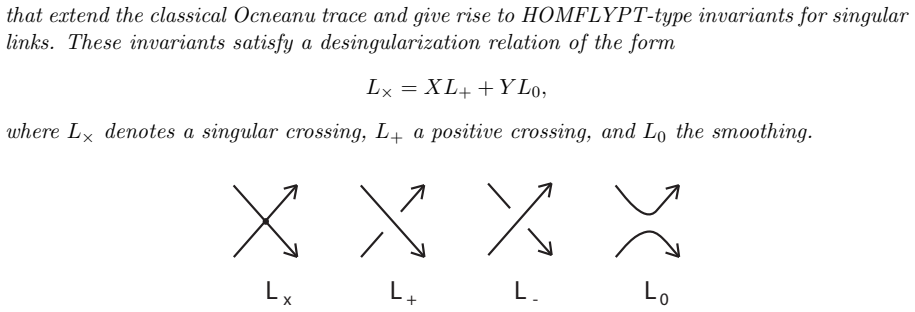
We construct a HOMFLYPT-type invariant for oriented pseudo links via the pseudo Hecke algebra of type A. The construction is based on a resolution homomorphism that maps each pseudo generator to a linear combination of a braid generator and its inverse, interpreting pre-crossings as algebraic superpositions of classical crossings. Composing this map with the Ocneanu trace and applying a suitable normalization yields an invariant satisfying a natural pseudo skein relation. We further show that the invariant admits a state-sum formulation as a weighted sum of classical HOMFLYPT-type invariants over all classical resolutions of the pseudo crossings, as well as a skein-theoretic characterization
What carries the argument
The resolution homomorphism from the pseudo Hecke algebra to the ordinary Hecke algebra, which sends each pseudo crossing generator to a linear combination of the corresponding braid generator and its inverse.
If this is right
- The invariant satisfies a pseudo skein relation relating its value on a pre-crossing to its values on the two classical crossings.
- It equals a weighted sum of classical HOMFLYPT invariants, one for each possible resolution of all pre-crossings in the diagram.
- It is uniquely determined by its values on ordinary links together with the pseudo skein relation.
- The invariant is unchanged under the pseudo Reidemeister moves when properly normalized.
Where Pith is reading between the lines
- This state-sum view suggests that the invariant for a pseudo link can be calculated by enumerating all classical link resolutions and averaging their HOMFLYPT values with appropriate weights.
- The skein characterization may allow recursive computation of the invariant directly on pseudo diagrams without enumerating resolutions.
Load-bearing premise
The proposed map from the pseudo Hecke algebra to the ordinary one must preserve all the algebraic relations and be compatible with the moves that define equivalence of pseudo links.
What would settle it
Compute the invariant for a specific pseudo link diagram and check whether it remains the same after performing a pseudo Reidemeister move that changes the diagram; if the value changes, the construction fails to produce an invariant.
Figures


read the original abstract
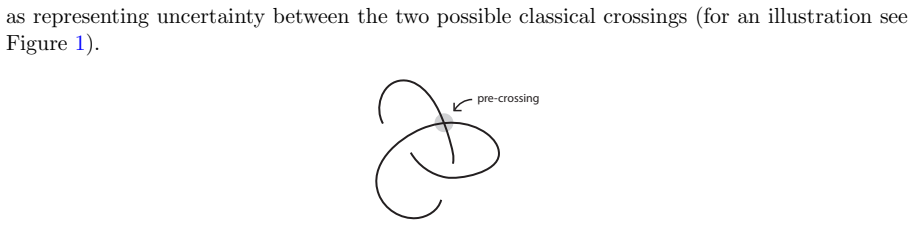
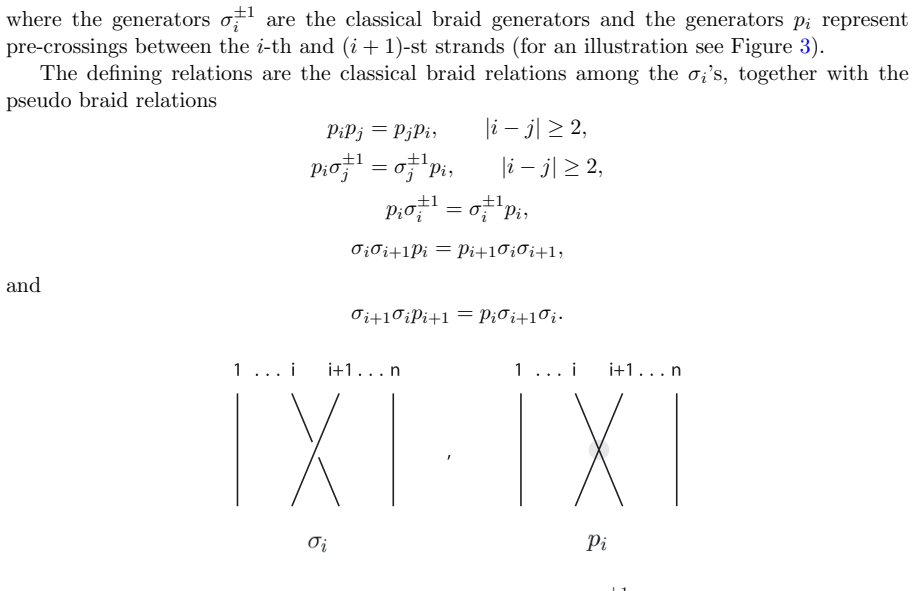
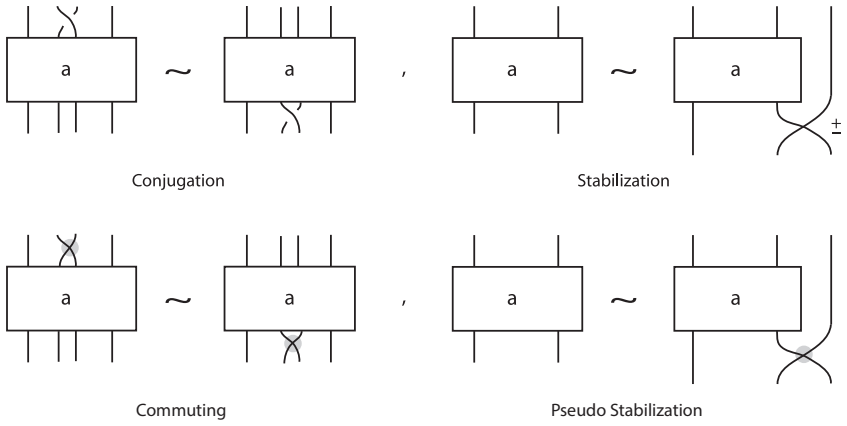
Pseudo links generalize classical links by allowing crossings with missing over/under information, called pre-crossings. While the pseudo braid framework provides an algebraic description of pseudo links via a Markov-type theorem, the construction of polynomial invariants using Hecke algebra techniques is obstructed by the presence of the pseudo Reidemeister 1 move. In this paper, we construct a HOMFLYPT-type invariant for oriented pseudo links via the pseudo Hecke algebra of type \(A\). The construction is based on a resolution homomorphism that maps each pseudo generator to a linear combination of a braid generator and its inverse, interpreting pre-crossings as algebraic superpositions of classical crossings. Composing this map with the Ocneanu trace and applying a suitable normalization yields an invariant satisfying a natural pseudo skein relation. We further show that the invariant admits a state-sum formulation as a weighted sum of classical HOMFLYPT-type invariants over all classical resolutions of the pseudo crossings, as well as a skein-theoretic characterization in terms of its values on classical links and the pseudo skein relation.
Editorial analysis
A structured set of objections, weighed in public.
Referee Report
Summary. The paper constructs a HOMFLYPT-type invariant for oriented pseudo links by introducing a pseudo Hecke algebra of type A and defining a resolution homomorphism that sends each pseudo generator to a linear combination of a classical braid generator and its inverse. Composing this map with the Ocneanu trace on the Hecke algebra, followed by suitable normalization, produces an invariant that satisfies a natural pseudo skein relation. The construction is shown to be equivalent to a state-sum formula expressing the invariant as a weighted sum of classical HOMFLYPT-type invariants over all possible classical resolutions of the pseudo crossings, and it admits a skein-theoretic characterization based on its values on classical links together with the pseudo skein relation.
Significance. If the resolution homomorphism is a well-defined algebra homomorphism compatible with the relations of the pseudo Hecke algebra and the pseudo Reidemeister moves (including the pseudo R1 move that obstructed prior attempts), the result supplies a systematic algebraic extension of the classical HOMFLYPT polynomial to the setting of pseudo links. The state-sum formulation provides an independent computational verification route and a direct link to existing invariants, which strengthens the claim and may facilitate applications in distinguishing pseudo links or studying their properties.
major comments (2)
- [Definition of the resolution homomorphism] The central claim rests on the resolution homomorphism being a well-defined algebra homomorphism from the pseudo Hecke algebra to the ordinary Hecke algebra. Explicit verification is required that this map preserves all defining relations of the pseudo Hecke algebra, especially those mixing pseudo generators with classical braid generators and inverses.
- [Proof of invariance under pseudo Reidemeister moves] Invariance under the pseudo Reidemeister 1 move must be checked after normalization; the abstract notes this move as the prior obstruction, so the choice of normalization constants (likely involving the parameters of the linear combination) needs to be shown to cancel the contribution of this move when the Ocneanu trace is applied.
minor comments (3)
- [Notation and definitions] Clarify the precise linear combination used for the resolution map (coefficients in terms of the Hecke algebra parameter) and confirm that it is independent of the choice of representative in the pseudo braid group.
- [Examples and computations] Add a short table or explicit example computing the invariant on a simple pseudo link (e.g., a single pseudo crossing) to illustrate the state-sum formula and its reduction to the classical HOMFLYPT polynomial when all crossings are resolved.
- [References] Ensure all references to the Markov-type theorem for pseudo braids and the standard Ocneanu trace are cited with precise statements of the external results being invoked.
Simulated Author's Rebuttal
We thank the referee for the careful reading and constructive suggestions. We address the two major comments below and will incorporate the requested clarifications into the revised manuscript.
read point-by-point responses
-
Referee: [Definition of the resolution homomorphism] The central claim rests on the resolution homomorphism being a well-defined algebra homomorphism from the pseudo Hecke algebra to the ordinary Hecke algebra. Explicit verification is required that this map preserves all defining relations of the pseudo Hecke algebra, especially those mixing pseudo generators with classical braid generators and inverses.
Authors: We agree that a fully explicit verification is necessary for rigor. In the revised manuscript we will add a dedicated subsection (in Section 3) that checks preservation of every defining relation of the pseudo Hecke algebra, with particular attention to the mixed relations involving both pseudo generators and classical generators/inverses. The verification proceeds by direct substitution of the linear combination into each relation and use of the quadratic and braid relations already satisfied by the classical Hecke algebra. revision: yes
-
Referee: [Proof of invariance under pseudo Reidemeister moves] Invariance under the pseudo Reidemeister 1 move must be checked after normalization; the abstract notes this move as the prior obstruction, so the choice of normalization constants (likely involving the parameters of the linear combination) needs to be shown to cancel the contribution of this move when the Ocneanu trace is applied.
Authors: We accept the observation. The normalization constants are chosen exactly so that the pseudo R1 contribution vanishes. In the revision we will expand the invariance proof (currently in Section 4) to include an explicit computation: after applying the resolution map and the Ocneanu trace, the difference between the two sides of the pseudo R1 move is shown to be zero by direct cancellation using the specific coefficients in the linear combination and the known properties of the trace on the classical Hecke algebra. revision: yes
Circularity Check
No significant circularity identified
full rationale
The paper introduces a new resolution homomorphism from the pseudo Hecke algebra to the ordinary Hecke algebra that maps each pseudo generator to a linear combination of a braid generator and its inverse. This is composed with the standard Ocneanu trace and a normalization to produce the invariant. The Markov-type theorem for pseudo braids and the Ocneanu trace are external prior results; the central construction, pseudo skein relation, and state-sum formulation over classical resolutions do not reduce to fitted inputs, self-definitions, or unverified self-citations. The derivation chain remains independent of the final invariant values.
Axiom & Free-Parameter Ledger
axioms (2)
- domain assumption The pseudo braid group admits a Markov-type theorem allowing invariants to be defined via traces on closures of pseudo braids.
- ad hoc to paper The resolution map sending each pseudo generator to a linear combination of a braid generator and its inverse respects the defining relations of the pseudo Hecke algebra.
Reference graph
Works this paper leans on
-
[1]
J. W. Alexander, A lemma on systems of knotted curves,Proc. Natl. Acad. Sci. USA, 9 (1923), 93–95. 20
1923
-
[2]
J. C. Baez, Link invariants of finite type and perturbation theory,Lett. Math. Phys., 26 (1992), 43–51
1992
-
[3]
V. G. Bardakov, S. Jablan, and H. Wang, Monoid and group of pseudo braids,J. Knot Theory Ramifications, 25 (2016), 1641002
2016
-
[4]
J. S. Birman, New points of view in knot theory,Bull. Amer. Math. Soc., 28 (1993), 253–287
1993
-
[5]
Diamantis, Tied pseudo links & pseudo knotoids,Mediterr
I. Diamantis, Tied pseudo links & pseudo knotoids,Mediterr. J. Math.18(2021), 201
2021
-
[6]
Diamantis, Pseudo links and singular links in the solid torus,Communications in Mathematics,31(2023), 333–357
I. Diamantis, Pseudo links and singular links in the solid torus,Communications in Mathematics,31(2023), 333–357
2023
-
[7]
Diamantis, L
I. Diamantis, L. H. Kauffman, and S. Lambropoulou, Topology and algebra of bonded knots and braids,Mathematics13(2025), 3260
2025
-
[8]
Freyd, D
P. Freyd, D. Yetter, J. Hoste, W. B. R. Lickorish, K. Millett, and A. Ocneanu, A new polynomial invariant of knots and links,Bull. Amer. Math. Soc.12(1985), 239–246
1985
-
[9]
Hanaki, Pseudo diagrams of knots, links and spatial graphs,Osaka J
R. Hanaki, Pseudo diagrams of knots, links and spatial graphs,Osaka J. Math., 47 (2010), 863–883
2010
-
[10]
Henrich, R
A. Henrich, R. Hoberg, S. Jablan, L. Johnson, E. Minten, and L. Radovi´ c, The theory of pseudoknots,J. Knot Theory Ramifications, 22 (2013), 1350032
2013
-
[11]
Henrich and L
A. Henrich and L. H. Kauffman, Tangle insertion invariants for pseudoknots, singular knots, and rigid vertex spatial graphs,Contemp. Math.689(2017), 177–189
2017
-
[12]
V. F. R. Jones, Hecke algebra representations of braid groups and link polynomials,Ann. of Math., 126 (1987), 335–388
1987
-
[13]
L. H. Kauffman, New invariants in the theory of knots,Amer. Math. Monthly, 95 (1988), 195–242
1988
-
[14]
Lambropoulou, Knot theory related to generalized and cyclotomic Hecke algebras of type B,J
S. Lambropoulou, Knot theory related to generalized and cyclotomic Hecke algebras of type B,J. Knot Theory Ramifications, 8 (1999), 621–658
1999
-
[15]
Lambropoulou, L-moves and Markov theorems,J
S. Lambropoulou, L-moves and Markov theorems,J. Knot Theory Ramifications, 16 (2007), 1459–1468
2007
-
[16]
A. A. Markov, ¨Uber die freie ¨Aquivalenz der geschlossenen Z¨ opfe,Rec. Math. [Mat. Sbornik] N.S.1(43)(1936), 73–78
1936
-
[17]
Paris and L
L. Paris and L. Rabenda, Singular Hecke algebras, Markov traces and HOMFLY-type invariants,Ann. Inst. Fourier, 58 (2008), 2413–2443. 21
2008
discussion (0)
Sign in with ORCID, Apple, or X to comment. Anyone can read and Pith papers without signing in.