Recognition: unknown
High-throughput full-f gyrokinetics of the tokamak boundary
Pith reviewed 2026-05-09 17:45 UTC · model grok-4.3
The pith
Hundreds of unsupervised full-f gyrokinetic simulations show plasma shaping effects on tokamak boundary confinement depend on heating power.
A machine-rendered reading of the paper's core claim, the machinery that carries it, and where it could break.
Core claim
Full-f global gyrokinetic simulations of the plasma boundary have until now required heroic computational efforts and case-by-case expert intervention, precluding systematic parameter scans. Here we demonstrate a paradigm shift by performing hundreds of independent, concurrent, and unsupervised full-f boundary gyrokinetic simulations in a geometry inspired by the Tokamak à Configuration Variable (TCV), covering both the closed flux surface region and the open-field-line scrape-off layer while scanning triangularity, elongation, and heating power. All simulations are evolved much longer than the turbulence relaxation time until the steady state is reached. Analysis of the steady-state profile
What carries the argument
The neoclassical trapped-ion mechanism in which triangularity modifies the field-line arc length between banana turning points and the high-field-side limiter, altering trapped-ion interaction with cold neutral-ionization regions.
If this is right
- The generated open dataset serves as a benchmark for boundary transport models.
- The dataset can train data-driven surrogate models for fusion applications.
- Fingerprint analysis categorizes boundary turbulence into ITG- or TEM-dominated regimes, confirmed by local linear calculations.
- The power-dependent response to shaping suggests different optimization priorities for low-power versus high-power tokamak operation.
Where Pith is reading between the lines
- The same unsupervised high-throughput approach could be extended to scan additional parameters such as aspect ratio or magnetic shear in other device geometries.
- The neoclassical orbit-length explanation implies that deliberate limiter placement or field-line mapping could be used to control SOL temperatures independently of core shaping.
- These steady-state profiles offer a concrete testbed for reduced models that aim to predict boundary transport without full gyrokinetic cost.
Load-bearing premise
The simulations reach a genuine steady state without artificial damping or intervention and accurately capture the neoclassical trapped-ion dynamics plus turbulent transport in a geometry representative of real devices.
What would settle it
Steady-state SOL ion temperature and edge gradient measurements in a device like TCV at matched triangularity and power levels that fail to reproduce the simulated power-dependent trends.
Figures



read the original abstract
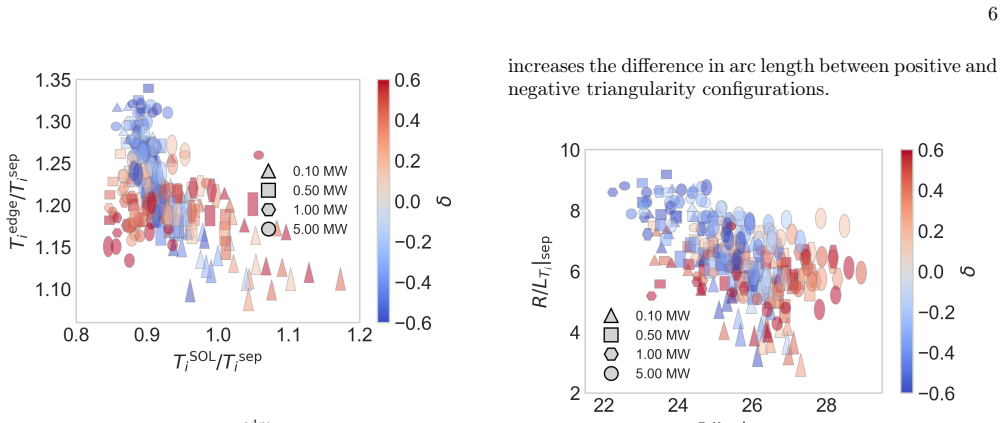
Full-f global gyrokinetic simulations of the plasma boundary have until now required heroic computational efforts and case-by-case expert intervention, precluding systematic parameter scans. Here we demonstrate a paradigm shift: hundreds of independent, concurrent, and unsupervised full-f boundary gyrokinetic simulations in a geometry inspired by the Tokamak \`a Configuration Variable (TCV), covering both the closed flux surface region and the open-field-line scrape-off layer (SOL) while scanning triangularity, elongation, and heating power. All simulations are evolved much longer than the turbulence relaxation time until the steady state is reached. Analysis of the steady-state profiles reveals that the impact of plasma shaping on confinement is strongly power dependent: at low power, triangularity primarily controls the SOL ion temperature, while at high power it mostly affects the edge ion temperature gradient. The low-power hot SOL observed for positive triangularity is explained by a neoclassical trapped-ion mechanism in which triangularity modifies the field-line arc length between banana turning points and the high-field-side limiter, altering the interaction with cold neutral-ionization regions. Fingerprint analysis of turbulent transport categorize the simulations in a regime dominated by ion temperature gradient (ITG) or trapped electron modes (TEMs), confirmed by dedicated local linear gyrokinetic calculations. The generated open data represents a previously unobtainable resource. It can serve both as a benchmark for boundary transport models, and as a training dataset for data-driven methods in fusion foundation and surrogate models.
Editorial analysis
A structured set of objections, weighed in public.
Referee Report
Summary. The paper introduces a high-throughput framework for full-f gyrokinetic simulations of the tokamak boundary, enabling hundreds of concurrent, unsupervised runs in TCV-like geometry across scans of triangularity, elongation, and heating power. The central finding is that the effect of plasma shaping on confinement is strongly power-dependent: at low power, triangularity governs the SOL ion temperature via a neoclassical trapped-ion mechanism, whereas at high power it primarily influences the edge ion temperature gradient. Turbulent regimes are identified through fingerprint analysis and confirmed with linear gyrokinetic calculations, with the resulting dataset released openly.
Significance. This work has high significance for the field if the results are robust. It overcomes previous computational barriers to systematic boundary studies, providing mechanistic insight into shaping effects that could guide experimental optimization. The unsupervised steady-state attainment, the open data resource for benchmarking and ML training, and the linear validation are notable strengths that enhance reproducibility and utility.
major comments (2)
- [Results section on steady-state profiles] The central claim of power-dependent shaping effects depends on the simulations having reached true steady state without intervention. Explicit evidence, such as time traces of integrated fluxes or profile evolution for representative low- and high-power cases, is needed to confirm the absence of slow secular drifts or residual damping effects.
- [Discussion of neoclassical mechanism] The explanation for the low-power hot SOL in positive triangularity cases via modification of field-line arc length between banana turning points and limiter interaction with neutrals is load-bearing for the mechanistic interpretation. Controlled tests, e.g., toggling the neutral model or orbit-averaged diagnostics, should be presented to isolate this from turbulent drive changes.
minor comments (2)
- [Methods] Clarify the exact criteria and thresholds used in the 'fingerprint analysis' for classifying ITG vs TEM dominated regimes.
- [Figures] Ensure that all profile plots include error bars or variability measures from the turbulent fluctuations to support the reported trends.
Simulated Author's Rebuttal
We thank the referee for the positive assessment of our work's significance and for the constructive major comments. We address each point below and will incorporate revisions to strengthen the evidence and mechanistic interpretation.
read point-by-point responses
-
Referee: [Results section on steady-state profiles] The central claim of power-dependent shaping effects depends on the simulations having reached true steady state without intervention. Explicit evidence, such as time traces of integrated fluxes or profile evolution for representative low- and high-power cases, is needed to confirm the absence of slow secular drifts or residual damping effects.
Authors: We agree that explicit time traces provide stronger confirmation of steady-state attainment than the textual statement alone. In the revised manuscript we will add plots of integrated heat and particle fluxes versus time, together with profile evolution, for representative low-power and high-power cases. These will demonstrate the absence of secular drifts after the turbulence relaxation time. revision: yes
-
Referee: [Discussion of neoclassical mechanism] The explanation for the low-power hot SOL in positive triangularity cases via modification of field-line arc length between banana turning points and limiter interaction with neutrals is load-bearing for the mechanistic interpretation. Controlled tests, e.g., toggling the neutral model or orbit-averaged diagnostics, should be presented to isolate this from turbulent drive changes.
Authors: We acknowledge that isolating the neoclassical contribution would strengthen the mechanistic claim. The original interpretation rests on the observed correlation between triangularity, field-line geometry, and SOL temperature at low power, together with the ITG/TEM fingerprint classification. In the revision we will add orbit-averaged diagnostics to quantify the trapped-ion orbit modifications. Full toggling of the neutral model across the entire scan is computationally prohibitive, but we will present results from a limited set of controlled runs with altered neutral sources to separate the effects. revision: partial
Circularity Check
No circularity: results from direct numerical evolution of gyrokinetic equations
full rationale
The paper reports outcomes from hundreds of independent full-f global gyrokinetic simulations evolved to steady state without intervention. The central claim—that triangularity's effect on confinement is power-dependent, with specific mechanisms for low-power SOL temperature and high-power edge gradients—follows from post-processing the simulated steady-state profiles. No equations, fitted parameters, or self-citations are shown to reduce these findings to the inputs by construction. The neoclassical trapped-ion explanation is presented as an interpretation of the simulation data rather than a prior assumption. The work is self-contained against external benchmarks as a numerical study, with no load-bearing steps that collapse to self-definition or renaming.
Axiom & Free-Parameter Ledger
axioms (1)
- domain assumption Standard gyrokinetic ordering and collisionless or weakly collisional assumptions remain valid in the tokamak boundary and scrape-off layer.
Reference graph
Works this paper leans on
-
[1]
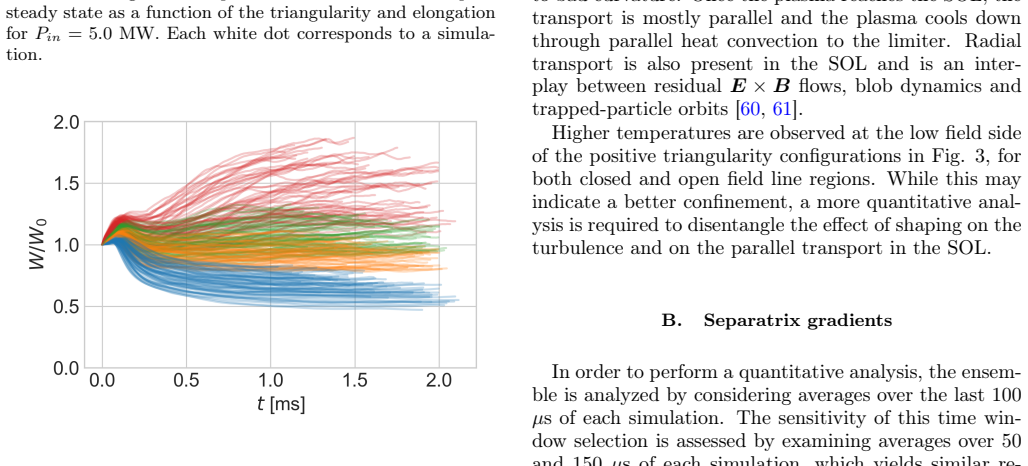
to provide a more robust setup for the large number of simulations of the scan, which is not tweaked case by case. In the following section, we verify that each simulation reaches a statistical steady state and then analyze the resulting confinement properties across the scan, from ion temperatures in the edge and SOL to the normalized gradients at the se...
-
[2]
A. J. Creely, M. J. Greenwald, S. B. Ballinger, D. Brun- ner, J. Canik, J. Doody, T. Fülöp, D. T. Garnier, R. Granetz, T. K. Gray, C. Holland, N. T. Howard, 9 J. W. Hughes, J. H. Irby, V. A. Izzo, G. J. Kramer, A. Q. Kuang, B. LaBombard, Y. Lin, B. Lipschultz, N. C. Logan, J. D. Lore, E. S. Marmar, K. Montes, R. T. Mumgaard, C. Paz-Soldan, C. Rea, M. L. R...
2020
-
[3]
Hegna, D
C. Hegna, D. Anderson, E. Andrew, A. Ayilaran, A. Bader, T. Bohm, K. C. Mata, J. Canik, L. Carba- jal, A. Cerfon, and et al., Journal of Plasma Physics91, E76 (2025)
2025
-
[4]
Lion, J.-C
J. Lion, J.-C. Anglès, L. Bonauer, A. Bañón Navarro, S. Cadena Ceron, R. Davies, M. Drevlak, N. Foppiani, J. Geiger, A. Goodman, W. Guo, E. Guiraud, F. Hernán- dez, S. Henneberg, R. Herrero, C. Hintze, H. Höchter, J. Jelonnek, F. Jenko, R. Jorge, M. Kaiser, M. Kubie, E. Lascas Neto, H. Laqua, M. Leoni, J. Lobsien, V. Mau- rin, A. Merlo, D. Middleton-Gear,...
2025
-
[5]
Swanson, S
C. Swanson, S. Kumar, D. Duda, E. Flom, W. Kalb, T. Kruger, M. Martin, J. Olatunji,et al., Overview of the Helios design: A practical planar coil stellarator fu- sion power plant (n.d.), white paper (not published in a journal). Accessed: 2026-03-07
2026
-
[6]
Wagner, G
F. Wagner, G. Becker, K. Behringer, D. Campbell, A. Eberhagen, W. Engelhardt, G. Fussmann, O. Gehre, J. Gernhardt, G. v. Gierke, G. Haas, M. Huang, F. Karger, M. Keilhacker, O. Klüber, M. Kornherr, K. Lackner, G. Lisitano, G. G. Lister, H. M. Mayer, D. Meisel, E. R. Müller, H. Murmann, H. Niedermeyer, W. Poschenrieder, H. Rapp, H. Röhr, F. Schneider, G. S...
1982
-
[7]
Pochelon, T
A. Pochelon, T. P. Goodman, M. Henderson, C. Angioni, R. Behn, S. Coda, F. Hofmann, J.-P. Hogge, N. Kirneva, A. A. Martynov, J.-M. Moret, Z. A. Pietrzyk, F. Por- celli, H. Reimerdes, J. Rommers, E. Rossi, O. Sauter, M. Q. Tran, H. Weisen, S. Alberti, S. Barry, P. Blan- chard, P. Bosshard, R. Chavan, B. P. Duval, Y. V. Es- ipchuck, D. Fasel, A. Favre, S. F...
1999
-
[8]
Marinoni, M
A. Marinoni, M. E. Austin, A. W. Hyatt, M. L. Walker, J. Candy, C. Chrystal, C. J. Lasnier, G. R. McKee, T. Odstrčil, C. C. Petty, M. Porkolab, J. C. Rost, O. Sauter, S. P. Smith, G. M. Staebler, C. Sung, K. E. Thome, A. D. Turnbull, and L. Zeng, Physics of Plasmas 26, 042515 (2019)
2019
-
[9]
J. C. Adam, W. M. Tang, and P. H. Rutherford, Physics of Fluids19, 561 (1976)
1976
-
[10]
P. C. Liewer, Nuclear Fusion25, 543 (1985)
1985
-
[11]
Romanelli, Physics of Fluids B1, 1018 (1989)
F. Romanelli, Physics of Fluids B1, 1018 (1989)
1989
-
[12]
Rewoldt, W
G. Rewoldt, W. M. Tang, and R. J. Hastie, The Physics of Fluids30, 807 (1987)
1987
-
[13]
G. M. Staebler, J. E. Kinsey, and R. E. Waltz, Physics of Plasmas12, 1 (2005)
2005
-
[14]
Bourdelle, X
C. Bourdelle, X. Garbet, F. Imbeaux, A. Casati, N. Dubuit, R. Guirlet, and T. Parisot, Physics of Plasmas 14, 112501 (2007)
2007
- [15]
-
[16]
Avdeeva, K
G. Avdeeva, K. Thome, S. Smith, D. Battaglia, C. Clauser, W. Guttenfelder, S. Kaye, J. McClenaghan, O. Meneghini, T. Odstrcil, and G. Staebler, Nuclear Fu- sion63, 126020 (2023)
2023
-
[17]
P. J. Catto, Plasma Physics20, 719 (1978)
1978
-
[18]
M. A. Beer and G. W. Hammett, Physics of Plasmas3, 4046 (1996)
1996
-
[19]
Jenko, W
F. Jenko, W. Dorland, and M. Kotschenreuther, Physics of Plasmas7, 1904 (2000)
1904
-
[20]
A. A. Schekochihin, S. C. Cowley, W. Dorland, G. W. Hammett, G. G. Howes, G. G. Plunk, E. Quataert, and T. Tatsuno, Plasma Physics and Controlled Fusion50, 124024 (2008)
2008
-
[21]
A. J. Brizard and T. S. Hahm, Reviews of Modern Physics79, 421 (2007)
2007
-
[22]
Dorland and G
W. Dorland and G. W. Hammett, Physics of Fluids B5, 812 (1993)
1993
-
[23]
Hoffmann, B
A. Hoffmann, B. Frei, and P. Ricci, Journal of Plasma Physics89, 905890214 (2023)
2023
-
[24]
Mandell, W
N. Mandell, W. Dorland, I. Abel, R. Gaur, P. Kim, M. Martin, and T. Qian, Journal of Plasma Physics90, 905900402 (2024)
2024
-
[25]
E. G. Highcock, A. A. Schekochihin, S. C. Cowley, M. Barnes, F. I. Parra, C. M. Roach, and W. Dorland, Phys. Rev. Lett.109, 265001 (2012)
2012
- [26]
-
[27]
Guttenfelder, N
W. Guttenfelder, N. Mandell, G. Le Bars, L. Singh, A. Bader, K. Camacho Mata, J. Canik, L. Carbajal, A. Cerfon, N. Davila, and et al., Journal of Plasma Physics91, E83 (2025)
2025
-
[28]
E. G. Highcock, N. R. Mandell, M. Barnes, and W. Dor- land, Journal of Plasma Physics84, 905840208 (2018)
2018
-
[29]
P. Ulbl, D. Michels, and F. Jenko, Contributions to Plasma Physics , e202100180 (2021)
2021
-
[30]
C. S. Chang, S. Ku, A. Loarte, V. Parail, F. Köchl, M. Romanelli, R. Maingi, J. W. Ahn, T. Gray, J. Hughes, B. LaBombard, T. Leonard, M. Makowski, and J. Terry, Nuclear Fusion57, 116023 (2017)
2017
-
[31]
J. Juno, A. Hakim, J. TenBarge, E. Shi, and W. Dorland, Journal of Computational Physics353, 110 (2018)
2018
-
[32]
Hakim, The Gkeyll code: documentation home
A. Hakim, The Gkeyll code: documentation home. (https://gkeyll.readthedocs.io) (2022)
2022
-
[33]
Francisquez, P
M. Francisquez, P. Cagas, A. Shukla, J. Juno, and G. W. Hammett, Journal of Computational Physics558, 114852 (2026)
2026
-
[34]
B. D. Dudson, M. V. Umansky, X. Q. Xu, P. B. Snyder, and H. R. Wilson, Computer Physics Communications 180, 1467 (2009)
2009
-
[35]
Stegmeir, D
A. Stegmeir, D. Coster, A. Ross, O. Maj, K. Lackner, and E. Poli, Plasma Physics and Controlled Fusion60, 035005 (2018)
2018
-
[36]
B. Zhu, M. Francisquez, and B. N. Rogers, Computer Physics Communications232, 46 (2018)
2018
-
[37]
Giacomin, P
M. Giacomin, P. Ricci, A. Coroado, G. Fourestey, D. Galassi, E. Lanti, D. Mancini, N. Richart, L. N. 10 Stenger,andN.Varini,JournalofComputationalPhysics 463, 111294 (2022)
2022
-
[38]
Hoffmann, T
A. Hoffmann, T. Bernard, M. Francisquez, G. Hammett, A. Hakim, J. Boedo, R. Rizkallah, C. Tsui, and T. T. Team, Nuclear Fusion66, 046022 (2026)
2026
-
[39]
S. Coda, A. Merle, O. Sauter, L. Porte, F. Bagnato, J. Boedo, T. Bolzonella, O. Février, B. Labit, A. Mari- noni, A. Pau, L. Pigatto, U. Sheikh, C. Tsui, M. Vallar, and T. Vu, Plasma Physics and Controlled Fusion64, 014004 (2022)
2022
-
[40]
M. E. Austin, A. Marinoni, M. L. Walker, M. W. Brook- man, J. S. Degrassie, A. W. Hyatt, G. R. McKee, C. C. Petty, T. L. Rhodes, S. P. Smith, C. Sung, K. E. Thome, and A. D. Turnbull, Physical Review Letters122, 115001 (2019)
2019
-
[41]
K. E. Thome, M. E. Austin, A. Hyatt, A. Marinoni, A. O. Nelson, C. Paz-Soldan, F. Scotti, W. Boyes, L. Casali, C. Chrystal, S. Ding, X. D. Du, D. Eldon, D. Ernst, R. Hong, G. R. McKee, S. Mordijck, O. Sauter, L. Schmitz, J. L. Barr, M. G. Burke, S. Coda, T. B. Cote, M. E. Fenstermacher, A. Garofalo, F. O. Khabanov, G. J. Kramer, C. J. Lasnier, N. C. Logan...
2024
-
[42]
Happel, T
T. Happel, T. Pütterich, D. Told, M. Dunne, R. Fischer, J. Hobirk, R. McDermott, and U. Plank, Nuclear Fusion 63, 016002 (2023)
2023
-
[43]
Marinoni, O
A. Marinoni, O. Sauter, and S. Coda, A brief history of negative triangularity tokamak plasmas (2021)
2021
-
[44]
A. Marinoni, C. Chrystal, S. Coda, R. Coosemans, C. Marini, M. Podesta, O. Sauter, M. Agostini, M. E. Austin, E. Belli, J. Candy, M. Gorelenkova, D. Hamm, A. W. Hyatt, M. Knolker, M. L. Matina, P. Lunia, S. Mordijck, A. O. Nelson, T. H. Osborne, C. Paz-Soldan, L. Porte, U. Sheikh, F. Scotti, K. E. Thome, M. V. Zee- land, the DIII-D, and T. Teams, Non-dime...
-
[45]
T. M. Collaboration, G. Rutherford, H. S. Wilson, A.Saltzman, D.Arnold, J.L.Ball, S.Benjamin, R.Biela- jew, N. de Boucaud, M. Calvo-Carrera, R. Chandra, H. Choudhury, C. Cummings, L. Corsaro, N. DaSilva, R. Diab, A. R. Devitre, S. Ferry, S. J. Frank, C. J. Hansen, J. Jerkins, J. D. Johnson, P. Lunia, J. van de Lindt, S. Mackie, A. D. Maris, N. R. Mandell,...
2024
-
[46]
N. Yüksek and T. Golfinopoulos, Feasibility of nega- tive triangularity equilibria in the sparc tokamak (2026), arXiv:2603.01208 [physics.plasm-ph]
-
[47]
Duval, A
B. Duval, A. Abdolmaleki, M. Agostini, C. Ajay, S. Alberti, E. Alessi, G. Anastasiou, Y. Andrèbe, G. Apruzzese, F. Auriemma, J. Ayllon-Guerola, F. Bag- nato, A. Baillod, F. Bairaktaris, L. Balbinot, A. Balestri, M. Baquero-Ruiz, C. Barcellona, M. Bernert, W. Bin, P. Blanchard, J. Boedo, T. Bolzonella, F. Bombarda, L. Boncagni, M. Bonotto, T. Bosman, D. Br...
2024
-
[48]
Lenard and I
A. Lenard and I. Bernstein, Physical Review E11, 1456 (1958)
1958
-
[49]
J. P. Dougherty, Physics of Fluids7, 1788 (1964)
1964
-
[50]
Francisquez, J
M. Francisquez, J. Juno, A. Hakim, G. W. Hammett, and D. R. Ernst, Journal of Plasma Physics88, 905880303 (2022)
2022
-
[51]
M. A. Beer, S. C. Cowley, and G. W. Hammett, Physics of Plasmas2, 2687 (1995)
1995
-
[52]
R. L. Miller, M. S. Chu, J. M. Greene, Y. R. Lin-Liu, and R. E. Waltz, Physics of Plasmas5, 973 (1998)
1998
-
[53]
F. Riva, E. Lanti, S. Jolliet, and P. Ricci, Plasma Physics and Controlled Fusion59, 035001 (2017)
2017
-
[54]
A. C. Hoffmann, A. Balestri, and P. Ricci, Plasma Physics and Controlled Fusion67, 015031 (2025)
2025
-
[55]
Merlo and F
G. Merlo and F. Jenko, Journal of Plasma Physics89, 905890104 (2023)
2023
-
[56]
Balestri, J
A. Balestri, J. Ball, and S. Coda, Plasma Physics and Controlled Fusion67, 105025 (2025)
2025
-
[57]
J. Ball, S. Brunner, and C. J. Ajay, Journal of Plasma Physics86, 905860207 (2020)
2020
-
[58]
Francisquez, N
M. Francisquez, N. R. Mandell, A. Hakim, and G. W. Hammett, Computer Physics Communications298, 109109 (2024)
2024
-
[59]
E. L. Shi, G. W. Hammett, T. Stoltzfus-Dueck, and A. Hakim, Journal of Plasma Physics83, 905830304 (2017)
2017
-
[60]
E. L. Shi, G. W. Hammett, T. Stoltzfus-Dueck, and A. Hakim, Physics of Plasmas26, 012307 (2019)
2019
-
[61]
T. N. Bernard, F. D. Halpern, M. Francisquez, J. Juno, N. R. Mandell, G. W. Hammett, A. Hakim, E. Humble, and R. Mukherjee, Physics of Plasmas30, 112501 (2023)
2023
-
[62]
Gohil, K
P. Gohil, K. H. Burrell, E. J. Doyle, R. J. Groebner, J. Kim, and R. P. Seraydarian, Nuclear Fusion34, 1057 (1994)
1994
-
[63]
Wagner, Plasma Physics and Controlled Fusion49, B1 (2007)
F. Wagner, Plasma Physics and Controlled Fusion49, B1 (2007)
2007
-
[64]
Zholobenko, F
W. Zholobenko, F. Jenko, K. Zhang, P. Ulbl, K. Eder, A. Stegmeir, C. Angioni, and P. Manz, Phys. Rev. Lett. 136, 075101 (2026)
2026
-
[65]
Merlo, M
G. Merlo, M. Fontana, S. Coda, D. Hatch, S. Janhunen, L. Porte, and F. Jenko, Physics of Plasmas26, 102302 (2019)
2019
-
[66]
A. Coroado and P. Ricci, Nuclear Fusion62, 10.1088/1741-4326/ac47b8 (2022)
-
[67]
Garbet, P
X. Garbet, P. Mantica, C. Angioni, E. Asp, Y. Bara- nov, C. Bourdelle, R. Budny, F. Crisanti, G. Cordey, L. Garzotti, N. Kirneva, D. Hogeweij, T. Hoang, F. Im- beaux, E. Joffrin, X. Litaudon, A. Manini, D. C. Mc- Donald, H. Nordman, V. Parail, A. Peeters, F. Ryter, C. Sozzi, M. Valovic, T. Tala, A. Thyagaraja, I. Voit- sekhovitch, J. Weiland, H. Weisen, A...
2004
-
[68]
Kotschenreuther, X
M. Kotschenreuther, X. Liu, D. Hatch, S. Mahajan, L. Zheng, A. Diallo, R. Groebner, the DIII-D TEAM, J. Hillesheim, C. Maggi, C. Giroud, F. Koechl, V. Parail, S. Saarelma, E. Solano, A. Chankin, and J. Contributors, Nuclear Fusion59, 096001 (2019)
2019
-
[69]
Hoffmann, B
A. Hoffmann, B. Frei, and P. Ricci, Journal of Plasma Physics89, 905890611 (2023)
2023
-
[70]
A. Balestri, J. Ball, S. Coda, D. J. Cruz-Zabala, M. Garcia-Munoz, and E. Viezzer, arXiv2403.14239 (2024)
-
[71]
E. A. Belli, G. W. Hammett, and W. Dorland, Physics of Plasmas15, 092303 (2008)
2008
-
[72]
F. D. Halpern, S. Jolliet, J. Loizu, A. Mosetto, and P. Ricci, Physics of Plasmas20, 10.1063/1.4807333 (2013)
discussion (0)
Sign in with ORCID, Apple, or X to comment. Anyone can read and Pith papers without signing in.