Recognition: unknown
New Bounds for Zarankiewicz Numbers via Reinforced LLM Evolutionary Search
Pith reviewed 2026-05-09 18:59 UTC · model grok-4.3
The pith
An LLM evolutionary search determines exact values for three Zarankiewicz numbers and improves lower bounds for 41 more.
A machine-rendered reading of the paper's core claim, the machinery that carries it, and where it could break.
Core claim
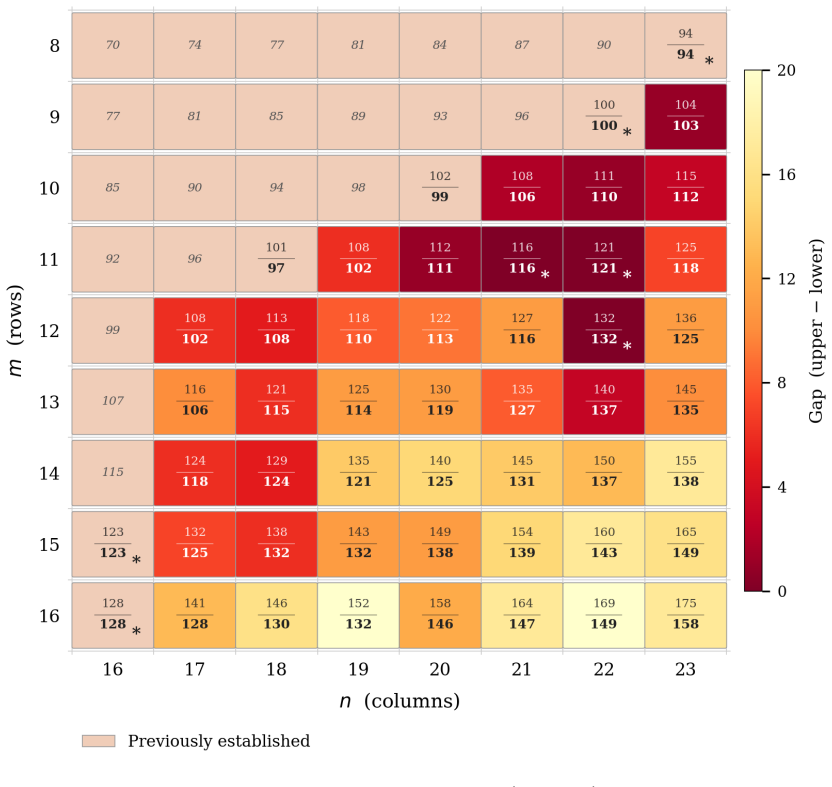
We determine for the first time the exact values of three Zarankiewicz numbers: Z(11, 21, 3, 3)=116, Z(11, 22, 3, 3)=121, and Z(12, 22, 3, 3)=132. We further establish lower bounds for 41 more Zarankiewicz numbers, including several that are within one edge of the best known upper bound, and we match the established value in four more closed cases. Our results are obtained using OpenEvolve, an open-source evolutionary algorithm based on Large Language Models (LLMs) that iteratively improves algorithms for generating mathematical constructions by optimizing a reward signal which we tailored for this specific problem.
What carries the argument
OpenEvolve, an LLM-based evolutionary algorithm that iteratively refines programs for producing K_{3,3}-free bipartite graphs by maximizing an edge-count reward.
If this is right
- Explicit constructions now exist that set the exact value for three Zarankiewicz parameters and tighten the gap in 41 others.
- Four previously open cases are now closed by matching the known upper bound.
- The same search process produces both the final graphs and the generation algorithms used to create them.
- Total compute cost remains below 30 dollars per parameter tuple, making the method reproducible with modest resources.
Where Pith is reading between the lines
- The same LLM evolutionary loop could be redirected to other extremal questions such as finding Ramsey numbers or C_4-free graphs.
- Independent verification of the adjacency matrices would confirm the absence of K_{3,3} and allow direct comparison with future upper-bound improvements.
- Refining the reward function or adding symmetry-breaking steps might push the method to larger vertex sets where current bounds remain wide.
- Releasing the generation code lets other researchers run longer searches or adapt the framework to different forbidden subgraphs.
Load-bearing premise
The upper bounds taken from earlier papers are correct and the new constructions contain no K_{3,3} subgraphs that escaped detection during verification.
What would settle it
Either a K_{3,3} subgraph found inside one of the reported constructions or a K_{3,3}-free bipartite graph on the same vertex sets with strictly more edges than the reported number.
Figures

read the original abstract
The Zarankiewicz number $\textbf{Z}(m, n, s, t)$ is the maximum number of edges in a bipartite graph $G_{m, n}$ such that there is no complete $K_{s, t}$ bipartite subgraph. We determine for the first time the exact values of three Zarankiewicz numbers: $\textbf{Z}(11, 21, 3, 3)=116$, $\textbf{Z}(11, 22, 3, 3)=121$, and $\textbf{Z}(12, 22, 3, 3)=132$. We further establish lower bounds for 41 more Zarankiewicz numbers, including several that are within one edge of the best known upper bound, and we match the established value in four more closed cases. Our results are obtained using OpenEvolve, an open-source evolutionary algorithm based on Large Language Models (LLMs) that iteratively improves algorithms for generating mathematical constructions by optimizing a reward signal which we tailored for this specific problem. These findings provide new extremal graph constructions and demonstrate the potential of LLM-guided evolutionary search to contribute to mathematical research. In addition to presenting the resulting constructions, we report the generation algorithms produced, describe the relevant implementation details, and provide our computational costs. Our costs are remarkably low, at less than \$30 for each Zarankiewicz parameter combination, showing that LLM-guided evolutionary search can be an inexpensive, reproducible, and accessible tool for discovering new combinatorial constructions.
Editorial analysis
A structured set of objections, weighed in public.
Referee Report
Summary. The manuscript introduces OpenEvolve, an open-source LLM-based evolutionary algorithm, and applies it to generate explicit bipartite graphs establishing new lower bounds on Zarankiewicz numbers Z(m,n,3,3). It claims exact determinations Z(11,21,3,3)=116, Z(11,22,3,3)=121, and Z(12,22,3,3)=132 by matching generated constructions to cited upper bounds, plus improved lower bounds for 41 further pairs and matches to four known exact values, all at computational cost below $30 per instance.
Significance. If the constructions are correct, the work closes three open exact cases and tightens many others with verifiable graphs, while demonstrating an inexpensive, reproducible search method for extremal combinatorial objects. The explicit constructions and reported generation algorithms constitute a concrete, auditable contribution beyond heuristic claims.
major comments (2)
- [Results section] Results section (constructions for Z(11,21,3,3), Z(11,22,3,3), Z(12,22,3,3)): the exact values rest on the generated graphs being K_{3,3}-free and achieving the stated edge counts. The manuscript describes the reward function and states that constructions are supplied, yet provides neither the source code for the subgraph-isomorphism checker nor a standalone, machine-readable verification script; independent confirmation therefore requires re-implementing the full pipeline, which is load-bearing for the headline claims.
- [Section 3] Section 3 (OpenEvolve algorithm): the reward signal is tailored to penalize K_{3,3} subgraphs, but the precise implementation details (e.g., how multiple edges or bipartite partitions are handled in the checker) are summarized rather than fully specified with pseudocode or reference implementation. This leaves a small but non-zero risk of silent counting errors that could produce an invalid lower bound coincidentally matching a cited upper bound.
minor comments (3)
- [Table 1] Table 1 (summary of new bounds): the column headers for 'lower bound' and 'upper bound' should explicitly note the source of each upper bound (citation and year) to allow immediate cross-checking.
- [Figure 2] Figure 2 (evolutionary loop diagram): the caption does not indicate whether the LLM prompt templates are fixed across runs or adapted; adding this detail would improve reproducibility.
- [Abstract] The abstract states 'we report the generation algorithms produced'; these should be collected in an appendix or supplementary file with line numbers for direct inspection.
Simulated Author's Rebuttal
We thank the referee for the positive evaluation and for identifying specific points that strengthen the verifiability of our results. We address each major comment below and will incorporate the requested clarifications and materials in the revised manuscript.
read point-by-point responses
-
Referee: [Results section] Results section (constructions for Z(11,21,3,3), Z(11,22,3,3), Z(12,22,3,3)): the exact values rest on the generated graphs being K_{3,3}-free and achieving the stated edge counts. The manuscript describes the reward function and states that constructions are supplied, yet provides neither the source code for the subgraph-isomorphism checker nor a standalone, machine-readable verification script; independent confirmation therefore requires re-implementing the full pipeline, which is load-bearing for the headline claims.
Authors: We agree that explicit verification aids independent confirmation. The manuscript already supplies the complete edge lists for the three exact constructions (and all other reported graphs) in machine-readable form, which can be checked for K_{3,3}-freeness and edge count with any correct bipartite subgraph detector. Nevertheless, to remove any implementation burden, we will add a standalone Python verification script to the supplementary materials and the OpenEvolve repository. The script will read the provided adjacency lists, confirm bipartiteness, count edges, and exhaustively test for K_{3,3} subgraphs using a standard enumeration routine. This addition will be included in the revision. revision: yes
-
Referee: [Section 3] Section 3 (OpenEvolve algorithm): the reward signal is tailored to penalize K_{3,3} subgraphs, but the precise implementation details (e.g., how multiple edges or bipartite partitions are handled in the checker) are summarized rather than fully specified with pseudocode or reference implementation. This leaves a small but non-zero risk of silent counting errors that could produce an invalid lower bound coincidentally matching a cited upper bound.
Authors: We accept that the current description of the checker is concise. In the revision we will expand Section 3 with explicit pseudocode for the K_{3,3}-detection routine used inside the reward function. The pseudocode will detail: (i) enforcement of the fixed bipartite partition (no intra-part edges are ever generated or counted), (ii) prevention of multiple edges between the same pair of vertices, and (iii) the exact enumeration procedure that returns both the presence of any K_{3,3} and the edge count. We will also point readers to the corresponding open-source implementation in the OpenEvolve repository, which contains the identical checker code. These changes eliminate the possibility of silent discrepancies. revision: yes
Circularity Check
No circularity: explicit constructions yield falsifiable lower bounds
full rationale
The paper reports lower bounds and exact values for Zarankiewicz numbers obtained by running an LLM-guided evolutionary search (OpenEvolve) that outputs explicit bipartite graphs. These graphs are presented as constructions achieving stated edge counts while remaining K_{3,3}-free; the claims are therefore externally verifiable by independent subgraph-isomorphism checks on the supplied adjacency data. Upper bounds are taken from prior literature without self-citation chains. No equations, fitted parameters, or self-referential definitions appear that would reduce the numerical results to the search procedure by construction. The method description is transparent but does not force the specific extremal values reported.
Axiom & Free-Parameter Ledger
axioms (2)
- standard math Zarankiewicz number Z(m,n,s,t) is the maximum edges in an m-by-n bipartite graph with no K_{s,t} subgraph
- standard math Bipartite graphs are 2-colorable with no odd cycles
Reference graph
Works this paper leans on
-
[1]
Claude 3.7 Sonnet and Claude Code
Anthropic. Claude 3.7 Sonnet and Claude Code. https://www.anthropic.com/news/ claude-3-7-sonnet, 2025. Accessed: 2026-04-29
2025
-
[2]
Introducing Claude Opus 4.6
Anthropic. Introducing Claude Opus 4.6. https://www.anthropic.com/news/ claude-opus-4-6, 2026. Accessed: 2026-04-29
2026
-
[3]
Ellenberg, Adam Zsolt Wagner, and Geordie Williamson
François Charton, Jordan S. Ellenberg, Adam Zsolt Wagner, and Geordie Williamson. Pat- ternBoost: Constructions in mathematics with a little help from AI, 2024. URL https: //arxiv.org/abs/2411.00566
-
[4]
Collins, Alexander W
Alex F. Collins, Alexander W. N. Riasanovsky, John C. Wallace, and Stanislaw P. Radziszowski. Zarankiewicz numbers and bipartite ramsey numbers. 2018
2018
-
[5]
Some remarks on the zarankiewicz problem
David Conlon. Some remarks on the zarankiewicz problem. Preprint. URL https://www. its.caltech.edu/~dconlon/zarankiewicz.pdf. Accessed 1 May 2026
2026
-
[6]
Improved upper bounds on Zarankiewicz numbers
Sara Davies, Peter Gill, and Daniel Horsley. Improved upper bounds on Zarankiewicz numbers. Discrete Mathematics, 349(5):114924, 2026. doi: 10.1016/j.disc.2025.114924
-
[7]
Spectrally indistin- guishable pseudorandom graphs, 2025
Arthur Forey, Javier Fresán, Emmanuel Kowalski, and Yuval Wigderson. Spectrally indistin- guishable pseudorandom graphs, 2025
2025
-
[8]
Henning, and Ortrud R
Wayne Goddard, Michael A. Henning, and Ortrud R. Oellermann. Bipartite ramsey numbers and zarankiewicz numbers.Discrete Mathematics, 219(1):85–95, 2000
2000
-
[9]
Gemini 2.0 Flash
Google. Gemini 2.0 Flash. https://cloud.google.com/vertex-ai/generative-ai/ docs/models/gemini/2-0-flash, 2025. Accessed: 2026-04-29
2025
-
[10]
Thomas P. Hayes. Separating the k-party communication complexity hierarchy: An application of the zarankiewicz problem.Discrete Mathematics & Theoretical Computer Science, 13(4): 15–22, 2011. doi: 10.46298/dmtcs.546
-
[11]
Complexity of linear boolean operators.F oundations and Trends in Theoretical Computer Science, 9(1):1–123, 2013
Stasys Jukna and Igor Sergeev. Complexity of linear boolean operators.F oundations and Trends in Theoretical Computer Science, 9(1):1–123, 2013
2013
-
[12]
T. K˝ovári, V . T. Sós, and P. Turán. On a problem of k. zarankiewicz.Colloquium Mathematicum, 3(1):50–57, 1954. doi: 10.4064/cm-3-1-50-57
-
[13]
Ranjit Kumaresan, Srinivasan Raghuraman, and Adam Sealfon. Network oblivious trans- fer. In Matthew Robshaw and Jonathan Katz, editors,Advances in Cryptology - CRYPTO 2016 - 36th Annual International Cryptology Conference, Santa Barbara, CA, USA, Au- gust 14-18, 2016, Proceedings, Part II, Lecture Notes in Computer Science, pages 366–396. Springer, 2016. ...
-
[14]
Reinforced generation of com- binatorial structures: Applications to complexity theory, 2025
Ansh Nagda, Prabhakar Raghavan, and Abhradeep Thakurta. Reinforced generation of com- binatorial structures: Applications to complexity theory, 2025. URL https://arxiv.org/ abs/2509.18057
-
[15]
Reinforced generation of combi- natorial structures: Ramsey numbers, 2026
Ansh Nagda, Prabhakar Raghavan, and Abhradeep Thakurta. Reinforced generation of combi- natorial structures: Ramsey numbers, 2026
2026
-
[16]
Alexander Novikov, Ngân V˜u, Marvin Eisenberger, Emilien Dupont, Po-Sen Huang, Adam Zsolt Wagner, Sergey Shirobokov, Borislav Kozlovskii, Francisco J. R. Ruiz, Abbas Mehrabian, M. Pawan Kumar, Abigail See, Swarat Chaudhuri, George Holland, Alex Davies, Sebastian Nowozin, Pushmeet Kohli, and Matej Balog. AlphaEvolve: A coding agent for scientific and algor...
2025
-
[17]
A problem of zarankiewicz.Journal of Combinatorial Theory, Series A, 18(2): 187–198, 1975
Steven Roman. A problem of zarankiewicz.Journal of Combinatorial Theory, Series A, 18(2): 187–198, 1975. doi: 10.1016/0097-3165(75)90007-2
-
[18]
Openevolve: an open-source evolutionary coding agent, 2025
Asankhaya Sharma. Openevolve: an open-source evolutionary coding agent, 2025. URL https://github.com/algorithmicsuperintelligence/openevolve
2025
-
[19]
A survey of zarankiewicz problems in geometry, 2025
Shakhar Smorodinsky. A survey of zarankiewicz problems in geometry, 2025
2025
-
[20]
An attack on Zarankiewicz’s problem through SAT solving, 2022
Jeremy Jierui Tan. An attack on Zarankiewicz’s problem through SAT solving, 2022
2022
-
[21]
Grapharena: Evaluating and exploring large language models on graph computation
Jianheng Tang, Qifan Zhang, Yuhan Li, Nuo Chen, and Jia Li. Grapharena: Evaluating and exploring large language models on graph computation. InInternational Conference on Learn- ing Representations, 2025. URL https://proceedings.iclr.cc/paper_files/paper/ 2025/hash/77fa8253adfc8b33209639f3e9985741-Abstract-Conference.html
2025
-
[22]
On an extremal problem in graph theory.Matematikai és Fizikai Lapok, 48:436–452, 1941
Pál Turán. On an extremal problem in graph theory.Matematikai és Fizikai Lapok, 48:436–452, 1941
1941
-
[23]
Qiming Wu, Zichen Chen, Will Corcoran, Misha Sra, and Ambuj Singh. GraphEval36K: Benchmarking coding and reasoning capabilities of large language models on graph datasets. InFindings of the Association for Computational Linguistics: NAACL 2025, pages 8110– 8132, Albuquerque, New Mexico, April 2025. Association for Computational Linguis- tics. doi: 10.1865...
-
[24]
Learning to discover at test time.arXiv preprint arXiv:2601.16175, 2026
Mert Yuksekgonul, Daniel Koceja, Xinhao Li, Federico Bianchi, Jed McCaleb, Xiaolong Wang, Jan Kautz, Yejin Choi, James Zou, Carlos Guestrin, and Yu Sun. Learning to discover at test time, 2026. URLhttps://arxiv.org/abs/2601.16175
-
[25]
Zarankiewicz
K. Zarankiewicz. Problem p 101.Colloquium Mathematicum, 2:301, 1951
1951
-
[26]
__main__
Yufei Zhao.Graph Theory and Additive Combinatorics: Exploring Structure and Randomness. Cambridge University Press, 2023. A Successful Search Algorithms Algorithm 2: Search algorithm establishing for the first time that the previously known upper bound forZ(11,21,3,3)is tight. import numpy as np def construct_graphs(): M, N = 11, 21 def is_valid(G): for i...
2023
discussion (0)
Sign in with ORCID, Apple, or X to comment. Anyone can read and Pith papers without signing in.