Recognition: unknown
CADFit: Precise Mesh-to-CAD Program Generation with Hybrid Optimization
Pith reviewed 2026-05-09 14:08 UTC · model grok-4.3
The pith
CADFit reconstructs complex editable CAD programs from meshes using incremental IoU-driven optimization over parametric operations.
A machine-rendered reading of the paper's core claim, the machinery that carries it, and where it could break.
Core claim
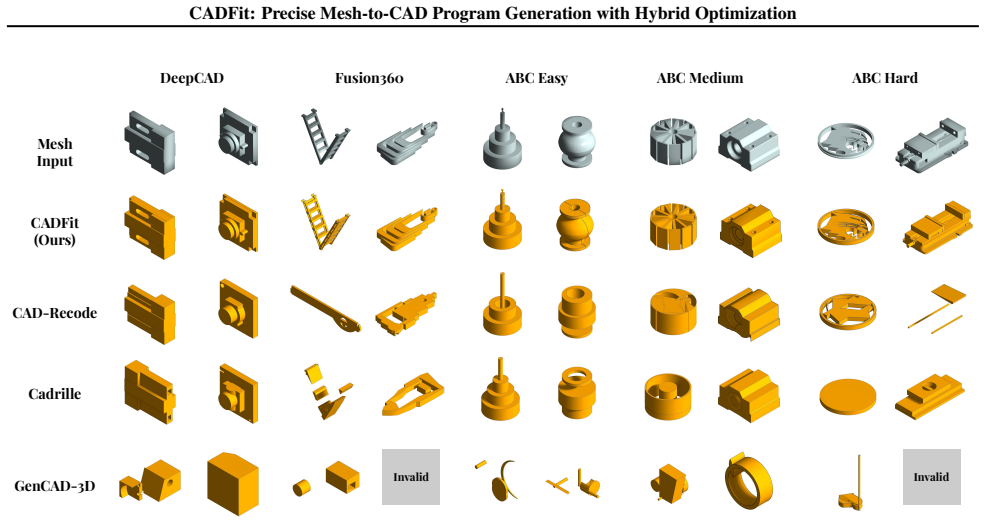
The paper claims that formulating reconstruction as incremental IoU-driven optimization over structured CAD programs, while supporting a rich set of parametric operations and using geometric feedback for validation at each step, recovers complex, valid, and editable construction sequences that achieve higher volumetric Intersection-over-Union and Chamfer Distance while reducing the Invalid Ratio compared with prior mesh-to-CAD methods.
What carries the argument
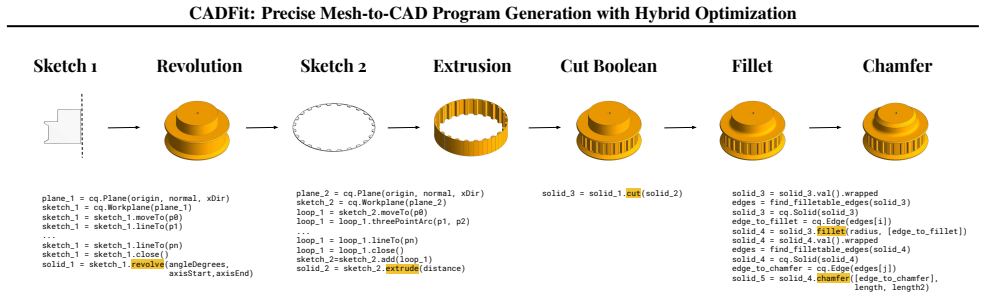
Incremental IoU-driven optimization that fits and validates a sequence of parametric CAD operations, including extrusions, revolutions, fillets, and chamfers, by repeatedly measuring geometric agreement between the current program and the input mesh.
Load-bearing premise
That step-by-step optimization guided by volume-overlap scores will reliably reach valid high-fidelity CAD programs for complex designs without becoming trapped in poor local solutions or needing substantial manual fixes.
What would settle it
A direct comparison on a set of complex CAD benchmark models in which CADFit produces lower volumetric overlap scores or a higher fraction of invalid programs than existing state-of-the-art mesh-to-CAD techniques.
Figures






read the original abstract
Despite recent progress, recovering parametric CAD construction sequences from geometric input, such as meshes or point clouds, is a key challenge for design and manufacturing, as existing CAD reconstruction and generation methods are largely restricted to difficult-to-edit formats like meshes or Breps or editable simple sketch-and-extrude pipelines and low-complexity datasets. We introduce CADFit, a hybrid optimization-based CAD reconstruction framework that recovers complex, editable CAD construction sequences from meshes by incrementally fitting and validating parametric operations using geometric feedback. Our approach is distinguished by formulating reconstruction as an IoU-driven optimization over structured CAD programs and supporting a rich set of operations, including extrusions, revolutions, fillets, and chamfers. Experiments on multiple CAD benchmarks show that CADFit outperforms state-of-the-art mesh-to-CAD methods in volumetric Intersection-over-Union and Chamfer Distance, while substantially reducing the Invalid Ratio of reconstructed CAD programs, particularly for complex designs. We further present a multimodal pipeline that enables end-to-end reconstruction of CAD construction sequences from images by combining image-based geometry reconstruction with CADFit. By enabling accurate reconstruction of higher-complexity CAD models, CADFit provides a practical foundation for generating richer datasets and advancing future learning-based approaches to CAD reverse engineering.
Editorial analysis
A structured set of objections, weighed in public.
Referee Report
Summary. The paper introduces CADFit, a hybrid optimization framework for reconstructing editable parametric CAD construction sequences from input meshes (or point clouds). It formulates the task as incremental IoU-driven fitting of a rich set of operations including extrusions, revolutions, fillets and chamfers, and reports that the resulting programs outperform prior mesh-to-CAD methods on volumetric IoU and Chamfer Distance while lowering the Invalid Ratio, especially on complex designs. A multimodal extension that first reconstructs geometry from images and then applies CADFit is also described.
Significance. If the performance claims are substantiated by rigorous experiments, CADFit would constitute a meaningful advance in CAD reverse engineering. By producing higher-fidelity, directly editable programs rather than meshes or B-reps, the method could improve downstream design, manufacturing and dataset generation pipelines and provide a stronger foundation for learning-based CAD approaches.
major comments (3)
- Experiments section (and abstract): the headline claims of improved volumetric IoU, Chamfer Distance and substantially reduced Invalid Ratio (particularly for complex designs) are stated without any description of the experimental protocol, choice of baselines, number of runs, statistical significance tests, or failure-mode analysis. This absence prevents verification that the reported gains are robust rather than artifacts of particular test cases or hyper-parameter choices.
- Method section on the hybrid optimizer: the incremental IoU-driven fitting procedure is presented as reliably converging to valid high-fidelity programs, yet no convergence analysis, escape-from-local-minima strategy, or empirical study of cases that require manual intervention is supplied. The skeptic's concern that the optimizer may routinely terminate in poor local solutions for complex topologies therefore remains unaddressed and directly affects the central performance claims.
- Results tables/figures: while the abstract asserts outperformance on “multiple CAD benchmarks,” the manuscript provides no quantitative breakdown by model complexity, no comparison against the strongest recent learning-based or optimization-based baselines, and no ablation isolating the contribution of each parametric operation (fillets, chamfers, etc.).
minor comments (2)
- Notation for the IoU objective and the structured program representation should be introduced with explicit mathematical definitions early in the method section to improve readability.
- The multimodal image-to-CAD pipeline is mentioned only briefly; a short diagram or pseudocode would clarify the interface between the image-based geometry stage and CADFit.
Simulated Author's Rebuttal
We thank the referee for the detailed and constructive feedback. The comments highlight important areas where additional rigor and transparency will strengthen the manuscript. We address each major comment below and commit to the corresponding revisions.
read point-by-point responses
-
Referee: Experiments section (and abstract): the headline claims of improved volumetric IoU, Chamfer Distance and substantially reduced Invalid Ratio (particularly for complex designs) are stated without any description of the experimental protocol, choice of baselines, number of runs, statistical significance tests, or failure-mode analysis. This absence prevents verification that the reported gains are robust rather than artifacts of particular test cases or hyper-parameter choices.
Authors: We agree that the current description of the experimental protocol is insufficient for full verification. In the revised manuscript we will expand the Experiments section with a complete protocol description, explicit justification for baseline selection, the number of independent runs, statistical significance tests, and a dedicated failure-mode analysis. The abstract will be updated for consistency with these additions. revision: yes
-
Referee: Method section on the hybrid optimizer: the incremental IoU-driven fitting procedure is presented as reliably converging to valid high-fidelity programs, yet no convergence analysis, escape-from-local-minima strategy, or empirical study of cases that require manual intervention is supplied. The skeptic's concern that the optimizer may routinely terminate in poor local solutions for complex topologies therefore remains unaddressed and directly affects the central performance claims.
Authors: We acknowledge that convergence properties and robustness to local minima were not analyzed in sufficient depth. We will add a dedicated subsection to the Method section that includes convergence analysis, the escape-from-local-minima mechanisms already present in the optimizer (multi-start initialization and perturbation), and empirical statistics on cases that required manual intervention or produced suboptimal programs. This addition will directly support the reliability claims for complex topologies. revision: yes
-
Referee: Results tables/figures: while the abstract asserts outperformance on “multiple CAD benchmarks,” the manuscript provides no quantitative breakdown by model complexity, no comparison against the strongest recent learning-based or optimization-based baselines, and no ablation isolating the contribution of each parametric operation (fillets, chamfers, etc.).
Authors: We agree that the results would benefit from greater granularity and completeness. In the revision we will add quantitative breakdowns by model complexity, ensure the baseline comparisons include the strongest recent methods, and introduce an ablation study that isolates the contribution of each operation type (extrusions, revolutions, fillets, chamfers). These will appear as new tables and figures in the Results section. revision: yes
Circularity Check
No circularity: CADFit presents an algorithmic optimization framework validated by external benchmarks
full rationale
The paper introduces a hybrid IoU-driven optimization procedure for recovering parametric CAD programs from meshes, relying on incremental fitting of operations such as extrusions and fillets. No mathematical derivations, predictions, or first-principles results are presented that reduce by construction to fitted inputs or self-referential definitions. Performance claims rest on comparisons against state-of-the-art methods using independent CAD benchmarks, with no load-bearing self-citations or ansatzes that collapse the central method to its own outputs. The approach is self-contained as an engineering pipeline rather than a closed deductive chain.
Axiom & Free-Parameter Ledger
Forward citations
Cited by 1 Pith paper
-
CADBench: A Multimodal Benchmark for AI-Assisted CAD Program Generation
CADBench is a multimodal benchmark for CAD program generation that shows specialized mesh-to-CAD models outperform general vision-language models but degrade with complexity and modality shifts.
Reference graph
Works this paper leans on
-
[1]
Proceedings of the IEEE/CVF International Conference on Computer Vision (ICCV) , year=
DeepCAD: A Deep Generative Network for Computer-Aided Design Models , author=. Proceedings of the IEEE/CVF International Conference on Computer Vision (ICCV) , year=
-
[2]
Proceedings of the IEEE/CVF Conference on Computer Vision and Pattern Recognition , pages=
Point2cad: Reverse engineering cad models from 3d point clouds , author=. Proceedings of the IEEE/CVF Conference on Computer Vision and Pattern Recognition , pages=
-
[3]
European Conference on Computer Vision (ECCV) , year=
Pixel2Mesh: Generating 3D Mesh Models from Single RGB Images , author=. European Conference on Computer Vision (ECCV) , year=
-
[4]
Proceedings of the IEEE/CVF conference on computer vision and pattern recognition , pages=
Occupancy networks: Learning 3d reconstruction in function space , author=. Proceedings of the IEEE/CVF conference on computer vision and pattern recognition , pages=
-
[5]
Hunyuan3D 2.0: Scaling Diffusion Models for High Resolution Textured 3D Assets Generation
Hunyuan3d 2.0: Scaling diffusion models for high resolution textured 3d assets generation , author=. arXiv preprint arXiv:2501.12202 , year=
-
[6]
Advanced Engineering Informatics , volume=
A quantitative analysis of parametric CAD model complexity and its relationship to perceived modeling complexity , author=. Advanced Engineering Informatics , volume=. 2023 , publisher=
2023
-
[7]
International Design Engineering Technical Conferences and Computers and Information in Engineering Conference , volume=
Cad-coder: An open-source vision-language model for computer-aided design code generation , author=. International Design Engineering Technical Conferences and Computers and Information in Engineering Conference , volume=. 2025 , organization=
2025
-
[8]
arXiv preprint arXiv:2409.16294 , year=
Gencad: Image-conditioned computer-aided design generation with transformer-based contrastive representation and diffusion priors , author=. arXiv preprint arXiv:2409.16294 , year=
-
[9]
Proceedings of the Computer Vision and Pattern Recognition Conference , pages=
Structured 3d latents for scalable and versatile 3d generation , author=. Proceedings of the Computer Vision and Pattern Recognition Conference , pages=
-
[10]
International Design Engineering Technical Conferences and Computers and Information in Engineering Conference , volume=
Gencad-3d: Cad program generation using multimodal latent space alignment and synthetic dataset balancing , author=. International Design Engineering Technical Conferences and Computers and Information in Engineering Conference , volume=. 2025 , organization=
2025
-
[11]
arXiv preprint arXiv:2505.22914 , year=
cadrille: Multi-modal CAD Reconstruction with Online Reinforcement Learning , author=. arXiv preprint arXiv:2505.22914 , year=
-
[12]
Proceedings of the IEEE/CVF International Conference on Computer Vision , pages=
Cad-recode: Reverse engineering cad code from point clouds , author=. Proceedings of the IEEE/CVF International Conference on Computer Vision , pages=
-
[13]
Cad-mllm: Unifying multimodality-conditioned cad generation with mllm , author=. arXiv preprint arXiv:2411.04954 , year=
-
[14]
Proceedings of the Computer Vision and Pattern Recognition Conference , pages=
CADDreamer: CAD Object Generation from Single-view Images , author=. Proceedings of the Computer Vision and Pattern Recognition Conference , pages=
-
[15]
Proceedings of the IEEE/CVF conference on computer vision and pattern recognition , pages=
Abc: A big cad model dataset for geometric deep learning , author=. Proceedings of the IEEE/CVF conference on computer vision and pattern recognition , pages=
-
[16]
ACM Transactions on Graphics (TOG) , volume=
Fusion 360 gallery: A dataset and environment for programmatic cad construction from human design sequences , author=. ACM Transactions on Graphics (TOG) , volume=. 2021 , publisher=
2021
-
[17]
arXiv preprint arXiv:2307.00149 , year=
Hierarchical neural coding for controllable cad model generation , author=. arXiv preprint arXiv:2307.00149 , year=
-
[18]
Proceedings of the IEEE/CVF Conference on Computer Vision and Pattern Recognition , pages=
Point2cyl: Reverse engineering 3d objects from point clouds to extrusion cylinders , author=. Proceedings of the IEEE/CVF Conference on Computer Vision and Pattern Recognition , pages=
-
[19]
Ahmet Serdar Karadeniz and Dimitrios Mallis and Danila Rukhovich and Kseniya Cherenkova and Anis Kacem and Djamila Aouada , booktitle=. Mi. 2025 , url=
2025
-
[20]
ACM Transactions on Graphics (TOG) , volume=
Brepgen: A b-rep generative diffusion model with structured latent geometry , author=. ACM Transactions on Graphics (TOG) , volume=. 2024 , publisher=
2024
-
[21]
Proceedings of the Special Interest Group on Computer Graphics and Interactive Techniques Conference Conference Papers , pages=
Brepdiff: Single-stage b-rep diffusion model , author=. Proceedings of the Special Interest Group on Computer Graphics and Interactive Techniques Conference Conference Papers , pages=
-
[22]
ACM Transactions on Graphics (TOG) , volume=
Inversecsg: Automatic conversion of 3d models to csg trees , author=. ACM Transactions on Graphics (TOG) , volume=. 2018 , publisher=
2018
-
[23]
CadQuery contributors , title =. doi:10.5281/zenodo.14590990 , url =
-
[24]
Proceedings of IEEE international conference on computer vision , pages=
Curve and surface smoothing without shrinkage , author=. Proceedings of IEEE international conference on computer vision , pages=. 1995 , organization=
1995
-
[25]
European conference on computer vision , pages=
A large-scale annotated mechanical components benchmark for classification and retrieval tasks with deep neural networks , author=. European conference on computer vision , pages=. 2020 , organization=
2020
-
[26]
Gemini: A Family of Highly Capable Multimodal Models
Gemini: a family of highly capable multimodal models , author=. arXiv preprint arXiv:2312.11805 , year=
work page internal anchor Pith review Pith/arXiv arXiv
-
[27]
Proceedings of the IEEE/CVF Conference on Computer Vision and Pattern Recognition , pages=
Cad-signet: Cad language inference from point clouds using layer-wise sketch instance guided attention , author=. Proceedings of the IEEE/CVF Conference on Computer Vision and Pattern Recognition , pages=
-
[28]
Proceedings of the AAAI Conference on Artificial Intelligence , volume=
Cad-gpt: Synthesising cad construction sequence with spatial reasoning-enhanced multimodal llms , author=. Proceedings of the AAAI Conference on Artificial Intelligence , volume=
discussion (0)
Sign in with ORCID, Apple, or X to comment. Anyone can read and Pith papers without signing in.