Recognition: unknown
The Garden of Forking Paths: Narrative Arc-Conditioned Gameplay Planning
Pith reviewed 2026-05-09 17:46 UTC · model grok-4.3
The pith
Forking Garden generates branching games from user storylines by first creating independent gameplay nodes then assembling them into a dungeon graph using narrative arc constraints.
A machine-rendered reading of the paper's core claim, the machinery that carries it, and where it could break.
Core claim
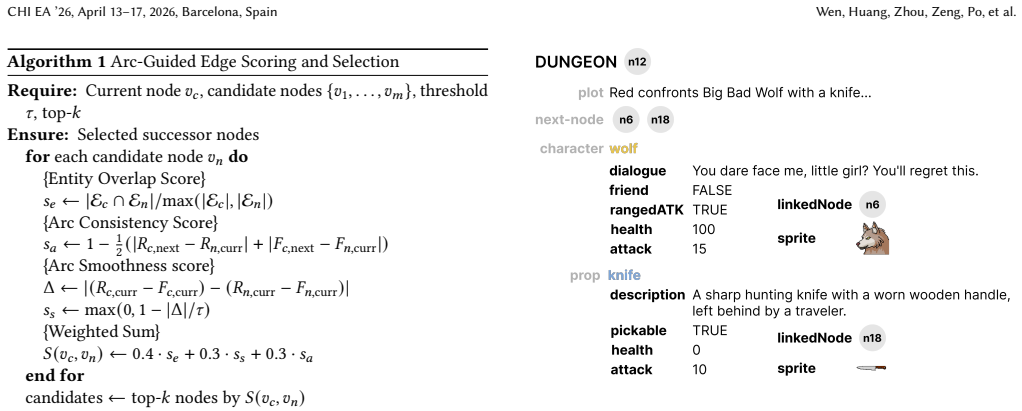
We propose Forking Garden, a framework for narrative arc-conditioned gameplay planning that generates branching games from user-provided storylines. Our approach first generates a diverse pool of independent nodes, then assembles them into a dungeon graph via arc-guided constraint algorithms, where each node achieves multimodal alignment of gameplay elements. We develop an end-to-end interactive system that instantiates the framework.
What carries the argument
Arc-guided constraint algorithms that take a pool of independently generated nodes and link them into a coherent branching dungeon graph while preserving the supplied narrative arc.
If this is right
- Branching games can be produced directly from storylines while keeping explicit narrative structure across paths.
- Each node in the graph carries internally consistent gameplay, visual, and other elements.
- Diversity among branches is preserved because nodes are generated independently before assembly.
- An interactive interface lets users supply the storyline and receive a ready-to-play dungeon graph.
- The method reduces the amount of post-generation human adjustment needed for narrative coherence.
Where Pith is reading between the lines
- The separation of node creation from graph assembly could be tested in genres other than dungeons, such as open-world or narrative-driven adventure games.
- If the constraint stage works well, similar pipelines might improve coherence in other LLM-driven creative tools like interactive fiction or level design assistants.
- Player studies could measure whether games produced this way feel more narratively satisfying than purely random procedural outputs.
- The framework implicitly suggests that enforcing archetypal story shapes may be a practical way to steer generative systems toward culturally resonant results.
Load-bearing premise
Arc-guided constraint algorithms can reliably turn independently generated nodes into coherent branching structures that stay aligned with the narrative arc and keep multimodal consistency without extra human fixes.
What would settle it
Feed the system several user storylines, generate the graphs, and check whether the resulting paths consistently follow the intended arc, maintain node-to-node coherence, and require no manual repair to become playable.
Figures



read the original abstract
Narrative archetypes (e.g., Hero's Journey, Three-act structure) provide universal story structures that resonate across cultures and media and are important for video game storytelling, yet existing LLM-based methods lack explicit use of these archetypes in procedurally generated games. We propose Forking Garden, a framework for narrative arc-conditioned gameplay planning that generates branching games from user-provided storylines. Our approach first generates a diverse pool of independent nodes, then assembles them into a dungeon graph via arc-guided constraint algorithms, where each node achieves multimodal alignment of gameplay elements. We develop an end-to-end interactive system that instantiates the framework.
Editorial analysis
A structured set of objections, weighed in public.
Referee Report
Summary. The paper proposes Forking Garden, a framework for narrative arc-conditioned gameplay planning that generates branching dungeon games from user-provided storylines. It first creates a diverse pool of independent nodes, then assembles them into graphs via arc-guided constraint algorithms that enforce multimodal alignment of gameplay elements with narrative archetypes (e.g., Hero's Journey). An end-to-end interactive system instantiates the framework.
Significance. If the assembly step can be shown to work reliably, the separation of flexible LLM node generation from hard arc-guided constraints offers a principled way to incorporate universal narrative structures into procedural content generation, a gap in current LLM-based game design tools. The conceptual distinction between node creation and arc-conditioned assembly is a clear strength and could support reproducible, archetype-driven branching narratives.
major comments (2)
- Abstract and Proposed Framework: The central claim that arc-guided constraint algorithms can reliably assemble independently generated nodes into coherent branching graphs while preserving narrative alignment and multimodal consistency is load-bearing, yet the manuscript supplies no formal invariants, success-rate bounds, compatibility checks, or even a single worked example of a valid assembly for a realistic storyline. Without these, the 'end-to-end without additional intervention' property remains unverified.
- Abstract: No experiments, quantitative metrics, ablation studies, error analysis, or user validation of the generated graphs are presented. This absence directly undermines assessment of whether the constraint solver routinely finds solutions or whether multimodal alignment holds in practice.
minor comments (1)
- Abstract: The term 'multimodal alignment' is used without specifying the modalities (visual, mechanical, audio, etc.) or the alignment metric, which should be defined early for clarity.
Simulated Author's Rebuttal
We thank the referee for their constructive comments, which highlight important areas for strengthening the presentation and validation of the Forking Garden framework. We agree that additional illustrative examples and empirical details will improve the manuscript and plan targeted revisions accordingly.
read point-by-point responses
-
Referee: Abstract and Proposed Framework: The central claim that arc-guided constraint algorithms can reliably assemble independently generated nodes into coherent branching graphs while preserving narrative alignment and multimodal consistency is load-bearing, yet the manuscript supplies no formal invariants, success-rate bounds, compatibility checks, or even a single worked example of a valid assembly for a realistic storyline. Without these, the 'end-to-end without additional intervention' property remains unverified.
Authors: We acknowledge that the manuscript does not include formal invariants, success-rate bounds, or a worked example of the assembly process. The framework separates node generation (via LLM) from assembly (via arc-guided constraints), where the constraints are designed to enforce narrative archetype alignment and multimodal consistency by construction during graph construction. In the revised version, we will add a detailed worked example showing node pool creation and constraint-based assembly for a realistic storyline (e.g., a Hero's Journey arc), including the specific constraints applied and the resulting graph. We will also describe the constraint types and their guarantees more explicitly, though deriving full formal invariants or probabilistic bounds would require further theoretical analysis that we can outline as future work. revision: partial
-
Referee: Abstract: No experiments, quantitative metrics, ablation studies, error analysis, or user validation of the generated graphs are presented. This absence directly undermines assessment of whether the constraint solver routinely finds solutions or whether multimodal alignment holds in practice.
Authors: The initial submission focuses on the conceptual framework and end-to-end system implementation rather than extensive evaluation. We agree that quantitative assessment is necessary to demonstrate reliability. In the revision, we will add a new evaluation section reporting: success rates of the constraint solver on a set of sample storylines, qualitative analysis of multimodal alignment in generated graphs, and an error analysis of failure cases (e.g., when no valid assembly exists). Ablation studies on the constraint components can also be included. Full user validation studies are valuable but may be noted as planned future work given the scope of this paper. revision: yes
Circularity Check
No circularity: framework proposal with no derivations or self-referential reductions
full rationale
The paper presents Forking Garden as a high-level system architecture: independent node generation followed by assembly via arc-guided constraints into dungeon graphs. No equations, fitted parameters, predictions, or first-principles derivations appear in the provided text. The central claims are engineering proposals rather than mathematical reductions, and no self-citations are invoked as load-bearing uniqueness theorems or ansatzes. The derivation chain is therefore self-contained with no steps that reduce to inputs by construction.
Axiom & Free-Parameter Ledger
axioms (1)
- domain assumption Narrative archetypes (e.g., Hero's Journey, Three-act structure) provide universal story structures that resonate across cultures and media and are important for video game storytelling.
invented entities (2)
-
Forking Garden framework
no independent evidence
-
arc-guided constraint algorithms
no independent evidence
Reference graph
Works this paper leans on
-
[1]
2008.The Hero with a Thousand Faces(3rd ed.)
Joseph Campbell. 2008.The Hero with a Thousand Faces(3rd ed.). Joseph Campbell Foundation; New World Library. Originally published in 1949. CHI EA ’26, April 13–17, 2026, Barcelona, Spain Wen, Huang, Zhou, Zeng, Po, et al
2008
- [2]
-
[3]
Sam Earle, Samyak Parajuli, and Andrzej Banburski-Fahey. 2025. DreamGarden: A Designer Assistant for Growing Games from a Single Prompt. InProceedings of the 2025 CHI Conference on Human Factors in Computing Systems (CHI ’25). Association for Computing Machinery, New York, NY, USA, Article 57, 19 pages. doi:10.1145/3706598.3714233
- [4]
- [5]
-
[6]
Sergio Poo Hernandez, Vadim Bulitko, and Marcia Spetch. 2015. Keeping the Player on an Emotional Trajectory in Interactive Storytelling. InProceedings of the Eleventh Artificial Intelligence and Interactive Digital Entertainment Conference (AIIDE ’15). Association for the Advancement of Artificial Intelligence. doi:10. 1609/aiide.v11i1.12783
2015
- [7]
- [8]
-
[9]
Vignesh Kumaran, Jonathan Rowe, and James Lester. 2024. NarrativeGenie: Gen- erating Narrative Beats and Dynamic Storytelling with Large Language Models. InProceedings of the AAAI Conference on Artificial Intelligence and Interactive Digital Entertainment (AIIDE), Vol. 20. 76–86. doi:10.1609/aiide.v20i1.31868
-
[10]
Jorge Leandro, Sudha Rao, Michael Xu, Weijia Xu, Nebojsa Jojic, Chris Brockett, and Bill Dolan. 2024. GENEVA: GENErating and Visualizing Branching Narratives Using LLMs. InIEEE Conference on Games 2024
2024
-
[11]
2011.Interactive Storytelling for Video Games (1st ed.)
Josiah Lebowitz and Chris Klug. 2011.Interactive Storytelling for Video Games (1st ed.). Focal Press, Burlington, MA, USA
2011
-
[12]
Bernstein
Joon Sung Park, Joseph O’Brien, Carrie Jun Cai, Meredith Ringel Morris, Percy Liang, and Michael S. Bernstein. 2023. Generative Agents: Interactive Simu- lacra of Human Behavior. InProceedings of the 36th Annual ACM Symposium on User Interface Software and Technology (UIST ’23). Association for Computing Machinery, New York, NY, USA, 1–22
2023
-
[13]
1928.Morphology of the Folktale(second ed.)
Vladimir Propp. 1928.Morphology of the Folktale(second ed.). Publications of the American Folklore Society, Vol. 9. University of Texas Press, Austin, TX. Originally published in Russian in 1928
1928
-
[14]
A. J. Reagan, L. Mitchell, D. Kiley, C. M. Danforth, and P. S. Dodds. 2016. The emotional arcs of stories are dominated by six basic shapes.EPJ Data Science5, 31 (2016). doi:10.1140/epjds/s13688-016-0093-1
-
[15]
Maria Teleki, Vedangi Bengali, Xiangjue Dong, Sai Tejas Janjur, Haoran Liu, Tian Liu, Cong Wang, Ting Liu, Yin Zhang, Frank Shipman, and James Caverlee. 2025. A Survey on LLMs for Story Generation. InFindings of the Association for Com- putational Linguistics: EMNLP 2025. Association for Computational Linguistics, Suzhou, China, 13954–13966. doi:10.18653/...
-
[16]
2007.The Writer’s Journey: Mythic Structure for Writers(3rd ed.)
Christopher Vogler. 2007.The Writer’s Journey: Mythic Structure for Writers(3rd ed.). Michael Wiese Productions, Studio City, CA, USA
2007
-
[17]
Stephen G. Ware, R. Michael Young, Brent Harrison, and David L. Roberts. 2014. A Computational Model of Plan-Based Narrative Conflict at the Fabula Level. IEEE Transactions on Computational Intelligence and AI in Games6, 3 (Sept. 2014), 271–284. doi:10.1109/TCIAIG.2014.2326072
-
[18]
Weiqi Wu, Hongqiu Wu, Lai Jiang, Xingyuan Liu, Hai Zhao, and Min Zhang. 2024. From Role-Play to Drama-Interaction: An LLM Solution. InFindings of the Asso- ciation for Computational Linguistics: ACL 2024. Association for Computational Linguistics, Bangkok, Thailand, 3271–3290. doi:10.18653/v1/2024.findings-acl.196
- [19]
-
[20]
Drinkwater, and Mark O
Alexander Zook, Stephen Lee-Urban, Michael R. Drinkwater, and Mark O. Riedl
-
[21]
InProceedings of the Eighth Artificial Intelligence and Interactive Digi- tal Entertainment Conference (AIIDE ’12)
Skill-Based Mission Generation: A Data-Driven Temporal Player Modeling Approach. InProceedings of the Eighth Artificial Intelligence and Interactive Digi- tal Entertainment Conference (AIIDE ’12). Association for the Advancement of Artificial Intelligence, Stanford, CA, USA
discussion (0)
Sign in with ORCID, Apple, or X to comment. Anyone can read and Pith papers without signing in.