Recognition: unknown
Machine Learning Enhanced Laser Spectroscopy for Multi-Species Gas Detection in Complex and Harsh Environments
Pith reviewed 2026-05-09 18:30 UTC · model grok-4.3
The pith
Machine learning models integrated with laser absorption spectroscopy enable real-time detection of multiple gas species in interfering and dynamic environments even when reference data is incomplete.
A machine-rendered reading of the paper's core claim, the machinery that carries it, and where it could break.
Core claim
The central claim is that deep denoising autoencoders improve trace-species detection limits in high-speed hydrocarbon pyrolysis, HT-SIMNet isolates species via spectral augmentation and Noise2Noise-style training without full references, UnblindMix reconstructs concentrations and signatures from mixtures of up to eight components, first-derivative convolution features highlight masked weak absorbers, and randomized-smoothing Voigt perturbation yields certifiable VOC classification. All are experimentally validated on shock-tube and mixture data, establishing a route to interference-resilient, reference-free multi-species gas sensing.
What carries the argument
ML models including denoising autoencoders, structured unsupervised networks, blind source separation autoencoders, derivative feature engineering, and certifiable smoothing classifiers applied directly to laser absorption spectra to handle noise, unknown interferents, and missing references.
If this is right
- Higher-fidelity signals allow lower detection limits for trace hydrocarbons during rapid pyrolysis.
- Unknown species interference can be mitigated in reactive flows without exhaustive calibration libraries.
- Mixture concentrations and pure spectra can be recovered directly from observed data for up to eight components.
- Weakly absorbing species can be recovered when masked by stronger overlapping absorbers.
- Classification of volatile organic compounds can be made certifiably robust to condition variations.
Where Pith is reading between the lines
- Hardware integration of these models could enable closed-loop control in industrial combustion systems.
- The blind separation approach might apply to other spectroscopic domains such as atmospheric remote sensing where species lists are incomplete.
- Combining the methods with different laser sources or field-deployed sensors would test whether the reference-free property holds beyond laboratory shock tubes.
Load-bearing premise
The trained machine learning models will continue to work accurately when applied to new harsh environments, unknown gas species, or different hardware configurations not represented in the shock-tube and mixture validation tests.
What would settle it
Apply one of the trained models to a new shock-tube experiment or mixture containing previously unseen species or interferents and measure whether detection accuracy or separation quality drops below conventional spectroscopic baselines.
Figures




read the original abstract
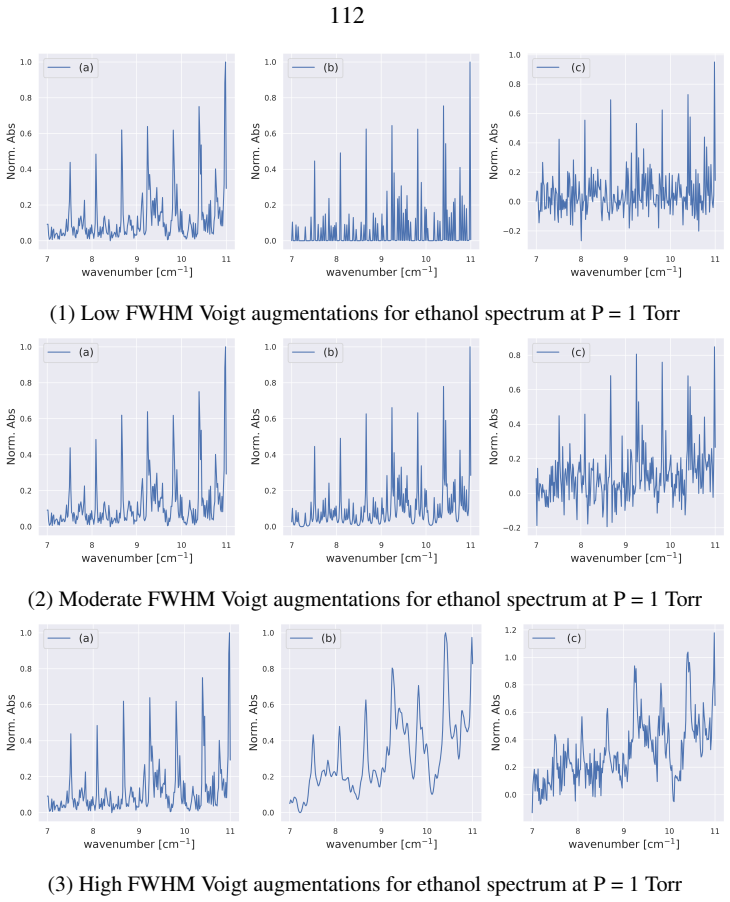
Laser absorption spectroscopy (LAS) is a well-established technique for non-intrusive measurement of gas species in combustion and atmospheric environments, but conventional methods struggle with multi-species mixtures under dynamic or interference-laden conditions. Overlapping spectral features, noise, and incomplete reference data limit reliability when unknown or weakly absorbing species are present. This dissertation develops diagnostics combining LAS with machine learning (ML) to address these limitations. Deep denoising autoencoders (DDAEs) are applied to shock-tube measurements during high-speed hydrocarbon pyrolysis, improving signal fidelity and detection limits for trace species. A structured unsupervised framework, HT-SIMNet, then mitigates interference from unknown species without full calibration data, using spectral augmentation and a Noise2Noise-inspired scheme to isolate species in reactive systems. Where reference spectra are unavailable, UnblindMix, an autoencoder-based blind source separation method, reconstructs concentrations and spectral signatures directly from mixture data, validated on mixtures of up to eight components. To recover weakly absorbing species masked by broader absorbers, a feature-engineering method based on first derivatives and convolutions selectively highlights minor species. Finally, VOC-certifire combines randomized smoothing with Voigt-based spectral perturbation to provide certifiable classification of volatile organic compounds under varying conditions. All techniques are experimentally validated and benchmarked. The integration of spectroscopic hardware with ML offers a path toward real-time, interference-resilient, reference-free gas detection for combustion science, environmental monitoring, and industrial safety.
Editorial analysis
A structured set of objections, weighed in public.
Referee Report
Summary. The manuscript develops and experimentally validates several machine learning techniques integrated with laser absorption spectroscopy (LAS) for multi-species gas detection under challenging conditions. These include deep denoising autoencoders (DDAEs) applied to shock-tube hydrocarbon pyrolysis measurements, the HT-SIMNet framework for interference mitigation via spectral augmentation and Noise2Noise-inspired training, UnblindMix for autoencoder-based blind source separation on mixtures of up to eight components, derivative-and-convolution feature engineering to highlight weakly absorbing species, and VOC-certifire combining randomized smoothing with Voigt perturbations for certifiable classification. The work claims these enable real-time, reference-free, interference-resilient detection in combustion, environmental, and industrial settings.
Significance. If the reported experimental validations hold under broader conditions, the integration of ML with LAS hardware could meaningfully advance non-intrusive diagnostics where spectral overlap, noise, and incomplete references currently limit reliability. The experimental grounding on real shock-tube data and controlled mixtures is a positive aspect, as is the focus on practical challenges like unknown species and dynamic environments. However, the narrow scope of testing limits the immediate impact on the claimed application domains.
major comments (2)
- [Abstract] Abstract: the central claim that the techniques enable 'real-time, interference-resilient, reference-free gas detection' for 'unknown or weakly absorbing species' in 'complex and harsh environments' is not supported by the described validations, which are restricted to shock-tube pyrolysis experiments and controlled mixtures of at most eight components; no tests on novel species, alternate laser hardware, or more extreme dynamic conditions are reported.
- [Validation sections] Validation sections (implied by abstract descriptions of DDAE, HT-SIMNet, UnblindMix, and VOC-certifire): the assertion of 'experimentally validated and benchmarked' performance lacks any mention of quantitative metrics, error bars, data exclusion criteria, or cross-validation procedures, preventing assessment of whether post-hoc tuning or limited test conditions affect the robustness claims.
minor comments (1)
- [Abstract] Abstract: the phrasing 'All techniques are experimentally validated and benchmarked' is vague; specifying the exact benchmarks, comparison baselines, and performance metrics would improve clarity.
Simulated Author's Rebuttal
We thank the referee for the thorough review and the recommendation for major revision. The comments highlight important points about the scope of our experimental validations and the clarity of quantitative reporting. We address each major comment below and outline revisions to strengthen the manuscript.
read point-by-point responses
-
Referee: [Abstract] Abstract: the central claim that the techniques enable 'real-time, interference-resilient, reference-free gas detection' for 'unknown or weakly absorbing species' in 'complex and harsh environments' is not supported by the described validations, which are restricted to shock-tube pyrolysis experiments and controlled mixtures of at most eight components; no tests on novel species, alternate laser hardware, or more extreme dynamic conditions are reported.
Authors: The shock-tube pyrolysis experiments represent a harsh, high-speed, dynamic combustion environment with significant spectral interference and unknown species formation, while the controlled mixtures (up to eight components) directly test multi-species overlap and blind separation via UnblindMix. HT-SIMNet and the derivative-convolution method address interference and weak absorbers under these conditions. We agree, however, that the abstract overstates generality without qualifiers. We will revise the abstract to specify that the methods are 'experimentally demonstrated in shock-tube pyrolysis and controlled multi-component mixtures' and add a sentence on the potential for broader application while noting the current scope. revision: yes
-
Referee: [Validation sections] Validation sections (implied by abstract descriptions of DDAE, HT-SIMNet, UnblindMix, and VOC-certifire): the assertion of 'experimentally validated and benchmarked' performance lacks any mention of quantitative metrics, error bars, data exclusion criteria, or cross-validation procedures, preventing assessment of whether post-hoc tuning or limited test conditions affect the robustness claims.
Authors: Each technique section in the manuscript reports quantitative metrics (e.g., RMSE for reconstruction, detection limit improvements, classification accuracy with randomized smoothing bounds) and includes benchmark comparisons against conventional LAS methods, with error bars shown in figures. Data handling follows standard practices for the respective experiments. To improve accessibility and address the concern directly, we will insert a new summary paragraph or table in the validation overview that explicitly lists key metrics, data exclusion rules, and any cross-validation or train/test splits used across the methods. revision: yes
- We cannot provide new experimental results on entirely novel species, alternate laser hardware platforms, or more extreme dynamic conditions, as these fall outside the scope of the completed study.
Circularity Check
No significant circularity; experimental validation of applied ML methods is self-contained
full rationale
The paper presents an applied dissertation that combines established laser absorption spectroscopy hardware with several machine-learning techniques (DDAEs, HT-SIMNet, UnblindMix, derivative feature engineering, and VOC-certifire). All central results are framed as experimental validations on shock-tube pyrolysis data and controlled multi-component mixtures rather than as first-principles derivations or predictions derived from fitted parameters. No equations, uniqueness theorems, or self-citations are invoked in a load-bearing manner that would reduce the reported performance metrics to quantities defined only in terms of the paper's own inputs. The work therefore contains no self-definitional, fitted-input-called-prediction, or self-citation-load-bearing steps.
Axiom & Free-Parameter Ledger
free parameters (2)
- Autoencoder architecture hyperparameters
- Spectral augmentation parameters
axioms (2)
- domain assumption Voigt line-shape profiles accurately represent absorption features under the tested conditions
- domain assumption The training and test distributions of spectral interferences are sufficiently similar
Reference graph
Works this paper leans on
-
[1]
Drivers of improved pm2. 5 air quality in china from 2013 to 2017,
Q. Zhang, Y . Zheng, D. Tong, M. Shao, S. Wang, Y . Zhang, X. Xu, J. Wang, H. He, W. Liuet al., “Drivers of improved pm2. 5 air quality in china from 2013 to 2017,” Proceedings of the National Academy of Sciences, vol. 116, no. 49, pp. 24 463– 24 469, 2019
2013
-
[2]
World Health Organization, “Who global air quality guidelines: Particulate matter (pm2.5 and pm 10), ozone, nitrogen dioxide, sulfur dioxide and carbon monoxide,” https://www.who.int/publications/i/item/9789240034228, 2021, accessed: 2025-04- 21
-
[3]
Who air quality guidelines 2021–aiming for healthier air for all: a joint statement by medical, public health, scientific societies and patient representative organisations,
B. Hoffmann, H. Boogaard, A. de Nazelle, Z. J. Andersen, M. Abramson, M. Brauer, B. Brunekreef, F. Forastiere, W. Huang, H. Kanet al., “Who air quality guidelines 2021–aiming for healthier air for all: a joint statement by medical, public health, scientific societies and patient representative organisations,”International journal of public health, vol. 66...
2021
-
[4]
National ambient air quality stan- dards (naaqs),
United States Environmental Protection Agency, “National ambient air quality stan- dards (naaqs),” https://www.epa.gov/naaqs, 2021, accessed: 2025-04-21
2021
-
[5]
Recent trends of volatile organic com- pounds in ambient air and its health impacts: A review,
S. K. Chauhan, N. Saini, and V . B. Yadav, “Recent trends of volatile organic com- pounds in ambient air and its health impacts: A review,”Int. J. Technol. Res. Eng, vol. 1, no. 8, p. 667, 2014
2014
-
[6]
Global concentrations of co2 and ch4 retrieved from gosat: First preliminary results,
T. Yokota, Y . Yoshida, N. Eguchi, Y . Ota, T. Tanaka, H. Watanabe, and S. Maksyu- tov, “Global concentrations of co2 and ch4 retrieved from gosat: First preliminary results,”Sola, vol. 5, pp. 160–163, 2009
2009
-
[7]
Comprehensive review on gas sensors: Unveiling recent developments and addressing challenges,
S. Panda, S. Mehlawat, N. Dhariwal, A. Kumar, and A. Sanger, “Comprehensive review on gas sensors: Unveiling recent developments and addressing challenges,” Materials Science and Engineering: B, vol. 308, p. 117616, 2024
2024
-
[8]
Chemical hazards and toxic substances,
Occupational Safety and Health Administration (OSHA), “Chemical hazards and toxic substances,” https://www.osha.gov/chemical-hazards, 2021, accessed: 2025- 04-21
2021
-
[9]
Confined spaces: Hazard atmospheres,
——, “Confined spaces: Hazard atmospheres,” https://www.osha.gov/ confined-spaces/hazard-atmosphere, 2021, accessed: 2025-04-21
2021
-
[10]
Indoor air quality monitoring systems based on internet of things: A systematic review,
J. Saini, M. Dutta, and G. Marques, “Indoor air quality monitoring systems based on internet of things: A systematic review,”International journal of environmental 135 research and public health, vol. 17, no. 14, p. 4942, 2020
2020
-
[11]
Achieving better indoor air quality with iot systems for future buildings: Opportunities and challenges,
X. Dai, W. Shang, J. Liu, M. Xue, and C. Wang, “Achieving better indoor air quality with iot systems for future buildings: Opportunities and challenges,”Science of The Total Environment, vol. 895, p. 164858, 2023
2023
-
[12]
Development of a real-time moni- toring and detection indoor air quality system for intensive care unit and emergency department
N. S. Baqer, H. Mohammed, A. Albahriet al., “Development of a real-time moni- toring and detection indoor air quality system for intensive care unit and emergency department.”Signa Vitae, vol. 19, no. 1, 2023
2023
-
[13]
A calibration-free ammonia breath sensor using a quantum cascade laser with wms 2f/1f,
K. Owen and A. Farooq, “A calibration-free ammonia breath sensor using a quantum cascade laser with wms 2f/1f,”Applied Physics B, vol. 116, pp. 371–383, 2014
2014
-
[14]
Sniffing out the truth: clinical diagnosis using the elec- tronic nose,
A. Pavlou and A. Turner, “Sniffing out the truth: clinical diagnosis using the elec- tronic nose,” 2000
2000
-
[15]
Electronic nose technology in respiratory diseases,
S. Dragonieri, G. Pennazza, P. Carratu, and O. Resta, “Electronic nose technology in respiratory diseases,”Lung, vol. 195, pp. 157–165, 2017
2017
-
[16]
Nanomaterial-based sensors for detection of disease by volatile organic compounds,
Y . Y . Broza and H. Haick, “Nanomaterial-based sensors for detection of disease by volatile organic compounds,”Nanomedicine, vol. 8, no. 5, pp. 785–806, 2013
2013
-
[17]
Multiplexed mhz-rate mid-infrared laser absorption spectroscopy for simultaneous in-chamber co, co2, h2o, tempera- ture, and pressure in a rotating detonation rocket engine,
N. M. Kuenning, A. P. Nair, A. R. Keller, N. Q. Minesi, E. Ozen, B. Bigler, J. Kriesel, J. W. Bennewitz, J. Burr, S. A. Danczyket al., “Multiplexed mhz-rate mid-infrared laser absorption spectroscopy for simultaneous in-chamber co, co2, h2o, tempera- ture, and pressure in a rotating detonation rocket engine,”Combustion and Flame, vol. 268, p. 113608, 2024
2024
-
[18]
Ultrafast-laser-absorption spectroscopy in the mid-infrared for single-shot, calibration-free temperature and species measurements in low-and high-pressure combustion gases,
R. J. Tancin and C. S. Goldenstein, “Ultrafast-laser-absorption spectroscopy in the mid-infrared for single-shot, calibration-free temperature and species measurements in low-and high-pressure combustion gases,”Optics Express, vol. 29, no. 19, pp. 30 140–30 154, 2021
2021
-
[19]
De- tection of chemical warfare agents with a miniaturized high-performance drift tube ion mobility spectrometer using high-energetic photons for ionization,
A. Ahrens, M. Allers, H. Bock, M. Hitzemann, A. Ficks, and S. Zimmermann, “De- tection of chemical warfare agents with a miniaturized high-performance drift tube ion mobility spectrometer using high-energetic photons for ionization,”Analytical chemistry, vol. 94, no. 44, pp. 15 440–15 447, 2022
2022
-
[20]
Field-portable gas chro- matograph mass spectrometer (gc-ms) unit for semi-volatile compound analysis in groundwater,
A. J. Bednar, A. L. Russell, T. Georgian, D. E. Splichal, C. A. Hayes, P. Tackett, L. V . Parker, R. A. Kirgan, M. Wells, D. Justeset al., “Field-portable gas chro- matograph mass spectrometer (gc-ms) unit for semi-volatile compound analysis in groundwater,” 2011
2011
-
[21]
Fieldable mass spectrometry for forensic science, homeland security, and defense applications,
K. Evans-Nguyen, A. R. Stelmack, P. C. Clowser, J. M. Holtz, and C. C. Mulligan, “Fieldable mass spectrometry for forensic science, homeland security, and defense applications,”Mass Spectrometry Reviews, vol. 40, no. 5, pp. 628–646, 2021
2021
-
[22]
Gas phase multicomponent detection and analysis combining broad- band dual-frequency comb absorption spectroscopy and deep learning,
L. Tian, J. Xia, A. A. Kolomenskii, H. A. Schuessler, F. Zhu, Y . Li, J. He, Q. Dong, 136 and S. Zhang, “Gas phase multicomponent detection and analysis combining broad- band dual-frequency comb absorption spectroscopy and deep learning,”Communi- cations Engineering, vol. 2, no. 1, p. 54, 2023
2023
-
[23]
Real-time gas mass spectroscopy by multivariate analysis,
L. Franceschelli, C. Ciricugno, M. Di Lorenzo, A. Romani, A. Berardinelli, M. Tartagni, and R. Correale, “Real-time gas mass spectroscopy by multivariate analysis,”Scientific Reports, vol. 13, no. 1, p. 6059, 2023
2023
-
[24]
O. D. Sparkman, Z. Penton, and F. G. Kitson,Gas chromatography and mass spec- trometry: a practical guide. Academic press, 2011
2011
-
[25]
Miniature and fieldable mass spectrometers: recent advances,
D. T. Snyder, C. J. Pulliam, Z. Ouyang, and R. G. Cooks, “Miniature and fieldable mass spectrometers: recent advances,”Analytical chemistry, vol. 88, no. 1, pp. 2–29, 2016
2016
-
[26]
High-resolution mass spectrometers,
A. G. Marshall and C. L. Hendrickson, “High-resolution mass spectrometers,”Annu. Rev. Anal. Chem., vol. 1, no. 1, pp. 579–599, 2008
2008
-
[27]
Time-of-flight mass spectrometry,
R. J. Cotter, “Time-of-flight mass spectrometry,”Encyclopedia of Genetics, Ge- nomics, Proteomics and Bioinformatics, 2004
2004
-
[28]
Fourier transform infrared spectrometry,
P. R. Griffiths, “Fourier transform infrared spectrometry,”Science, vol. 222, no. 4621, pp. 297–302, 1983
1983
-
[29]
Infrared laser- absorption sensing for combustion gases,
C. S. Goldenstein, R. M. Spearrin, J. B. Jeffries, and R. K. Hanson, “Infrared laser- absorption sensing for combustion gases,”Progress in Energy and Combustion Sci- ence, vol. 60, pp. 132–176, 2017
2017
-
[30]
Laser sensors for energy systems and process industries: Perspectives and directions,
A. Farooq, A. B. Alquaity, M. Raza, E. F. Nasir, S. Yao, and W. Ren, “Laser sensors for energy systems and process industries: Perspectives and directions,”Progress in Energy and Combustion Science, vol. 91, p. 100997, 2022
2022
-
[31]
Laser absorption spectroscopy for combustion diagnosis in re- active flows: A review,
C. Liu and L. Xu, “Laser absorption spectroscopy for combustion diagnosis in re- active flows: A review,”Applied Spectroscopy Reviews, vol. 54, no. 1, pp. 1–44, 2019
2019
-
[32]
A multi-wavelength speciation framework for high-temperature hy- drocarbon pyrolysis,
N. H. Pinkowski, Y . Ding, S. E. Johnson, Y . Wang, T. C. Parise, D. F. Davidson, and R. K. Hanson, “A multi-wavelength speciation framework for high-temperature hy- drocarbon pyrolysis,”Journal of Quantitative Spectroscopy and Radiative Transfer, vol. 225, pp. 180–205, 2019
2019
-
[34]
P. F. Bernath,Spectra of atoms and molecules. Oxford university press, 2020
2020
-
[35]
Selectivity in trace gas sensing: recent developments, challenges, and future perspectives,
P. Barik and M. Pradhan, “Selectivity in trace gas sensing: recent developments, challenges, and future perspectives,”Analyst, vol. 147, no. 6, pp. 1024–1054, 2022
2022
-
[36]
Exomol: molecular line lists for exoplanet and 137 other atmospheres,
J. Tennyson and S. N. Yurchenko, “Exomol: molecular line lists for exoplanet and 137 other atmospheres,”Monthly Notices of the Royal Astronomical Society, vol. 425, no. 1, pp. 21–33, 2012
2012
-
[37]
Gas-phase databases for quantitative infrared spectroscopy,
S. W. Sharpe, T. J. Johnson, R. L. Sams, P. M. Chu, G. C. Rhoderick, and P. A. John- son, “Gas-phase databases for quantitative infrared spectroscopy,”Appl. Spectrosc, vol. 58, no. 12, pp. 1452–1461, 2004
2004
-
[38]
Artificial intelligence in gas sensing: A re- view,
M. Chowdhury and M. Oehlschlaeger, “Artificial intelligence in gas sensing: A re- view,”ACS sensors, 2025
2025
-
[39]
Mixtures recomposition by neural nets: a multidisciplinary overview,
A. Nicolle, S. Deng, M. Ihme, N. Kuzhagaliyeva, E. A. Ibrahim, and A. Farooq, “Mixtures recomposition by neural nets: a multidisciplinary overview,”Journal of Chemical Information and Modeling, vol. 64, no. 3, pp. 597–620, 2024
2024
-
[40]
Combustion machine learning: Princi- ples, progress and prospects,
M. Ihme, W. T. Chung, and A. A. Mishra, “Combustion machine learning: Princi- ples, progress and prospects,”Progress in Energy and Combustion Science, vol. 91, p. 101010, 2022
2022
-
[41]
Artificial intelligence as a catalyst for combustion sci- ence and engineering,
M. Ihme and W. T. Chung, “Artificial intelligence as a catalyst for combustion sci- ence and engineering,”Proceedings of the Combustion Institute, vol. 40, no. 1-4, p. 105730, 2024
2024
-
[42]
Predicting infrared spectra with message passing neural networks,
C. McGill, M. Forsuelo, Y . Guan, and W. H. Green, “Predicting infrared spectra with message passing neural networks,”Journal of chemical information and modeling, vol. 61, no. 6, pp. 2594–2609, 2021
2021
-
[43]
Octane prediction from infrared spectroscopic data,
E. Al Ibrahim and A. Farooq, “Octane prediction from infrared spectroscopic data,” Energy & Fuels, vol. 34, no. 1, pp. 817–826, 2019
2019
-
[44]
Chemprop: a machine learning package for chem- ical property prediction,
E. Heid, K. P. Greenman, Y . Chung, S.-C. Li, D. E. Graff, F. H. Vermeire, H. Wu, W. H. Green, and C. J. McGill, “Chemprop: a machine learning package for chem- ical property prediction,”Journal of Chemical Information and Modeling, vol. 64, no. 1, pp. 9–17, 2023
2023
-
[45]
Prediction of the derived cetane number and car- bon/hydrogen ratio from infrared spectroscopic data,
E. Al Ibrahim and A. Farooq, “Prediction of the derived cetane number and car- bon/hydrogen ratio from infrared spectroscopic data,”Energy & Fuels, vol. 35, no. 9, pp. 8141–8152, 2021
2021
-
[46]
Chemical gas sensors: Recent developments, chal- lenges, and the potential of machine learning—a review,
U. Yaqoob and M. I. Younis, “Chemical gas sensors: Recent developments, chal- lenges, and the potential of machine learning—a review,”Sensors, vol. 21, no. 8, p. 2877, 2021
2021
-
[47]
Selective btex measurements using deep neural networks,
M. Mhanna, M. Sy, and A. Farooq, “Selective btex measurements using deep neural networks,” inCLEO: Science and Innovations. Optica Publishing Group, 2021, pp. JTh3A–49
2021
-
[48]
Deep learning for gas sensing via infrared spectroscopy,
M. A. Z. Chowdhury and M. A. Oehlschlaeger, “Deep learning for gas sensing via infrared spectroscopy,”Sensors, vol. 24, no. 6, p. 1873, 2024. 138
2024
-
[49]
Selective btex detection using laser absorption spectroscopy in the ch bending mode region,
A. Elkhazraji, M. Sy, M. Mhanna, J. Aldhawyan, M. K. Shakfa, and A. Farooq, “Selective btex detection using laser absorption spectroscopy in the ch bending mode region,”Experimental Thermal and Fluid Science, vol. 151, p. 111090, 2024
2024
-
[50]
Deep neural networks for si- multaneous btex sensing at high temperatures,
M. Mhanna, M. Sy, A. Elkhazraji, and A. Farooq, “Deep neural networks for si- multaneous btex sensing at high temperatures,”Optics Express, vol. 30, no. 21, pp. 38 550–38 563, 2022
2022
-
[51]
Laser-based selective btex sensing using deep neural networks,
M. Mhanna, M. Sy, A. Arfaj, J. Llamas, and A. Farooq, “Laser-based selective btex sensing using deep neural networks,”Optics Letters, vol. 47, no. 13, pp. 3247–3250, 2022
2022
-
[52]
Multi-speciation in shock tube kinetics using deep neural networks and cavity-enhanced absorption spectroscopy,
M. Mhanna, M. Sy, A. Elkhazraji, and A. Farooq, “Multi-speciation in shock tube kinetics using deep neural networks and cavity-enhanced absorption spectroscopy,” Proceedings of the Combustion Institute, vol. 40, no. 1-4, p. 105733, 2024
2024
-
[53]
Blind source separation method based on neu- ral network with bias term and maximum likelihood estimation criterion,
S. Liu, B. Wang, and L. Zhang, “Blind source separation method based on neu- ral network with bias term and maximum likelihood estimation criterion,”Sensors, vol. 21, no. 3, p. 973, 2021
2021
-
[54]
Unsupervised blind source separation with vari- ational auto-encoders,
J. Neri, R. Badeau, and P. Depalle, “Unsupervised blind source separation with vari- ational auto-encoders,” inProceedings of the 29th European Signal Processing Con- ference (EUSIPCO), Dublin, Ireland, 2021
2021
-
[55]
Human internal state estimation as blind source separation using a dynamic auto-encoder,
C. A. Steed and N. Kim, “Human internal state estimation as blind source separation using a dynamic auto-encoder,” in2023 15th International Conference on Advanced Computational Intelligence (ICACI). IEEE, 2023, pp. 1–6
2023
-
[56]
Leveraging deep learning for optimal methane gas detection: Residual network filter assisted direct absorption spectroscopy,
R. Xu, L. Tian, J. Xia, F. Zhao, K. Guo, Z. Liang, and S. Zhang, “Leveraging deep learning for optimal methane gas detection: Residual network filter assisted direct absorption spectroscopy,”Sensors and Actuators A: Physical, vol. 369, p. 115195, 2024
2024
-
[57]
The beer-lambert law,
D. F. Swinehart, “The beer-lambert law,”J. Chem. Educ., vol. 39, no. 7, p. 333, 1962
1962
-
[58]
Deep learning for near-infrared spectral data modelling: Hypes and benefits,
P. Mishra, D. Passos, F. Marini, J. Xu, J. Amigo, A. Gowen, J. Jansen, A. Biancolillo, J. Roger, D. Rutledge, and A. Nordon, “Deep learning for near-infrared spectral data modelling: Hypes and benefits,”TrAC Trends in Analytical Chemistry, vol. 157, p. 116804, 2022
2022
-
[59]
A scoping review of infrared spectroscopy and machine learning methods for head and neck precancer and cancer diagnosis and prognosis,
S. Alajaji, R. Sabzian, Y . Wang, A. Sultan, and R. Wang, “A scoping review of infrared spectroscopy and machine learning methods for head and neck precancer and cancer diagnosis and prognosis,”Cancers, vol. 17, no. 5, p. 796, 2025
2025
-
[60]
P. Cunningham, M. Cord, and S. Delany, “Supervised learning,” inMachine Learning Techniques for Multimedia, ser. Cognitive Technologies, M. Cord and P. Cunningham, Eds. Springer, Berlin, Heidelberg, 2008, pp. 21–49. [Online]. 139 Available: https://doi.org/10.1007/978-3-540-75171-7 2
-
[61]
Explainable artificial intelligence for spectroscopy data: a review,
J. Contreras and T. Bocklitz, “Explainable artificial intelligence for spectroscopy data: a review,”Pfl ¨ugers Archiv-European Journal of Physiology, vol. 477, no. 4, pp. 603–615, 2025
2025
-
[62]
Z. Ghahramani, “Unsupervised learning,” inAdvanced Lectures on Machine Learning, ser. Lecture Notes in Computer Science, O. Bousquet, U. von Luxburg, and G. R ¨atsch, Eds. Springer, Berlin, Heidelberg, 2004, vol. 3176, pp. 72–112. [Online]. Available: https://doi.org/10.1007/978-3-540-28650-9 5
-
[63]
P. Naik, I. P ¨ol¨onen, and P. Salmi, “Blind and endmember guided autoencoder model for unmixing the absorbance spectra of phytoplankton pigments,” Scientific Reports, vol. 15, p. 13157, 2025. [Online]. Available: https: //doi.org/10.1038/s41598-025-96023-5
-
[64]
A. Puleio, R. Rossi, and P. Gaudio, “Calibration of spectra in presence of non-stationary background using unsupervised physics-informed deep learning,” Scientific Reports, vol. 13, no. 1, p. 2156, 2023. [Online]. Available: https://doi.org/10.1038/s41598-023-29371-9
-
[65]
Y . LeCun, Y . Bengio, and G. Hinton, “Deep learning,”Nature, vol. 521, no. 7553, pp. 436–444, 2015. [Online]. Available: https://doi.org/10.1038/nature14539
-
[66]
Test- ing the limits of a portable nir spectrometer: content uniformity of complex powder mixtures followed by calibration transfer for in-line blend monitoring,
T. Casian, A. Gavan, S. Iurian, A. Porfire, V . Toma, R. Stiufiuc, and I. Tomuta, “Test- ing the limits of a portable nir spectrometer: content uniformity of complex powder mixtures followed by calibration transfer for in-line blend monitoring,”Molecules, vol. 26, no. 4, p. 1129, 2021
2021
-
[67]
Linear and non-linear modelling methods for a gas sensor array developed for process control applications,
R. Lakhmi, M. Fischer, Q. Darves-Blanc, R. Alrammouz, M. Rieu, and J.-P. Viri- celle, “Linear and non-linear modelling methods for a gas sensor array developed for process control applications,”Sensors, vol. 24, no. 11, p. 3499, 2024
2024
-
[68]
Tdacnn: Target-domain-free domain adaptation convolutional neural network for drift com- pensation in gas sensors,
Y . Zhang, S. Xiang, Z. Wang, X. Peng, Y . Tian, S. Duan, and J. Yan, “Tdacnn: Target-domain-free domain adaptation convolutional neural network for drift com- pensation in gas sensors,”Sensors and Actuators B: Chemical, vol. 361, p. 131739, 2022
2022
-
[69]
Co-training neural network-based in- frared sensor array for natural gas monitoring,
J. Wang, S. Lian, B. Lei, B. Li, and S. Lei, “Co-training neural network-based in- frared sensor array for natural gas monitoring,”Sensors and Actuators A: Physical, vol. 335, p. 113392, 2022
2022
-
[71]
Analysis of gas mixtures with broadband dual frequency comb spec- 140 troscopy and unsupervised learning neural network,
L. Tianet al., “Analysis of gas mixtures with broadband dual frequency comb spec- 140 troscopy and unsupervised learning neural network,”Communications Engineering, vol. 2, p. 105, 2023
2023
-
[72]
Y . Zhang, S. Xiang, Z. Wang, X. Peng, Y . Tian, S. Duan, and J. Yan, “Tdacnn: Target-domain-free domain adaptation convolutional neural network for drift com- pensation in gas sensors,”ArXiv preprint arXiv:2107.08274, 2021
-
[73]
Denoising and baseline correction methods for ra- man spectroscopy based on convolutional autoencoder: A unified solution,
M. Han, Y . Dang, and J. Han, “Denoising and baseline correction methods for ra- man spectroscopy based on convolutional autoencoder: A unified solution,”Sensors, vol. 24, no. 10, p. 3161, 2024
2024
-
[74]
Deep learning-based denoising for fast time-resolved flame emission spectroscopy in high-pressure combustion environ- ment,
T. Yoon, S. W. Kim, H. Byunet al., “Deep learning-based denoising for fast time-resolved flame emission spectroscopy in high-pressure combustion environ- ment,”arXiv preprint, 2022
2022
-
[75]
Convolution net- work with custom loss function for the denoising of low snr raman spectra,
S. Barton, S. Alakkari, K. O’Dwyer, T. Ward, and B. Hennelly, “Convolution net- work with custom loss function for the denoising of low snr raman spectra,”Sensors, vol. 21, no. 14, p. 4823, 2021
2021
-
[76]
Convolutional neural network and guided filtering for sar image denoising,
S. Liu, T. Liu, L. Gaoet al., “Convolutional neural network and guided filtering for sar image denoising,”Remote Sensing, vol. 11, no. 6, p. 702, 2019
2019
-
[77]
Laser absorption spectroscopy based on dual-convolutional neu- ral network algorithms for multiple trace gases analysis,
F. n. w. Renet al., “Laser absorption spectroscopy based on dual-convolutional neu- ral network algorithms for multiple trace gases analysis,”arXiv preprint, 2024
2024
-
[78]
Principal component analysis: a review and recent de- velopments,
I. T. Jolliffe and J. Cadima, “Principal component analysis: a review and recent de- velopments,”Philosophical transactions of the royal society A: Mathematical, Phys- ical and Engineering Sciences, vol. 374, no. 2065, p. 20150202, 2016
2065
-
[79]
Independent component analysis: algorithms and appli- cations,
A. Hyv ¨arinen and E. Oja, “Independent component analysis: algorithms and appli- cations,”Neural Netw., vol. 13, no. 4-5, pp. 411–430, 2000
2000
-
[80]
Learning the parts of objects by non-negative matrix factorization,
D. D. Lee and H. S. Seung, “Learning the parts of objects by non-negative matrix factorization,”nature, vol. 401, no. 6755, pp. 788–791, 1999
1999
-
[81]
Deep learn- ing for visualization and novelty detection in large x-ray diffraction datasets,
L. Banko, P. M. Maffettone, D. Naujoks, D. Olds, and A. Ludwig, “Deep learn- ing for visualization and novelty detection in large x-ray diffraction datasets,”Npj Computational Materials, vol. 7, no. 1, p. 104, 2021
2021
-
[82]
Deep attractor network for single-microphone speaker separation,
Z. Chen, Y . Luo, and N. Mesgarani, “Deep attractor network for single-microphone speaker separation,” in2017 IEEE international conference on acoustics, speech and signal processing (ICASSP). IEEE, 2017, pp. 246–250
2017
discussion (0)
Sign in with ORCID, Apple, or X to comment. Anyone can read and Pith papers without signing in.