Recognition: unknown
Minimal Dimensions of Maximal Commutative Matrix Algebras and Sharp Courter-Type Bounds
Pith reviewed 2026-05-10 15:22 UTC · model grok-4.3
The pith
Maximal commutative subalgebras inside n by n matrices over an algebraically closed field have dimension at least n for every n at most 13, with the first smaller example appearing only at n equals 14.
A machine-rendered reading of the paper's core claim, the machinery that carries it, and where it could break.
Core claim
We prove that dim A ≥ n for all n ≤ 13, so no Courter-like algebras exist in this range. Moreover, we show that Courter's example in M_14(K) is the first possible exceptional case and already attains the optimal bound. Finally, we introduce a stack construction and obtain explicit infinite families of maximal commutative subalgebras attaining the bound for all n ≥ 14.
What carries the argument
The stack construction, which assembles larger maximal commutative subalgebras from smaller ones while keeping both maximality and the dimension equal to n.
If this is right
- Every maximal commutative subalgebra of M_n(K) for n ≤ 13 must have dimension at least n.
- Courter's 14 by 14 example is the smallest matrix size where a maximal commutative subalgebra can have dimension smaller than n.
- Infinite families of maximal commutative subalgebras of dimension exactly n exist for every n ≥ 14.
- The earlier lower bound of Laffey is improved to these sharp values in all dimensions.
- Direct searches or classifications for small n can safely start from dimension n without missing any smaller examples.
Where Pith is reading between the lines
- The stack construction supplies a concrete way to produce examples in every dimension, which could be used to test conjectures about the possible Jordan forms or eigenvalue structures inside these algebras.
- Because the bound is attained for all n ≥ 14, questions about the variety of such algebras can now focus on describing all possibilities rather than hunting for smaller dimensions.
- The separation at n=14 suggests that computational verification of the bound for n=13 is now the last finite case that needs checking before the infinite families take over.
Load-bearing premise
The underlying field must be algebraically closed so that the existence and dimension properties of maximal commutative subalgebras can be controlled by classical structure theorems.
What would settle it
An explicit maximal commutative subalgebra A inside M_n(K) with dimension strictly less than n for some concrete n between 1 and 13, or a proof that no maximal commutative subalgebra of dimension n exists for some n greater than or equal to 14.
Figures
read the original abstract
Let $K$ be an algebraically closed field and let $M_n(K)$ denote the algebra of $n\times n$ matrices over $K$. A classical problem asks for the minimal possible dimension of a maximal commutative subalgebra $A \subseteq M_n(K)$. We determine sharp lower bounds for maximal commutative subalgebras of $M_n(K)$, refining the classical estimate of Laffey. In particular, we prove that $\dim A \ge n$ for all $n \le 13$, so no Courter-like algebras exist in this range. Moreover, we show that Courter's example in $M_{14}(K)$ is the first possible exceptional case and already attains the optimal bound. Finally, we introduce a stack construction and obtain explicit infinite families of maximal commutative subalgebras attaining the bound for all $n \ge 14$.
Editorial analysis
A structured set of objections, weighed in public.
Referee Report
Summary. The manuscript determines sharp lower bounds for the minimal dimension of a maximal commutative subalgebra A of M_n(K) over an algebraically closed field K. It proves dim A ≥ n for all n ≤ 13 (hence no Courter-type examples exist in this range), shows that Courter's 14×14 example is the smallest possible exception and already optimal, and introduces an explicit 'stack construction' that produces infinite families of maximal commutative subalgebras attaining the bound for every n ≥ 14.
Significance. If the results hold, the paper supplies the first complete resolution of the minimal-dimension problem up to n=13 together with optimal examples and a uniform construction for all larger n, sharpening Laffey's classical estimate. The lower-bound arguments rest on simultaneous triangularization plus direct Jordan-form case analysis with explicit dimension counts; the stack construction is defined by concrete block embeddings whose commutativity and maximality are verified by centralizer computations. These features—explicit constructions, machine-checkable case analysis for small n, and parameter-free families—constitute genuine progress on a long-standing question in matrix algebra.
minor comments (3)
- The abstract refers to 'the bound' for n ≥ 14 without stating its explicit value or citing the relevant theorem; adding a short formula or forward reference would improve readability.
- In the definition of the stack construction (presumably §4), a single concrete matrix example for n=14 or n=15 would help readers verify the block-embedding pattern before the general argument.
- A few sentences comparing the new lower bound with the earlier Courter and Laffey constants would clarify the improvement for readers unfamiliar with the literature.
Simulated Author's Rebuttal
We thank the referee for the positive and encouraging report, including the detailed summary of our results and the recommendation to accept the manuscript.
Circularity Check
No circularity: proofs rely on explicit case analysis and constructions
full rationale
The lower bounds for n ≤ 13 are obtained via simultaneous triangularization (standard over algebraically closed fields) followed by exhaustive case analysis on possible Jordan forms and invariant subspaces, with each step using direct dimension counts. The stack construction for n ≥ 14 is defined explicitly via block embeddings; commutativity follows immediately from the block-diagonal structure, and maximality is verified by explicit centralizer computations showing any larger commuting matrix lies inside the algebra. These arguments invoke only classical external results on matrix algebras and contain no fitted parameters, self-definitional reductions, or load-bearing self-citations that collapse the claimed bounds back to the inputs.
Axiom & Free-Parameter Ledger
axioms (2)
- domain assumption K is an algebraically closed field
- standard math Standard structural results on commutative subalgebras of M_n(K) over algebraically closed fields
invented entities (1)
-
stack construction
no independent evidence
Reference graph
Works this paper leans on
-
[1]
W. C. Brown,On maximal commutative subalgebras of matrix algebras, J. Algebra187(1997), 706–722. doi:10.1006/jabr.1996.6789
-
[2]
R. C. Courter,Maximal commutative subalgebras of matrix algebras, Duke Math. J.28(1961), 225–232. doi:10.1215/S0012-7094-61-02827-9
-
[3]
Song,Notes on the constructions of maximal commutative subalgebras ofM n(k), Comm
Y. Song,Notes on the constructions of maximal commutative subalgebras ofM n(k), Comm. Algebra27(1999), no. 8, 4163–4173. doi:10.1080/00927879908826670
-
[4]
T. J. Laffey,On commutative subalgebras of matrix algebras, Linear Algebra Appl.55(1983), 1–7. doi:10.1016/0024-3795(83)90112-3
-
[5]
On the minimal dimension of maximal commutative subalgebras of $M_6(k)$
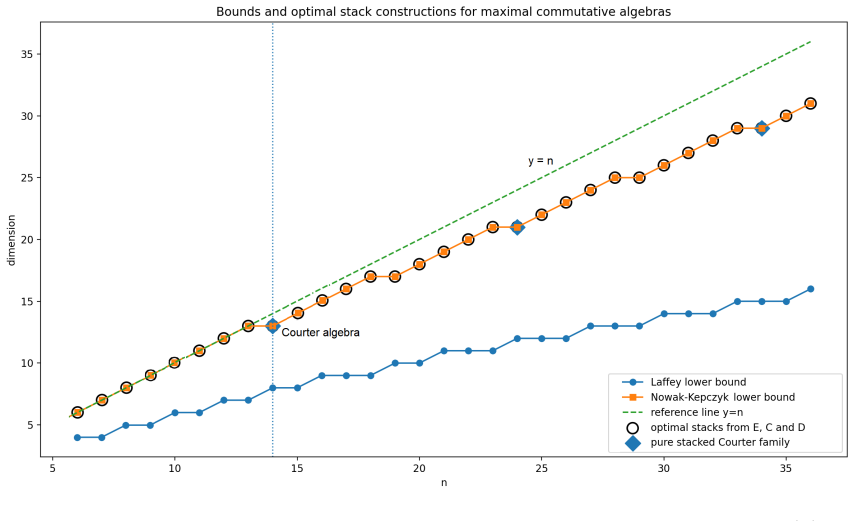
M. Nowak-Kępczyk,On the minimal dimension of maximal commutative subalgebras ofM6(k), arXiv:2604.23322 (2026), doi:10.48550/arXiv.2604.23322. 14 Figure 1: Comparison of Laffey’s classical lower bound, the Courter-type boundfC(n) = 5 + ⌈0.8(n−4)⌉, and explicit stack constructions fromE,C, andD. The liney=nseparates the trivial range from the exceptional on...
work page internal anchor Pith review Pith/arXiv arXiv doi:10.48550/arxiv.2604.23322 2026
-
[6]
D. A. Suprunenko, R. I. Tyshkevich,Commutative Matrices, Academic Press, New York, 1968
1968
-
[7]
I. Arzhantsev, Y. Zaitseva,Equivariant completions of affine spaces, Russian Math. Surveys77 (2022), no. 4, 571–622. doi:10.1070/RM10040 15
discussion (0)
Sign in with ORCID, Apple, or X to comment. Anyone can read and Pith papers without signing in.