Recognition: unknown
Black Hole Supernovae Outcomes Across a Wide Progenitor Range
Pith reviewed 2026-05-09 18:36 UTC · model grok-4.3
The pith
Black hole formation after shock revival occurs across most progenitors from 19.5 to 60 solar masses.
A machine-rendered reading of the paper's core claim, the machinery that carries it, and where it could break.
Core claim
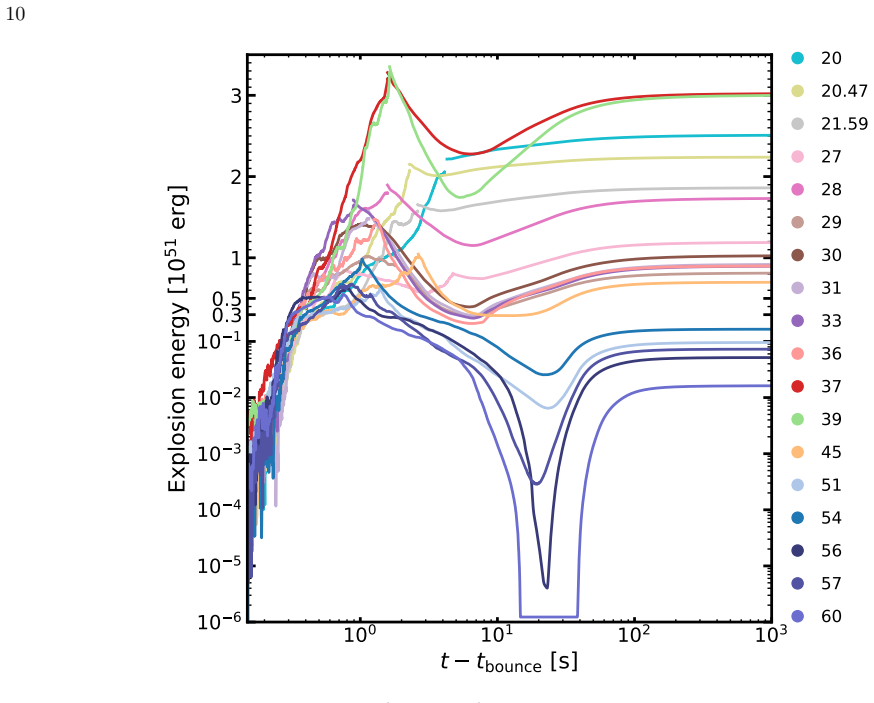
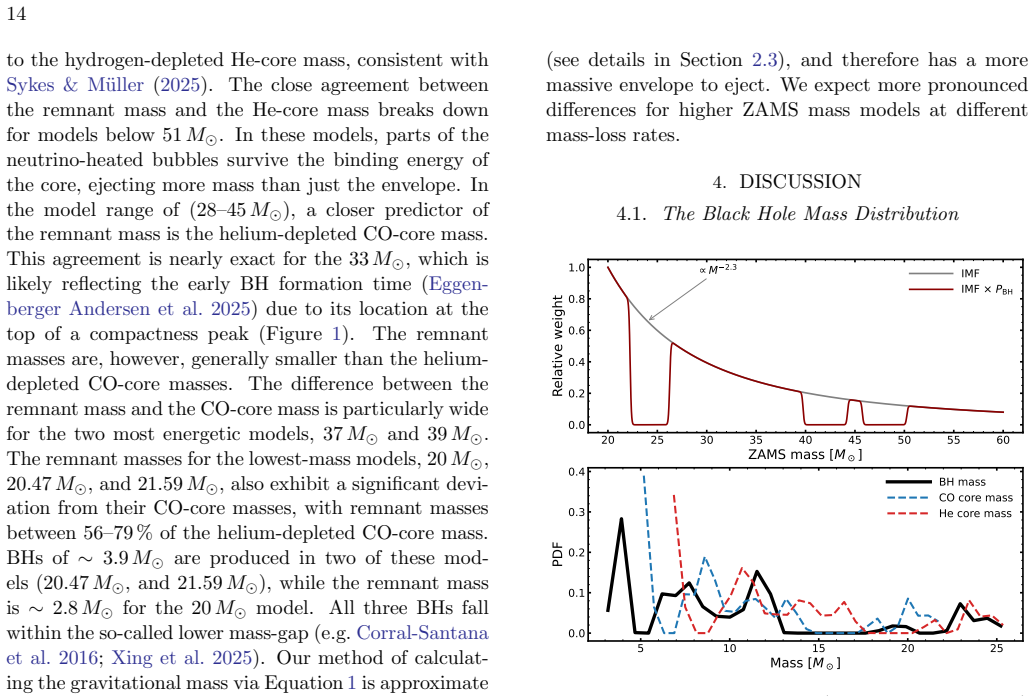
We find 18 black hole supernova outcomes across nearly the full zero-age main sequence mass range considered, corresponding to progenitors with 0.40 ≲ ξ2.5 ≲ 0.63. Black hole formation occurs between ∼0.7 s and ∼4.4 s after bounce. After black hole formation, we continue the evolution with an excision treatment to at least 5000 s. The final explosion energies span ∼2×10^49-3×10^51 erg, while the final black hole gravitational masses span ∼3-26 M⊙. We find a clear remnant-mass trend with CO-core mass, but show that the CO core alone is not an adequate proxy for the final black hole mass, especially for progenitors at the low- and high-mass ends of the CO-core distribution. Except for the high
What carries the argument
Long-term axisymmetric core-collapse simulations with neutrino transport, extended past shock revival to black hole formation and then continued with excision to track the final explosion energy and remnant mass.
If this is right
- Black hole formation after shock revival is a systematic outcome for progenitors with compactness between 0.40 and 0.63.
- Final black hole masses range from 3 to 26 solar masses and follow a trend with carbon-oxygen core mass.
- The carbon-oxygen core mass is not an adequate standalone predictor of black hole mass at the low and high ends of the distribution.
- No single spherical mass coordinate cleanly separates ejecta from remnant material except for the highest carbon-oxygen core models.
- Two-dimensional axisymmetric results differ from three-dimensional geometry in the details of the evolution.
Where Pith is reading between the lines
- A larger fraction of stellar-mass black holes may form through this post-revival channel than models limited to pre-revival collapse would predict.
- The wide range of predicted explosion energies and black hole masses can be tested against observed supernova remnants and gravitational-wave events from core collapse.
- Full three-dimensional calculations for the same progenitors would likely shift the exact compactness boundaries where black hole supernovae occur.
- Longer post-excision runs beyond 5000 seconds could reveal additional fallback or accretion effects on the final remnant.
Load-bearing premise
The two-dimensional axisymmetric geometry and the chosen neutrino transport and progenitor models sufficiently capture the three-dimensional dynamics and microphysics that determine whether and when a black hole forms after shock revival.
What would settle it
A three-dimensional simulation of a progenitor with compactness near 0.5 that produces no black hole after shock revival, or forms the black hole only before revival, would falsify the reported prevalence and timing of these outcomes.
Figures




read the original abstract
Black hole supernovae (BHSNe), the term we use for core-collapse events in which black hole (BH) formation occurs after shock revival but before the explosion is complete, have emerged as a natural outcome of multidimensional simulations as these calculations have been extended to seconds after bounce. Yet they remain one of the least studied outcomes of core collapse. Here, we assess whether they are confined to the most compact and massive progenitors, whose birth rates are low, or whether they arise systematically across a wider range of progenitor structures. We perform 23 long-term axisymmetric core-collapse simulations of progenitors spanning 19.51-60$\,M_\odot$ and compactnesses $0.31 \lesssim \xi_{2.5} \lesssim 0.63$. We find 18 BHSN outcomes across nearly the full ZAMS mass range considered, corresponding to progenitors with $0.40 \lesssim \xi_{2.5} \lesssim 0.63$. BH formation occurs between $\sim0.7$ s and $\sim4.4$ s after bounce. After BH formation, we continue the evolution with an excision treatment to at least 5000 s. The final explosion energies span $\sim2\times10^{49}$-$3\times10^{51}$ erg, while the final BH gravitational masses span $\sim3$-$26\,M_\odot$. We find a clear remnant-mass trend with CO-core mass, but show that the CO core alone is not an adequate proxy for the final BH mass, especially for progenitors at the low- and high-mass ends of the CO-core distribution. Except for the highest CO-core mass models, no single spherical mass coordinate cleanly separates ejecta from remnant material. Finally, a 2D axisymmetric and a 3D model are compared as we discuss differences between the two geometries.
Editorial analysis
A structured set of objections, weighed in public.
Referee Report
Summary. The paper presents results from 23 long-term axisymmetric core-collapse simulations of progenitors spanning 19.51-60 M_⊙ with compactnesses 0.31 ≲ ξ_{2.5} ≲ 0.63. It reports 18 black hole supernova (BHSN) outcomes for progenitors with 0.40 ≲ ξ_{2.5} ≲ 0.63, where black hole formation occurs between ~0.7 s and ~4.4 s after bounce. Post-BH formation evolution uses excision up to at least 5000 s, yielding explosion energies from ~2×10^{49} to 3×10^{51} erg and BH gravitational masses from ~3 to 26 M_⊙. Trends with CO-core mass are discussed, noting that CO core is not a sufficient proxy for final BH mass at the extremes, and a comparison between 2D and 3D geometries is included.
Significance. If these results hold, the work demonstrates that black hole supernovae are not restricted to the most massive and compact progenitors but occur systematically across a wide range of progenitor structures. This has important implications for the rates of black hole formation and the diversity of core-collapse supernova outcomes. The assessment is strengthened by the explicit set of 23 simulations, the clear reporting of trends in remnant mass and explosion energy, and the inclusion of a 2D-to-3D comparison, which provides a computational foundation for the claims.
minor comments (2)
- [Discussion section on 2D vs 3D] The comparison of one 2D axisymmetric and one 3D model is a positive step, but the manuscript does not quantify the potential impact of three-dimensional effects on the post-revival accretion rates and neutrino heating that determine BH formation timing across the ξ2.5 range. This could be addressed by discussing how the reported BH formation window of 0.7-4.4 s might shift in 3D, particularly for the lower compactness cases near 0.40.
- [Results on remnant mass trends] The statement that 'no single spherical mass coordinate cleanly separates ejecta from remnant material' except for highest CO-core models is significant; ensure that this is supported by explicit figures or tables showing the mass coordinate evolution for representative models at low, mid, and high CO-core masses.
Simulated Author's Rebuttal
We thank the referee for their positive assessment of our manuscript and for recommending minor revision. The summary accurately captures the scope of our 23 axisymmetric simulations and the key findings on black hole supernova outcomes across the progenitor range. No major comments were raised in the report.
Circularity Check
Direct numerical simulations with no analytical derivation chain
full rationale
The paper reports outcomes from 23 long-term axisymmetric core-collapse simulations across progenitors with 19.51-60 M⊙ and 0.31 ≲ ξ2.5 ≲ 0.63. Central claims (18 BHSN events for 0.40 ≲ ξ2.5 ≲ 0.63, BH formation at 0.7-4.4 s post-bounce, explosion energies ~2e49-3e51 erg, BH masses ~3-26 M⊙, and remnant-mass trends) are direct results of these computations, continued with excision to 5000 s. No equations, derivations, or predictions are presented that reduce by construction to fitted inputs, self-definitions, or self-citation chains. The single 2D-3D comparison is noted but does not bear the load of the main results. The work is a self-contained computational experiment against external benchmarks (progenitor models, neutrino transport), with no renaming of known results or imported uniqueness theorems.
Axiom & Free-Parameter Ledger
axioms (1)
- domain assumption Standard assumptions of general relativistic hydrodynamics, neutrino transport, and equation of state in core-collapse supernova modeling
Reference graph
Works this paper leans on
-
[1]
R., Langer , N., Antoniadis , J., & M \"u ller , B
Aguilera-Dena , D. R., Langer , N., Antoniadis , J., & M \"u ller , B. 2020, , 901, 114, 10.3847/1538-4357/abb138
-
[2]
Bethe , H. A. 1990, , 62, 801
1990
-
[3]
Stability of Standing Accretion Shocks, with an Eye toward Core-Collapse Supernovae
Blondin , J. M., Mezzacappa , A., & DeMarino , C. 2003, , 584, 971, 10.1086/345812
-
[4]
Boccioli , L., & Roberti , L. 2024, Universe, 10, 148, 10.3390/universe10030148
-
[5]
Boccioli , L., Vartanyan , D., O'Connor , E. P., & Kasen , D. 2025, , 540, 3885, 10.1093/mnras/staf963
-
[6]
Bollig , R., Yadav , N., Kresse , D., et al. 2021, , 915, 28, 10.3847/1538-4357/abf82e
-
[7]
Borges , R., Carmona , M., Costa , B., & Don , W. S. 2008, jcoph, 227, 3191, 10.1016/j.jcp.2007.11.038
-
[8]
Bruenn , S. W. 1985, , 58, 771, 10.1086/191056
-
[9]
2006, , 457, 281
Buras , R., Janka , H.-T., Rampp , M., & Kifonidis , K. 2006, , 457, 281
2006
-
[10]
1988, , 334, 891
Burrows , A. 1988, , 334, 891
1988
-
[11]
2023, , 957, 68, 10.3847/1538-4357/acfc1c
Burrows , A., Vartanyan , D., & Wang , T. 2023, , 957, 68, 10.3847/1538-4357/acfc1c
-
[12]
Burrows , A., Wang , T., & Vartanyan , D. 2024, , 964, L16, 10.3847/2041-8213/ad319e
-
[13]
2025, ApJ, 987, 164, doi: 10.3847/1538-4357/addd04
---. 2025, , 987, 164, 10.3847/1538-4357/addd04
-
[14]
2020, , 495, 3751, 10.1093/mnras/staa1431
Chan , C., M \"u ller , B., & Heger , A. 2020, , 495, 3751, 10.1093/mnras/staa1431
-
[15]
2018, , 852, L19, 10.3847/2041-8213/aaa28c
Chan , C., M \"u ller , B., Heger , A., Pakmor , R., & Springel , V. 2018, , 852, L19, 10.3847/2041-8213/aaa28c
-
[16]
2013, Python and HDF5 (O'Reilly)
Collette, A. 2013, Python and HDF5 (O'Reilly)
2013
-
[17]
M., Casares, J., Mu˜ noz-Darias, T., et al
Corral-Santana , J. M., Casares , J., Mu \ n oz-Darias , T., et al. 2016, , 587, A61, 10.1051/0004-6361/201527130
- [18]
-
[19]
M., Carlson, J., Pajkos, M., et al
Couch, S. M., Carlson, J., Pajkos, M., et al. 2021, Parallel Computing, 108, 102830, https://doi.org/10.1016/j.parco.2021.102830
-
[20]
Couch , S. M., & O'Connor , E. P. 2014, , 785, 123, 10.1088/0004-637X/785/2/123
-
[21]
da Silva Schneider , A., O'Connor , E., Granqvist , E., Betranhandy , A., & Couch , S. M. 2020, , 894, 4, 10.3847/1538-4357/ab8308
-
[22]
2022, apj, 942, 16, 10.3847/1538-4357/aca332
da Silva Schneider, A., & O’Connor, E. 2022, apj, 942, 16, 10.3847/1538-4357/aca332
-
[23]
da Silva Schneider , A. S., Roberts , L. F., Ott , C. D., & O'Connor , E. 2019, , 100, 055802, 10.1103/PhysRevC.100.055802
-
[24]
Dubey , A., Reid , L. B., Weide , K., et al. 2009, Parallel Comput., 35, 512, 10.1016/j.parco.2009.08.001
-
[25]
Eggenberger Andersen , O., O'Connor , E., Andresen , H., da Silva Schneider , A., & Couch , S. M. 2025, , 980, 53, 10.3847/1538-4357/ada899
-
[26]
1988, in Shock tubes and waves; Proceedings of the Sixteenth International Symposium, Aachen, Germany, July 26--31, 1987
Einfeldt , B. 1988, in Shock tubes and waves; Proceedings of the Sixteenth International Symposium, Aachen, Germany, July 26--31, 1987. VCH Verlag, Weinheim, Germany, 671
1988
-
[27]
Fryxell , B., Olson , K., Ricker , P., et al. 2000, , 131, 273, 10.1086/317361
-
[28]
Harris, C. R., Millman, K. J., van der Walt, S. J., et al. 2020, Nature, 585, 357, 10.1038/s41586-020-2649-2
-
[29]
L., Woosley , S
Heger , A., Fryer , C. L., Woosley , S. E., Langer , N., & Hartmann , D. H. 2003, , 591, 288
2003
-
[30]
Horowitz , C. J., Caballero , O. L., Lin , Z., O'Connor , E., & Schwenk , A. 2017, , 95, 025801, 10.1103/PhysRevC.95.025801
-
[31]
Hunter, J. D. 2007, Computing In Science & Engineering, 9, 90
2007
-
[32]
Janka , H.-T. 2012, Ann. Rev. Nuc. Par. Sci., 62, 407, 10.1146/annurev-nucl-102711-094901
-
[33]
Janka , H.-T., Hanke , F., H \"u depohl , L., et al. 2012, Prog. Th. Exp. Phys., 2012, 010000. 1211.1378
-
[34]
Kovelenko, L. et al. 2026, in preparation
2026
-
[35]
G., Staveley-Smith, L., de Blok, W
Kroupa , P. 2001, , 322, 231, 10.1046/j.1365-8711.2001.04022.x
-
[36]
2018, , 477, L80, 10.1093/mnrasl/sly059
Kuroda , T., Kotake , K., Takiwaki , T., & Thielemann , F.-K. 2018, , 477, L80, 10.1093/mnrasl/sly059
-
[37]
2018, ApJS, 237, 13, doi: 10.3847/1538-4365/aacb24
Limongi , M., & Chieffi , A. 2018, , 237, 13, 10.3847/1538-4365/aacb24
-
[38]
Marek , A., Dimmelmeier , H., Janka , H.-T., M \"u ller , E., & Buras , R. 2006, , 445, 273. astro-ph/0502161
-
[39]
2015, , 453, 287, 10.1093/mnras/stv1611
M \"u ller , B. 2015, , 453, 287, 10.1093/mnras/stv1611
-
[40]
M \"u ller , B., Janka , H.-T., & Marek , A. 2012, , 756, 84, 10.1088/0004-637X/756/1/84
-
[41]
M \"u ller , B., Melson , T., Heger , A., & Janka , H.-T. 2017, , 472, 491, 10.1093/mnras/stx1962
-
[42]
Nakamura , K., Takiwaki , T., Kuroda , T., & Kotake , K. 2015, , 10.1093/pasj/psv073
-
[43]
O'Connor , E. 2015, , 219, 24, 10.1088/0067-0049/219/2/24
-
[44]
O'Connor , E., & Ott , C. D. 2011, , 730, 70, 10.1088/0004-637X/730/2/70
-
[45]
O'Connor , E. P., & Couch , S. M. 2018 a , , 854, 63, 10.3847/1538-4357/aaa893
-
[46]
2018 b , , 865, 81, 10.3847/1538-4357/aadcf7
---. 2018 b , , 865, 81, 10.3847/1538-4357/aadcf7
-
[47]
Pan , K.-C., Liebend \"o rfer , M., Couch , S. M., & Thielemann , F.-K. 2018, , 857, 13, 10.3847/1538-4357/aab71d
-
[48]
2021, , 914, 140, 10.3847/1538-4357/abfb05
---. 2021, , 914, 140, 10.3847/1538-4357/abfb05
-
[49]
2021, , 503, 2108, 10.1093/mnras/stab614
Powell , J., M \"u ller , B., & Heger , A. 2021, , 503, 2108, 10.1093/mnras/stab614
-
[50]
T., Stockinger , G., & Woosley , S
Rahman , N., Janka , H. T., Stockinger , G., & Woosley , S. E. 2022, , 512, 4503, 10.1093/mnras/stac758
-
[51]
Schneider , F. R. N., Podsiadlowski , P., & M \"u ller , B. 2021, , 645, A5, 10.1051/0004-6361/202039219
-
[52]
Shibata , M., Kiuchi , K., Sekiguchi , Y., & Suwa , Y. 2011, Prog. Th. Phys., 125, 1255. 1104.3937
-
[53]
Steiner , A. W., Lattimer , J. M., & Brown , E. F. 2013, , 765, L5, 10.1088/2041-8205/765/1/L5
-
[54]
Sukhbold , T., Woosley , S. E., & Heger , A. 2018, , 860, 93, 10.3847/1538-4357/aac2da
-
[55]
2023, , 107, 103010, 10.1103/PhysRevD.107.103010
Sykes , B., Mueller , B., Cordero-Carri \'o n , I., Cerd \'a -Dur \'a n , P., & Novak , J. 2023, , 107, 103010, 10.1103/PhysRevD.107.103010
-
[56]
2025, , 538, 572, 10.1093/mnras/staf317
Sykes , B., & M \"u ller , B. 2025, , 538, 572, 10.1093/mnras/staf317
-
[57]
GWTC-4.0: Population Properties of Merging Compact Binaries
The LIGO Scientific Collaboration , the Virgo Collaboration , & the KAGRA Collaboration . 2025, arXiv e-prints, arXiv:2508.18083, 10.48550/arXiv.2508.18083
work page internal anchor Pith review Pith/arXiv arXiv doi:10.48550/arxiv.2508.18083 2025
-
[58]
Timmes , F. X., & Swesty , F. D. 2000, , 126, 501, 10.1086/313304
-
[59]
Toro , E. F., Spruce , M., & Speares , W. 1994, Shock Waves, 4, 25, 10.1007/BF01414629
-
[60]
Tur , C., Heger , A., & Austin , S. M. 2007, , 671, 821, 10.1086/523095
-
[61]
Turk , M. J., Smith , B. D., Oishi , J. S., et al. 2011, , 192, 9, 10.1088/0067-0049/192/1/9
-
[62]
Vartanyan , D., Tsang , B. T. H., Kasen , D., et al. 2025, , 982, 9, 10.3847/1538-4357/adb1e4
-
[63]
Virtanen, P., Gommers, R., Oliphant, T. E., et al. 2020, Nature Methods, 17, 261, 10.1038/s41592-019-0686-2
-
[64]
Walk , L., Tamborra , I., Janka , H.-T., Summa , A., & Kresse , D. 2020, , 101, 123013, 10.1103/PhysRevD.101.123013
-
[65]
E., Hirschi , R., Varma , V., et al
Whitehead , E. E., Hirschi , R., Varma , V., et al. 2026, , 546, staf2245, 10.1093/mnras/staf2245
-
[66]
2021, , 921, 19, 10.3847/1538-4357/ac1a6d
Witt , M., Psaltis , A., Yasin , H., et al. 2021, , 921, 19, 10.3847/1538-4357/ac1a6d
-
[67]
Xing , Z., Kalogera , V., Fragos , T., et al. 2025, , 989, 188, 10.3847/1538-4357/adec6d
discussion (0)
Sign in with ORCID, Apple, or X to comment. Anyone can read and Pith papers without signing in.