Recognition: unknown
Who Decides What Is Harmful? Content Moderation Policy Through A Multi-Agent Personalised Inference Framework
Pith reviewed 2026-05-09 18:15 UTC · model grok-4.3
The pith
A multi-agent LLM framework personalizes content moderation to individual user sensitivity profiles.
A machine-rendered reading of the paper's core claim, the machinery that carries it, and where it could break.
Core claim
The authors claim that their LLM-based multi-agent personalised inference framework, which integrates domain-specific Expert Agents, a Manager Agent for orchestration, and a Ghost Profile Agent for simulating user perspectives, produces moderation decisions that better match individual perceptions of harm than non-personalized systems.
What carries the argument
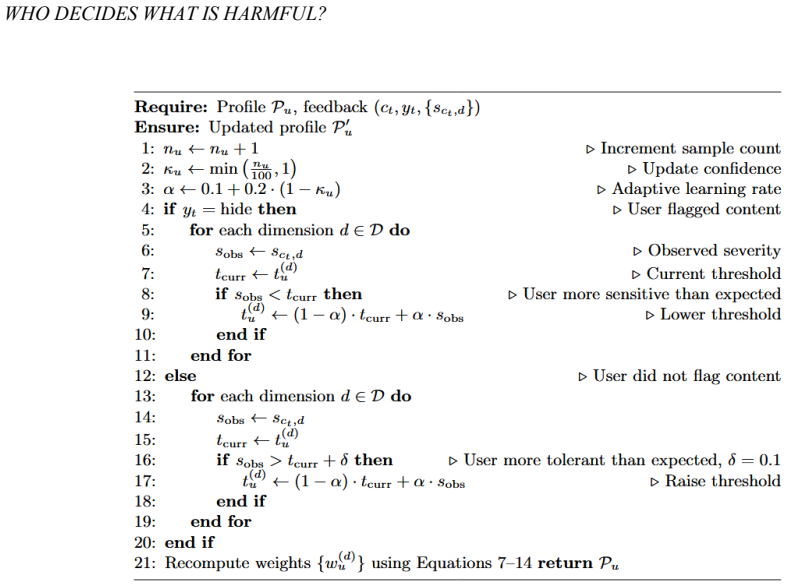
The multi-agent personalised inference framework combining domain-specific Expert Agents, a Manager Agent for orchestrating analysis and selection, and a Ghost Profile Agent for simulating user perspectives to inform moderation decisions.
If this is right
- Moderation policies can scale while accommodating subjective differences in harm perception across users.
- Platforms receive a concrete method to reconcile centralized rules with individual digital rights and autonomy.
- The architecture supplies policy insights for governance that balance societal standards and personal sensitivities.
- Accuracy improvements of up to 32 percent over non-personalised baselines become possible through agent-based personalization.
Where Pith is reading between the lines
- This method could reduce widespread user complaints about over-moderation or under-moderation by adapting per profile.
- Similar agent structures might apply to other subjective platform decisions such as recommendation or privacy controls.
- Implementation would require safeguards to prevent the simulation from encoding biased or incomplete user models.
- Testing across different cultural or demographic groups would reveal whether the personalization generalizes beyond the evaluated cases.
Load-bearing premise
The Ghost Profile Agent can reliably simulate individual users' subjective perceptions of harm and that this simulation produces moderation decisions that genuinely align with real user sensitivities.
What would settle it
A direct comparison study measuring how often the system's moderation outputs match real users' own judgments on identical content samples.
Figures


read the original abstract
The increasing scale and complexity of online platforms raises critical policy questions around harmful content, digital well-being, and user autonomy. Traditional content moderation systems rely on centralised, top-down rules, often failing to accommodate the subjective nature of harm perception. This paper proposes an LLM-based multi-agent personalised inference framework that filters content based on unique sensitivity profiles of individual users. Our architecture combines domain-specific Expert Agents, a Manager Agent for orchestrating content analysis and agent selection, and a Ghost Profile Agent for simulating user perspectives, to inform moderation decisions. Evaluated against a range of non-personalised baselines, the system demonstrates up to a 32% improvement in accuracy, showing increased alignment with individual user sensitivities. Beyond technical performance, our framework provides policy-relevant insights for platform governance, providing a scalable way to reconcile moderation policies with societal and individual digital rights
Editorial analysis
A structured set of objections, weighed in public.
Referee Report
Summary. The manuscript proposes an LLM-based multi-agent framework for personalized content moderation. It combines domain-specific Expert Agents, a Manager Agent for orchestration and agent selection, and a Ghost Profile Agent to simulate individual users' subjective harm perceptions. The system is evaluated against non-personalized baselines and claims up to 32% accuracy improvement with better alignment to user sensitivities, while also offering policy insights for platform governance and digital rights.
Significance. If the evaluation were properly grounded, the framework could offer a scalable technical approach to reconciling centralized moderation policies with individual differences in harm perception, which is a persistent challenge in content moderation research. The multi-agent design provides a concrete architecture for personalization that could inform governance discussions, but the current lack of validation against human data limits its contribution to either technical or policy literature.
major comments (2)
- [Abstract] Abstract: The central claim of 'up to a 32% improvement in accuracy' is presented without any information on the evaluation dataset, baseline definitions, evaluation protocol, statistical tests, or error analysis. This information is required to determine whether the reported gain reflects genuine alignment with user sensitivities or internal consistency within the LLM agents.
- [Framework and Evaluation sections] Framework and Evaluation sections: The Ghost Profile Agent is described as simulating user perspectives to produce personalized moderation decisions, yet no correlation, user study, or human-labeled validation is reported between the simulated profiles and actual participant ratings of harm. Without this grounding, the accuracy metric risks measuring LLM self-consistency rather than external validity, which directly undermines the alignment claim.
minor comments (1)
- [Abstract] Abstract: The phrase 'increased alignment with individual user sensitivities' is used without defining the alignment metric or how it was quantified.
Simulated Author's Rebuttal
We thank the referee for their constructive feedback, which identifies key areas where additional transparency will strengthen the manuscript. We address each major comment below and commit to revisions that clarify the evaluation details and explicitly discuss the simulation-based approach.
read point-by-point responses
-
Referee: [Abstract] Abstract: The central claim of 'up to a 32% improvement in accuracy' is presented without any information on the evaluation dataset, baseline definitions, evaluation protocol, statistical tests, or error analysis. This information is required to determine whether the reported gain reflects genuine alignment with user sensitivities or internal consistency within the LLM agents.
Authors: We agree that the abstract requires more supporting context for the central claim. In the revised manuscript, we will expand the abstract to briefly specify the evaluation dataset (content samples paired with diverse simulated sensitivity profiles), the non-personalized baselines (standard LLM classifiers and heuristic moderation), the protocol (comparative accuracy against profile-aligned decisions), and references to statistical tests and error analysis detailed in the Evaluation section. This will help readers assess whether the 32% gain reflects alignment with simulated sensitivities. revision: yes
-
Referee: [Framework and Evaluation sections] Framework and Evaluation sections: The Ghost Profile Agent is described as simulating user perspectives to produce personalized moderation decisions, yet no correlation, user study, or human-labeled validation is reported between the simulated profiles and actual participant ratings of harm. Without this grounding, the accuracy metric risks measuring LLM self-consistency rather than external validity, which directly undermines the alignment claim.
Authors: This observation is correct and highlights a genuine limitation of the current work. The evaluation measures alignment between the multi-agent outputs and decisions generated from the Ghost Profile Agent's simulated sensitivities, without human participant data or correlation studies. We will revise the Framework and Evaluation sections to state this limitation explicitly, elaborate on the profile simulation method (including prompt design for consistency), and add a dedicated future-work subsection outlining plans for human validation studies. The framework remains a technical contribution for scalable personalization, but we agree external human grounding is needed to fully support the alignment claims. revision: partial
Circularity Check
No significant circularity in empirical evaluation of multi-agent framework
full rationale
The paper presents an LLM-based multi-agent architecture (Expert Agents, Manager Agent, Ghost Profile Agent) for personalized content moderation and reports an empirical result: up to 32% accuracy improvement over non-personalised baselines. No equations, derivations, or load-bearing steps are described that reduce this claim to a self-definition, fitted parameter renamed as prediction, or self-citation chain. The accuracy metric is positioned as an external comparison, not internally forced by the framework's own logic or assumptions. This is a standard non-circular empirical claim, consistent with the default expectation and the provided reader's assessment of minimal circularity concern.
Axiom & Free-Parameter Ledger
axioms (1)
- domain assumption LLMs can effectively simulate individual user perspectives on harmful content via a Ghost Profile Agent
invented entities (1)
-
Ghost Profile Agent
no independent evidence
Reference graph
Works this paper leans on
-
[1]
I always assumed that I wasn't really that close to [her]
Antypas, D., & Camacho-Collados, J. (2023, July). Robust Hate Speech Detection in Social Media: A Cross-Dataset Empirical Evaluation. In The 7th Workshop on Online Abuse and Harms (WOAH) (pp. 231-242). Addison J. Wu, Ryan Liu, Kerem Oktar, Theodore R. Sumers, & Thomas L. Griffiths. (2025). Are Large Language Models Sensitive to the Motives Behind Communic...
-
[2]
(Vol. 1884, pp. 35-42). Kennedy, C., Bacon, G., Sahn, A., & Vacano, C. (2020). Constructing interval variables via faceted Rasch measurement and multitask deep learning: a hate speech application . arXiv preprint arXiv:2009.10277. Kocoń, J., Gruza, M., Bielaniewicz, J., Grimling, D., Kanclerz, K., Miłkowski, P., & Kazienko, P. (2021, December). Learning p...
discussion (0)
Sign in with ORCID, Apple, or X to comment. Anyone can read and Pith papers without signing in.