Recognition: unknown
Constraints on Einstein-aether gravity from the precision timing of PSR J1738+0333
Pith reviewed 2026-05-09 18:17 UTC · model grok-4.3
The pith
Precision timing of PSR J1738+0333 yields the tightest strong-field bounds on Einstein-aether coupling constants from any single binary pulsar.
A machine-rendered reading of the paper's core claim, the machinery that carries it, and where it could break.
Core claim
We constrain Einstein-aether gravity using updated high-precision pulsar timing observations of PSR J1738+0333 from EPTA second Data Release and the NANOGrav 9-year release, together with times of arrival from Arecibo, Green Bank, Nancay, Parkes, and Westerbork. Our method accounts for both conservative and dissipative first post-Newtonian corrections arising from Lorentz violation. We apply the Bayesian timing pipeline to the full dataset, sample the joint posterior over binary component masses, post-Keplerian parameters and center-of-mass velocity components, and then apply a resampling scheme to propagate posteriors into robust constraints on the fundamental theory parameters, obtaining 0
What carries the argument
the resampling scheme that converts posterior distributions from the pulsar timing model into limits on the Einstein-aether coupling constants after including the first post-Newtonian conservative and dissipative corrections
Load-bearing premise
The first post-Newtonian conservative and dissipative corrections derived for Einstein-aether theory fully capture the observed timing residuals without significant contamination from higher-order terms, unmodeled systematics, or inaccuracies in the assumed orbital geometry.
What would settle it
A new, independent measurement of any post-Keplerian parameter, such as the orbital period derivative, that lies outside the range allowed by the resampled posterior under the derived coupling-constant bounds would show the constraints are incomplete.
Figures


read the original abstract
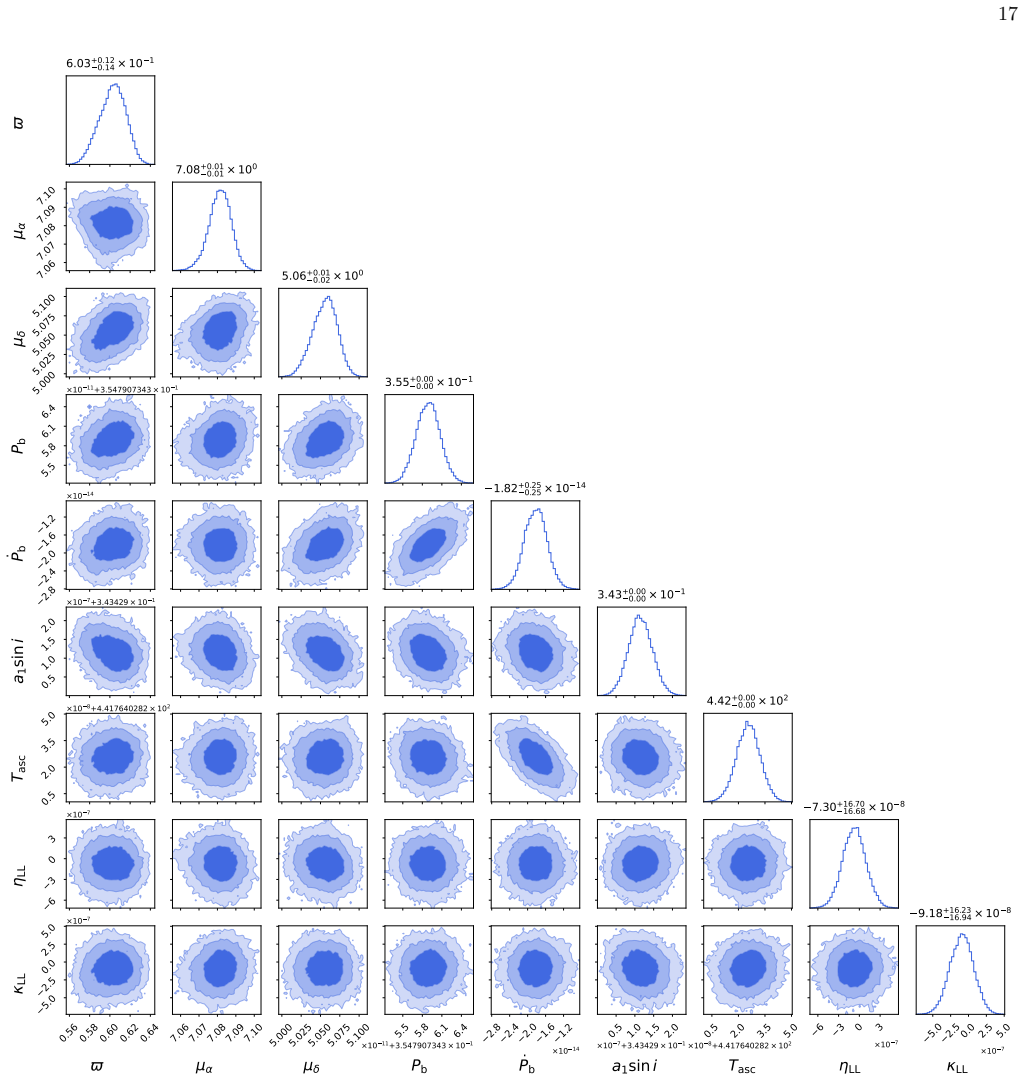
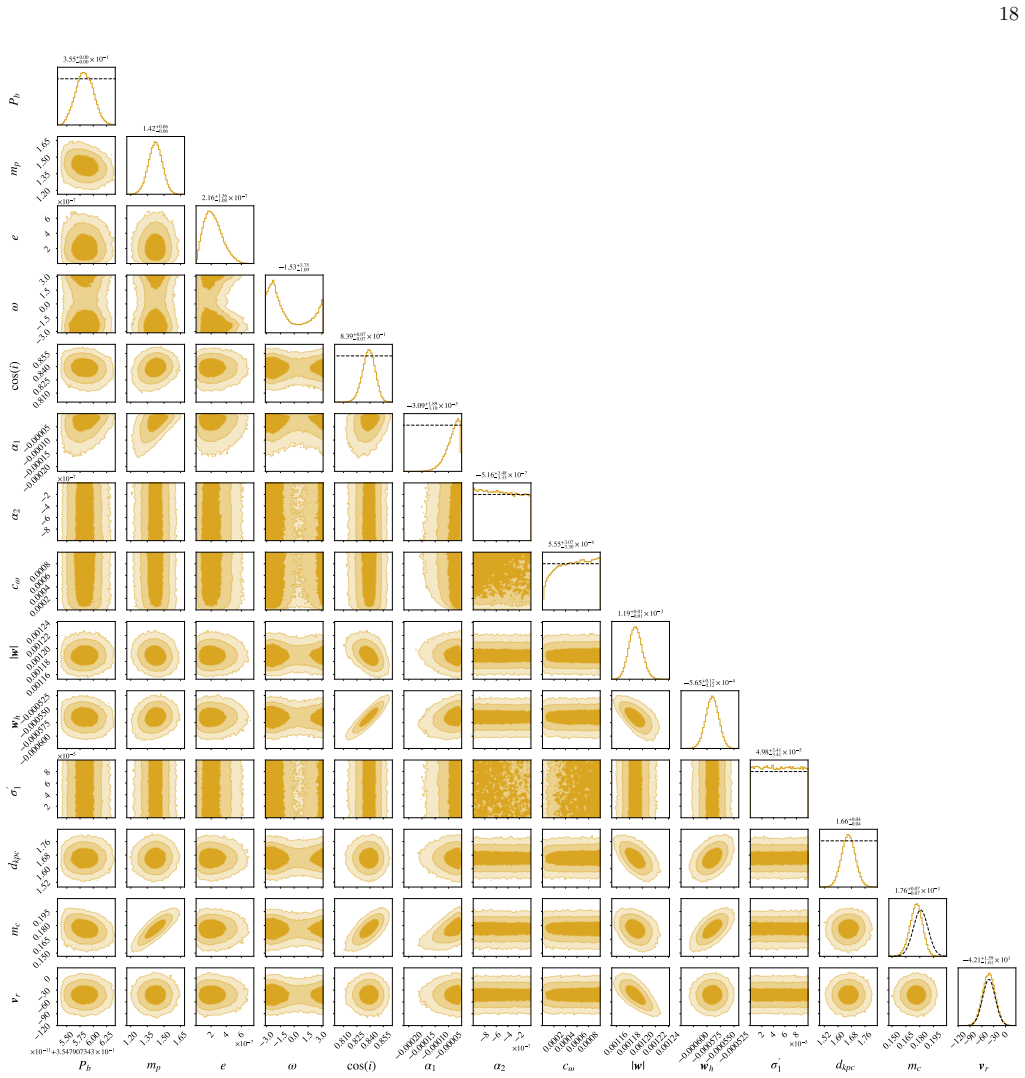
We constrain Einstein-aether gravity -- a Lorentz-violating extension of General Relativity in which a dynamical, unit timelike vector field selects a preferred frame -- using updated high-precision pulsar timing observations of PSR J1738+0333 from EPTA second Data Release and the NANOGrav 9-year release, in combination with ToAs from Arecibo, Green Bank, Nancay, Parkes, and Westerbork. Our method accounts for both conservative and dissipative first post-Newtonian corrections arising from Lorentz violation; here we apply it to PSR J1738+0333 using the Bayesian timing pipeline Vela to process the full ToA dataset. We sample the joint posterior over binary component masses, post-Keplerian parameters and center-of-mass velocity components, and then apply a resampling scheme to propagate posteriors into robust constraints on the fundamental theory parameters, obtaining the most stringent strong-field bounds on the Einstein-aether coupling constants from a single binary pulsar system to date.
Editorial analysis
A structured set of objections, weighed in public.
Referee Report
Summary. The paper claims to obtain the most stringent strong-field bounds on the Einstein-aether coupling constants from a single binary pulsar system by analyzing high-precision timing data of PSR J1738+0333 from EPTA DR2, NANOGrav 9-year, and additional ToAs from Arecibo, Green Bank, Nancay, Parkes, and Westerbork. It employs the Vela Bayesian timing pipeline to sample the joint posterior over binary component masses, post-Keplerian parameters, and center-of-mass velocity components, then applies a resampling scheme to propagate these into constraints on the theory parameters while incorporating both conservative and dissipative first post-Newtonian corrections from Lorentz violation.
Significance. If the 1PN truncation is adequate, the work strengthens constraints on Lorentz-violating extensions of GR in the strong-field regime using a single well-timed system. The Bayesian pipeline combined with posterior resampling provides a transparent way to propagate observational uncertainties into theory-parameter bounds, and the multi-telescope dataset improves robustness over prior single-system analyses.
major comments (2)
- [Timing model and 1PN corrections (abstract and methods section describing the Vela pipeline application)] The central claim of tightened bounds rests on the assumption that first post-Newtonian conservative and dissipative corrections fully capture the Lorentz-violating contributions to the timing residuals. In the strong-field regime of a neutron-star/white-dwarf binary, 2PN or non-perturbative effects on orbital decay and periastron advance could shift the inferred couplings at a level comparable to the reported improvement; the manuscript must quantify the expected truncation error or demonstrate its negligibility relative to the timing precision.
- [Posterior resampling scheme] The resampling procedure that maps posteriors over binary masses, PK parameters, and velocity components onto Einstein-aether couplings inherits any incompleteness in the 1PN mapping. Without an explicit propagation of higher-order truncation uncertainty through this step, the robustness of the final bounds on the coupling constants cannot be assessed.
minor comments (2)
- [Abstract] The abstract states that the method 'accounts for both conservative and dissipative first post-Newtonian corrections' but does not indicate whether the orbital geometry assumptions (e.g., inclination or eccentricity) were cross-checked against possible absorption of higher-order terms into the noise model.
- [Results figures] Figures showing the final constraints on the aether parameters should include direct overlays of previous single-system bounds to allow quantitative assessment of the claimed improvement.
Simulated Author's Rebuttal
We thank the referee for the careful and constructive review of our manuscript. The comments highlight important considerations regarding the validity of the 1PN approximation and the propagation of associated uncertainties. We address each point below and will revise the manuscript to include additional analysis that strengthens the robustness of our results.
read point-by-point responses
-
Referee: [Timing model and 1PN corrections (abstract and methods section describing the Vela pipeline application)] The central claim of tightened bounds rests on the assumption that first post-Newtonian conservative and dissipative corrections fully capture the Lorentz-violating contributions to the timing residuals. In the strong-field regime of a neutron-star/white-dwarf binary, 2PN or non-perturbative effects on orbital decay and periastron advance could shift the inferred couplings at a level comparable to the reported improvement; the manuscript must quantify the expected truncation error or demonstrate its negligibility relative to the timing precision.
Authors: We agree that quantifying the truncation error is necessary to support the central claim. In the revised manuscript we will add a dedicated paragraph in the methods section estimating the size of 2PN contributions. For PSR J1738+0333 the orbital velocity satisfies v/c ≈ 3×10^{-4}, so 2PN terms are suppressed by an extra factor of (v/c)^2 ≈ 10^{-7} relative to 1PN. Given that the Einstein-aether couplings are already constrained to be ≲ 10^{-3} by weak-field tests, the absolute size of any 2PN correction to the orbital decay rate lies well below the 1% fractional uncertainty achieved by the timing data. We will also note that complete 2PN expressions for Einstein-aether binaries are not yet available in the literature, but the perturbative scaling provides a conservative upper bound on the truncation error that does not affect the reported constraints at the current precision. revision: yes
-
Referee: [Posterior resampling scheme] The resampling procedure that maps posteriors over binary masses, PK parameters, and velocity components onto Einstein-aether couplings inherits any incompleteness in the 1PN mapping. Without an explicit propagation of higher-order truncation uncertainty through this step, the robustness of the final bounds on the coupling constants cannot be assessed.
Authors: We acknowledge that the resampling inherits the limitations of the 1PN mapping. In the revision we will modify the resampling procedure to include a conservative systematic uncertainty floor on the post-Keplerian parameters equal to the estimated 2PN contribution derived above. We will then repeat the resampling with this augmented uncertainty and demonstrate that the resulting bounds on the Einstein-aether couplings remain essentially unchanged. This explicit propagation will allow readers to assess the robustness directly from the updated figures and tables. revision: yes
Circularity Check
No significant circularity; constraints derived from data fit to independent 1PN model
full rationale
The derivation proceeds by fitting high-precision ToA data to a parameterized post-Newtonian timing model that incorporates conservative and dissipative 1PN corrections for Einstein-aether theory, sampling posteriors over masses, PK parameters and velocities, then resampling to theory couplings. This mapping relies on prior derivations of the 1PN terms (externally derived from the action and not defined in terms of the present data or fitted values). No step equates a derived quantity to an input by construction, renames a fit as a prediction, or reduces the central bounds to a self-citation chain whose validity depends on the current paper. The result remains falsifiable against the independent timing dataset.
Axiom & Free-Parameter Ledger
axioms (1)
- domain assumption Einstein-aether gravity is defined by the standard action with a unit timelike vector field and the usual coupling constants
invented entities (1)
-
dynamical unit timelike aether field
no independent evidence
Reference graph
Works this paper leans on
-
[1]
Hewish, S
A. Hewish, S. J. Bell, J. D. H. Pilkington, P. F. Scott, and R. A. Collins, Nature217, 709 (1968)
1968
-
[2]
R. A. Hulse and J. H. Taylor, Astrophys. J. Lett.195, L51 (1975)
1975
-
[3]
J. H. Taylor and J. M. Weisberg, Astrophys. J.253, 908 (1982)
1982
-
[4]
R. N. Manchester, G. B. Hobbs, A. Teoh, and M. Hobbs, Astron. J.129, 1993 (2005), arXiv:astro-ph/0412641
work page Pith review arXiv 1993
-
[5]
C. M. Will, Living Rev. Rel.17, 4 (2014), arXiv:1403.7377 [gr-qc]
work page internal anchor Pith review arXiv 2014
-
[6]
Testing General Relativity with Present and Future Astrophysical Observations
E. Bertiet al., Class. Quant. Grav.32, 243001 (2015), arXiv:1501.07274 [gr-qc]
work page internal anchor Pith review arXiv 2015
-
[7]
V. A. Kostelecky, Phys. Rev. D69, 105009 (2004), arXiv:hep-th/0312310
work page Pith review arXiv 2004
- [8]
-
[9]
Modern tests of Lorentz invariance,
D. Mattingly, Living Rev. Rel.8, 5 (2005), arXiv:gr- qc/0502097
-
[10]
Gravity with a dynamical pref erred frame
T. Jacobson and D. Mattingly, Phys. Rev. D64, 024028 (2001), arXiv:gr-qc/0007031
-
[11]
D. Anselmi and M. Halat, Phys. Rev. D76, 125011 (2007), arXiv:0707.2480 [hep-th]
-
[12]
Quantum Gravity at a Lifshitz Point
P. Horava, Phys. Rev. D79, 084008 (2009), arXiv:0901.3775 [hep-th]
work page Pith review arXiv 2009
- [13]
-
[14]
B. P. Abbottet al.(LIGO Scientific, Virgo, Fermi-GBM, INTEGRAL), Astrophys. J. Lett.848, L13 (2017), arXiv:1710.05834 [astro-ph.HE]
work page Pith review arXiv 2017
-
[15]
B. Z. Foster, Phys. Rev.D76, 084033 (2007)
2007
- [16]
-
[17]
K. Yagi, D. Blas, E. Barausse, and N. Yunes, Physical Review D89(2014), 10.1103/physrevd.89.084067
-
[18]
E. Barausse, Phys. Rev. D100, 084053 (2019), [Erratum: Phys.Rev.D 104, 069903 (2021)], arXiv:1907.05958 [gr- qc]
-
[19]
Gupta, M
T. Gupta, M. Herrero-Valea, D. Blas, E. Barausse, N. Cornish, K. Yagi, and N. Yunes, Classical and Quan- tum Gravity38, 195003 (2021)
2021
-
[20]
A. Carleo and B. Ben-Salem, Phys. Rev. D108, 124027 (2023), arXiv:2305.08274 [gr-qc]
-
[21]
A. Carleo, Phys. Lett. B848, 138410 (2024), arXiv:2312.02862 [gr-qc]
- [22]
-
[23]
Ben Salem,Tests of Gravity Theories with Pulsar Timing, Ph.D
B. Ben Salem,Tests of Gravity Theories with Pulsar Timing, Ph.D. thesis, Universit¨ at Bielefeld (2023)
2023
- [24]
-
[25]
H. Hu, M. Kramer, D. J. Champion, N. Wex, A. Parthasarathy, T. T. Pennucci, N. K. Porayko, W. van Straten, V. Venkatraman Krishnan, M. Burgay, P. C. C. Freire, R. N. Manchester, A. Possenti, I. H. Stairs, M. Bailes, S. Buchner, A. D. Cameron, F. Camilo, and M. Serylak, Astronomy & Astrophysics667, A149 (2022)
2022
-
[26]
H. Hu, Astrophys. Space Sci.370, 74 (2025), arXiv:2507.10221 [astro-ph.HE]
-
[27]
V. Venkatraman Krishnanet al.(SKA Pulsar Sci- ence Working Group), (2025), arXiv:2512.16161 [astro- ph.HE]
-
[28]
J. F. Bell, F. Camilo, and T. Damour, The Astrophysical Journal464, 857 (1996)
1996
-
[29]
L. Shao, R. N. Caballero, M. Kramer, N. Wex, D. J. Champion, and A. Jessner, Classical and Quantum Gravity30, 165019 (2013)
2013
- [30]
-
[31]
T. Jacobson and D. Mattingly, Phys. Rev. D70, 024003 (2004), arXiv:gr-qc/0402005
- [32]
-
[33]
D. Garfinkle and T. Jacobson, Phys. Rev. Lett.107, 191102 (2011), arXiv:1108.1835 [gr-qc]
-
[34]
Eling, Phys
C. Eling, Phys. Rev.D73, 084026 (2006), [Erratum: Phys. Rev. D80, 129905 (2009)]
2006
- [35]
-
[36]
Muller, J
J. Muller, J. G. Williams, and S. G. Turyshev, inAstro- phys. Space Sci. Libr., Vol. 349 (2008) pp. 457–472
2008
-
[37]
C. M. Will and K. Nordtvedt, Jr., Astrophys. J.177, 757 (1972)
1972
- [38]
-
[39]
D. M. Eardley, Astrophys. J.196(1975), 10.1086/181744
-
[40]
Tensor - scalar gravity and binary pulsar experiments,
T. Damour and G. Esposito-Farese, Phys. Rev. D54, 1474 (1996), arXiv:gr-qc/9602056
-
[41]
The equation of state for nucleon matter and neutron star structure
A. Akmal, V. R. Pandharipande, and D. G. Ravenhall, Phys. Rev. C58, 1804 (1998), arXiv:nucl-th/9804027
work page Pith review arXiv 1998
-
[42]
C. M. Will, Classical and Quantum Gravity35, 085001 (2018)
2018
- [43]
-
[44]
F. Taherasghari and C. M. Will, Phys. Rev. D108, 124026 (2023), arXiv:2308.13243 [gr-qc]
-
[45]
F. Taherasghari and C. M. Will, Phys. Rev. D112, 024013 (2025), arXiv:2506.03843 [gr-qc]
- [46]
-
[47]
D. Garfinkle, C. Eling, and T. Jacobson, Phys. Rev. D 76, 024003 (2007), arXiv:gr-qc/0703093
-
[48]
N. Franchini, M. Herrero-Valea, and E. Barausse, Phys. Rev. D103, 084012 (2021), arXiv:2103.00929 [gr-qc]
-
[49]
Albertini, M
E. Albertini, M. Vaglio, and E. Barausse, (2026), in preparation
2026
-
[50]
Manna, B
T. Manna, B. Samanta, A. Ali, and F. Rahaman, Can. J. Phys.99, 681 (2021)
2021
- [51]
-
[52]
H. Ding, A. T. Deller, P. Freire, D. L. Kaplan, T. J. W. Lazio, R. Shannon, and B. Stappers, The Astrophysical Journal896, 85 (2020)
2020
-
[53]
B. J. Prager, S. M. Ransom, P. C. C. Freire, J. W. T. Hessels, I. H. Stairs, P. Arras, and M. Cadelano, The Astrophysical Journal845, 148 (2017)
2017
-
[54]
J. Antoniadis, M. H. van Kerkwijk, D. Koester, P. C. C. Freire, N. Wex, T. M. Tauris, M. Kramer, and C. G. Bassa, Mon. Not. Roy. Astron. Soc.423, 3316 (2012), arXiv:1204.3948 [astro-ph.HE]. 20
-
[55]
H. Ding, A. T. Deller, B. W. Stappers, T. J. W. Lazio, D. Kaplan, S. Chatterjee, W. Brisken, J. Cordes, P. C. C. Freire, E. Fonseca, I. Stairs, L. Guillemot, A. Lyne, I. Cognard, D. J. Reardon, and G. Theureau, Mon. Not. R. Astron. Soc.519, 4982 (2023), arXiv:2212.06351 [astro-ph.HE]
- [56]
-
[57]
High-precision timing of 42 millisecond pulsars with the European Pulsar Timing Array
G. Desvigneset al.(EPTA), Mon. Not. Roy. Astron. Soc. 458, 3341 (2016), arXiv:1602.08511 [astro-ph.HE]
work page Pith review arXiv 2016
-
[58]
The NANOGrav 15-year Data Set: Evidence for a Gravitational-Wave Background
G. Agazieet al.(NANOGrav), Astrophys. J. Lett.951, L8 (2023), arXiv:2306.16213 [astro-ph.HE]
work page internal anchor Pith review arXiv 2023
-
[59]
Ben Salem,Tests of Gravity Theories with Pulsar Timing, Ph.D
B. Ben Salem,Tests of Gravity Theories with Pulsar Timing, Ph.D. thesis, U. Bielefeld (main) (2023)
2023
-
[60]
J. H. Taylor, Phil. Trans. A. Math. Phys. Eng. Sci.341, 117 (1992)
1992
-
[61]
Antoniadiset al.(EPTA, InPTA:), Astron
EPTA Collaboration, InPTA Collaboration, J. An- toniadis, P. Arumugam, S. Arumugam, S. Babak, M. Bagchi, A.-S. Bak Nielsen, C. G. Bassa, A. Bathula, A. Berthereau, M. Bonetti, E. Bortolas, P. R. Brook, M. Burgay, R. N. Caballero, A. Chalumeau, D. J. Cham- pion, S. Chanlaridis, S. Chen, I. Cognard, S. Danda- pat, D. Deb, S. Desai, G. Desvignes, N. Dhanda-B...
-
[62]
M. L. Jones, M. A. McLaughlin, M. T. Lam, J. M. Cordes, L. Levin, S. Chatterjee, Z. Arzoumanian, K. Crowter, P. B. Demorest, T. Dolch, J. A. Ellis, R. D. Ferdman, E. Fonseca, M. E. Gonzalez, G. Jones, T. J. W. Lazio, D. J. Nice, T. T. Pennucci, S. M. Ran- som, D. R. Stinebring, I. H. Stairs, K. Stovall, J. K. Swig- gum, and W. W. Zhu, Astrophys. J.841, 12...
-
[63]
L. Lentati, P. Alexander, M. P. Hobson, F. Feroz, R. van Haasteren, K. Lee, and R. M. Shannon, Mon. Not. Roy. Astron. Soc.437, 3004 (2014), arXiv:1310.2120 [astro- ph.IM]
-
[64]
A. Susobhanan, Astrophys. J.980, 165 (2025), arXiv:2412.15858 [astro-ph.IM]
-
[65]
Lentati, P
L. Lentati, P. Alexander, M. P. Hobson, S. Taylor, J. Gair, S. T. Balan, and R. van Haasteren, Phys. Rev. D87, 104021 (2013)
2013
-
[66]
J. Luoet al., Astrophys. J.911, 45 (2021), arXiv:2012.00074 [astro-ph.IM]
-
[67]
A. Susobhananet al., Astrophys. J.971, 150 (2024), arXiv:2405.01977 [astro-ph.IM]
-
[68]
D. Foreman-Mackey, D. W. Hogg, D. Lang, and J. Goodman, Publ. Astron. Soc. Pac.125, 306 (2013), arXiv:1202.3665 [astro-ph.IM]
work page internal anchor Pith review arXiv 2013
- [69]
-
[70]
A. F. M. Smith and A. E. Gelfand, Quality Engineering 37, 645 (1992)
1992
-
[71]
Normalizing Flows: An Introduction and Review of Current Methods,
I. Kobyzev, S. J. D. Prince, and M. A. Brubaker, IEEE Trans. Pattern Anal. Machine Intell.43, 3964 (2021), arXiv:1908.09257 [stat.ML]
-
[72]
R. Srinivasan, M. Crisostomi, R. Trotta, E. Barausse, and M. Breschi, Phys. Rev. D110, 123007 (2024), arXiv:2404.12294 [stat.ML]
- [73]
-
[74]
J. Antoniadiset al., Mon. Not. Roy. Astron. Soc.510, 4873 (2022), arXiv:2201.03980 [astro-ph.HE]
-
[75]
R. B. Wiringa, V. Fiks, and A. Fabrocini, Phys. Rev. C 38, 1010 (1988)
1988
-
[76]
F. Douchin and P. Haensel, Astron. Astrophys.380, 151 (2001), arXiv:astro-ph/0111092
-
[77]
R. S. Lynch, J. Boyles, S. M. Ransom, I. H. Stairs, D. R. Lorimer, M. A. McLaughlin, J. W. T. Hessels, V. M. Kaspi, V. I. Kondratiev, A. M. Archibald, A. Berndsen, R. F. Cardoso, A. Cherry, C. R. Epstein, C. Karako- Argaman, C. A. McPhee, T. Pennucci, M. S. E. Roberts, K. Stovall, and J. van Leeuwen, Astrophys. J.763, 81 (2013), arXiv:1209.4296 [astro-ph.HE]
- [78]
-
[79]
M. Burgay, N. D’Amico, A. Possenti, R. N. Manch- ester, A. G. Lyne, B. C. Joshi, M. A. McLaughlin, M. Kramer, J. M. Sarkissian, F. Camilo, V. Kalogera, C. Kim, and D. R. Lorimer, Nature (London)426, 531 (2003), arXiv:astro-ph/0312071 [astro-ph]
- [80]
discussion (0)
Sign in with ORCID, Apple, or X to comment. Anyone can read and Pith papers without signing in.