Recognition: unknown
Multi-Lepton Probes of the Drell-Yan Production of Triplet Higgses
Pith reviewed 2026-05-09 14:29 UTC · model grok-4.3
The pith
The real triplet Higgs model fits triboson excesses but overpredicts observed event rates.
A machine-rendered reading of the paper's core claim, the machinery that carries it, and where it could break.
Core claim
In the real Higgs triplet model (ΔSM), Drell-Yan production of the triplet scalars leads to enhanced cross sections for triboson final states that decay into multi-lepton signatures. Comparison with current ATLAS and CMS data shows a 2.6σ preference for non-zero new physics, but the model predicts more events than observed, rendering it consistent with data yet not favored over the Standard Model alone.
What carries the argument
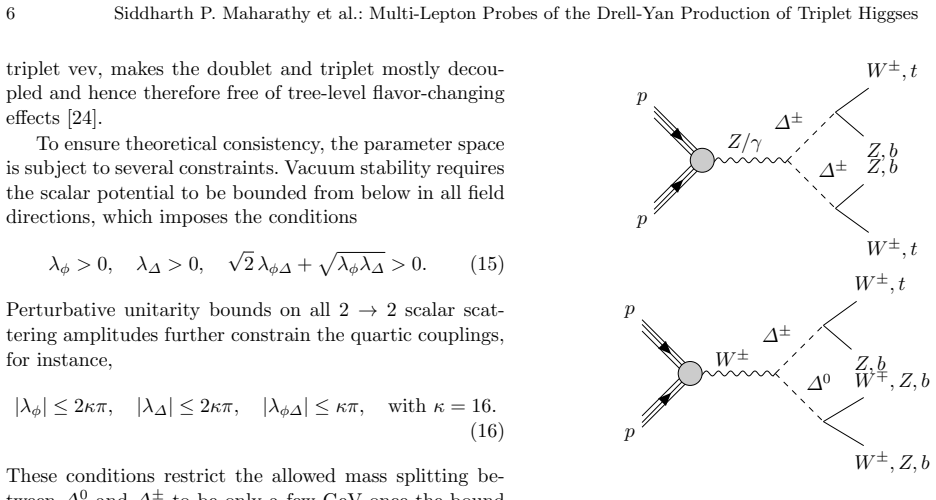
Drell-Yan production of triplet scalars in the real Higgs triplet model with Y=0, followed by their dominant decays to electroweak bosons that produce multi-lepton final states from WWZ, WZZ and WWW processes.
If this is right
- The model predicts specific enhancements in multi-lepton channels from triboson decays without producing an excess in ZZ.
- The current mild tension between predicted and observed rates can be tested with increased statistics from Run 3 and the high-luminosity LHC.
- The triplet scalars provide a common origin for both the 152 GeV Higgs-like excesses and the triboson signals.
Where Pith is reading between the lines
- Confirmation would link multiple LHC anomalies to one concrete extension of the Higgs sector.
- Dedicated multi-lepton searches in additional final states could further constrain or support the triplet hypothesis.
- The overprediction may point to the value of refined background modeling in the triboson analyses.
Load-bearing premise
The observed excesses in di-photon, Z gamma, WW and triboson channels all arise from the same 152 GeV Higgs bosons in the real triplet model produced via Drell-Yan processes.
What would settle it
Future LHC data at Run 3 or HL-LHC luminosities that show triboson event yields either significantly below the model's prediction or fully consistent with Standard Model expectations alone would rule out the model's ability to explain the excesses.
Figures



read the original abstract
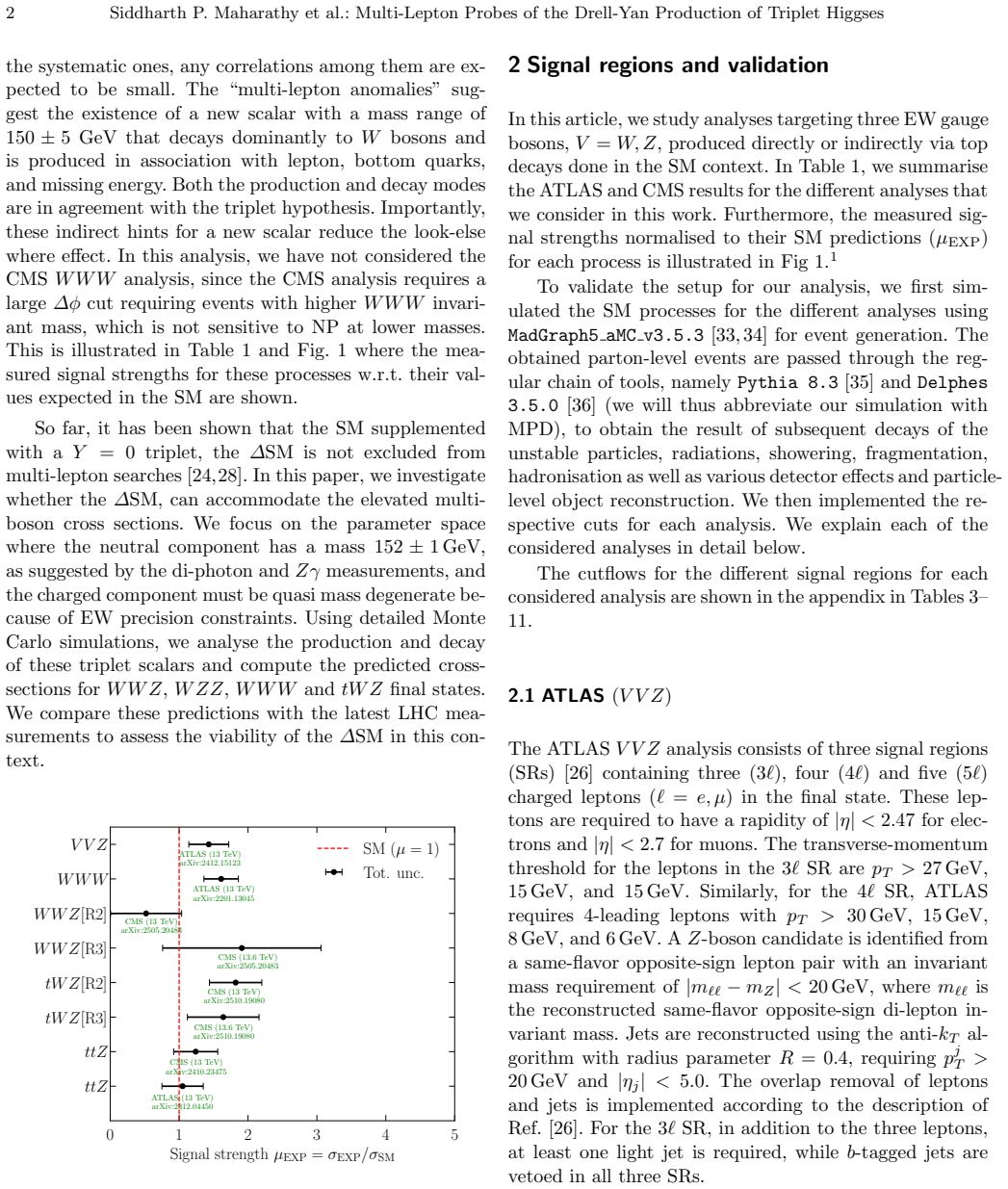
Excesses in di-photon, $Z\gamma$, and $WW$ spectra indicate the existence of a new Higgs boson with mass $152 \pm 1$ GeV. However, no excess is observed in the $ZZ$ channel. This pattern aligns with a Real Higgs Triplet model with hypercharge $Y = 0$ ($\Delta$SM). A prediction of this model is the Drell--Yan production of scalars at the LHC, which dominantly decay to electroweak bosons, thus enhancing the cross sections of triboson channels such as $WWZ$, $WZZ$, and $WWW$. Interestingly, both ATLAS and CMS have reported higher-than-expected significances for such processes: $6.4\sigma$ (observed) vs $4.7\sigma$ (expected) in the $VVZ$ (where $V = W$ or $Z$) channel and $4.4\sigma$ vs $3.6\sigma$ in $WWZ$, suggesting the possibility that these signals may be manifestations of an extended Higgs sector. We investigate whether the $\Delta$SM can account for these triboson excesses through electroweak production and decay of triplet scalars. We find that while current data prefers a non-zero new physics signal ($2.6\sigma$), the $\Delta$SM predicts more events than observed, such that it is consistent with data but not preferred over the SM. However, this tension could be clarified with Run~3 and HL-LHC data.
Editorial analysis
A structured set of objections, weighed in public.
Referee Report
Summary. The paper claims that excesses in di-photon, Zγ, and WW spectra point to a 152 GeV Higgs from the real Higgs triplet model (ΔSM, Y=0), which naturally suppresses ZZ. This model predicts Drell-Yan production of triplet scalars decaying to electroweak bosons, enhancing triboson rates. The authors compare this to ATLAS/CMS excesses in VVZ (6.4σ obs vs 4.7σ exp) and WWZ (4.4σ vs 3.6σ), finding data prefers non-zero NP at 2.6σ but that ΔSM overpredicts events, so it is consistent with data yet not preferred over the SM; future Run 3/HL-LHC data may resolve the tension.
Significance. If the result holds, the work supplies a concrete, multi-lepton test of the ΔSM that links the 152 GeV candidate directly to triboson final states via a single free parameter (triplet mass). The quantitative comparison of predicted versus observed event yields using existing public data is a strength and yields a falsifiable statement about overprediction. This adds to the toolkit for extended Higgs searches even if the current tension is only mild.
major comments (2)
- [Results section] Results section: the central claim that ΔSM overpredicts triboson events (rendering it consistent but not preferred) is load-bearing and rests on fixing the triplet scalar mass to 152 GeV from the diphoton/Zγ/WW excesses. The manuscript does not supply the explicit Drell-Yan cross-section values, branching ratios for neutral/charged components, or acceptance corrections used to obtain the predicted yields; without these the overprediction cannot be verified and the stress-test concern on parameter transfer remains open.
- [§3 (Triboson production and decay)] §3 (Triboson production and decay): the assumption that the same electroweak production and decay modes transfer without modification from the 152 GeV signals to VVZ/WWZ final states is not cross-checked against possible interference with SM amplitudes or differences in lepton acceptance; this directly affects whether the predicted excess is robust.
minor comments (2)
- [Abstract] Abstract and introduction: the 2.6σ figure is quoted without stating whether it is for the combined VVZ+WWZ dataset or a single channel; adding this clarification would improve precision.
- [Introduction] References: the specific ATLAS and CMS papers reporting the triboson significances should be cited explicitly rather than generically.
Simulated Author's Rebuttal
We thank the referee for the thorough review and constructive feedback. We appreciate the recognition of the work's potential significance and address each major comment below with revisions to improve verifiability and robustness.
read point-by-point responses
-
Referee: [Results section] Results section: the central claim that ΔSM overpredicts triboson events (rendering it consistent but not preferred) is load-bearing and rests on fixing the triplet scalar mass to 152 GeV from the diphoton/Zγ/WW excesses. The manuscript does not supply the explicit Drell-Yan cross-section values, branching ratios for neutral/charged components, or acceptance corrections used to obtain the predicted yields; without these the overprediction cannot be verified and the stress-test concern on parameter transfer remains open.
Authors: We agree that explicit numerical values are necessary for full verification of the overprediction. The triplet scalar mass is fixed to 152 GeV as the single relevant parameter, determined directly from the diphoton, Zγ, and WW excesses reported in the literature. Drell-Yan production cross sections for the neutral and charged components were obtained via standard electroweak Monte Carlo simulation at 13 TeV, branching ratios follow from the model's tree-level couplings to vector bosons (fixed by the Y=0 hypercharge assignment and the chosen mass), and acceptance factors were taken from the public ATLAS/CMS triboson analyses to ensure consistency with experimental selections. In the revised manuscript we will add these quantities explicitly (cross sections, branching ratios, and effective acceptances) in the Results section or a new appendix so that the predicted yields and the resulting mild tension with data can be reproduced directly. revision: yes
-
Referee: [§3 (Triboson production and decay)] §3 (Triboson production and decay): the assumption that the same electroweak production and decay modes transfer without modification from the 152 GeV signals to VVZ/WWZ final states is not cross-checked against possible interference with SM amplitudes or differences in lepton acceptance; this directly affects whether the predicted excess is robust.
Authors: The Drell-Yan production of the triplet scalars is a tree-level electroweak process, and the subsequent decays to vector bosons are likewise tree-level with branching ratios fixed by the model. SM triboson production at the same final-state multiplicity is loop-suppressed or higher-order, rendering interference with the resonant new-physics contribution negligible at the level relevant for current statistics. Lepton acceptances are taken from the experimental analyses whose signal regions are defined at a comparable mass scale; the kinematic similarity implies that acceptance differences remain small. To make this reasoning explicit, we will insert a concise paragraph in §3 of the revised manuscript justifying the transfer assumption and estimating the size of any residual acceptance variation. A dedicated interference simulation can be added if future data warrant it. revision: partial
Circularity Check
No load-bearing circularity; model parameters transferred from independent excesses to separate triboson observables
full rationale
The derivation fixes the triplet vev/mixing from the 152 GeV di-photon/Zγ/WW excesses (external ATLAS/CMS data) and computes expected Drell-Yan triboson rates in the standard ΔSM Lagrangian. This is a conventional parameter transfer and comparison to independent VVZ/WWZ data, not a self-definition or fitted-input prediction. No equations reduce the triboson prediction to the input by construction, and no self-citation chain is load-bearing for the central consistency statement. The paper remains self-contained against external benchmarks.
Axiom & Free-Parameter Ledger
free parameters (1)
- triplet scalar mass
axioms (1)
- domain assumption The real triplet model with Y=0 produces scalars that decay dominantly to electroweak bosons.
invented entities (1)
-
real Higgs triplet scalars
no independent evidence
Reference graph
Works this paper leans on
-
[1]
6 (2024) 294 [arXiv:2309.03870]
A. Crivellin and B. Mellado, “Anomalies in particle physics and their implications for physics beyond the standard model,” Nature Rev. Phys.6no. 5, (2024) 294–309,arXiv:2309.03870 [hep-ph]
-
[2]
O. Fischer et al., “Unveiling hidden physics at the LHC,” Eur. Phys. J. C82no. 8, (2022) 665,arXiv:2109.06065 [hep-ph]
-
[3]
S. von Buddenbrock, N. Chakrabarty, A. S. Cornell, D. Kar, M. Kumar, T. Mandal, B. Mellado, B. Mukhopadhyaya, R. G. Reed, and X. Ruan, “Phenomenological signatures of additional scalar bosons at the LHC,” Eur. Phys. J. C76no. 10, (2016) 580, arXiv:1606.01674 [hep-ph]
-
[4]
S. von Buddenbrock, A. S. Cornell, A. Fadol, M. Kumar, B. Mellado, and X. Ruan, “Multi-lepton signatures of additional scalar bosons beyond the Standard Model at the LHC,” J. Phys. G45no. 11, (2018) 115003, arXiv:1711.07874 [hep-ph]
-
[5]
Y. Hernandez, M. Kumar, A. S. Cornell, S.-E. Dahbi, Y. Fang, B. Lieberman, B. Mellado, K. Monnakgotla, X. Ruan, and S. Xin, “The anomalous production of multi-lepton and its impact on the measurement ofW h production at the LHC,” Eur. Phys. J. C81no. 4, (2021) 365,arXiv:1912.00699 [hep-ph]
-
[6]
S. Buddenbrock, A. S. Cornell, Y. Fang, A. Fadol Mohammed, M. Kumar, B. Mellado, and K. G. Tomiwa, “The emergence of multi-lepton anomalies at the LHC and their compatibility with new physics at the EW scale,” JHEP10(2019) 157,arXiv:1901.05300 [hep-ph]. 9.A TLASCollaboration, G. Aad et al., “Search for dark matter in events with missing transverse momentu...
-
[7]
G. Coloretti, A. Crivellin, S. Bhattacharya, and B. Mellado, “Searching for low-mass resonances decaying into W bosons,” Phys. Rev. D108no. 3, (2023) 035026, arXiv:2302.07276 [hep-ph]
-
[8]
A. Crivellin, Y. Fang, O. Fischer, S. Bhattacharya, M. Kumar, E. Malwa, B. Mellado, N. Rapheeha, X. Ruan, and Q. Sha, “Accumulating evidence for the associated production of a new Higgs boson at the LHC,” Phys. Rev. D108no. 11, (2023) 115031, arXiv:2109.02650 [hep-ph]
-
[9]
S. Bhattacharya, B. Lieberman, M. Kumar, A. Crivellin, Y. Fang, R. Mazini, and B. Mellado, “Emerging Excess Consistent with a Narrow Resonance at 152 GeV in High-Energy Proton-Proton Collisions,” arXiv:2503.16245 [hep-ph]. 18.CMSCollaboration, A. Tumasyan et al., “A portrait of the Higgs boson by the CMS experiment ten years after the discovery.,” Nature6...
-
[10]
Neutral currents and the Higgs mechanism,
D. A. Ross and M. J. G. Veltman, “Neutral currents and the Higgs mechanism,” Nucl. Phys. B95(1975) 135–147
1975
-
[11]
Higgs triplets in the standard model,
J. F. Gunion, R. Vega, and J. Wudka, “Higgs triplets in the standard model,” Phys. Rev. D42(1990) 1673–1691
1990
-
[12]
Explaining the γγ+XExcesses at≈151.5 GeV via the Drell-Yan production of a Higgs triplet,
S. Ashanujjaman, S. Banik, G. Coloretti, A. Crivellin, S. P. Maharathy, and B. Mellado, “Explaining the γγ+XExcesses at≈151.5 GeV via the Drell-Yan production of a Higgs triplet,” Phys. Lett. B862(2025) 139298,arXiv:2402.00101 [hep-ph]
-
[13]
Growing evidence for a Higgs triplet*,
A. Crivellin, S. Ashanujjaman, S. Banik, G. Coloretti, S. P. Maharathy, and B. Mellado, “Growing evidence for a Higgs triplet*,” Chin. Phys. C49no. 5, (2025) 053107, arXiv:2404.14492 [hep-ph]
-
[14]
Anatomy of the real Higgs triplet model,
S. Ashanujjaman, S. Banik, G. Coloretti, A. Crivellin, S. P. Maharathy, and B. Mellado, “Anatomy of the real Higgs triplet model,” JHEP04(2025) 003, arXiv:2411.18618 [hep-ph]
-
[15]
Discovery Prospects for theY= 0 Scalar Triplet at Futuree +e− Colliders,
S. P. Maharathy, P. Maroeshe, P. Ndhlovu, S. Bhattacharya, A. Crivellin, M. Kumar, R. Mazini, and B. Mellado, “Discovery Prospects for theY= 0 Scalar Triplet at Futuree +e− Colliders,”arXiv:2509.14378 [hep-ph]. 26.A TLASCollaboration, G. Aad et al., “Observation of V V Zproduction at √s= 13 TeV with the ATLAS detector,” Phys. Lett. B866(2025) 139527, arXi...
-
[16]
Custodial symmetry breaking and Higgs boson signatures at the LHC,
J. Butterworth, H. Debnath, P. Fileviez Perez, and F. Mitchell, “Custodial symmetry breaking and Higgs boson signatures at the LHC,” Phys. Rev. D109no. 9, (2024) 095014,arXiv:2309.10027 [hep-ph]. 29.A TLASCollaboration, G. Aad et al., “Observation of W W WProduction inppCollisions at √s=13 TeV with the ATLAS Detector,” Phys. Rev. Lett.129no. 6, (2022) 061...
-
[17]
J. Alwall, R. Frederix, S. Frixione, V. Hirschi, F. Maltoni, O. Mattelaer, H. S. Shao, T. Stelzer, P. Torrielli, and M. Zaro, “The automated computation of tree-level and next-to-leading order differential cross sections, and their matching to parton shower simulations,” JHEP07(2014) 079,arXiv:1405.0301 [hep-ph]
work page internal anchor Pith review arXiv 2014
-
[18]
R. Frederix, S. Frixione, V. Hirschi, D. Pagani, H. S. Shao, and M. Zaro, “The automation of next-to-leading order electroweak calculations,” JHEP07(2018) 185, arXiv:1804.10017 [hep-ph]. [Erratum: JHEP 11, 085 (2021)]
-
[19]
T. Sj¨ ostrand, S. Ask, J. R. Christiansen, R. Corke, N. Desai, P. Ilten, S. Mrenna, S. Prestel, C. O. Rasmussen, and P. Z. Skands, “An introduction to PYTHIA 8.2,” Comput. Phys. Commun.191(2015) 159–177,arXiv:1410.3012 [hep-ph]. 36.DELPHES 3Collaboration, J. de Favereau, C. Delaere, P. Demin, A. Giammanco, V. Lemaˆ ıtre, A. Mertens, and M. Selvaggi, “DEL...
work page internal anchor Pith review arXiv 2015
-
[20]
Measuring masses of semiinvisibly decaying particles pair produced at hadron colliders,
C. G. Lester and D. J. Summers, “Measuring masses of semiinvisibly decaying particles pair produced at hadron colliders,” Phys. Lett. B463(1999) 99–103, arXiv:hep-ph/9906349
-
[21]
m(T2): The Truth behind the glamour,
A. Barr, C. Lester, and P. Stephens, “m(T2): The Truth behind the glamour,” J. Phys. G29(2003) 2343–2363, arXiv:hep-ph/0304226. 40.LHC Higgs Cross Section W orking Group Collaboration, J. R. Andersen et al., “Handbook of LHC Siddharth P. Maharathy et al.: Multi-Lepton Probes of the Drell-Yan Production of Triplet Higgses 13 Higgs Cross Sections: 3. Higgs ...
-
[22]
Searching for a Charged Higgs Boson in Top-Quark Decays via the $WZ$ Mode
S. Ashanujjaman, A. Crivellin, S. P. Maharathy, and B. Mellado, “Searching for a Charged Higgs Boson in Top-Quark Decays via theW ZMode,” arXiv:2509.07094 [hep-ph]
work page internal anchor Pith review Pith/arXiv arXiv
-
[23]
(Non)decoupling of the Higgs triplet effects,
P. H. Chankowski, S. Pokorski, and J. Wagner, “(Non)decoupling of the Higgs triplet effects,” Eur. Phys. J. C50(2007) 919–933,arXiv:hep-ph/0605302
-
[24]
Precision observables in SU(2) x U(1) models with an additional Higgs triplet,
T. Blank and W. Hollik, “Precision observables in SU(2) x U(1) models with an additional Higgs triplet,” Nucl. Phys. B514(1998) 113–134,arXiv:hep-ph/9703392
-
[25]
Mass bounds in a model with a triplet Higgs,
J. R. Forshaw, A. Sabio Vera, and B. E. White, “Mass bounds in a model with a triplet Higgs,” JHEP06(2003) 059,arXiv:hep-ph/0302256
-
[26]
Higgs triplets and limits from precision measurements,
M.-C. Chen, S. Dawson, and T. Krupovnickas, “Higgs triplets and limits from precision measurements,” Phys. Rev. D74(2006) 035001,arXiv:hep-ph/0604102
-
[27]
R. S. Chivukula, N. D. Christensen, and E. H. Simmons, “Low-energy effective theory, unitarity, and non-decoupling behavior in a model with heavy Higgs-triplet fields,” Phys. Rev. D77(2008) 035001, arXiv:0712.0546 [hep-ph]
-
[28]
Obscure Higgs boson at Colliders,
P. Bandyopadhyay and A. Costantini, “Obscure Higgs boson at Colliders,” Phys. Rev. D103no. 1, (2021) 015025,arXiv:2010.02597 [hep-ph]
-
[29]
P. Fileviez Perez, H. H. Patel, M. J. Ramsey-Musolf, and K. Wang, “Triplet Scalars and Dark Matter at the LHC,” Phys. Rev. D79(2009) 055024,arXiv:0811.3957 [hep-ph]
discussion (0)
Sign in with ORCID, Apple, or X to comment. Anyone can read and Pith papers without signing in.