Recognition: unknown
Priority Scheduling in the M/G/1 with Preemption Overhead
Pith reviewed 2026-05-10 15:51 UTC · model grok-4.3
The pith
Preemptive priority scheduling in the M/G/1 admits an exact response time distribution formula even when each pause or resume incurs stochastic overhead.
A machine-rendered reading of the paper's core claim, the machinery that carries it, and where it could break.
Core claim
For class-based preemptive priority in the M/G/1 with stochastic overhead incurred independently on each pause or resume, a recursive formula yields the Laplace transform of response time for jobs of any given class; all moments follow by differentiation. The derivation relies on modeling the joint effect of job size and overheads via a new tool, the job joint transform, that remains closed under the priority discipline and extends to a wide variety of overhead distributions.
What carries the argument
The job joint transform, which tracks the combined effect of remaining job size and preemption overheads so that the transform recurses cleanly when a job is preempted or resumed under priority ordering.
If this is right
- All moments of response time for each class become computable from the Laplace transform.
- The stability region of the system can be obtained while fully accounting for overhead.
- The same job joint transform technique applies to many other overhead models beyond the one analyzed.
- Designers can now compare preemptive priority against non-preemptive alternatives using exact performance metrics that include overhead.
Where Pith is reading between the lines
- The recursive structure may admit numerical inversion routines that let practitioners compute tail probabilities for specific overhead distributions.
- The approach could extend to size-based preemptive policies such as SRPT once an analogous joint transform is defined for remaining work.
- In real systems the formula supplies a benchmark for choosing preemption thresholds that balance overhead against responsiveness.
Load-bearing premise
The preemption overhead must be stochastic and incurred independently on each pause or resume with a distribution that lets the joint transform close under the priority discipline.
What would settle it
Simulate an M/G/1 system with a concrete overhead distribution, compute the empirical response time distribution for each class, and invert the recursive Laplace transform; disagreement between the two distributions falsifies the formula.
Figures

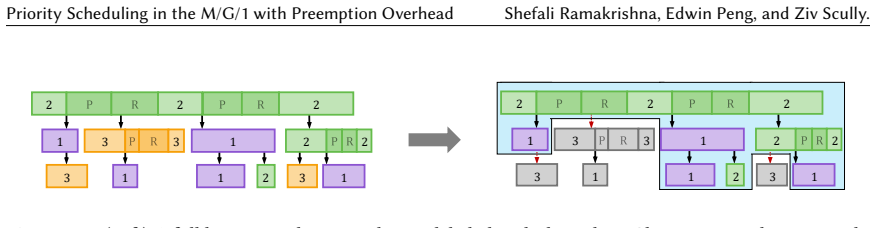



read the original abstract
Virtually all practical settings where preemptive scheduling is employed are susceptible to preemption overhead, and accounting for these overheads is necessary to make informed scheduling design decisions. However, preemption overhead is almost never accounted for in queueing-theoretic analyses of preemptive scheduling policies. This is true even for simple preemptive policies in simple queueing models: even the stability region, let alone the response time distribution, is difficult to analyze under overhead. In this work, we give the first response time distribution analysis of an M/G/1 under a preemptive scheduling policy with preemption overhead. Specifically, we consider class-based preemptive priority, where a stochastic overhead is incurred when pausing or resuming a job. We derive a recursive formula for the Laplace transform of response time for jobs of any given class, from which all response time moments can be extracted. Beyond the specific policy and model we analyze, our broader aim is to provide a first step towards a general framework for analyzing queues with preemption overhead. To that end, we perform much of our analysis in a way that applies to a wide variety of overhead models by introducing a new theoretical tool called the job joint transform.
Editorial analysis
A structured set of objections, weighed in public.
Referee Report
Summary. The paper analyzes the M/G/1 queue under class-based preemptive priority scheduling with stochastic preemption overhead incurred on each pause or resume. It introduces the job joint transform as a new tool and derives a recursive formula for the Laplace transform of response time for each class, from which moments can be extracted. The broader goal is a framework for queues with preemption overhead.
Significance. If the recursive derivation is correct, the result is significant: it supplies the first exact response-time analysis for a standard preemptive policy once overhead is included, fills a practical gap in queueing theory, and supplies a reusable transform tool. The ability to extract all moments and the explicit handling of overhead distinguish it from prior work that assumes zero-cost preemption.
major comments (1)
- [§4] §4 (recursive Laplace-transform derivation) and the definition of the job joint transform: the recursion is stated to hold for a general stochastic overhead model, yet the closure property under the priority discipline is only guaranteed when the overhead distribution satisfies the specific transform-manipulation conditions identified in the skeptic note. The manuscript should add an explicit lemma or corollary stating the precise conditions on the overhead distribution (e.g., independence, support, or moment requirements) that make the joint transform close recursively; without this, the central claim applies only to a narrower class of overheads than advertised.
minor comments (3)
- [Abstract] The abstract claims that 'all response time moments can be extracted' from the Laplace transform; a short paragraph or appendix showing the differentiation steps for the first two moments would make this concrete and aid readers.
- [Introduction] Stability region is mentioned as difficult to analyze under overhead, yet no explicit stability condition (in terms of load and overhead moments) is given for the multi-class case; adding this would strengthen the practical utility.
- [§3] Notation for the joint transform (e.g., the arguments corresponding to remaining work and overhead) should be summarized in a table or displayed equation early in the paper to reduce reader effort when following the recursion.
Simulated Author's Rebuttal
We thank the referee for their careful reading of the manuscript and for identifying an opportunity to strengthen the presentation of the job joint transform and its recursive application. We address the major comment below and have revised the manuscript to incorporate an explicit statement of the required conditions.
read point-by-point responses
-
Referee: §4 (recursive Laplace-transform derivation) and the definition of the job joint transform: the recursion is stated to hold for a general stochastic overhead model, yet the closure property under the priority discipline is only guaranteed when the overhead distribution satisfies the specific transform-manipulation conditions identified in the skeptic note. The manuscript should add an explicit lemma or corollary stating the precise conditions on the overhead distribution (e.g., independence, support, or moment requirements) that make the joint transform close recursively; without this, the central claim applies only to a narrower class of overheads than advertised.
Authors: We agree that an explicit statement of the closure conditions improves clarity. The job joint transform is constructed precisely so that it remains closed under the preemptive priority recursion whenever the overhead random variables are independent of service times and of one another and possess a Laplace-Stieltjes transform that is analytic in a neighborhood of the origin. These are the minimal conditions needed for the algebraic manipulations in the recursion to be valid. We have added Lemma 4.1 in Section 4, which states these requirements formally and proves that they suffice for recursive closure. The lemma is referenced in the abstract, introduction, and the statement of the main theorem. We have also added a short remark clarifying that the result therefore applies to any overhead distribution satisfying these standard analytic conditions (e.g., exponential, deterministic, or phase-type overheads), which covers the models of practical interest while making the scope precise. revision: yes
Circularity Check
No circularity: derivation introduces independent joint transform tool
full rationale
The paper derives a recursive Laplace-transform formula for response time by introducing a new 'job joint transform' tool that enables closure under the priority discipline for a class of overhead models. This is a first-principles application of standard transform methods to an extended model; the recursion is obtained from the tool rather than by renaming or fitting inputs. No self-citations are load-bearing in the provided derivation chain, and the result is not equivalent to the inputs by construction. The closure property is an explicit modeling assumption, not a hidden tautology.
Axiom & Free-Parameter Ledger
axioms (2)
- domain assumption Jobs arrive according to a Poisson process and have i.i.d. general service times (M/G/1 model)
- domain assumption Preemption overhead is stochastic, incurred on each pause or resume, and independent of job state
invented entities (1)
-
job joint transform
no independent evidence
Reference graph
Works this paper leans on
-
[1]
Søren Asmussen and Peter W. Glynn. 2017. On Preemptive-Repeat LIFO Queues.Queueing Systems87, 1 (Oct. 2017), 1–22. doi:10.1007/s11134-017-9532-3
-
[2]
Krishna B. Athreya and Peter E. Ney. 1972.Branching Processes. Springer, Berlin, Germany. doi:10.1007/978-3-642-65371-1
-
[3]
B. Avi-Itzhak. 1963. Preemptive Repeat Priority Queues as a Special Case of the Multipurpose Server Problem—II.Operations Research11, 4 (Aug. 1963), 610–619. doi:10.1287/opre.11.4. 610
-
[4]
Nikhil Bansal, Bart Kamphorst, and Bert Zwart. 2018. Achievable Performance of Blind Policies in Heavy Traffic.Mathematics of Operations Research43, 3 (Aug. 2018), 949–964. doi:10.1287/moor.2017.0890
-
[5]
Jacob Bergquist and Karl Sigman. 2022. Stationary Workload and Service Times for Some Nonwork-Conserving M/G/1 Preemptive LIFO Queues.Stochastic Models38, 4 (Oct. 2022), 515–544. doi:10.1080/15326349.2022.2074458
-
[6]
Dimitris Bertsimas and José Niño-Mora. 1999. Optimization of Multiclass Queueing Networks with Changeover Times via the Achievable Region Approach: Part II, the Multi-Station Case. Mathematics of Operations Research24, 2 (May 1999), 331–361. doi:10.1287/moor.24.2.331
-
[7]
Marko A. A. Boon, Rob D. van der Mei, and Erik M. M. Winands. 2011. Applications of Polling Systems.Surveys in Operations Research and Management Science16, 2 (July 2011), 67–82. doi:10.1016/j.sorms.2011.01.001 26 Priority Scheduling in the M/G/1 with Preemption Overhead Shefali Ramakrishna, Edwin Peng, and Ziv Scully
-
[8]
Sem C. Borst and Onno J. Boxma. 1997. Polling Models with and without Switchover Times. Operations Research45, 4 (Aug. 1997), 536–543. doi:10.1287/opre.45.4.536
-
[9]
Sem C. Borst and Onno J. Boxma. 2018. Polling: Past, Present, and Perspective.TOP26, 3 (Oct. 2018), 335–369. doi:10.1007/s11750-018-0484-5
-
[10]
Onno J. Boxma and Wim P. Groenendijk. 1987. Pseudo-Conservation Laws in Cyclic-Service Systems.Journal of Applied Probability24, 4 (1987), 949–964. doi:10.2307/3214218
-
[11]
Onno J. Boxma and Bert Zwart. 2007. Tails in Scheduling.ACM SIGMETRICS Performance Evaluation Review34, 4 (March 2007), 13–20. doi:10.1145/1243401.1243406
-
[12]
Jianyu Cao and Weixin Xie. 2017. Stability of a Two-Queue Cyclic Polling System with BMAPs under Gated Service and State-Dependent Time-Limited Service Disciplines.Queueing Systems 85, 1 (Feb. 2017), 117–147. doi:10.1007/s11134-016-9504-z
-
[13]
Wei Chang. 1965. Preemptive Priority Queues.Operations Research13, 5 (Oct. 1965), 820–827. doi:10.1287/opre.13.5.820
-
[14]
Steve Drekic and David A. Stanford. 2001. Reducing Delay in Preemptive Repeat Priority Queues.Operations Research49, 1 (Feb. 2001), 145–156. doi:10.1287/opre.49.1.145.11186
-
[15]
Ernst, Søren Asmussen, and John J
Philip A. Ernst, Søren Asmussen, and John J. Hasenbein. 2018. Stability and Busy Periods in a Multiclass Queue with State-Dependent Arrival Rates.Queueing Systems90, 3-4 (Dec. 2018), 207–224. doi:10.1007/s11134-018-9587-9
-
[16]
Val Andrei Fajardo and Steve Drekic. 2017. Waiting Time Distributions in the Preemptive Accumulating Priority Queue.Methodology and Computing in Applied Probability19, 1 (March 2017), 255–284. doi:10.1007/s11009-015-9476-1
-
[17]
S. W. Fuhrmann and Robert B. Cooper. 1985. Stochastic Decompositions in the 𝑀/𝐺/ 1Queue with Generalized Vacations.Operations Research33, 5 (Oct. 1985), 1117–1129. doi: 10.1287/ opre.33.5.1117
1985
-
[18]
Donald P. Gaver. 1962. A Waiting Line with Interrupted Service, Including Priorities.Journal of the Royal Statistical Society. Series B (Methodological)24, 1 (1962), 73–90. doi: 10.1111/j. 2517-6161.1962.tb00438.x
work page doi:10.1111/j 1962
-
[19]
Carmelita Goerg. 1986. Evaluation of the Optimal SRPT Strategy with Overhead.IEEE Transactions on Communications34, 4 (April 1986), 338–344. doi: 10.1109/TCOM.1986.1096548
-
[20]
2013.Performance Modeling and Design of Computer Systems: Queueing Theory in Action
Mor Harchol-Balter. 2013.Performance Modeling and Design of Computer Systems: Queueing Theory in Action. Cambridge University Press, Cambridge, UK. doi: 10.1017/ CBO9781139226424
2013
-
[21]
1963.The Theory of Branching Processes
Theodore Edward Harris. 1963.The Theory of Branching Processes. Springer, Berlin, Germany. https://www.rand.org/pubs/reports/R381.html
1963
-
[22]
Bart Kamphorst and Bert Zwart. 2020. Heavy-Traffic Analysis of Sojourn Time under the Foreground–Background Scheduling Policy.Stochastic Systems10, 1 (March 2020), 1–28. doi:10.1287/stsy.2019.0036 27 Priority Scheduling in the M/G/1 with Preemption Overhead Shefali Ramakrishna, Edwin Peng, and Ziv Scully
-
[23]
1976.Queueing Systems, Volume 2: Computer Applications
Leonard Kleinrock. 1976.Queueing Systems, Volume 2: Computer Applications. Wiley, New York, NY
1976
-
[24]
Chuanpeng Li, Chen Ding, and Kai Shen. 2007. Quantifying the Cost of Context Switch. In Proceedings of the 2007 Workshop on Experimental Computer Science (ExpCS 2007). ACM, San Diego, CA, 4. doi:10.1145/1281700.1281702
-
[25]
Minghong Lin, Adam Wierman, and Bert Zwart. 2011. Heavy-Traffic Analysis of Mean Response Time under Shortest Remaining Processing Time.Performance Evaluation68, 10 (Oct. 2011), 955–966. doi:10.1016/j.peva.2011.06.001
-
[26]
John D. C. Little. 2011. Little’s Law as Viewed on Its 50th Anniversary.Operations Research 59, 3 (June 2011), 536–549. doi:10.1287/opre.1110.0940
-
[27]
Jayakrishnan Nair, Adam Wierman, and Bert Zwart. 2010. Tail-Robust Scheduling via Limited Processor Sharing.Performance Evaluation67, 11 (Nov. 2010), 978–995. doi: 10.1016/j.peva. 2010.08.012
-
[28]
Marcel F. Neuts. 1977. The 𝑀/𝐺/ 1Queue with Several Types of Customers and Change-over Times.Advances in Applied Probability9, 3 (Sept. 1977), 604–644. doi:10.2307/1426117
-
[29]
Rudesindo Núñez-Queija. 2002. Queues with Equally Heavy Sojourn Time and Service Requirement Distributions.Annals of Operations Research113, 1/4 (July 2002), 101–117. doi:10.1023/A:1020905810996
-
[30]
Natalia Osipova, Urtzi Ayesta, and Konstantin Avrachenkov. 2009. Optimal Policy for Multi- Class Scheduling in a Single Server Queue. In21st International Teletraffic Congress (ITC 21). IEEE, Paris, France, 1–8
2009
-
[31]
Edwin Peng. 2022. Exact Response Time Analysis of Preemptive Priority Scheduling with Switching Overhead.ACM SIGMETRICS Performance Evaluation Review49, 2 (Jan. 2022), 72–74. doi:10.1145/3512798.3512824
-
[32]
Shefali Ramakrishna and Ziv Scully. 2024. Transform Analysis of Preemption Overhead in the M/G/1.ACM SIGMETRICS Performance Evaluation Review52, 2 (Sept. 2024), 18–20. doi:10.1145/3695411.3695419
-
[33]
Runnenburg
Johannes Th. Runnenburg. 1965. On the Use of the Method of Collective Marks in Queueing Theory. InProceedings of the Symposium on Congestion Theory, Walter L. Smith and William E. Wilkinson (Eds.). University of North Carolina Press, Chapel Hill, 399–438
1965
-
[34]
Runnenburg
Johannes Th. Runnenburg. 1979. Van Dantzig’s Collective Marks Revisited. InProceedings Bicentennial Congress Wiskundig Genootschap; Part II (Mathematical Centre Tracts, 101), P. C. Baayen, D. van Dulst, and J. Oosterhoff (Eds.). Centrum Voor Wiskunde en Informatica, Amsterdam, The Netherlands, 309–329
1979
-
[35]
Linus Schrage. 1969. A Mixed-Priority Queue with Applications to the Analysis of Real-Time Systems.Operations Research17, 4 (Aug. 1969), 728–742. doi:10.1287/opre.17.4.728 28 Priority Scheduling in the M/G/1 with Preemption Overhead Shefali Ramakrishna, Edwin Peng, and Ziv Scully
-
[36]
Linus E. Schrage. 1967. The Queue 𝑀/𝐺/ 1with Feedback to Lower Priority Queues.Manage- ment Science13, 7 (March 1967), 466–474. doi:10.1287/mnsc.13.7.466
-
[37]
Schrage and Louis W
Linus E. Schrage and Louis W. Miller. 1966. The Queue 𝑀/𝐺/ 1with the Shortest Remaining Processing Time Discipline.Operations Research14, 4 (Aug. 1966), 670–684. doi: 10.1287/ opre.14.4.670
1966
-
[38]
2022.A New Toolbox for Scheduling Theory
Ziv Scully. 2022.A New Toolbox for Scheduling Theory. Ph. D. Dissertation. Carnegie Mellon University, Pittsburgh, PA.https://ziv.codes/pdf/scully-thesis.pdf
2022
-
[39]
Ziv Scully and Mor Harchol-Balter. 2018. SOAP Bubbles: Robust Scheduling under Adversarial Noise. In56th Annual Allerton Conference on Communication, Control, and Computing. IEEE, Monticello, IL, 144–154. doi:10.1109/ALLERTON.2018.8635963
-
[40]
Ziv Scully, Mor Harchol-Balter, and Alan Scheller-Wolf. 2018. SOAP: One Clean Analysis of All Age-Based Scheduling Policies.Proceedings of the ACM on Measurement and Analysis of Computing Systems2, 1, Article 16 (March 2018), 30 pages. doi:10.1145/3179419
-
[41]
Boxma, Jan-Pieter Dorsman, and Adam Wierman
Ziv Scully, Lucas van Kreveld, Onno J. Boxma, Jan-Pieter Dorsman, and Adam Wierman
-
[42]
Characterizing Policies with Optimal Response Time Tails under Heavy-Tailed Job Sizes. Proceedings of the ACM on Measurement and Analysis of Computing Systems4, 2, Article 30 (June 2020), 33 pages. doi:10.1145/3392148
-
[43]
Stanford, Peter Taylor, and Ilze Ziedins
David A. Stanford, Peter Taylor, and Ilze Ziedins. 2014. Waiting Time Distributions in the Accumulating Priority Queue.Queueing Systems77, 3 (July 2014), 297–330. doi: 10.1007/ s11134-013-9382-6
2014
-
[44]
Lajos Takács. 1963. Delay Distributions for One Line with Poisson Input, General Holding Times, and Various Orders of Service.Bell System Technical Journal42, 2 (March 1963), 487–503. doi:10.1002/j.1538-7305.1963.tb00509.x
-
[45]
Mark P. Van Oyen, Dimitrios G. Pandelis, and Demosthenis Teneketzis. 1992. Optimality of Index Policies for Stochastic Scheduling with Switching Penalties.Journal of Applied Probability29, 4 (Dec. 1992), 957–966. doi:10.2307/3214727
-
[46]
2019.Queueing Systems with Non-Standard Service Poli- cies and Server Vacations
Rocco van Vreumingen. 2019.Queueing Systems with Non-Standard Service Poli- cies and Server Vacations. MSc. University of Amsterdam, Amsterdam, The Nether- lands. http://www.mt-support.nl/VanVreumingen/Rocco/wp-content/uploads/2020/01/ Master-thesis-Queueing-systems-with-non-standard-service-policies-and-server-vacations. pdf
2019
-
[47]
Chang-Heng Wang, Siva Theja Maguluri, and Tara Javidi. 2021. Heavy Traffic Queue Length Scaling in Switches with Reconfiguration Delay.Queueing Systems98, 1 (June 2021), 49–93. doi:10.1007/s11134-021-09695-x
-
[48]
Adam Wierman, Mor Harchol-Balter, and Takayuki Osogami. 2005. Nearly Insensitive Bounds on SMART Scheduling.ACM SIGMETRICS Performance Evaluation Review33, 1 (June 2005), 205–216. doi:10.1145/1071690.1064236 29 Priority Scheduling in the M/G/1 with Preemption Overhead Shefali Ramakrishna, Edwin Peng, and Ziv Scully
- [49]
-
[50]
Adam Wierman and Bert Zwart. 2012. Is Tail-Optimal Scheduling Possible?Operations Research60, 5 (Oct. 2012), 1249–1257. doi:10.1287/opre.1120.1086 30 Priority Scheduling in the M/G/1 with Preemption Overhead Shefali Ramakrishna, Edwin Peng, and Ziv Scully. A Notation Table Notation Description Defined in 𝑛number of classes § 2 <𝑘,≤𝑘,>𝑘,≥𝑘shorthand for set...
discussion (0)
Sign in with ORCID, Apple, or X to comment. Anyone can read and Pith papers without signing in.