Recognition: 3 theorem links
· Lean TheoremHall-Like Transversal Stress and Sandpile Criticality on Real Production Networks
Pith reviewed 2026-05-08 19:34 UTC · model grok-4.3
The pith
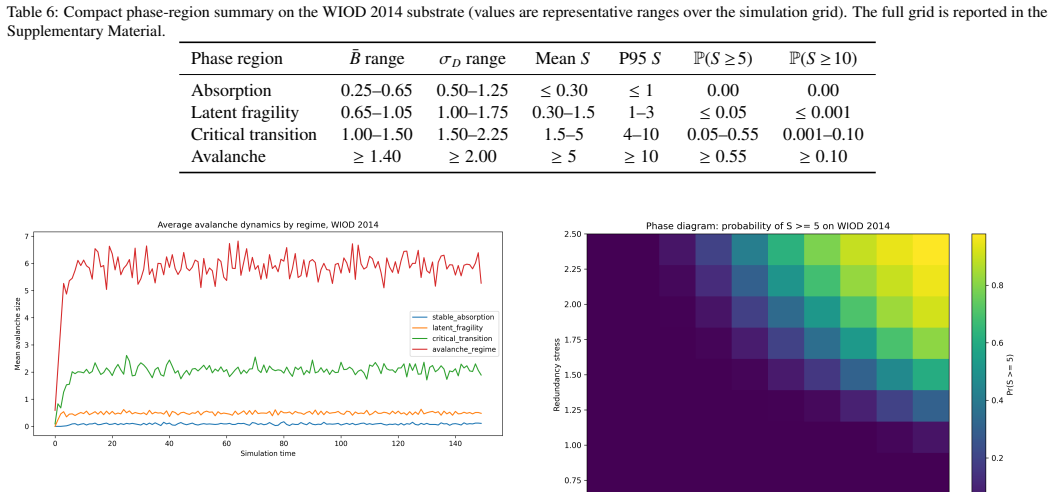
The Hall-Sandpile model on WIOD networks generates four ordered regimes of instability where mean avalanche size and large-event probabilities increase with shock intensity and reduced redundancy, without evidence for universal power-law criticality.
A machine-rendered reading of the paper's core claim, the machinery that carries it, and where it could break.
Core claim
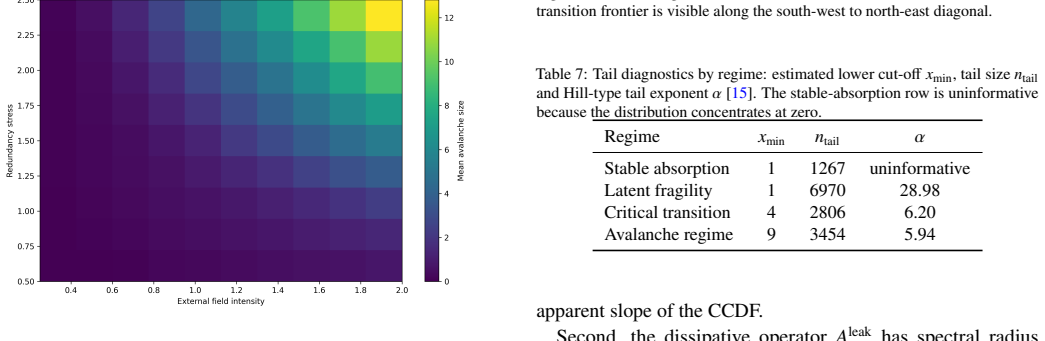
Controlled Monte Carlo experiments over external field intensity and redundancy stress generate four ordered regimes: stable absorption, latent fragility, critical transition, and avalanche regime. Mean avalanche size and the probabilities of finite-size systemic events Pr(S≥5), Pr(S≥10) and Pr(S≥20) rise jointly with field intensity and redundancy stress.
Load-bearing premise
That economic shocks act as external fields that generate systemic stress via a multiplicative conversion function on flow-intensive, low-redundancy, low-capacity nodes, with the effective activation threshold declining with transversal exposure, enabling sandpile-style toppling and avalanche dynamics on the production network.
Figures




read the original abstract
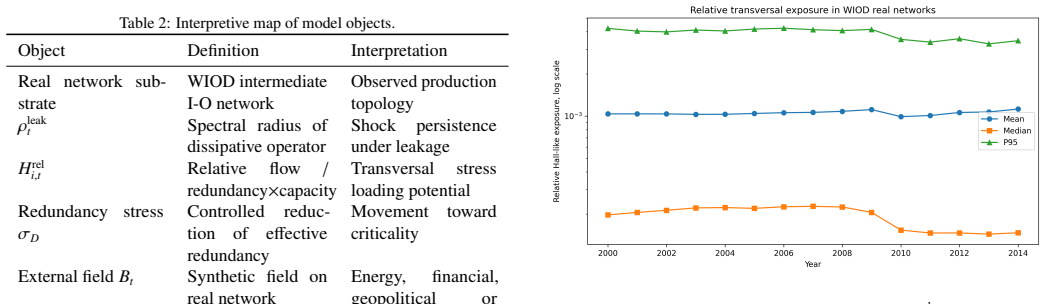
This paper develops a Hall-Sandpile model of economic instability that combines a Hall-like transversal stress mechanism with sandpile threshold dynamics on a real production-network substrate. In analogy with the physical Hall effect, where exposed flows under an external field generate stress in a transversal direction, we model economic shocks as fields that act on flow-intensive, low-redundancy, low-capacity nodes and produce systemic stress through a multiplicative conversion function. The accumulated stress drives a discrete toppling rule and an avalanche dynamics whose effective activation threshold declines with transversal exposure. The model is calibrated on annual World Input--Output Database (WIOD) production networks for 2000--2014 and simulated on the 2014 substrate (2{,}283 country--sector nodes) under three alternative propagation normalisations to avoid mechanical near-criticality from row-stochastic operators. Controlled Monte Carlo experiments over external field intensity and redundancy stress generate four ordered regimes: stable absorption, latent fragility, critical transition, and avalanche regime. Mean avalanche size and the probabilities of finite-size systemic events $\Pr(S\!\geq\!5)$, $\Pr(S\!\geq\!10)$ and $\Pr(S\!\geq\!20)$ rise jointly with field intensity and redundancy stress. Tail diagnostics show regime-dependent thickening of the avalanche distribution, but the estimated tail indices remain too high to interpret as evidence of universal power-law criticality. The contribution is therefore a finite-size, real-network description of how transversal stress activates structural fragility, not a claim of self-organised criticality in the global economy.
Editorial analysis
A structured set of objections, weighed in public.
Referee Report
Summary. The paper develops a Hall-Sandpile model combining a Hall-like transversal stress mechanism with sandpile threshold dynamics on real production networks from the WIOD database. Calibrated on 2000-2014 WIOD data and simulated via Monte Carlo on the 2014 substrate (2,283 nodes) under three propagation normalisations, it identifies four ordered regimes (stable absorption, latent fragility, critical transition, avalanche) in which mean avalanche size and Pr(S≥5), Pr(S≥10), Pr(S≥20) rise jointly with external field intensity and redundancy stress. Tail indices are reported as too high for power-law criticality, positioning the work as a finite-size descriptive device rather than a claim of self-organised criticality.
Significance. If the reported regime ordering and joint increases in avalanche statistics hold under the stated dynamics, the paper supplies a concrete, real-network illustration of how transversal stress can activate structural fragility in production systems. Strengths include the use of empirical WIOD substrate, explicit avoidance of mechanical near-criticality via multiple normalisations, and clear caveats against universal power-law interpretations.
major comments (1)
- [Monte Carlo experiments] Monte Carlo experiments section: the four regimes and the joint rise in mean avalanche size and Pr(S≥5), Pr(S≥10), Pr(S≥20) are generated by varying the model's own input parameters (field intensity and redundancy stress); the manuscript supplies neither the exact numerical ranges used, the number of Monte Carlo runs, nor any error bars or standard errors on the reported probabilities, leaving the statistical reliability and reproducibility of the regime ordering unassessable.
minor comments (3)
- [Abstract] Abstract and model section: the three alternative propagation normalisations are invoked to avoid row-stochastic artifacts but are not defined mathematically; a brief equation or reference for each would clarify how they differ from standard row-stochastic operators.
- [Model] Model construction: the multiplicative conversion function that maps shocks to transversal stress and the precise rule by which transversal exposure lowers the activation threshold are described only qualitatively; explicit functional forms and parameter values should be stated.
- [Results] Results: tables or figures reporting avalanche statistics should include the number of simulations and variability measures; the current presentation leaves the magnitude of the reported increases difficult to gauge.
Axiom & Free-Parameter Ledger
free parameters (3)
- multiplicative conversion function parameters
- activation threshold parameters
- propagation normalisation parameters
axioms (3)
- domain assumption WIOD country-sector flows form a suitable static substrate for stress propagation
- ad hoc to paper Stress accumulation obeys discrete toppling rules analogous to sandpiles
- ad hoc to paper Transversal exposure lowers the effective activation threshold
invented entities (2)
-
Hall-like transversal stress
no independent evidence
-
multiplicative conversion function
no independent evidence
Lean theorems connected to this paper
-
IndisputableMonolith.Cost (J(x) = ½(x+x⁻¹)−1)washburn_uniqueness_aczel unclearH_{i,t} = B_t I_{i,t} / (D_{i,t} C_{i,t} + ε) ... a multiplicative combination of loading, exposure and structural resistance.
Reference graph
Works this paper leans on
-
[1]
The network origins of aggregate fluc- tuations
Acemoglu, D., Carvalho, V .M., Ozdaglar, A., Tahbaz- Salehi, A., 2012. The network origins of aggregate fluc- tuations. Econometrica 80, 1977–2016. doi: 10.3982/ ECTA9623
2012
-
[2]
How Nature Works: The Science of Self- Organized Criticality
Bak, P., 1996. How Nature Works: The Science of Self- Organized Criticality. Copernicus, New York
1996
-
[4]
Self-organized criticality
Bak, P., Tang, C., Wiesenfeld, K., 1988. Self-organized criticality. Physical Review A 38, 364–374. doi:10.1103/ PhysRevA.38.364
1988
-
[5]
The macroeconomic im- pact of microeconomic shocks: Beyond Hulten’s theorem
Baqaee, D.R., Farhi, E., 2019a. The macroeconomic im- pact of microeconomic shocks: Beyond Hulten’s theorem. Econometrica 87, 1155–1203. doi:10.3982/ECTA15202
-
[6]
Networks, barriers, and trade
Baqaee, D.R., Farhi, E., 2019b. Networks, barriers, and trade. NBER Working Paper
-
[7]
Input specificity and the propagation of idiosyncratic shocks in production net- works
Barrot, J.N., Sauvagnat, J., 2016. Input specificity and the propagation of idiosyncratic shocks in production net- works. The Quarterly Journal of Economics 131, 1543–
2016
-
[8]
doi:10.1093/qje/qjw018
-
[9]
DebtRank: Too central to fail? Financial net- works, the FED and systemic risk
Battiston, S., Puliga, M., Kaushik, R., Tasca, P., Caldarelli, G., 2012. DebtRank: Too central to fail? Financial net- works, the FED and systemic risk. Scientific Reports 2,
2012
-
[10]
doi:10.1038/srep00541
-
[11]
Absence of epidemic threshold in scale-free networks with degree correlations
Boguñá, M., Pastor-Satorras, R., Vespignani, A., 2003. Absence of epidemic threshold in scale-free networks with degree correlations. Physical Review Letters 90, 028701. doi:10.1103/PhysRevLett.90.028701
-
[12]
Theory of Financial Risk and Derivative Pricing: From Statistical Physics to Risk Management
Bouchaud, J.P., Potters, M., 2003. Theory of Financial Risk and Derivative Pricing: From Statistical Physics to Risk Management. 2 ed., Cambridge University Press, Cambridge
2003
-
[13]
Catastrophic cascade of failures in in- terdependent networks
Buldyrev, S.V ., Parshani, R., Paul, G., Stanley, H.E., Havlin, S., 2010. Catastrophic cascade of failures in in- terdependent networks. Nature 464, 1025–1028. doi: 10. 1038/nature08932
2010
-
[14]
Reconstructing a credit network
Caldarelli, G., Chessa, A., Pammolli, F., Gabrielli, A., Puliga, M., 2013. Reconstructing a credit network. Nature Physics 9, 125–126. doi:10.1038/nphys2580
-
[15]
Carvalho, V .M., Nirei, M., Saito, Y .U., Tahbaz-Salehi, A.,
-
[16]
The Quarterly Journal of Economics 136, 1255–1321
Supply chain disruptions: Evidence from the great east Japan earthquake. The Quarterly Journal of Economics 136, 1255–1321. doi:10.1093/qje/qjaa044
-
[17]
Pro- duction networks: A primer
Carvalho, V .M., Tahbaz-Salehi, A., 2019. Pro- duction networks: A primer. Annual Review of Economics 11, 635–663. doi: 10.1146/ annurev-economics-080218-030212
2019
-
[18]
Clauset, A., Shalizi, C.R., Newman, M.E.J., 2009. Power- law distributions in empirical data. SIAM Review 51, 661–703. doi:10.1137/070710111
-
[19]
Financial networks and contagion
Elliott, M., Golub, B., Jackson, M.O., 2014. Financial networks and contagion. American Economic Review 104, 3115–3153. doi:10.1257/aer.104.10.3115
-
[20]
The granular origins of aggregate fluctuations
Gabaix, X., 2011. The granular origins of aggregate fluctuations. Econometrica 79, 733–772. doi: 10.3982/ ECTA8769. 15
2011
-
[21]
Contagion in financial net- works
Gai, P., Kapadia, S., 2010. Contagion in financial net- works. Proceedings of the Royal Society A 466, 2401–
2010
-
[22]
doi:10.1098/rspa.2009.0410
-
[23]
Contagion in financial networks
Glasserman, P., Young, H.P., 2016. Contagion in financial networks. Journal of Economic Literature 54, 779–831. doi:10.1257/jel.20151228
-
[24]
Systemic risk in bank- ing ecosystems
Haldane, A.G., May, R.M., 2011. Systemic risk in bank- ing ecosystems. Nature 469, 351–355. doi: 10.1038/ nature09659
2011
-
[25]
American Journal of Mathematics2(3), 287 (1879) https://doi.org/10.2307/2369245
Hall, E.H., 1879. On a new action of the magnet on electric currents. American Journal of Mathematics 2, 287–292. doi:10.2307/2369245
-
[26]
Lippiello, E., de Arcangelis, L., Godano, C., 2008. Dynam- ical scaling in branching models for seismicity. Physical Review Letters 100, 038501. doi:10.1103/PhysRevLett. 100.038501
-
[27]
Real business cycles
Long, J.B., Plosser, C.I., 1983. Real business cycles. Journal of Political Economy 91, 39–69. doi: 10.1086/ 261128
1983
-
[28]
An Introduction to Econophysics: Correlations and Complexity in Finance
Mantegna, R.N., Stanley, H.E., 2000. An Introduction to Econophysics: Correlations and Complexity in Finance. Cambridge University Press, Cambridge
2000
-
[29]
Complex systems: Ecology for bankers
May, R.M., Levin, S.A., Sugihara, G., 2008. Complex systems: Ecology for bankers. Nature 451, 893–895. doi:10.1038/451893a
-
[30]
Cascade-based attacks on complex networks
Motter, A.E., Lai, Y .C., 2002. Cascade-based attacks on complex networks. Physical Review E 66, 065102. doi:10. 1103/PhysRevE.66.065102
2002
-
[31]
Economic networks: The new challenges
Schweitzer, F., Fagiolo, G., Sornette, D., Vega-Redondo, F., Vespignani, A., White, D.R., 2009. Economic networks: The new challenges. Science 325, 422–425. doi:10.1126/ science.1173644
2009
-
[33]
Critical truths about power laws
Stumpf, M.P.H., Porter, M.A., 2012. Critical truths about power laws. Science 335, 665–666. doi: 10.1126/ science.1216142
2012
-
[34]
An illustrated user guide to the World Input–Output Database: The case of global automotive production
Timmer, M.P., Dietzenbacher, E., Los, B., Stehrer, R., de Vries, G.J., 2015. An illustrated user guide to the World Input–Output Database: The case of global automotive production. Review of International Economics 23, 575–
2015
-
[35]
doi:10.1111/roie.12178
-
[36]
An anatomy of the global trade slowdown based on the WIOD 2016 release
Timmer, M.P., Los, B., Stehrer, R., de Vries, G.J., 2016. An anatomy of the global trade slowdown based on the WIOD 2016 release. GGDC Research Memorandum
2016
-
[37]
Self-organized criticality
Turcotte, D.L., 1999. Self-organized criticality. Reports on Progress in Physics 62, 1377–1429. doi: 10.1088/ 0034-4885/62/10/201
1999
-
[38]
Sandpile economics: A geometric perspective on macroeconomic fragility
Vallarino, D., 2024. Sandpile economics: A geometric perspective on macroeconomic fragility. Working Paper Available at SSRN
2024
-
[39]
How self-organized criticality works: A unified mean-field picture
Vespignani, A., Zapperi, S., 1998. How self-organized criticality works: A unified mean-field picture. Physical Review E 57, 6345–6362. doi: 10.1103/PhysRevE.57. 6345
-
[40]
Watts, D.J., 2002. A simple model of global cas- cades on random networks. Proceedings of the National Academy of Sciences 99, 5766–5771. doi:10.1073/pnas. 082090499. 16
discussion (0)
Sign in with ORCID, Apple, or X to comment. Anyone can read and Pith papers without signing in.