Recognition: 3 theorem links
· Lean TheoremBrain criticality through nonadditive entropic analysis of electroencephalograms
Pith reviewed 2026-05-08 19:36 UTC · model grok-4.3
The pith
EEG amplitudes follow q-Gaussian distributions where the entropic index q varies monotonically with β, revealing critical brain behavior and higher complexity in ADHD children than typical ones.
A machine-rendered reading of the paper's core claim, the machinery that carries it, and where it could break.
Core claim
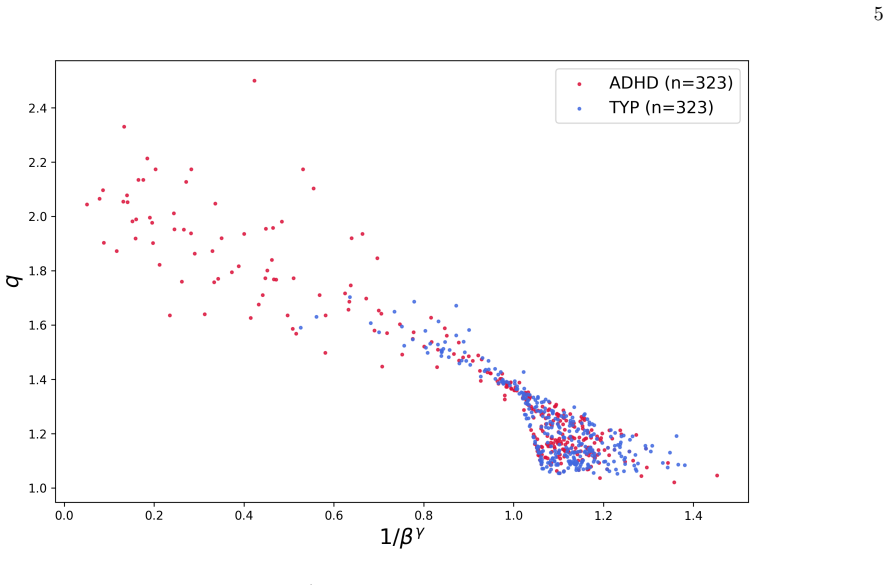
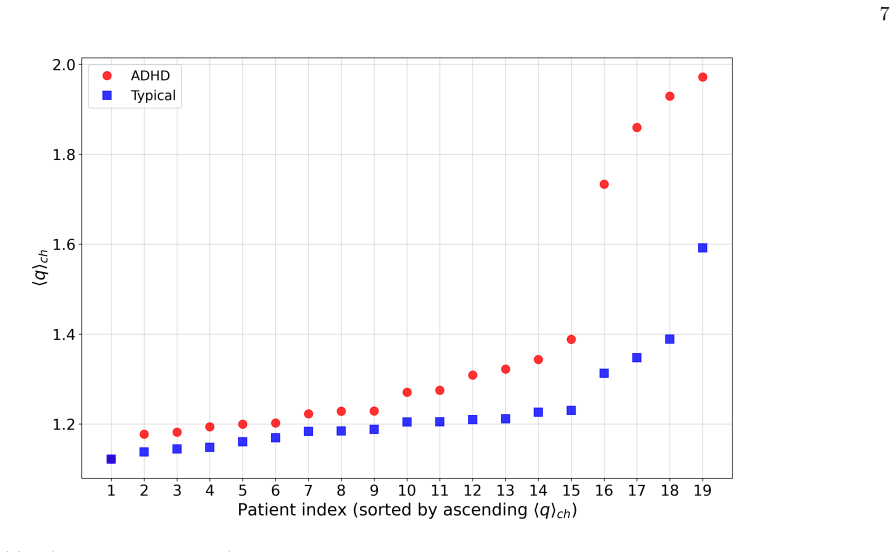
We show that q tends to monotonically vary with β for both typical and ADHD subjects, thus revealing critical behavior of the brain. Moreover, we verify that ADHD subjects have a higher complexity than the typical ones.
Load-bearing premise
That the probability distributions of EEG amplitudes are well-described by q-Gaussians and that the observed monotonic variation of the fitted q with β constitutes direct evidence of criticality without further controls or alternative models.
Figures


read the original abstract
On the grounds of nonadditive entropies -- appropriate for complex systems -- we investigate the electroencephalogram amplitudes of typical and ADHD children. The corresponding probability distributions are $q$-Gaussians, i.e., $\rho(x) \propto e_q^{-\beta x^2} \equiv [1+(q-1) \beta x^2]^{1/(1-q)}$, where $(q,\beta)$ are, respectively, the entropic index characterizing complexity and the inverse width. We show that $q$ tends to monotonically vary with $\beta$ for both typical and ADHD subjects, thus revealing critical behavior of the brain. Moreover, we verify that ADHD subjects have a higher complexity than the typical ones. Consistently, biomarkers for objective phychyatric diagnosis could emerge along this path. We show that $q$ tends to monotonically vary with $\beta$ for both typical and ADHD subjects, thus revealing critical behavior of the brain. Moreover, we verify that ADHD subjects have a higher complexity than the typical ones. Consistently, biomarkers for objective phychyatric diagnosis could emerge along this path.
Editorial analysis
A structured set of objections, weighed in public.
Axiom & Free-Parameter Ledger
free parameters (2)
- q
- β
axioms (1)
- domain assumption Nonadditive entropies are appropriate for complex systems such as the brain.
Lean theorems connected to this paper
-
IndisputableMonolith.Cost (Jcost = ½(x + x⁻¹) − 1)washburn_uniqueness_aczel unclearρ(x) ∝ e_q^{−βx²} ≡ [1+(q−1)βx²]^{1/(1−q)}, where (q,β) are, respectively, the entropic index characterizing complexity and the inverse width.
-
IndisputableMonolith.Foundation.LogicAsFunctionalEquation / BranchSelectionbranch_selection (RCL bilinear branch with combiner P(u,v)=2u+2v+c·uv) unclearwe observe that q = q(β) varies as an affine function of 1/β^γ, namely q_i(β) = c_i − 1/β^{γ_i}
Reference graph
Works this paper leans on
-
[1]
American Psychiatric Association,Diagnostic and statis- tical manual of mental disorders, 5th ed. (2022)
2022
-
[2]
D. M. Abramov,Complexity and psychopathology: from mechanistic science to a physical understanding of the mental conditions based on chaos and complexity, Front. Psychiatry17, 1764422 (2026)
2026
-
[3]
O’Byrne, K
J. O’Byrne, K. Jerbi,How critical is brain criticality? Trends Neurosci.45(11), 820 (2022)
2022
-
[4]
Y. Tian, Z. Tan, H. Hou, G. Li, A. Cheng, Y. Qiu, K. Weng, C. Chen, P. Sun,Theoretical foundations of study- ing criticality in the brain, Netw Neurosci.6(4), 1148 (2022). 5 FIG. 4. Plot ofqversus 1/β γ for all 17 channels and all 38 patients. TABLE II. Values ofγcorresponding to the channels F (frontal), C (central), O (occipital), P (parietal), and T (temporal)
2022
-
[5]
Zimmern,Why brain criticality is clinically relevant: A scoping review, Front Neural Circuits14, 54 (2020)
V. Zimmern,Why brain criticality is clinically relevant: A scoping review, Front Neural Circuits14, 54 (2020)
2020
-
[6]
B. S. Peterson, J. Trampush, M. Brown, M. Maglione, M. Bolshakova, M. Rozelle, J. Miles, S. Pakdaman, S. Yagyu, A. Motala, S. Hempel,Tools for the Diagnosis of ADHD in Children and Adolescents: A Systematic Re- view, Pediatrics153(4), e2024065854 (2024)
2024
-
[7]
Koirala, G
S. Koirala, G. Grimsrud, M. A. Mooney, B. Larsen, E. Feczko, J. T. Elison, S. M. Nelson, J. T. Nigg, B. Tervo- Clemmens, D. A. Fair,Neurobiology of attention-deficit hyperactivity disorder: historical challenges and emerging frontiers, Nat. Rev. Neurosci.25(12), 759 (2024)
2024
-
[8]
A. L. Goldberger, C. K. Peng, L. A. Lipsitz.What is physiologic complexity and how does it change with aging and disease?, Neurobiology of Aging23(1), 23 (2002)
2002
-
[9]
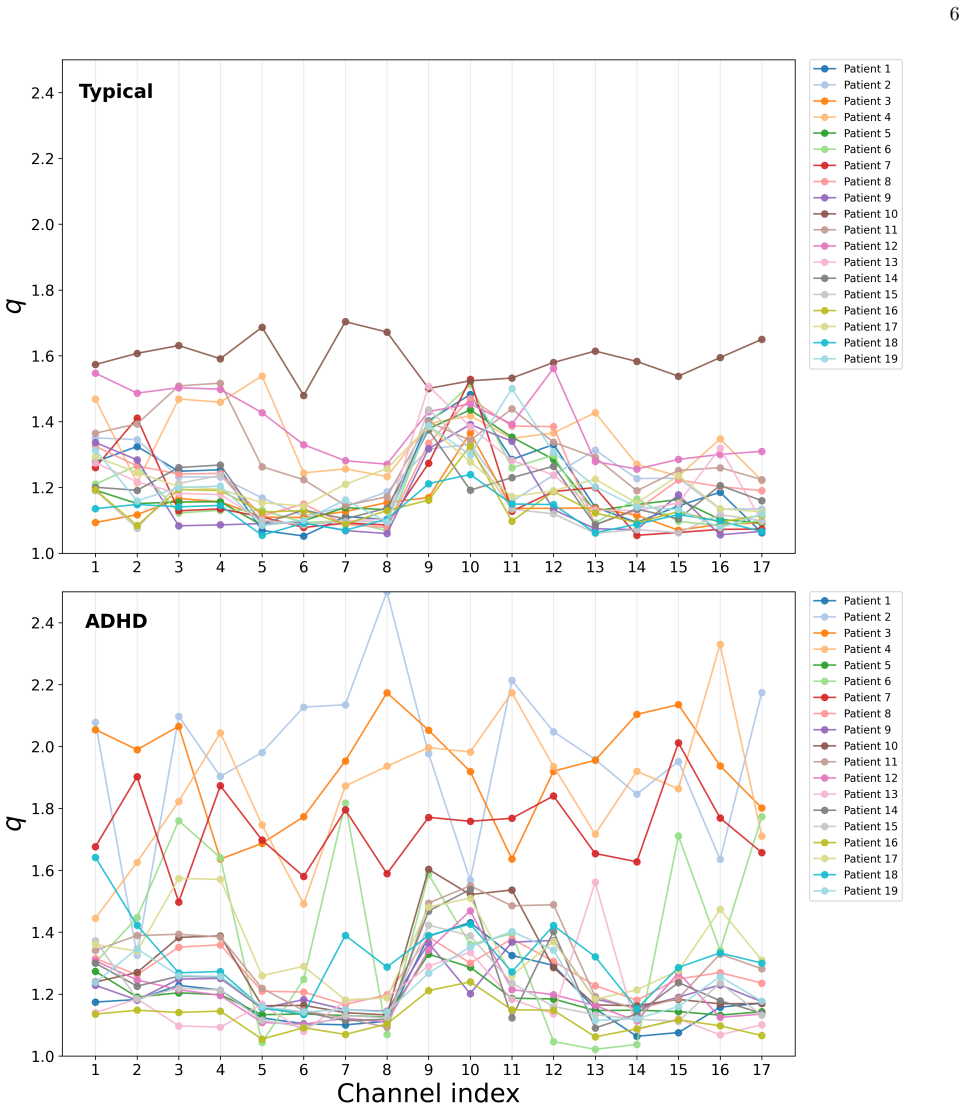
A. C. Yang, S. J. Tsai.Is mental illness complex? From 6 FIG. 5. Plot ofqversus channel index for all 38 subjects. The channels are ordered as follows: F3, F4, C3, C4, P3, P4, O1, O2, F7, F8, T3, T4, T5, T6, Fz, Cz, Pz (17 channels in total). behavior to brain, Progress in Neuropsychopharmacology & Biological Psychiatry45, 42 (2013)
2013
-
[10]
Chatterjee, G
A. Chatterjee, G. Georgiev, G. Iannacchione.Aging and efficiency in living systems: Complexity, adaptation and self-organization. Mechanisms of Ageing and Develop- ment163, 2 (2017)
2017
-
[11]
Hadoush, M
H. Hadoush, M. Alafeef, E. Abdulhay,Brain Complexity in Children with Mild and Severe Autism Spectrum Dis- orders: Analysis of Multiscale Entropy in EEG, Brain Topography32(5), 914 (2019)
2019
-
[12]
C. Gu, Z. X. Liu, S. Woltering,Electroencephalogra- phy complexity in resting and task states in adults with attention-deficit/hyperactivity disorder, Brain Communi- cations4(2), fcac054 (2022)
2022
-
[13]
Z. J. Lau, T. Pham, S. H. A. Chen, D. Makowski,Brain entropy, fractal dimensions and predictability: A review 7 FIG. 6. Plot of⟨q⟩ ch (average over channels) versus patient index in ascending order. The indices of the first ADHD and first typical patients coincide. of complexity measures for EEG in healthy and neuropsy- chiatric populations, European Jour...
2022
-
[14]
Niedermeyer, F
E. Niedermeyer, F. L. da Silva, editors.Niedermeyer’s Electroencephalography: Basic Principles, Clinical Appli- cations, and Related Fields. 6th ed. Philadelphia: Lippin- cott Williams & Wilkins (2011)
2011
-
[15]
D. M. Abramov, C. Tsallis, H. S. Lima,Neural com- plexity through a nonextensive statistical-mechanical ap- proach of human electroencephalograms, Sci Rep.13(1), 10318 (2023)
2023
-
[16]
D. M. Abramov, H. S. Lima, V. Lazarev, P. R. Galhanone, C. Tsallis,Identifying attention- deficit/hyperactivity disorder through the electroen- cephalogram complexity, Physica A653, 130093 (2024)
2024
-
[17]
D. M. Abramov, D. F. Quintanilha, H. S. Lima, R. P. Costa, C. Kamil-Leite, V. V. Lazarev, C. Tsallis,Neu- rophysiological correlates to the human brain complexity through q-statistical analysis of electroencephalogram, Sci Rep.15, 36502 (2025)
2025
-
[18]
Tsallis,Possible generalization of Boltzmann-Gibbs statistics, J
C. Tsallis,Possible generalization of Boltzmann-Gibbs statistics, J. Stat. Phys.52, 479 (1988)
1988
-
[19]
Tsallis and D
C. Tsallis and D. J. Bukman,Anomalous diffusion in the presence of external forces: exact time-dependent solu- tions and their thermostatistical basis, Phys. Rev. E54, R2197-R2200 (1996)
1996
-
[20]
M. L. Lyra and C. Tsallis,Nonextensivity and Multi- fractality in Low-Dimensional Dissipative Systems, Phys. Rev. Lett.80, 53 (1998)
1998
-
[21]
E. K. Lenzi, L. C. Malacarne, R. S. Mendes, and I. T. Pedron,Anomalous diffusion, nonlinear fractional Fokker-Planck equation and solutions, Physica A319, 245 (2003)
2003
-
[22]
Tsallis, M
C. Tsallis, M. Gell-Mann, and Y. Sato,Asymptotically scale-invariant occupancy of phase space makes the en- tropy Sq extensive, Proc. Natl. Acad. Sci. USA102, 15377 (2005)
2005
-
[23]
Umarov, C
S. Umarov, C. Tsallis, and S. Steinberg,On a q-central limit theorem consistent with nonextensive statistical me- chanics, Milan J. Math.76, 307 (2008)
2008
-
[24]
D. M. Abramov, C. Q. Cunha, P. R. Galhanone, R. J. Alvim, A. M. de Oliveira, V. V. Lazarev,Neurophysiolog- ical and behavioral correlates of alertness impairment and compensatory processes in ADHD evidenced by the Atten- tion Network Test, PLoS One14(7), e0219472 (2019)
2019
-
[25]
Ruiz and A
G. Ruiz and A. F. de Marcos,Evidence for criticality in financial data, Eur. Phys. J. B91, 1 (2018)
2018
-
[26]
Greco, C
A. Greco, C. Tsallis, A. Rapisarda, A. Pluchino, G. Fichera and L. Contrafatto,Acoustic emissions in com- pression of building materials: q-statistics enables the anticipation of the breakdown point, European Physical Journal Special Topics229(5), 841 (2020)
2020
-
[27]
de Oliveira, S
R.M. de Oliveira, S. Brito, L.R. da Silva and C. Tsallis, Statistical mechanical approach of complex networks with weighted links, JSTAT 063402 (2022)
2022
-
[28]
Briggs and C
K. Briggs and C. Beck,Modelling train delays withq- exponential functions, Physica A378, 498 (2007)
2007
discussion (0)
Sign in with ORCID, Apple, or X to comment. Anyone can read and Pith papers without signing in.