Recognition: unknown
From Cortical Synchronous Rhythm to Brain Inspired Learning Mechanism: An Oscillatory Spiking Neural Network with Time-Delayed Coordination
Pith reviewed 2026-05-09 17:03 UTC · model grok-4.3
The pith
A spiking neural network coordinates distributed neurons through bottom-up oscillatory synchronization and top-down time-delayed modulation.
A machine-rendered reading of the paper's core claim, the machinery that carries it, and where it could break.
Core claim
Cognition-level neural synchrony emerges through iterative bottom-up and top-down interactions between micro-scale spiking dynamics and a macro-scale oscillatory synchronization mechanism. Each parcel is treated as a spiking neuron in a connectivity scaffold; bottom-up accumulation of past spikes over a finite window produces oscillatory coordination, and top-down time-delayed modulation adjusts heterogeneous firing without forcing global phase locking. The resulting S2-Net uses rhythmic timing as the control signal for information processing.
What carries the argument
The time-delayed synchronization formulation, which converts accumulated spiking activity into a top-down modulation signal that preserves partial and transient coordination across distributed neurons.
If this is right
- Rhythmic timing becomes the primary control signal for coordinating information across spatially distributed spiking units.
- The same bottom-up/top-down loop supports temporal binding of events and basic semantic reasoning without separate modules.
- Energy use drops because only selectively grouped neurons fire, rather than every unit processing every input at full rate.
- The architecture scales to heterogeneous systems by design, since time delays explicitly tolerate differing local firing patterns.
Where Pith is reading between the lines
- The same coordination rule could be inserted into existing spiking simulators to test whether it improves robustness on long temporal sequences.
- If the memory window length is treated as a tunable hyperparameter, the model might reveal optimal scales for binding events that match known cortical rhythms.
- Extending the connectivity scaffold to include long-range anatomical priors could link the abstract parcels to real brain parcellations without changing the core dynamics.
Load-bearing premise
Iterative accumulation of spiking activity into oscillatory rhythms plus time-delayed top-down modulation will reliably generate stable, cognition-level synchrony rather than trivial, unstable, or globally locked dynamics.
What would settle it
Run the network on a large-scale neural recording dataset and measure whether synchronization remains partial and transient across trials; if it collapses to full locking or fails to synchronize at all, the central coordination claim is falsified.
Figures





read the original abstract
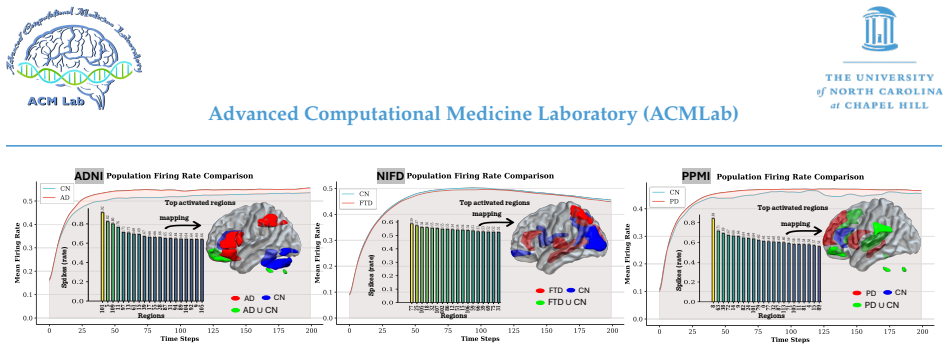
Human cognition emerges from coordinated spiking dynamics in distributed neural circuits, where information is encoded via both firing rates and precise spike timing determined by brain rhythms. Inspired by this notion, we propose a brain-inspired learning primitive in which cognition-level neural synchrony emerges through iterative bottom-up and top-down interactions between micro-scale dynamics of spiking neurons and a macro-scale mechanism of oscillatory synchronization. Specifically, we model each parcel (e.g., a cortical region or an image pixel) in the target system as a spiking neuron embedded in a predefined connectivity scaffold. Low-level information is encoded in a spatiotemporal domain, where neurons are selectively grouped and fire spontaneously over time through self-organized dynamics. In the bottom-up route, oscillatory synchronization is formed from past spiking activity accumulated over a finite memory window. Since brain dynamics operate in a regime of partial and transient synchronization rather than global phase locking, we model oscillatory coordination using a time-delayed synchronization formulation, which enables a top-down modulation of heterogeneous neural spiking for a large-scale distributed system. Together, we devise a spiking-by-synchronization neural network (S2-Net) that uses rhythmic timing as a control mechanism for efficient information processing. Promising results have been achieved across a broad range of tasks, including neural activity decoding, energy-efficient signal processing, temporal binding and semantic reasoning.
Editorial analysis
A structured set of objections, weighed in public.
Referee Report
Summary. The manuscript proposes a spiking-by-synchronization neural network (S2-Net) in which cognition-level neural synchrony emerges iteratively via bottom-up accumulation of spiking activity over a finite memory window to form oscillatory synchronization, combined with top-down time-delayed modulation of heterogeneous neurons to achieve partial and transient (rather than global) synchrony. This rhythmic timing mechanism is presented as a control primitive for efficient information processing, with promising results claimed on neural activity decoding, energy-efficient signal processing, temporal binding, and semantic reasoning.
Significance. If the claimed dynamics can be rigorously shown to produce stable partial transient synchrony without collapse to trivial states, the work could offer a novel integration of rate and timing codes grounded in cortical rhythms. The approach draws on established ideas of neural oscillations and delay coupling but currently lacks the mathematical and empirical grounding needed to assess whether it advances beyond existing spiking network models.
major comments (2)
- [S2-Net model formulation and time-delayed synchronization description] The central construction relies on bottom-up accumulation over a memory window producing oscillatory synchronization that is then modulated top-down by time-delayed coordination to maintain partial transient synchrony. No stability analysis, Lyapunov exponents, bifurcation diagrams, or parameter-regime exploration is supplied to demonstrate that the chosen delay kernel and coupling strengths avoid the multistability, chaos, or rapid convergence to full synchrony/incoherence that is well-documented in delay-coupled oscillator networks. This analysis is load-bearing for the claim that useful rhythmic timing emerges for decoding, binding, and reasoning tasks.
- [Abstract and results sections] The abstract states that promising results were achieved across multiple tasks, yet the manuscript supplies no equations defining the spiking neuron model, memory window, delay kernel, or synchronization metric; no experimental details, baselines, quantitative metrics, or error bars; and no data descriptions. Without these, the soundness of the reported performance cannot be evaluated against the claimed mechanism.
minor comments (2)
- The manuscript would benefit from explicit comparison to prior work on delay-coupled spiking networks and oscillatory SNNs to clarify the novelty of the bottom-up/top-down coordination scheme.
- Notation for the memory window length and time-delay parameters should be introduced formally with their ranges and selection criteria.
Simulated Author's Rebuttal
We thank the referee for the thoughtful and constructive report. The comments highlight important areas where the theoretical grounding and presentation of results can be strengthened. We address each major comment below and outline the revisions we will make.
read point-by-point responses
-
Referee: [S2-Net model formulation and time-delayed synchronization description] The central construction relies on bottom-up accumulation over a memory window producing oscillatory synchronization that is then modulated top-down by time-delayed coordination to maintain partial transient synchrony. No stability analysis, Lyapunov exponents, bifurcation diagrams, or parameter-regime exploration is supplied to demonstrate that the chosen delay kernel and coupling strengths avoid the multistability, chaos, or rapid convergence to full synchrony/incoherence that is well-documented in delay-coupled oscillator networks. This analysis is load-bearing for the claim that useful rhythmic timing emerges for decoding, binding, and reasoning tasks.
Authors: We agree that a dedicated stability analysis would strengthen the manuscript. The current work relies on empirical demonstration across tasks that the selected delay kernel and coupling regime produce the desired partial and transient synchrony without collapse to global locking or incoherence. In the revised version we will add a new subsection containing (i) a brief Lyapunov-exponent estimate computed on representative trajectories, (ii) a parameter-sweep diagram showing the region of stable partial synchrony, and (iii) a short discussion of how the biologically motivated memory window and heterogeneous delays help avoid the multistable regimes known from the delay-coupled oscillator literature. These additions will be placed immediately after the model definition. revision: yes
-
Referee: [Abstract and results sections] The abstract states that promising results were achieved across multiple tasks, yet the manuscript supplies no equations defining the spiking neuron model, memory window, delay kernel, or synchronization metric; no experimental details, baselines, quantitative metrics, or error bars; and no data descriptions. Without these, the soundness of the reported performance cannot be evaluated against the claimed mechanism.
Authors: We acknowledge that the abstract and main results sections currently present the performance claims at a high level. The full manuscript does contain the neuron model, memory-window definition, delay kernel, and synchronization metric in the Methods section, together with task-specific experimental protocols. To improve accessibility we will (i) move the core equations into the main text or a new “Model Summary” box, (ii) expand the abstract to mention the key quantitative metrics, and (iii) add a consolidated table of baselines, metrics, and error bars (or standard deviations) for all reported tasks. These changes will be implemented in the next revision. revision: yes
Circularity Check
Model proposal without detectable self-referential derivation
full rationale
The paper describes S2-Net as a modeling choice in which oscillatory synchronization emerges via bottom-up accumulation of spiking activity over a memory window combined with top-down time-delayed modulation. This is presented as an architectural primitive inspired by brain dynamics rather than a mathematical derivation whose central result reduces to its own inputs by construction. No equations, fitted parameters renamed as predictions, or load-bearing self-citations appear in the provided text that would allow identification of any of the enumerated circularity patterns. Claims of results on decoding, binding, and reasoning tasks are external to the construction itself and would constitute independent support if validated.
Axiom & Free-Parameter Ledger
free parameters (2)
- memory window length
- time delay parameters
axioms (1)
- domain assumption Brain dynamics operate in a regime of partial and transient synchronization rather than global phase locking.
invented entities (1)
-
S2-Net (spiking-by-synchronization neural network)
no independent evidence
Reference graph
Works this paper leans on
-
[1]
Long short-term memory and learning-to-learn in networks of spiking neurons
Guillaume Bellec, Darjan Salaj, Anand Subramoney, Robert Legenstein, and Wolfgang Maass. Long short-term memory and learning-to-learn in networks of spiking neurons. Advances in Neural Information Processing Systems, 31, 2018
2018
-
[2]
Transcranial magnetic stimulation distinguishes alzheimer disease from frontotemporal dementia
Alberto Benussi, Francesco Di Lorenzo, Valentina Dell'Era, Maura Cosseddu, Antonella Alberici, Salvatore Caratozzolo, Maria Sofia Cotelli, Anna Micheli, Luca Rozzini, Alessandro Depari, et al. Transcranial magnetic stimulation distinguishes alzheimer disease from frontotemporal dementia. Neurology, 89 0 (7): 0 665--672, 2017
2017
-
[3]
The lifespan human connectome project in aging: an overview
Susan Y Bookheimer, David H Salat, Melissa Terpstra, Beau M Ances, Deanna M Barch, Randy L Buckner, Gregory C Burgess, Sandra W Curtiss, Mirella Diaz-Santos, Jennifer Stine Elam, et al. The lifespan human connectome project in aging: an overview. Neuroimage, 185: 0 335--348, 2019
2019
-
[4]
Dynamic models of large-scale brain activity
Michael Breakspear. Dynamic models of large-scale brain activity. Nature Neuroscience, 20 0 (3): 0 340--352, 2017
2017
-
[5]
Configurational stability for the kuramoto--sakaguchi model
Jared C Bronski, Thomas Carty, and Lee DeVille. Configurational stability for the kuramoto--sakaguchi model. Chaos: An Interdisciplinary Journal of Nonlinear Science, 28 0 (10), 2018
2018
-
[6]
Topological structure in visual perception
Lin Chen. Topological structure in visual perception. Science, 218 0 (4573): 0 699--700, 1982
1982
-
[7]
The heidelberg spiking data sets for the systematic evaluation of spiking neural networks
Benjamin Cramer, Yannik Stradmann, Johannes Schemmel, and Friedemann Zenke. The heidelberg spiking data sets for the systematic evaluation of spiking neural networks. IEEE Transactions on Neural Networks and Learning Systems, 33 0 (7): 0 2744--2757, 2020
2020
-
[8]
Sinkhorn distances: Lightspeed computation of optimal transport
Marco Cuturi. Sinkhorn distances: Lightspeed computation of optimal transport. Advances in neural information processing systems, 26, 2013
2013
-
[9]
Exploring the enigma of neural dynamics through a scattering-transform mixer landscape for riemannian manifold
Tingting Dan, Ziquan Wei, Won Hwa Kim, and Guorong Wu. Exploring the enigma of neural dynamics through a scattering-transform mixer landscape for riemannian manifold. In International Conference on Machine Learning, pages 9976--9990. PMLR, 2024
2024
-
[10]
Explore brain-inspired machine intelligence for connecting dots on graphs through holographic blueprint of oscillatory synchronization
Tingting Dan, Jiaqi Ding, and Guorong Wu. Explore brain-inspired machine intelligence for connecting dots on graphs through holographic blueprint of oscillatory synchronization. Nature Communications, 16 0 (1): 0 9425, 2025
2025
-
[11]
Key role of coupling, delay, and noise in resting brain fluctuations
Gustavo Deco, Viktor Jirsa, Anthony R McIntosh, Olaf Sporns, and Rolf K \"o tter. Key role of coupling, delay, and noise in resting brain fluctuations. Proceedings of the National Academy of Sciences, 106 0 (25): 0 10302--10307, 2009
2009
-
[12]
Distributed hierarchical processing in the primate cerebral cortex
Daniel J Felleman and David C Van Essen. Distributed hierarchical processing in the primate cerebral cortex. Cerebral cortex (New York, NY: 1991), 1 0 (1): 0 1--47, 1991
1991
-
[13]
A mechanism for cognitive dynamics: neuronal communication through neuronal coherence
Pascal Fries. A mechanism for cognitive dynamics: neuronal communication through neuronal coherence. Trends in cognitive sciences, 9 0 (10): 0 474--480, 2005
2005
-
[14]
On the binding problem in artificial neural networks.arXiv preprint arXiv:2012.05208, 2020
Klaus Greff, Sjoerd Van Steenkiste, and J \"u rgen Schmidhuber. On the binding problem in artificial neural networks. arXiv preprint arXiv:2012.05208, 2020
-
[15]
Mamba: Linear-Time Sequence Modeling with Selective State Spaces
Albert Gu and Tri Dao. Mamba: Linear-time sequence modeling with selective state spaces. arXiv preprint arXiv:2312.00752, 2023
work page internal anchor Pith review arXiv 2023
-
[16]
When noise meets chaos: Stochastic resonance in neurochaos learning
Nellippallil Balakrishnan Harikrishnan and Nithin Nagaraj. When noise meets chaos: Stochastic resonance in neurochaos learning. Neural Networks, 143: 0 425--435, 2021
2021
-
[17]
Whitwell, Chadwick Ward, et al
Clifford R Jack Jr, Matt A Bernstein, Nick C Fox, Paul Thompson, Gene Alexander, Danielle Harvey, Bret Borowski, Paula J Britson, Jennifer L. Whitwell, Chadwick Ward, et al. The alzheimer's disease neuroimaging initiative (adni): Mri methods. Journal of Magnetic Resonance Imaging: An Official Journal of the International Society for Magnetic Resonance in ...
2008
-
[18]
Dynamics in the sakaguchi-kuramoto model with two subpopulations
Ping Ju, Qionglin Dai, Hongyan Cheng, and Junzhong Yang. Dynamics in the sakaguchi-kuramoto model with two subpopulations. Physical Review E, 90 0 (1): 0 012903, 2014
2014
-
[19]
Self-entrainment of a population of coupled non-linear oscillators
Yoshiki Kuramoto. Self-entrainment of a population of coupled non-linear oscillators. In International symposium on mathematical problems in theoretical physics: January 23--29, 1975, kyoto university, kyoto/Japan, pages 420--422. Springer, 2005
1975
-
[20]
A simple way to initialize recurrent networks of rectified linear units
Quoc V Le, Navdeep Jaitly, and Geoffrey E Hinton. A simple way to initialize recurrent networks of rectified linear units. arXiv preprint arXiv:1504.00941, 2015
-
[21]
Object-centric learning with slot attention
Francesco Locatello, Dirk Weissenborn, Thomas Unterthiner, Aravindh Mahendran, Georg Heigold, Jakob Uszkoreit, Alexey Dosovitskiy, and Thomas Kipf. Object-centric learning with slot attention. Advances in neural information processing systems, 33: 0 11525--11538, 2020
2020
-
[22]
Dendritic computation
Michael London and Michael H \"a usser. Dendritic computation. Annual Review of Neuroscience, 28 0 (1): 0 503--532, 2005
2005
-
[23]
Networks of spiking neurons: the third generation of neural network models
Wolfgang Maass. Networks of spiking neurons: the third generation of neural network models. Neural networks, 10 0 (9): 0 1659--1671, 1997
1997
-
[24]
The parkinson progression marker initiative (ppmi)
Kenneth Marek, Danna Jennings, Shirley Lasch, Andrew Siderowf, Caroline Tanner, Tanya Simuni, Chris Coffey, Karl Kieburtz, Emily Flagg, Sohini Chowdhury, et al. The parkinson progression marker initiative (ppmi). Progress in Neurobiology, 95 0 (4): 0 629--635, 2011
2011
-
[25]
Circuit mechanisms of parkinson’s disease
Matthew M McGregor and Alexandra B Nelson. Circuit mechanisms of parkinson’s disease. Neuron, 101 0 (6): 0 1042--1056, 2019
2019
-
[26]
Multimodal population brain imaging in the uk biobank prospective epidemiological study
Karla L Miller, Fidel Alfaro-Almagro, Neal K Bangerter, David L Thomas, Essa Yacoub, Junqian Xu, Andreas J Bartsch, Saad Jbabdi, Stamatios N Sotiropoulos, Jesper LR Andersson, et al. Multimodal population brain imaging in the uk biobank prospective epidemiological study. Nature Neuroscience, 19 0 (11): 0 1523--1536, 2016
2016
-
[27]
Artificial kuramoto oscillatory neurons
Takeru Miyato, Sindy L \"o we, Andreas Geiger, and Max Welling. Artificial kuramoto oscillatory neurons. In The Thirteenth International Conference on Learning Representations, 2025
2025
-
[28]
Surrogate gradient learning in spiking neural networks: Bringing the power of gradient-based optimization to spiking neural networks
Emre O Neftci, Hesham Mostafa, and Friedemann Zenke. Surrogate gradient learning in spiking neural networks: Bringing the power of gradient-based optimization to spiking neural networks. IEEE Signal Processing Magazine, 36 0 (6): 0 51--63, 2019
2019
-
[29]
From coupled oscillators to graph neural networks: Reducing over-smoothing via a kuramoto model-based approach
Tuan Nguyen, Hirotada Honda, Takashi Sano, Vinh Nguyen, Shugo Nakamura, and Tan Minh Nguyen. From coupled oscillators to graph neural networks: Reducing over-smoothing via a kuramoto model-based approach. In International Conference on Artificial Intelligence and Statistics, pages 2710--2718. PMLR, 2024
2024
-
[30]
Network abnormalities and interneuron dysfunction in alzheimer disease
Jorge J Palop and Lennart Mucke. Network abnormalities and interneuron dysfunction in alzheimer disease. Nature Reviews Neuroscience, 17 0 (12): 0 777--792, 2016
2016
-
[31]
Anatomical mri staging of frontotemporal dementia variants
Vincent Planche, Boris Mansencal, Jos \'e V Manjon, Thomas Tourdias, Gwena \"e lle Catheline, Pierrick Coup \'e , Frontotemporal Lobar Degeneration Neuroimaging Initiative , and the National Alzheimer's Coordinating Center cohort . Anatomical mri staging of frontotemporal dementia variants. Alzheimer's & Dementia, 19 0 (8): 0 3283--3294, 2023
2023
-
[32]
Predictive coding in the visual cortex: a functional interpretation of some extra-classical receptive-field effects
Rajesh PN Rao and Dana H Ballard. Predictive coding in the visual cortex: a functional interpretation of some extra-classical receptive-field effects. Nature neuroscience, 2 0 (1): 0 79--87, 1999
1999
-
[33]
Object-based attention in the primary visual cortex of the macaque monkey
Pieter R Roelfsema, Victor AF Lamme, and Henk Spekreijse. Object-based attention in the primary visual cortex of the macaque monkey. Nature, 395 0 (6700): 0 376--381, 1998
1998
-
[34]
Towards spike-based machine intelligence with neuromorphic computing
Kaushik Roy, Akhilesh Jaiswal, and Priyadarshini Panda. Towards spike-based machine intelligence with neuromorphic computing. Nature, 575 0 (7784): 0 607--617, 2019
2019
-
[35]
Graph-coupled oscillator networks
T Konstantin Rusch, Ben Chamberlain, James Rowbottom, Siddhartha Mishra, and Michael Bronstein. Graph-coupled oscillator networks. In International conference on machine learning, pages 18888--18909. PMLR, 2022
2022
-
[36]
Neuronal synchrony: a versatile code for the definition of relations? Neuron, 24 0 (1): 0 49--65, 1999
Wolf Singer. Neuronal synchrony: a versatile code for the definition of relations? Neuron, 24 0 (1): 0 49--65, 1999
1999
-
[37]
Computing with oscillators from theoretical underpinnings to applications and demonstrators
Aida Todri-Sanial, Corentin Delacour, Madeleine Abernot, and Filip Sabo. Computing with oscillators from theoretical underpinnings to applications and demonstrators. Npj unconventional computing, 1 0 (1): 0 14, 2024
2024
-
[38]
Automated anatomical labeling of activations in spm using a macroscopic anatomical parcellation of the mni mri single-subject brain
Nathalie Tzourio-Mazoyer, Brigitte Landeau, Dimitri Papathanassiou, Fabrice Crivello, Octave Etard, Nicolas Delcroix, Bernard Mazoyer, and Marc Joliot. Automated anatomical labeling of activations in spm using a macroscopic anatomical parcellation of the mni mri single-subject brain. Neuroimage, 15 0 (1): 0 273--289, 2002
2002
-
[39]
The wu-minn human connectome project: an overview
David C Van Essen, Stephen M Smith, Deanna M Barch, Timothy EJ Behrens, Essa Yacoub, Kamil Ugurbil, Wu-Minn HCP Consortium, et al. The wu-minn human connectome project: an overview. Neuroimage, 80: 0 62--79, 2013
2013
-
[40]
The brainweb: phase synchronization and large-scale integration
Francisco Varela, Jean-Philippe Lachaux, Eugenio Rodriguez, and Jacques Martinerie. The brainweb: phase synchronization and large-scale integration. Nature reviews neuroscience, 2 0 (4): 0 229--239, 2001
2001
-
[41]
Pete Warden. Speech commands: A dataset for limited-vocabulary speech recognition. arXiv preprint arXiv:1804.03209, 2018
-
[42]
Direct training for spiking neural networks: Faster, larger, better
Yujie Wu, Lei Deng, Guoqi Li, Jun Zhu, Yuan Xie, and Luping Shi. Direct training for spiking neural networks: Faster, larger, better. In Proceedings of the AAAI Conference on Artificial Intelligence, volume 33, pages 1311--1318, 2019
2019
-
[43]
Efficient and robust temporal processing with neural oscillations modulated spiking neural networks
Yinsong Yan, Qu Yang, Yujie Wu, Hanwen Liu, Malu Zhang, Haizhou Li, Kay Chen Tan, and Jibin Wu. Efficient and robust temporal processing with neural oscillations modulated spiking neural networks. Nature Communications, 16 0 (1): 0 8651, 2025
2025
-
[44]
Time delay in the kuramoto model of coupled oscillators
MK Stephen Yeung and Steven H Strogatz. Time delay in the kuramoto model of coupled oscillators. Physical review letters, 82 0 (3): 0 648, 1999
1999
-
[45]
Effective and efficient computation with multiple-timescale spiking recurrent neural networks
Bojian Yin, Federico Corradi, and Sander M Boht \'e . Effective and efficient computation with multiple-timescale spiking recurrent neural networks. In International Conference on Neuromorphic Systems 2020, pages 1--8, 2020
2020
-
[46]
Accurate and efficient time-domain classification with adaptive spiking recurrent neural networks
Bojian Yin, Federico Corradi, and Sander M Boht \'e . Accurate and efficient time-domain classification with adaptive spiking recurrent neural networks. Nature Machine Intelligence, 3 0 (10): 0 905--913, 2021
2021
-
[47]
The remarkable robustness of surrogate gradient learning for instilling complex function in spiking neural networks
Friedemann Zenke and Tim P Vogels. The remarkable robustness of surrogate gradient learning for instilling complex function in spiking neural networks. Neural Computation, 33 0 (4): 0 899--925, 2021
2021
discussion (0)
Sign in with ORCID, Apple, or X to comment. Anyone can read and Pith papers without signing in.