Recognition: no theorem link
TCDA: Thread-Constrained Discourse-Aware Modeling for Conversational Sentiment Quadruple Analysis
Pith reviewed 2026-05-11 00:43 UTC · model grok-4.3
The pith
Thread-constrained directed acyclic graphs and discourse-aware position embeddings capture dialogue structure for sentiment quadruple analysis.
A machine-rendered reading of the paper's core claim, the machinery that carries it, and where it could break.
Core claim
The central discovery is that combining a Thread-Constrained Directed Acyclic Graph (TC-DAG) with Discourse-Aware Rotary Position Embedding (D-RoPE) enables better modeling of interrelationships in dialogues by filtering cross-thread noise, incorporating temporal sequences, aligning multi-layer semantics, and alleviating distance dilution problems.
What carries the argument
Thread-Constrained Directed Acyclic Graph (TC-DAG) for noise filtering and temporal ordering, paired with Discourse-Aware Rotary Position Embedding (D-RoPE) for semantic alignment and dependency capture using tree-like distances.
Load-bearing premise
That the observed improvements are due to the specific design of TC-DAG and D-RoPE rather than implementation details or dataset characteristics.
What would settle it
An ablation study removing the thread constraints from the graph or the discourse-aware modifications from the position embeddings that results in no significant performance loss would challenge the contribution of these components.
Figures


read the original abstract
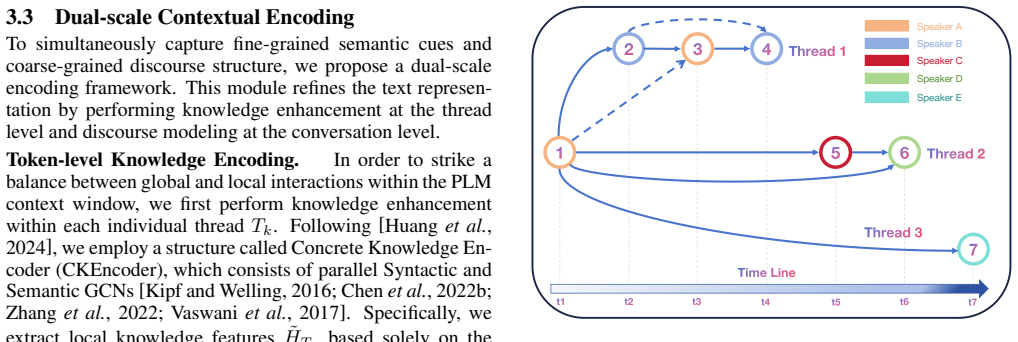
Conversational Aspect-based Sentiment Quadruple Analysis (DiaASQ) needs to capture the complex interrelationships in multiple rounds of dialogues. Existing methods usually employ simple Graph Convolutional Networks (GCN), which introduce structural noise and fail to consider the temporal sequence of the dialogues, or use standard RoPE, which implicitly captures relative distances in a flat sequence but cannot clearly separate the token-level syntactic order from the utterance-level progression, and may suffer from the Distance Dilution problem. To address these issues, we propose a new framework that combines Thread-Constrained Directed Acyclic Graph (TC-DAG) and Discourse-Aware Rotary Position Embedding (D-RoPE). Specifically, TC-DAG filters out cross-thread noise based on thread constraints, maintains global connectivity through root anchoring, and incorporates the temporal sequence of the dialogues. D-RoPE aligns multi-layer semantics using dual-stream projection and multi-scale frequency signals, captures thread dependencies using tree-like distances, and alleviates the token-level Distance Dilution problem by incorporating utterance-level progressions. Experimental results on two benchmark datasets demonstrate that our framework achieves state-of-the-art performance.
Editorial analysis
A structured set of objections, weighed in public.
Referee Report
Summary. The manuscript introduces the TCDA framework for Conversational Aspect-based Sentiment Quadruple Analysis (DiaASQ). It proposes Thread-Constrained Directed Acyclic Graph (TC-DAG) to filter cross-thread noise while maintaining global connectivity and incorporating temporal dialogue sequences, and Discourse-Aware Rotary Position Embedding (D-RoPE) to align semantics with dual-stream projection, capture thread dependencies via tree-like distances, and mitigate distance dilution using utterance-level signals. The authors report that this framework achieves state-of-the-art performance on two benchmark datasets.
Significance. Should the empirical superiority be confirmed through rigorous controls, this work would contribute to the field by offering a structured approach to modeling discourse and thread constraints in conversational sentiment analysis, potentially improving accuracy in tasks involving multi-turn dialogues.
major comments (2)
- [Experimental Results] Experimental Results: The central SOTA claim lacks supporting ablation experiments that isolate the effects of TC-DAG (e.g., without thread constraints or root anchoring) and D-RoPE (e.g., replaced by standard RoPE). Without these comparisons, it is not possible to attribute performance gains specifically to the proposed components rather than baseline GCN+RoPE variants, hyperparameter choices, or other implementation details.
- [Methods] Methods: The descriptions of TC-DAG and D-RoPE remain at a high level without formal mathematical definitions, pseudocode, or explicit equations for key mechanisms such as root anchoring, dual-stream projection, or multi-scale frequency signals, hindering verification of the claimed properties.
minor comments (1)
- [Abstract] The abstract would be strengthened by including specific performance metrics (e.g., F1 scores) and the names of the two benchmark datasets to provide immediate evidence for the SOTA claim.
Simulated Author's Rebuttal
We thank the referee for the constructive feedback on our manuscript. We address each major comment below and outline the revisions we will make to strengthen the empirical validation and methodological clarity.
read point-by-point responses
-
Referee: [Experimental Results] Experimental Results: The central SOTA claim lacks supporting ablation experiments that isolate the effects of TC-DAG (e.g., without thread constraints or root anchoring) and D-RoPE (e.g., replaced by standard RoPE). Without these comparisons, it is not possible to attribute performance gains specifically to the proposed components rather than baseline GCN+RoPE variants, hyperparameter choices, or other implementation details.
Authors: We agree that additional ablation studies are required to rigorously isolate the contributions of TC-DAG and D-RoPE. In the revised manuscript, we will include targeted ablations such as TC-DAG without thread constraints or root anchoring, and D-RoPE replaced by standard RoPE, along with comparisons to baseline GCN+RoPE variants. These experiments will be reported with performance metrics on both benchmarks to attribute gains specifically to the proposed components. revision: yes
-
Referee: [Methods] Methods: The descriptions of TC-DAG and D-RoPE remain at a high level without formal mathematical definitions, pseudocode, or explicit equations for key mechanisms such as root anchoring, dual-stream projection, or multi-scale frequency signals, hindering verification of the claimed properties.
Authors: We acknowledge that the current high-level descriptions limit verifiability. We will expand the Methods section with formal mathematical definitions, including explicit equations for root anchoring in TC-DAG, dual-stream projection, tree-like distances, and multi-scale frequency signals in D-RoPE, as well as pseudocode for the core mechanisms to support the claimed properties and improve reproducibility. revision: yes
Circularity Check
No circularity: empirical SOTA claims rest on benchmark experiments, not derivations
full rationale
The paper proposes TC-DAG and D-RoPE components to address limitations in GCN and standard RoPE for conversational sentiment quadruple analysis. Its strongest claims are that the combined framework achieves state-of-the-art performance on two DiaASQ benchmark datasets. No equations, first-principles derivations, or mathematical predictions are presented anywhere in the provided text. There are no self-definitional steps, fitted parameters renamed as predictions, or load-bearing self-citations that reduce the results to inputs by construction. The performance improvements are framed purely as empirical outcomes from experiments, making the derivation chain self-contained against external benchmarks with no reduction to tautology.
Axiom & Free-Parameter Ledger
axioms (2)
- domain assumption Simple GCNs introduce structural noise and ignore temporal sequence in dialogues
- domain assumption Standard RoPE suffers from Distance Dilution and cannot separate token-level and utterance-level order
invented entities (2)
-
TC-DAG
no independent evidence
-
D-RoPE
no independent evidence
Reference graph
Works this paper leans on
-
[1]
D ia ASQ : A Benchmark of Conversational Aspect-based Sentiment Quadruple Analysis
Li, Bobo and Fei, Hao and Li, Fei and Wu, Yuhan and Zhang, Jinsong and Wu, Shengqiong and Li, Jingye and Liu, Yijiang and Liao, Lizi and Chua, Tat-Seng and Ji, Donghong. D ia ASQ : A Benchmark of Conversational Aspect-based Sentiment Quadruple Analysis. Findings of the Association for Computational Linguistics: ACL 2023. 2023. doi:10.18653/v1/2023.finding...
-
[2]
Context-Aware Directed Acyclic Graph Network for Conversational Aspect-Based Sentiment Quadruple Analysis , year=
Zhang, Qiang and Zeng, Jie and Zhang, Runze and Cui, Dong , journal=. Context-Aware Directed Acyclic Graph Network for Conversational Aspect-Based Sentiment Quadruple Analysis , year=
-
[3]
Huang, Peijie and Xiao, Xisheng and Xu, Yuhong and Chen, Jiawei. DMIN : A Discourse-specific Multi-granularity Integration Network for Conversational Aspect-based Sentiment Quadruple Analysis. Findings of the Association for Computational Linguistics: ACL 2024. 2024. doi:10.18653/v1/2024.findings-acl.966
-
[4]
Multi-level Association Refinement Network for Dialogue Aspect-based Sentiment Quadruple Analysis
Tong, Zeliang and Wei, Wei and Qu, Xiaoye and Huang, Rikui and Chen, Zhixin and Yan, Xingyu. Multi-level Association Refinement Network for Dialogue Aspect-based Sentiment Quadruple Analysis. Proceedings of the 63rd Annual Meeting of the Association for Computational Linguistics (Volume 1: Long Papers). 2025. doi:10.18653/v1/2025.acl-long.686
-
[5]
Li, Bobo and Fei, Hao and Liao, Lizi and Zhao, Yu and Su, Fangfang and Li, Fei and Ji, Donghong , title =. Proceedings of the Thirty-Eighth AAAI Conference on Artificial Intelligence and Thirty-Sixth Conference on Innovative Applications of Artificial Intelligence and Fourteenth Symposium on Educational Advances in Artificial Intelligence , articleno =. 2...
-
[6]
and Bloem, Peter and van den Berg, Rianne and Titov, Ivan and Welling, Max
Schlichtkrull, Michael and Kipf, Thomas N. and Bloem, Peter and van den Berg, Rianne and Titov, Ivan and Welling, Max. Modeling Relational Data with Graph Convolutional Networks. The Semantic Web. 2018
2018
-
[7]
Dynamic Multi-Scale Context Aggregation for Conversational Aspect-Based Sentiment Quadruple Analysis , year=
Li, Yuqing and Zhang, Wenyuan and Li, Binbin and Jia, Siyu and Qi, Zisen and Tan, Xingbang , booktitle=. Dynamic Multi-Scale Context Aggregation for Conversational Aspect-Based Sentiment Quadruple Analysis , year=
-
[8]
Vedula, Nikhita and Collins, Marcus and Rokhlenko, Oleg , title =. Proceedings of the 46th International ACM SIGIR Conference on Research and Development in Information Retrieval , pages =. 2023 , isbn =. doi:10.1145/3539618.3591974 , abstract =
-
[9]
RoFormer: Enhanced Transformer with Rotary Position Embedding,
Jianlin Su and Murtadha Ahmed and Yu Lu and Shengfeng Pan and Wen Bo and Yunfeng Liu , keywords =. RoFormer: Enhanced transformer with Rotary Position Embedding , journal =. 2024 , issn =. doi:https://doi.org/10.1016/j.neucom.2023.127063 , url =
-
[10]
H i R o PE : Length Extrapolation for Code Models Using Hierarchical Position
Zhang, Kechi and Li, Ge and Zhang, Huangzhao and Jin, Zhi. H i R o PE : Length Extrapolation for Code Models Using Hierarchical Position. Proceedings of the 62nd Annual Meeting of the Association for Computational Linguistics (Volume 1: Long Papers). 2024. doi:10.18653/v1/2024.acl-long.735
-
[11]
Bengio, Yoshua and Louradour, J\'. Curriculum learning , year =. Proceedings of the 26th Annual International Conference on Machine Learning , pages =. doi:10.1145/1553374.1553380 , abstract =
-
[12]
Proceedings of the 28th European Conference on Artificial Intelligence (ECAI 2025) , year =
Xinran Li and Xiujuan Xu and Jiaqi Qiao , title =. Proceedings of the 28th European Conference on Artificial Intelligence (ECAI 2025) , year =. doi:10.3233/FAIA251292 , series =
-
[13]
Proceedings of the AAAI Conference on Artificial Intelligence , author=
Do LLMs Feel? Teaching Emotion Recognition with Prompts, Retrieval, and Curriculum Learning , volume=. Proceedings of the AAAI Conference on Artificial Intelligence , author=. 2026 , month=. doi:10.1609/aaai.v40i38.40446 , number=
-
[14]
Aspect Sentiment Quad Prediction as Paraphrase Generation
Zhang, Wenxuan and Deng, Yang and Li, Xin and Yuan, Yifei and Bing, Lidong and Lam, Wai. Aspect Sentiment Quad Prediction as Paraphrase Generation. Proceedings of the 2021 Conference on Empirical Methods in Natural Language Processing. 2021. doi:10.18653/v1/2021.emnlp-main.726
-
[15]
S eq2 P ath: Generating Sentiment Tuples as Paths of a Tree
Mao, Yue and Shen, Yi and Yang, Jingchao and Zhu, Xiaoying and Cai, Longjun. S eq2 P ath: Generating Sentiment Tuples as Paths of a Tree. Findings of the Association for Computational Linguistics: ACL 2022. 2022. doi:10.18653/v1/2022.findings-acl.174
-
[16]
Dual Encoder: Exploiting the Potential of Syntactic and Semantic for Aspect Sentiment Triplet Extraction
Zhao, Xiaowei and Zhou, Yong and Xu, Xiujuan. Dual Encoder: Exploiting the Potential of Syntactic and Semantic for Aspect Sentiment Triplet Extraction. Proceedings of the 2024 Joint International Conference on Computational Linguistics, Language Resources and Evaluation (LREC-COLING 2024). 2024
2024
-
[17]
Graph attention networks , url=
Veli. Graph attention networks , url=. doi:10.17863/CAM.48429 , publisher=
-
[18]
S em E val-2014 Task 4: Aspect Based Sentiment Analysis
Pontiki, Maria and Galanis, Dimitris and Pavlopoulos, John and Papageorgiou, Harris and Androutsopoulos, Ion and Manandhar, Suresh. S em E val-2014 Task 4: Aspect Based Sentiment Analysis. Proceedings of the 8th International Workshop on Semantic Evaluation ( S em E val 2014). 2014. doi:10.3115/v1/S14-2004
-
[19]
S em E val-2016 Task 5: Aspect Based Sentiment Analysis
Pontiki, Maria and Galanis, Dimitris and Papageorgiou, Haris and Androutsopoulos, Ion and Manandhar, Suresh and AL-Smadi, Mohammad and Al-Ayyoub, Mahmoud and Zhao, Yanyan and Qin, Bing and De Clercq, Orph. S em E val-2016 Task 5: Aspect Based Sentiment Analysis. Proceedings of the 10th International Workshop on Semantic Evaluation ( S em E val-2016). 2016...
-
[20]
A Survey on Aspect-Based Sentiment Analysis: Tasks, Methods, and Challenges , year=
Zhang, Wenxuan and Li, Xin and Deng, Yang and Bing, Lidong and Lam, Wai , journal=. A Survey on Aspect-Based Sentiment Analysis: Tasks, Methods, and Challenges , year=
-
[21]
Proceedings of the ACM Web Conference 2024 , pages =
Zhou, Changzhi and Wu, Zhijing and Song, Dandan and Hu, Linmei and Tian, Yuhang and Xu, Jing , title =. Proceedings of the ACM Web Conference 2024 , pages =. 2024 , isbn =. doi:10.1145/3589334.3645355 , abstract =
-
[22]
International Conference on Learning Representations , year=
Directed Acyclic Graph Neural Networks , author=. International Conference on Learning Representations , year=
-
[23]
Directed Acyclic Graph Network for Conversational Emotion Recognition
Shen, Weizhou and Wu, Siyue and Yang, Yunyi and Quan, Xiaojun. Directed Acyclic Graph Network for Conversational Emotion Recognition. Proceedings of the 59th Annual Meeting of the Association for Computational Linguistics and the 11th International Joint Conference on Natural Language Processing (Volume 1: Long Papers). 2021. doi:10.18653/v1/2021.acl-long.123
-
[24]
Proceedings of the AAAI Conference on Artificial Intelligence , author=
Hybrid Curriculum Learning for Emotion Recognition in Conversation , volume=. Proceedings of the AAAI Conference on Artificial Intelligence , author=. 2022 , month=. doi:10.1609/aaai.v36i10.21413 , abstractNote=
-
[25]
Curriculum Learning Meets Directed Acyclic Graph for Multimodal Emotion Recognition
Nguyen, Cam-Van Thi and Nguyen, Cao-Bach and Le, Duc-Trong and Ha, Quang-Thuy. Curriculum Learning Meets Directed Acyclic Graph for Multimodal Emotion Recognition. Proceedings of the 2024 Joint International Conference on Computational Linguistics, Language Resources and Evaluation (LREC-COLING 2024). 2024
2024
-
[26]
BERT: Pre-training of deep bidi- rectional transformers for language understanding
Devlin, Jacob and Chang, Ming-Wei and Lee, Kenton and Toutanova, Kristina. BERT : Pre-training of Deep Bidirectional Transformers for Language Understanding. Proceedings of the 2019 Conference of the North A merican Chapter of the Association for Computational Linguistics: Human Language Technologies, Volume 1 (Long and Short Papers). 2019. doi:10.18653/v...
-
[27]
ArXiv , year=
Semi-Supervised Classification with Graph Convolutional Networks , author=. ArXiv , year=
-
[28]
Enhanced Multi-Channel Graph Convolutional Network for Aspect Sentiment Triplet Extraction
Chen, Hao and Zhai, Zepeng and Feng, Fangxiang and Li, Ruifan and Wang, Xiaojie. Enhanced Multi-Channel Graph Convolutional Network for Aspect Sentiment Triplet Extraction. Proceedings of the 60th Annual Meeting of the Association for Computational Linguistics (Volume 1: Long Papers). 2022. doi:10.18653/v1/2022.acl-long.212
-
[29]
Zhang, Zheng and Zhou, Zili and Wang, Yanna. SSEGCN : Syntactic and Semantic Enhanced Graph Convolutional Network for Aspect-based Sentiment Analysis. Proceedings of the 2022 Conference of the North American Chapter of the Association for Computational Linguistics: Human Language Technologies. 2022. doi:10.18653/v1/2022.naacl-main.362
-
[30]
Neural Information Processing Systems , year=
Attention is All you Need , author=. Neural Information Processing Systems , year=
-
[31]
International Joint Conference on Artificial Intelligence , year=
Aspect Term Extraction with History Attention and Selective Transformation , author=. International Joint Conference on Artificial Intelligence , year=
-
[32]
Dual Graph Convolutional Networks for Aspect-based Sentiment Analysis
Li, Ruifan and Chen, Hao and Feng, Fangxiang and Ma, Zhanyu and Wang, Xiaojie and Hovy, Eduard. Dual Graph Convolutional Networks for Aspect-based Sentiment Analysis. Proceedings of the 59th Annual Meeting of the Association for Computational Linguistics and the 11th International Joint Conference on Natural Language Processing (Volume 1: Long Papers). 20...
-
[33]
2024 , url=
Extensible Multi-Granularity Fusion Network and Transferable Curriculum Learning for Aspect-based Sentiment Analysis , author=. 2024 , url=
2024
-
[34]
International Joint Conference on Artificial Intelligence , year=
Learn from Syntax: Improving Pair-wise Aspect and Opinion Terms Extractionwith Rich Syntactic Knowledge , author=. International Joint Conference on Artificial Intelligence , year=
-
[35]
Aspect-Category-Opinion-Sentiment Quadruple Extraction with Implicit Aspects and Opinions
Cai, Hongjie and Xia, Rui and Yu, Jianfei. Aspect-Category-Opinion-Sentiment Quadruple Extraction with Implicit Aspects and Opinions. Proceedings of the 59th Annual Meeting of the Association for Computational Linguistics and the 11th International Joint Conference on Natural Language Processing (Volume 1: Long Papers). 2021. doi:10.18653/v1/2021.acl-long.29
-
[36]
ArXiv , year=
RoBERTa: A Robustly Optimized BERT Pretraining Approach , author=. ArXiv , year=
-
[37]
IEEE/ACM Transactions on Audio, Speech, and Language Processing , year=
Pre-Training With Whole Word Masking for Chinese BERT , author=. IEEE/ACM Transactions on Audio, Speech, and Language Processing , year=
-
[38]
Learning Span-Level Interactions for Aspect Sentiment Triplet Extraction
Xu, Lu and Chia, Yew Ken and Bing, Lidong. Learning Span-Level Interactions for Aspect Sentiment Triplet Extraction. Proceedings of the 59th Annual Meeting of the Association for Computational Linguistics and the 11th International Joint Conference on Natural Language Processing (Volume 1: Long Papers). 2021. doi:10.18653/v1/2021.acl-long.367
-
[39]
Cai, Chenran and Zhao, Qin and Xu, Ruifeng and Qin, Bing , title =. Natural Language Processing and Chinese Computing: 12th National CCF Conference, NLPCC 2023, Foshan, China, October 12–15, 2023, Proceedings, Part III , pages =. 2023 , isbn =. doi:10.1007/978-3-031-44699-3_14 , abstract =
-
[40]
Zhang, Yu and Zhong, Zhaoman and Lv, Huihui. Inter-sentence Context Modeling and Structure-aware Representation Enhancement for Conversational Sentiment Quadruple Extraction. Proceedings of the 2025 Conference on Empirical Methods in Natural Language Processing. 2025. doi:10.18653/v1/2025.emnlp-main.867
-
[41]
Haoyu Jiang and Xiaoliang Chen and Duoqian Miao and Hongyun Zhang and Xiaolin Qin and Xu Gu and Peng Lu , keywords =. IFusionQuad: A novel framework for improved aspect-based sentiment quadruple analysis in dialogue contexts with advanced feature integration and contextual CloBlock , journal =. 2025 , issn =. doi:https://doi.org/10.1016/j.eswa.2024.125556 , url =
-
[42]
Xiaoyong Liu and Miao Hu and Chunlin Xu and Zhiguo Du , keywords =. SARA: Span-aware framework with relation-augmented grid tagging for conversational aspect-based sentiment quadruple analysis , journal =. 2025 , issn =. doi:https://doi.org/10.1016/j.engappai.2025.110915 , url =
discussion (0)
Sign in with ORCID, Apple, or X to comment. Anyone can read and Pith papers without signing in.