Recognition: 3 theorem links
· Lean TheoremEmergent Macro-Criticality from Micro-Critical Agents
Pith reviewed 2026-05-08 18:45 UTC · model grok-4.3
The pith
In a multi-agent system with light-signal interactions, collective near-critical dynamics emerge from slightly subcritical individual agent regimes rather than from critical ones, modulated by network connectivity.
A machine-rendered reading of the paper's core claim, the machinery that carries it, and where it could break.
Core claim
Macroscopic critical-like dynamics are enabled by microscopic regimes that deviate from criticality, with the required deviation depending on the properties of the interaction network. Specifically, slightly subcritical micro-level regimes support near-critical dynamics across a wider range of macroscopic parameters. Near-critical dynamics within individual agents is not sufficient to produce collective critical-like avalanche statistics. Scale-free behavior depends on the effective connectivity of the macroscopic interaction network, which controls activity propagation.
What carries the argument
The reservoir dynamical system governing each agent's internal state, coupled to the spatially constrained light-signal interaction network that sets the macroscopic topology and activity propagation.
Load-bearing premise
Avalanche statistics reliably indicate true criticality and the reservoir model plus spatial light interactions capture the essential mechanisms of real biological or artificial collective systems.
What would settle it
An experiment or simulation in which microscopic parameters are held at criticality while network connectivity is varied, yet scale-free avalanches still appear across the full parameter range, would contradict the claim.
Figures



read the original abstract
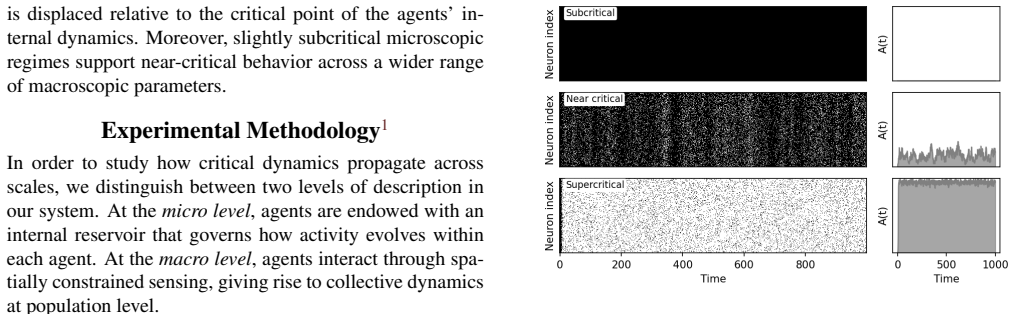
Criticality has been proposed as a key principle underlying complex behavior in biological and artificial systems; however, how criticality translates from individual dynamics to collective behavior remains unclear. We study this question using a multi-agent system with spatially constrained interactions in which agents sense neighboring light signals through exteroceptors and act by switching their own light on or off, thereby forming a dynamical interaction network at the macroscopic level. The agents' internal states are themselves governed by a reservoir dynamical system at the microscopic level. By varying the microscopic parameters around dynamical criticality, together with the macroscopic interaction topology, we systematically investigate the relation between the two levels. We find that near-critical dynamics within individual agents is not sufficient to produce collective critical-like avalanche statistics. Instead, scale-free behavior depends on the effective connectivity of the macroscopic interaction network, which controls activity propagation. As a result, macroscopic critical-like dynamics are enabled by microscopic regimes that deviate from criticality, with the required deviation depending on the properties of the interaction network. Investigating this relation, we find that slightly subcritical micro-level regimes support near-critical dynamics across a wider range of macroscopic parameters. These results show that in this multi-agent system, collective near-critical behavior depends on the interplay between internal dynamics and the interaction structure that governs activity propagation.
Editorial analysis
A structured set of objections, weighed in public.
Referee Report
Summary. The paper studies a multi-agent system in which each agent has internal dynamics governed by a reservoir model at the microscopic level and interacts with neighbors via spatially constrained light signals, switching its own light on or off. Through systematic variation of microscopic reservoir parameters around dynamical criticality together with macroscopic interaction topology, the authors report that near-critical micro-level dynamics are insufficient to produce collective scale-free avalanche statistics; instead, slightly subcritical micro regimes enable near-critical macro behavior across a wider range of effective connectivities, with activity propagation controlled by the macroscopic network structure.
Significance. If the reported micro-macro relation holds after controls, the work would clarify conditions under which collective critical-like statistics emerge from non-critical individual dynamics, with relevance to biological and artificial collective systems. The systematic parameter sweeps across both levels constitute a clear strength, providing an explicit mapping rather than a fitted or circular relation.
major comments (2)
- [§3] §3 (Avalanche Statistics and Micro-Macro Relation): The central claim that slightly subcritical micro regimes support near-critical macro dynamics over a wider parameter range depends on avalanche size/duration distributions being a faithful indicator of criticality. However, the manuscript does not report controls such as randomized switching thresholds or comparisons against memoryless agents; without these, it remains possible that the scale-free statistics arise primarily from the binary propagation rules and finite-size spatial network rather than the micro-regime deviation.
- [Methods] Methods (Avalanche Detection and Reservoir Criticality): Full specification of avalanche detection criteria, power-law fitting procedures, error bars on exponents, and exclusion criteria for runs is absent. This is load-bearing because post-hoc choices in detection can alter the reported dependence of macro critical-like behavior on micro subcriticality; explicit equations defining how micro criticality is located (e.g., via Lyapunov spectrum or other reservoir measures) are also needed to make the parameter sweeps reproducible.
minor comments (2)
- [Figures] Figure captions and legends should explicitly state the number of independent runs, variability measures, and any parameter values held fixed during sweeps.
- [Notation] Notation for reservoir parameters and effective connectivity should be introduced with a single consolidated table or equation block to avoid scattered definitions.
Simulated Author's Rebuttal
We thank the referee for the constructive and detailed comments, which have helped us strengthen the manuscript. We address each major point below and have revised the manuscript to incorporate additional controls and methodological details for improved clarity and reproducibility.
read point-by-point responses
-
Referee: The central claim that slightly subcritical micro regimes support near-critical macro dynamics over a wider parameter range depends on avalanche size/duration distributions being a faithful indicator of criticality. However, the manuscript does not report controls such as randomized switching thresholds or comparisons against memoryless agents; without these, it remains possible that the scale-free statistics arise primarily from the binary propagation rules and finite-size spatial network rather than the micro-regime deviation.
Authors: We agree that additional controls are necessary to isolate the contribution of the micro-regime from the binary propagation rules and network structure. In the revised manuscript, we have added two control experiments in a new subsection of §3: (1) memoryless agents in which the reservoir is replaced by a direct threshold on the summed input signal, and (2) agents with randomized switching thresholds sampled uniformly from [0.1, 0.9]. In both controls, the range of macroscopic connectivities yielding scale-free avalanche statistics is substantially narrower than in the subcritical reservoir case, and the dependence on micro-regime deviation is lost. These results are now reported with the same avalanche statistics measures, supporting that the micro-dynamics play an essential role beyond the propagation rules alone. revision: yes
-
Referee: Full specification of avalanche detection criteria, power-law fitting procedures, error bars on exponents, and exclusion criteria for runs is absent. This is load-bearing because post-hoc choices in detection can alter the reported dependence of macro critical-like behavior on micro subcriticality; explicit equations defining how micro criticality is located (e.g., via Lyapunov spectrum or other reservoir measures) are also needed to make the parameter sweeps reproducible.
Authors: We acknowledge the omission of these details and have expanded the Methods section accordingly. The revised text now includes: (i) the avalanche detection algorithm with explicit equations—an avalanche begins when total activity exceeds 1 and terminates after 5 consecutive time steps of zero activity; (ii) power-law fitting via maximum-likelihood estimation with the estimator formula, Kolmogorov-Smirnov goodness-of-fit test, and p-value thresholds; (iii) exponent error bars obtained from 1000 bootstrap resamples of the avalanche dataset; (iv) exclusion criteria (runs with <100 avalanches or failure to reach steady state within 10^4 steps are discarded). Micro criticality is defined by the largest Lyapunov exponent λ_max crossing zero, computed via QR decomposition of the reservoir Jacobian; the reservoir update rule and Lyapunov calculation equations are now provided explicitly to ensure reproducibility of the parameter sweeps. revision: yes
Circularity Check
No circularity: claims are simulation outputs from independent parameter variation
full rationale
The paper's central result—that slightly subcritical micro-regimes enable wider macro critical-like avalanche statistics—is obtained by systematically sweeping independent microscopic reservoir parameters and macroscopic interaction topologies in agent-based simulations. Avalanche size/duration distributions are measured outputs, not quantities defined in terms of the target relation or fitted to presuppose it. No self-definitional loops, fitted-input predictions, or load-bearing self-citations appear in the derivation chain; the reported dependence on effective connectivity and micro deviation is an emergent numerical finding rather than a tautology.
Axiom & Free-Parameter Ledger
free parameters (2)
- microscopic reservoir parameters
- macroscopic interaction topology parameters
axioms (2)
- domain assumption Power-law avalanche statistics indicate critical dynamics
- domain assumption Reservoir dynamical system captures relevant internal agent states
Lean theorems connected to this paper
-
Cost.FunctionalEquation / Foundation.GeneralizedDAlembertwashburn_uniqueness_aczel; dAlembert_cosh_solution_aczel unclear?
unclearRelation between the paper passage and the cited Recognition theorem.
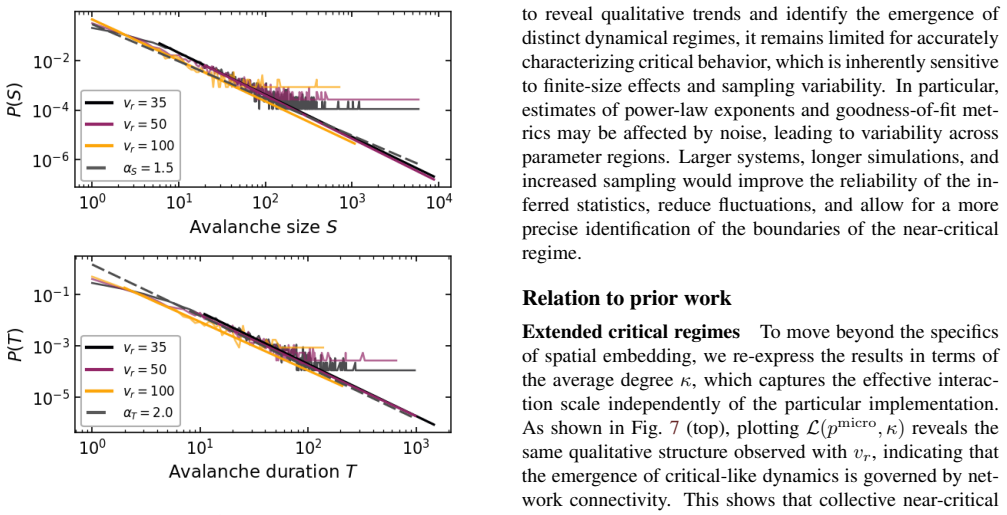
L(p_micro, v_r) = |α_S − 1.5| + |α_T − 2| + KS_S + KS_T ... reference values 1.5 and 2 correspond to the classical critical exponents predicted by simple branching-process models
-
Foundation.AlphaCoordinateFixation / CostJ_uniquely_calibrated_via_higher_derivative unclear?
unclearRelation between the paper passage and the cited Recognition theorem.
p_micro_c = 1/(N_neurons − 1) ... homogeneous transmission probability W_{i,j} = p_micro for i ≠ j
-
Foundation.AlexanderDuality (RS dimensional forcing)alexander_duality_circle_linking unclear?
unclearRelation between the paper passage and the cited Recognition theorem.
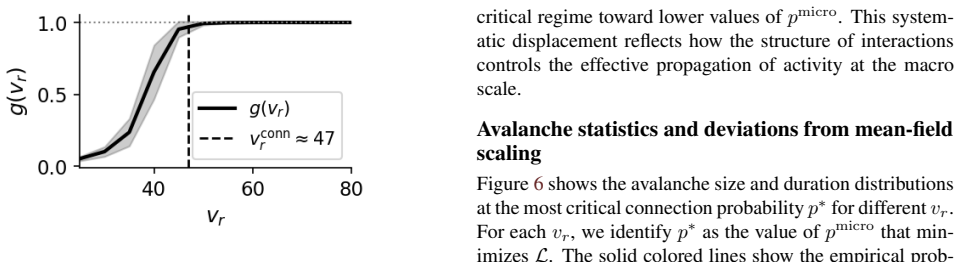
v_r^conn = sqrt(L² ln N_agents / ((N_agents − 1) π)) ≈ 47 ... classical result for Random Geometric Graph connectivity
What do these tags mean?
- matches
- The paper's claim is directly supported by a theorem in the formal canon.
- supports
- The theorem supports part of the paper's argument, but the paper may add assumptions or extra steps.
- extends
- The paper goes beyond the formal theorem; the theorem is a base layer rather than the whole result.
- uses
- The paper appears to rely on the theorem as machinery.
- contradicts
- The paper's claim conflicts with a theorem or certificate in the canon.
- unclear
- Pith found a possible connection, but the passage is too broad, indirect, or ambiguous to say the theorem truly supports the claim.
Reference graph
Works this paper leans on
-
[1]
and Bedia, M
Aguilera, M. and Bedia, M. G. (2018). Adaptation to criticality through organizational invariance in embodied agents.Scien- tific Reports, 8(1):7723
2018
-
[2]
Alstott, J., Bullmore, E., and Plenz, D. (2014). powerlaw: A Python Package for Analysis of Heavy-Tailed Distributions. PLoS ONE, 9(1):e85777
2014
-
[3]
and Plenz, D
Beggs, J. and Plenz, D. (2003). Neuronal Avalanches in Neocorti- cal Circuits.The Journal of Neuroscience, 23:11167–11177
2003
-
[4]
T., Mayer, N
Boedecker, J., Obst, O., Lizier, J. T., Mayer, N. M., and Asada, M. (2012). Information processing in echo state networks at the edge of chaos.Theory in Biosciences, 131(3):205–213
2012
-
[5]
Braccini, M., Roli, A., Barbieri, E., and Kauffman, S. A. (2022). On the Criticality of Adaptive Boolean Network Robots.En- tropy, 24(10):1368
2022
-
[6]
R., and Newman, M
Clauset, A., Shalizi, C. R., and Newman, M. E. J. (2009). Power-Law Distributions in Empirical Data.SIAM Review, 51(4):661–703
2009
-
[7]
Meier, K., and Priesemann, V . (2020). Control of critical- ity and computation in spiking neuromorphic networks with plasticity.Nature Communications, 11(1):2853
2020
- [8]
-
[9]
and Sayama, H
Kim, H. and Sayama, H. (2018).How Criticality of Gene Regu- latory Networks Affects the Resulting Morphogenesis under Genetic Perturbations
2018
-
[10]
Mora, T. and Bialek, W. (2011). Are biological systems poised at criticality?Journal of Statistical Physics, 144(2):268–302. arXiv:1012.2242 [q-bio]
- [11]
-
[12]
Romanczuk, P. and Daniels, B. C. (2023). Phase Transitions and Criticality in the Collective Behavior of Animals – Self-organization and biological function. pages 179–208. arXiv:2211.03879 [physics]. R¨am¨o, P., Kesseli, J., and Yli-Harja, O. (2006). Perturbation avalanches and criticality in gene regulatory networks.Jour- nal of Theoretical Biology, 242...
-
[13]
Torres-Sosa, C., Huang, S., and Aldana, M. (2012). Criticality Is an Emergent Property of Genetic Networks that Exhibit Evolvability.PLOS Computational Biology, 8(9):e1002669
2012
discussion (0)
Sign in with ORCID, Apple, or X to comment. Anyone can read and Pith papers without signing in.