Recognition: unknown
Reviving Motivated Inflationary Potentials with K-inflation in the light of ACT
Pith reviewed 2026-05-09 16:04 UTC · model grok-4.3
The pith
A field-dependent non-canonical kinetic term revives α-attractor T-models and natural inflation to match the higher scalar spectral index favored by ACT data.
A machine-rendered reading of the paper's core claim, the machinery that carries it, and where it could break.
Core claim
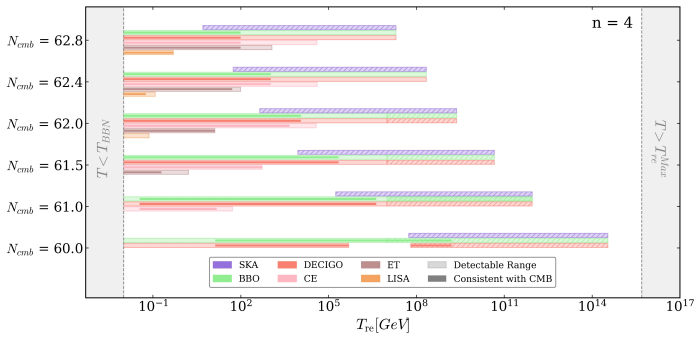
In this K-inflation framework the non-minimal kinetic coupling supplies extra friction that shifts the α-attractor T-model with n=2 into the observationally favored region for β∼O(10) and α≳O(10^{-3}) to satisfy Swampland criteria, while natural inflation with n=4,5 becomes compatible for α≲7,8 and β≲−1. These parameter choices yield matter-like reheating and a red-tilted gravitational-wave background for the T-model, versus stiff reheating and a blue-tilted gravitational-wave background for natural inflation that could be accessible to LISA, Cosmic Explorer, Einstein Telescope, DECIGO and BBO while obeying BBN and ΔNeff limits.
What carries the argument
The field-dependent non-canonical kinetic term G(φ) that augments the friction term in the inflaton equation of motion beyond the canonical case.
Load-bearing premise
The specific functional form chosen for the non-canonical kinetic term G(φ) is assumed to be a theoretically motivated effective description rather than a phenomenological choice tuned to fit the data.
What would settle it
A measurement of the primordial gravitational-wave spectral index that is inconsistent with the red tilt predicted for the viable T-model parameters or the blue tilt predicted for the viable natural-inflation parameters would rule out the proposed mechanism.
Figures





read the original abstract
Recent ACT data favor a higher scalar spectral index $n_s$, placing models such as $\alpha$-attractor T-models and natural Inflation in tension with current observations. We propose a K-inflation framework with a field-dependent non-canonical kinetic term $G(\phi)$ that reconciles these models with the latest Planck-ACT-LB-BK18 constraints. Our analysis includes a refined calculation of the reheating equation-of-state parameter $w_{\rm re}$, avoids standard power-law approximations, and tests consistency with the Swampland Distance and de Sitter Conjectures. We find that the additional friction from the non-minimal kinetic coupling shifts both models into the favored observational regions. For the $\alpha$-attractor T-model with $n=2$, viable solutions occur for $\beta\sim \mathcal{O}(10)$, with Swampland consistency favoring $\alpha\gtrsim \mathcal{O}(10^{-3})$. This case predicts matter-like reheating and a red-tilted gravitational-wave background that is unlikely to be detected soon. In contrast, natural Inflation with $n=4,5$ is compatible with CMB constraints for $\alpha\lesssim 7,8$ and $\beta\lesssim -1$, respectively, leading to stiff reheating and a blue-tilted gravitational-wave background potentially observable by LISA, Cosmic Explorer, Einstein Telescope, DECIGO, and BBO while satisfying BBN and $\Delta N_{\rm eff}$ bounds. Combining gravitational-wave probes with Swampland criteria may therefore help distinguish possible UV completions of inflation.
Editorial analysis
A structured set of objections, weighed in public.
Referee Report
Summary. The paper proposes a K-inflation framework incorporating a field-dependent non-canonical kinetic term G(φ) to reconcile α-attractor T-models (n=2) and natural inflation (n=4,5) with recent ACT data favoring a higher scalar spectral index ns. It reports that the additional friction from this term shifts the models into the observationally allowed regions for parameter ranges such as β∼O(10) and α≳O(10^{-3}) for the T-model, and α≲7,8 with β≲−1 for natural inflation. The analysis includes a refined computation of the reheating equation-of-state parameter w_re without standard power-law approximations, consistency checks with the Swampland Distance and de Sitter Conjectures, and predictions for the gravitational-wave background spectrum and its detectability.
Significance. If the specific functional form of G(φ) can be shown to arise from a UV-complete theory or symmetry principle, the work would offer a concrete mechanism to revive these otherwise disfavored inflationary potentials while generating distinct, testable signatures in reheating and primordial gravitational waves. The refined reheating calculation and explicit Swampland tests are positive features that go beyond standard slow-roll analyses.
major comments (2)
- [Model definition section] Model definition section: the functional form chosen for the non-canonical kinetic term G(φ) is introduced without derivation from a symmetry, UV completion, or string embedding. This choice is load-bearing for the central claim, as the reported shifts in ns and the viable windows for α, β are achieved only for this specific G(φ); without independent motivation the reconciliation remains a phenomenological adjustment rather than a theoretically motivated extension.
- [Parameter scan and results section] Parameter scan and results section: the quoted viable ranges (β∼O(10) for the T-model; α≲7,8 and β≲−1 for natural inflation) are obtained by fitting the modified slow-roll parameters directly to the same Planck-ACT-LB-BK18 dataset. No independent external benchmark, analytic derivation, or cross-check against a different observable is provided to establish these windows as predictions rather than post-hoc fits.
minor comments (2)
- [Abstract and introduction] The abstract and introduction would benefit from a clearer statement of the explicit functional form adopted for G(φ) and the precise definition of the parameters α and β.
- [Figures] Figure captions for the ns-r contours and GW spectra should explicitly state the reheating assumptions and the range of β values shown.
Simulated Author's Rebuttal
We thank the referee for the constructive and detailed report. We address the major comments point by point below, providing clarifications and revisions where they strengthen the manuscript without altering its core results.
read point-by-point responses
-
Referee: [Model definition section] the functional form chosen for the non-canonical kinetic term G(φ) is introduced without derivation from a symmetry, UV completion, or string embedding. This choice is load-bearing for the central claim, as the reported shifts in ns and the viable windows for α, β are achieved only for this specific G(φ); without independent motivation the reconciliation remains a phenomenological adjustment rather than a theoretically motivated extension.
Authors: We acknowledge that the specific form of G(φ) is introduced phenomenologically within the K-inflation framework to demonstrate the impact of field-dependent non-canonical kinetics on the inflationary observables. Such terms are standard in effective field theory treatments of inflation, where they arise as higher-order operators or from integrating out heavy degrees of freedom. While this work does not derive the exact functional form from a particular string embedding or UV completion, we have revised the model definition section to include a brief discussion of possible theoretical origins (e.g., from axion monodromy or supergravity corrections) and to explicitly state the phenomenological nature of the choice. The central claim remains that this mechanism shifts the models into the allowed region; a full UV derivation is left for future work. revision: partial
-
Referee: [Parameter scan and results section] the quoted viable ranges (β∼O(10) for the T-model; α≲7,8 and β≲−1 for natural inflation) are obtained by fitting the modified slow-roll parameters directly to the same Planck-ACT-LB-BK18 dataset. No independent external benchmark, analytic derivation, or cross-check against a different observable is provided to establish these windows as predictions rather than post-hoc fits.
Authors: The quoted ranges are the values of the model parameters (α, β) for which the modified slow-roll predictions satisfy the Planck-ACT-LB-BK18 constraints. This is the standard procedure for constraining inflationary models. The underlying potentials are independently motivated by theory, and the additional predictions of the framework—refined reheating dynamics, explicit Swampland consistency checks, and the distinct gravitational-wave spectra (red-tilted for the T-model, blue-tilted and potentially detectable for natural inflation)—serve as independent tests. We have revised the results section to emphasize these cross-checks and to clarify that the ranges represent observationally viable windows rather than a priori predictions. revision: partial
Circularity Check
No significant circularity detected
full rationale
The paper proposes a specific functional form for the non-canonical kinetic term G(φ) to introduce additional friction and then computes the resulting slow-roll parameters, viable ranges for α and β, reheating equation of state, and gravitational-wave spectra that satisfy the ACT/Planck constraints. This constitutes standard parameter-space exploration and consistency checking rather than any self-definitional loop, fitted input renamed as prediction, or load-bearing self-citation that reduces the central claim to its own inputs by construction. Swampland criteria are applied after the fact as external tests. No equations or derivations in the abstract reduce the reported viability windows to tautological fits.
Axiom & Free-Parameter Ledger
free parameters (2)
- β
- α
axioms (2)
- domain assumption Swampland Distance and de Sitter Conjectures hold and can be used to constrain inflationary models
- standard math Standard single-field slow-roll perturbation theory remains valid after the non-canonical kinetic term is introduced
invented entities (1)
-
field-dependent non-canonical kinetic term G(φ)
no independent evidence
Reference graph
Works this paper leans on
-
[1]
Equation of state during the reheating phase 7
-
[2]
Swampland
Bounds on number of inflationary efolds 8 C. Gravitational Wave Background 11 IV.α-Attractor T-Model 12 V. Natural Inflation 16 A. Quartic case (n= 4) 17 B. Quintic case (n= 5) 22 VI. Discussion and Conclusion 24 Acknowledgment 27 A. Validity of the Power-LawP t Approximation 27 B. Natural Inflation with Negative Cosine 29 References 30 2 I. INTRODUCTION ...
2018
-
[3]
Equation of state during the reheating phase The cosmological evolution during the reheating phase also depends on how the inflaton energy density is diluted by cosmic expansion. This evolution can be captured by the effective equation 7 of state parameter 1 wre, i.e.,ρ(a) =ρ i exp h −3 R lna lna i 3(1 +w re(a))dlna i which reduces toρ∝ a−3(1+wre) for a c...
-
[4]
g∗s(T0) g∗s(Tre) 1/3 πMPl r rAs 2 ! a0T0 kTre e−Nre # ,(17) = ln
Bounds on number of inflationary efolds Consider the cosmological evolution starting when the perturbation of comoving scalek=a kHk (witha k andH k being the scale factor and Hubble parameter at that time) exited the horizon during inflation. This mode left the horizonN k ≡ln(a end/ak) e-folds before inflation ends and reenters the horizon at the CMB scal...
-
[5]
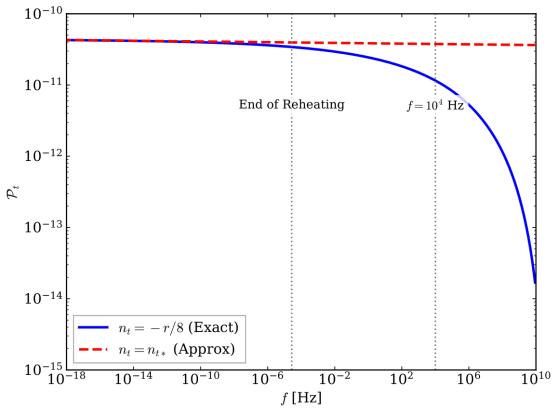
wherek a k is the physical Hubble size when the modekreenters the horizon, andH 0 is the Hubble scale today. In this work, we consider a power-law tensor power spectrum Pt(f) =rA s(f /f∗)nt with the spectral indexn t obtained from the consistency relationn t ≃ −r/8, whoseris evaluated for a given model at the CMB scale. The frequency corresponding to CMB ...
2018
-
[6]
A. H. Guth,The Inflationary Universe: A Possible Solution to the Horizon and Flatness Problems, Phys. Rev. D23(1981) 347
1981
-
[7]
A. D. Linde,A New Inflationary Universe Scenario: A Possible Solution of the Horizon, Flatness, Homogeneity, Isotropy and Primordial Monopole Problems,Phys. Lett. B108(1982) 389
1982
-
[8]
A. A. Starobinsky,A New Type of Isotropic Cosmological Models Without Singularity,Phys. Lett. B 91(1980) 99
1980
-
[9]
V. F. Mukhanov and G. V. Chibisov,Quantum Fluctuations and a Nonsingular Universe,JETP Lett.33(1981) 532
1981
-
[10]
S. W. Hawking,The Development of Irregularities in a Single Bubble Inflationary Universe,Phys. Lett. B115(1982) 295
1982
-
[11]
A. H. Guth and S. Y. Pi,Fluctuations in the New Inflationary Universe,Phys. Rev. Lett.49(1982) 1110. 30 [7]WMAPcollaboration,Nine-Year Wilkinson Microwave Anisotropy Probe (WMAP) Observations: Cosmological Parameter Results,Astrophys. J. Suppl.208(2013) 19 [1212.5226]. [8]Planckcollaboration,Planck 2018 results. X. Constraints on inflation,Astron. Astroph...
work page Pith review arXiv 1982
-
[12]
Universality Class in Conformal Inflation
R. Kallosh and A. Linde,Universality Class in Conformal Inflation,JCAP07(2013) 002 [1306.5220]
work page Pith review arXiv 2013
-
[13]
Superconformal Inflationary $\alpha$-Attractors
R. Kallosh, A. Linde and D. Roest,Superconformal Inflationaryα-Attractors,JHEP11(2013) 198 [1311.0472]
work page Pith review arXiv 2013
-
[14]
F. Parvizi, S. Heydari, M. Solbi and K. Karami,Loop quantum inflation with inverse volume corrections in light of ACT data,JHEAp52(2026) 100563 [2510.03882]
-
[15]
H. Heidarian, M. Solbi, S. Heydari and K. Karami,α-attractor inflation modified by GUP in light of ACT observations,Phys. Lett. B869(2025) 139833 [2506.10547]
-
[16]
R. Kallosh, A. Linde and D. Roest,Atacama Cosmology Telescope, South Pole Telescope, and Chaotic Inflation,Phys. Rev. Lett.135(2025) 161001 [2503.21030]
- [17]
-
[18]
C. Dioguardi, A. J. Iovino and A. Racioppi,Fractional attractors in light of the latest ACT observations,Phys. Lett. B868(2025) 139664 [2504.02809]
-
[19]
Independent connection in action during inflation,
A. Salvio,Independent connection in action during inflation,Phys. Rev. D112(2025) L061301 [2504.10488]
- [20]
-
[21]
M. Drees and Y. Xu,Refined predictions for Starobinsky inflation and post-inflationary constraints in light of ACT,Phys. Lett. B867(2025) 139612 [2504.20757]
-
[22]
L. Liu, Z. Yi and Y. Gong,Reconciling Higgs Inflation with ACT Observations through Reheating, 2505.02407
work page internal anchor Pith review Pith/arXiv arXiv
- [23]
-
[24]
Pallis,Updating GUT-Scale Pole Higgs Inflation After ACT DR6, Phys
C. Pallis,Updating GUT-scale pole Higgs inflation after ACT DR6,Phys. Rev. D113(2026) 015033 [2510.02083]
-
[25]
Y. Aldabergenov and S. V. Ketov,Single-field D-type inflation in the minimal supergravity in light of Planck-ACT-SPT data,Eur. Phys. J. C86(2026) 91 [2512.08760]
- [26]
- [27]
-
[28]
J. Yuennan, P. Koad, F. Atamurotov and P. Channuie,Quantum-correctedϕ 4 inflation in light of ACT observations,Eur. Phys. J. C85(2025) 1307 [2508.17263]
-
[29]
D. S. Zharov, O. O. Sobol and S. I. Vilchinskii,ACT observations, reheating, and Starobinsky and Higgs inflation,Phys. Rev. D112(2025) 023544
2025
- [30]
- [31]
-
[32]
J. Alexandre, L. Heurtier and S. Pla,Exact Renormalisation Group Evolution of the Inflation Dynamics: Reconcilingα-Attractors with ACT,2511.05296
-
[33]
C. Armendariz-Picon, T. Damour and V. F. Mukhanov,k - inflation,Phys. Lett. B458(1999) 209 [hep-th/9904075]
-
[34]
J. Garriga and V. F. Mukhanov,Perturbations in k-inflation,Phys. Lett. B458(1999) 219 [hep-th/9904176]
-
[35]
G. Barenboim and W. H. Kinney,Slow roll in simple non-canonical inflation,JCAP03(2007) 014 [astro-ph/0701343]
- [36]
-
[37]
M. Solbi and K. Karami,Primordial black holes and induced gravitational waves ink-inflation, JCAP08(2021) 056 [2102.05651]
-
[38]
M. Solbi and K. Karami,Primordial black holes formation in the inflationary model with field-dependent kinetic term for quartic and natural potentials,Eur. Phys. J. C81(2021) 884 [2106.02863]
-
[39]
K. Freese and W. H. Kinney,Natural Inflation: Consistency with Cosmic Microwave Background Observations of Planck and BICEP2,JCAP03(2015) 044 [1403.5277]
-
[40]
Kitabayashi,Generalized hybrid natural inflation,Phys
T. Kitabayashi,Generalized hybrid natural inflation,Phys. Rev. D108(2023) 043514 [2305.03905]
-
[41]
N. Zhang, Y.-B. Wu, J.-W. Lu, C.-W. Sun, L.-J. Shou and H.-Z. Xu,Constraints on the generalized natural inflation after Planck 2018,Chin. Phys. C44(2020) 095107 [1807.03596]
-
[42]
Cosmological Constraints on Late-time Entropy Production
M. Kawasaki, K. Kohri and N. Sugiyama,Cosmological constraints on late time entropy production, 32 Phys. Rev. Lett.82(1999) 4168 [astro-ph/9811437]
work page Pith review arXiv 1999
-
[43]
MeV-scale Reheating Temperature and Thermalization of Neutrino Background
M. Kawasaki, K. Kohri and N. Sugiyama,MeV scale reheating temperature and thermalization of neutrino background,Phys. Rev. D62(2000) 023506 [astro-ph/0002127]
work page Pith review arXiv 2000
-
[44]
S. Hannestad,What is the lowest possible reheating temperature?,Phys. Rev. D70(2004) 043506 [astro-ph/0403291]
-
[45]
P. F. de Salas, M. Lattanzi, G. Mangano, G. Miele, S. Pastor and O. Pisanti,Bounds on very low reheating scenarios after Planck,Phys. Rev. D92(2015) 123534 [1511.00672]
work page Pith review arXiv 2015
-
[46]
L. Iacconi, S. Bhattacharya, M. Fasiello and D. Wands,Closing in onα-attractors,2511.14673
- [47]
-
[48]
Y. Watanabe and E. Komatsu,Improved Calculation of the Primordial Gravitational Wave Spectrum in the Standard Model,Phys. Rev. D73(2006) 123515 [astro-ph/0604176]
- [49]
- [50]
-
[51]
K. Saikawa and S. Shirai,Primordial gravitational waves, precisely: The role of thermodynamics in the Standard Model,JCAP05(2018) 035 [1803.01038]
- [52]
-
[53]
R. Allahverdi et al.,The First Three Seconds: a Review of Possible Expansion Histories of the Early Universe,Open J. Astrophys.4(2021) astro.2006.16182 [2006.16182]
-
[54]
Y. Gouttenoire, G. Servant and P. Simakachorn,Kination cosmology from scalar fields and gravitational-wave signatures,2111.01150
-
[55]
Y. Gouttenoire, G. Servant and P. Simakachorn,Revealing the Primordial Irreducible Inflationary Gravitational-Wave Background with a Spinning Peccei-Quinn Axion,2108.10328
- [56]
-
[57]
Simakachorn,Charting Cosmological History and New Particle Physics with Primordial Gravitational Waves, Ph.D
P. Simakachorn,Charting Cosmological History and New Particle Physics with Primordial Gravitational Waves, Ph.D. thesis, U. Hamburg (main), Hamburg U., 2022
2022
- [58]
-
[59]
A. Konings, M. Marinichenko, O. Mikulenko and S. P. Patil,Primordial Gravitational Wave Probes of Non-Standard Thermal Histories,2412.15144. [61]LIGO Scientific, VIRGO, KAGRAcollaboration,Cosmological and High Energy Physics 33 implications from gravitational-wave background searches in LIGO-Virgo-KAGRA’s O1-O4a runs, 2510.26848. [62]LIGO Scientific, VIRG...
-
[60]
Sensitivity Studies for Third-Generation Gravitational Wave Observatories
S. Hild et al.,Sensitivity Studies for Third-Generation Gravitational Wave Observatories,Class. Quant. Grav.28(2011) 094013 [1012.0908]
work page Pith review arXiv 2011
-
[61]
The Science of the Einstein Telescope
M. Punturo et al.,The Einstein Telescope: A third-generation gravitational wave observatory,Class. Quant. Grav.27(2010) 194002. [69]ETcollaboration,The Science of the Einstein Telescope,JCAP03(2026) 081 [2503.12263]. [70]LIGO Scientificcollaboration,Exploring the Sensitivity of Next Generation Gravitational Wave Detectors,Class. Quant. Grav.34(2017) 04400...
work page internal anchor Pith review Pith/arXiv arXiv 2010
-
[62]
G. M. Harry, P. Fritschel, D. A. Shaddock, W. Folkner and E. S. Phinney,Laser interferometry for the big bang observer,Class. Quant. Grav.23(2006) 4887
2006
-
[63]
J. Crowder and N. J. Cornish,Beyond LISA: Exploring future gravitational wave missions,Phys. Rev. D72(2005) 083005 [gr-qc/0506015]
-
[64]
Detecting the Cosmic Gravitational Wave Background with the Big Bang Observer
V. Corbin and N. J. Cornish,Detecting the cosmic gravitational wave background with the big bang observer,Class. Quant. Grav.23(2006) 2435 [gr-qc/0512039]
work page Pith review arXiv 2006
-
[65]
Detector configuration of DECIGO/BBO and identification of cosmological neutron-star binaries
K. Yagi and N. Seto,Detector configuration of DECIGO/BBO and identification of cosmological neutron-star binaries,Phys. Rev. D83(2011) 044011 [1101.3940]
work page Pith review arXiv 2011
-
[66]
N. Seto, S. Kawamura and T. Nakamura,Possibility of direct measurement of the acceleration of the universe using 0.1-Hz band laser interferometer gravitational wave antenna in space,Phys. Rev. Lett. 87(2001) 221103 [astro-ph/0108011]
work page Pith review arXiv 2001
-
[67]
Kawamura et al.,The Japanese space gravitational wave antenna DECIGO,Class
S. Kawamura et al.,The Japanese space gravitational wave antenna DECIGO,Class. Quant. Grav. 23(2006) S125
2006
-
[68]
The NANOGrav 15-year Data Set: Evidence for a Gravitational-Wave Background
S. Kawamura et al.,The Japanese space gravitational wave antenna: DECIGO,Class. Quant. Grav. 28(2011) 094011. [78]NANOGravcollaboration,The NANOGrav 15 yr Data Set: Evidence for a Gravitational-wave Background,Astrophys. J. Lett.951(2023) L8 [2306.16213]. [79]NANOGravcollaboration,The NANOGrav 15 yr Data Set: Search for Signals from New Physics, Astrophys...
work page internal anchor Pith review arXiv 2011
-
[69]
D. J. Reardon et al.,Search for an Isotropic Gravitational-wave Background with the Parkes Pulsar Timing Array,Astrophys. J. Lett.951(2023) L6 [2306.16215]. [82]SKAO Pulsar Science Working Groupcollaboration,The SKAO Pulsar Timing Array, 2512.16163
work page internal anchor Pith review arXiv 2023
-
[70]
On the Geometry of the String Landscape and the Swampland
H. Ooguri and C. Vafa,On the Geometry of the String Landscape and the Swampland,Nucl. Phys. B 766(2007) 21 [hep-th/0605264]
work page Pith review arXiv 2007
-
[71]
The String Landscape and the Swampland
C. Vafa,The String landscape and the swampland,hep-th/0509212
-
[72]
Das,Note on single-field inflation and the swampland criteria,Phys
S. Das,Note on single-field inflation and the swampland criteria,Phys. Rev. D99(2019) 083510 [1809.03962]
- [73]
-
[74]
Distance and de Sitter Conjectures on the Swampland
H. Ooguri, E. Palti, G. Shiu and C. Vafa,Distance and de Sitter Conjectures on the Swampland, Phys. Lett. B788(2019) 180 [1810.05506]
work page Pith review arXiv 2019
-
[75]
A. Kehagias and A. Riotto,A note on Inflation and the Swampland,Fortsch. Phys.66(2018) 1800052 [1807.05445]
-
[76]
T. Kobayashi, M. Yamaguchi and J. Yokoyama,G-inflation: Inflation driven by the Galileon field, Phys. Rev. Lett.105(2010) 231302 [1008.0603]
- [77]
-
[78]
K. Mukaida and K. Nakayama,Dynamics of oscillating scalar field in thermal environment,JCAP 01(2013) 017 [1208.3399]
- [79]
-
[80]
G. Germ´ an, R. G. Quaglia and A. M. M. Colorado,Model independent bounds for the number of e-folds during the evolution of the universe,JCAP03(2023) 004 [2212.03730]
discussion (0)
Sign in with ORCID, Apple, or X to comment. Anyone can read and Pith papers without signing in.