Recognition: 3 theorem links
· Lean TheoremA revision of Litvak's conjecture on Gaussian minima and a volumetric zone conjecture
Pith reviewed 2026-05-08 19:28 UTC · model grok-4.3
The pith
The cosine correlation matrix minimizes the p-moments of the minimum absolute coordinate among correlated Gaussians, disproving Litvak's simplex conjecture.
A machine-rendered reading of the paper's core claim, the machinery that carries it, and where it could break.
Core claim
Litvak conjectured that among all n by n correlation matrices the Gram matrix of the regular simplex in R^{n-1} minimizes E[min_i |g_i|^p] for g ~ N(0, Σ). We disprove this by exhibiting the matrix Σ^cos with entries cos(π(i-j)/n), which gives a strictly smaller value for p=2 and n=4. We propose that Σ^cos minimizes the moment for all p>0 and all n. Conditional on a volumetric extension of Fejes Tóth's zone conjecture we prove that min_i |g_i| under Σ^cos is stochastically dominated by the same minimum under any other correlation matrix Σ.
What carries the argument
The cosine matrix Σ^cos with entries cos(π(i-j)/n), which the paper shows outperforms the simplex and conjectures to be the global minimizer of the p-moments, with stochastic dominance following from the volumetric zone conjecture.
If this is right
- The p-moment E[min_i |g_i|^p] is at least as large for any correlation matrix as it is for the cosine matrix.
- Conditional on the volumetric zone conjecture, min_i |g_i| under the cosine matrix is stochastically smaller than under any other correlation matrix.
- The cosine matrix is conjectured to be the unique minimizer of these moments for every p>0 and every n.
- The counterexample was located by an AI-assisted optimization procedure over the space of correlation matrices.
Where Pith is reading between the lines
- If the cosine matrix is optimal then explicit tail bounds on the smallest coordinate become available for stationary Gaussian sequences whose covariance is a cosine function of lag.
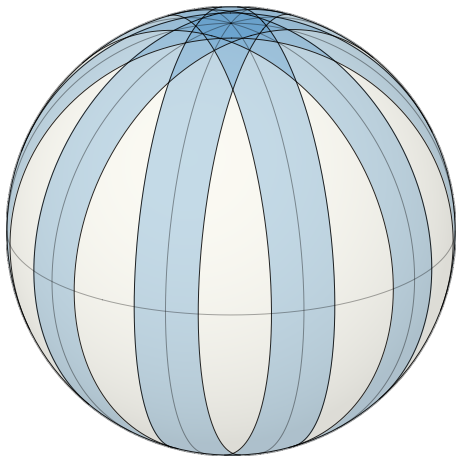
- The volumetric zone conjecture can be checked directly in spherical geometry without reference to Gaussians, by comparing volumes of certain spherical zones.
- For n larger than 4 the same optimization approach could be rerun to test whether the cosine pattern continues to produce the smallest observed moments.
- Circulant correlation structures may play an extremal role more generally in problems involving the distribution of coordinate-wise minima of Gaussian vectors.
Load-bearing premise
The volumetric extension of Fejes Tóth's zone conjecture holds, which is required to establish stochastic dominance of the minimum under the cosine matrix.
What would settle it
A numerical search over 4 by 4 correlation matrices that finds one whose E[min_i |g_i|^2] is smaller than the value attained by the cosine matrix.
Figures


read the original abstract
Litvak (2018) conjectured that, for any $p > 0$, the quantity $\mathbb{E}[\min_{i = 1}^n |g_i|^p]$ where $g \sim \mathcal{N}(0, \Sigma)$ is a centered Gaussian random vector is minimized among $n \times n$ correlation matrices $\Sigma$ by the Gram matrix of the regular simplex in $\mathbb{R}^{n - 1}$. We disprove this conjecture: the matrix with entries $\Sigma^{\mathrm{cos}}_{ij}=\cos(\pi(i - j) / n)$ already achieves a smaller moment for $p = 2$ and $n = 4$. We propose that $\Sigma^{\mathrm{cos}}$ is in fact the correct minimizer of these moments for all $p > 0$ and $n \geq 1$. Towards proving this, we conjecture a volumetric extension of Fejes T\'{o}th's zone conjecture (1973), whose covering version was proved by Jiang and Polyanskii (2017). Conditional on this conjecture, we show the stronger result that $\min_{i = 1}^n |g_i|$ for $g \sim \mathcal{N}(0, \Sigma^{\mathrm{cos}})$ is stochastically dominated by $\min_{i = 1}^n |h_i|$ for $h \sim \mathcal{N}(0, \Sigma)$ for any $n \times n$ correlation matrix $\Sigma$. Our counterexample $\Sigma^{\mathrm{cos}}$ was found by the AlphaEvolve AI-assisted optimization system, and we also include a brief discussion of its application to such problems.
Editorial analysis
A structured set of objections, weighed in public.
Referee Report
Summary. The paper claims to disprove Litvak's conjecture by showing that the cosine correlation matrix Σ^{cos} gives a smaller E[min |g_i|^p] for p=2, n=4 than the simplex. It proposes Σ^{cos} as the general minimizer and conjectures a volumetric zone conjecture to prove stochastic dominance of min |g_i| under this matrix over arbitrary Σ.
Significance. The explicit counterexample provides a concrete disproof, which is verifiable and strengthens the literature on Gaussian extrema. If the new conjecture holds, it offers a stronger result on stochastic dominance with geometric interpretations via spherical zones, potentially impacting related conjectures in convex geometry. Credit is given for the AI-assisted discovery method.
major comments (2)
- [Conjecture 1.3] This volumetric extension is introduced without proof or supporting calculations for the Gaussian minima context. As the stochastic dominance in Theorem 1.4 depends on it, the proposed revision of Litvak's conjecture is not fully substantiated beyond the specific counterexample.
- [Theorem 1.4] The proof of stochastic dominance is conditional on the unproven Conjecture 1.3. This is a load-bearing assumption for the stronger claim, and the paper would benefit from either proving the conjecture or providing empirical evidence for small n to support the general statement.
minor comments (2)
- Provide the explicit numerical values of the moments computed for the counterexample to facilitate independent verification.
- Ensure all references to prior work on the zone conjecture, such as Jiang-Polyanskii, are clearly cited in the introduction.
Simulated Author's Rebuttal
We thank the referee for their thoughtful and constructive report. The primary contribution of the manuscript is the explicit, verifiable counterexample disproving Litvak's conjecture for n=4 and p=2. We agree that the stochastic dominance claim in Theorem 1.4 is conditional on the new volumetric conjecture, and we will revise the paper to clarify this dependence, emphasize the independent value of the counterexample, and add empirical support for small n as suggested.
read point-by-point responses
-
Referee: [Conjecture 1.3] This volumetric extension is introduced without proof or supporting calculations for the Gaussian minima context. As the stochastic dominance in Theorem 1.4 depends on it, the proposed revision of Litvak's conjecture is not fully substantiated beyond the specific counterexample.
Authors: We acknowledge that Conjecture 1.3 is presented without a proof, as it is a new conjecture extending Fejes Tóth's zone conjecture to a volumetric setting. The manuscript's disproof of Litvak's original conjecture relies solely on the explicit computation with Σ^cos for n=4, p=2, which stands independently. The volumetric conjecture is offered as a potential route to the stronger general result. In the revision we will add numerical verification of the volumetric inequality for small n (n≤6) in the specific context of Gaussian minima to provide concrete supporting calculations. revision: partial
-
Referee: [Theorem 1.4] The proof of stochastic dominance is conditional on the unproven Conjecture 1.3. This is a load-bearing assumption for the stronger claim, and the paper would benefit from either proving the conjecture or providing empirical evidence for small n to support the general statement.
Authors: The manuscript already states explicitly that Theorem 1.4 holds conditionally on Conjecture 1.3. We believe the conditional stochastic dominance result remains of interest because it reduces the revised conjecture to a purely geometric statement. Following the referee's recommendation, we will include a new subsection with Monte Carlo simulations for small n (including n=3,4,5,6) that compare the empirical CDF of min_i |g_i| under Σ^cos against the simplex, equiangular, and identity matrices, thereby supplying empirical evidence for the dominance in the Gaussian setting. revision: yes
Circularity Check
No circularity; disproof is explicit computation and dominance is conditional on new independent conjecture
full rationale
The paper's core disproof of Litvak's conjecture for p=2 and n=4 is an unconditional, direct numerical comparison showing that the explicitly defined cosine matrix Σ^cos achieves a strictly smaller E[min |g_i|^p] than the regular simplex Gram matrix; this calculation stands alone without reference to any fitted parameters, self-defined quantities, or the new conjecture. The proposed minimizer property and the stochastic dominance theorem (Theorem 1.4) are both stated as conditional on Conjecture 1.3, a volumetric extension of Fejes Tóth's zone conjecture whose covering case is cited from independent prior work (Jiang-Polyanskii 2017). No derivation step reduces a claimed prediction or uniqueness result to a quantity defined in terms of itself, and the AI-assisted discovery of the counterexample is an external search process rather than an internal fit. The paper is therefore self-contained against external benchmarks for its unconditional claims.
Axiom & Free-Parameter Ledger
axioms (1)
- ad hoc to paper Volumetric extension of Fejes Tóth's zone conjecture
Lean theorems connected to this paper
-
Cost.FunctionalEquation (J = ½(x+x⁻¹)−1, washburn_uniqueness_aczel)washburn_uniqueness_aczel unclear?
unclearRelation between the paper passage and the cited Recognition theorem.
Σ^cos_{ij} := cos(π(i-j)/n) ... a rank-two correlation matrix
-
Foundation.AlexanderDuality (D=3 forcing via circle linking)alexander_duality_circle_linking unclear?
unclearRelation between the paper passage and the cited Recognition theorem.
Conjecture 4.1 (Volumetric zone conjecture) on S^{d-1} for arbitrary d
What do these tags mean?
- matches
- The paper's claim is directly supported by a theorem in the formal canon.
- supports
- The theorem supports part of the paper's argument, but the paper may add assumptions or extra steps.
- extends
- The paper goes beyond the formal theorem; the theorem is a base layer rather than the whole result.
- uses
- The paper appears to rely on the theorem as machinery.
- contradicts
- The paper's claim conflicts with a theorem or certificate in the canon.
- unclear
- Pith found a possible connection, but the passage is too broad, indirect, or ambiguous to say the theorem truly supports the claim.
Reference graph
Works this paper leans on
-
[1]
Covering by planks and avoiding zeros of polynomials
Alexey Glazyrin, Roman Karasev, and Alexandr Polyanskii. Covering by planks and avoiding zeros of polynomials. International Mathematics Research Notices , 2023(13):11684--11700, 2023
2023
-
[2]
Minima of sequences of Gaussian random variables
Yehoram Gordon, Alexander Litvak, Carsten Sch \"u tt, and Elisabeth Werner. Minima of sequences of Gaussian random variables. Comptes Rendus Math \'e matique , 340(6):445--448, 2005
2005
-
[3]
Litvak, Carsten Sch \"u tt, and Elisabeth Werner
Yehoram Gordon, Alexander E. Litvak, Carsten Sch \"u tt, and Elisabeth Werner. On the minimum of several random variables. Proceedings of the American Mathematical Society , 134(12):3665--3675, 2006
2006
-
[4]
Proof of L \'a szl \'o F ejes T \'o th's zone conjecture
Zilin Jiang and Alexandr Polyanskii. Proof of L \'a szl \'o F ejes T \'o th's zone conjecture. Geometric and Functional Analysis , 27(6):1367--1377, 2017
2017
-
[5]
Alexander E. Litvak. Around the simplex mean width conjecture. In Analytic Aspects of Convexity , pages 73--84. Springer, 2018
2018
-
[6]
Litvak and Konstantin Tikhomirov
Alexander E. Litvak and Konstantin Tikhomirov. Order statistics of vectors with dependent coordinates, and the Karhunen--Lo \`e ve basis. The Annals of Applied Probability , 28(4):2083--2104, 2018
2083
-
[7]
A conjecture concerning optimality of the Karhunen--Loeve basis in nonlinear reconstruction
Stephane Mallat and Ofer Zeitouni. A conjecture concerning optimality of the Karhunen--Loeve basis in nonlinear reconstruction. arXiv preprint arXiv:1109.0489 , 2011
-
[8]
Reinforced generation of com- binatorial structures: Applications to complexity theory, 2025
Ansh Nagda, Prabhakar Raghavan, and Abhradeep Thakurta. Reinforced generation of combinatorial structures: Hardness of approximation. arXiv preprint arXiv:2509.18057 , 2025
-
[9]
Reinforced Generation of Combinatorial Structures: Ramsey Numbers
Ansh Nagda, Prabhakar Raghavan, and Abhradeep Thakurta. Reinforced generation of combinatorial structures: Ramsey numbers. arXiv preprint arXiv:2603.09172 , 2026
work page internal anchor Pith review Pith/arXiv arXiv 2026
-
[10]
Alexander Novikov, Ng \^a n V \ u , Marvin Eisenberger, Emilien Dupont, Po-Sen Huang, Adam Zsolt Wagner, Sergey Shirobokov, Borislav Kozlovskii, Francisco J. R. Ruiz, Abbas Mehrabian, et al. AlphaEvolve : A coding agent for scientific and algorithmic discovery. arXiv preprint arXiv:2506.13131 , 2025
work page internal anchor Pith review arXiv 2025
-
[11]
An optimal plank theorem
Oscar Ortega-Moreno. An optimal plank theorem. Proceedings of the American Mathematical Society , 149(3):1225--1237, 2021
2021
-
[12]
Exploring a planet
L Fejes T \'o th. Exploring a planet. The American Mathematical Monthly , 80(9):1043--1044, 1973
1973
-
[13]
Plank theorems and their applications: a survey, 2022
William Verreault. Plank theorems and their applications: a survey, 2022. arXiv:2203.05540
-
[14]
Exploring a planet, revisited
Yufei Zhao. Exploring a planet, revisited. The American Mathematical Monthly , 129(7):678--680, 2022
2022
discussion (0)
Sign in with ORCID, Apple, or X to comment. Anyone can read and Pith papers without signing in.