Recognition: 2 theorem links
RenCon 2025: Revival of the Expressive Performance Rendering Competition
Pith reviewed 2026-05-08 18:30 UTC · model grok-4.3
The pith
The revived RenCon 2025 competition shows clear progress in systems that render expressive piano performances from scores, yet they still fall short of human musicians in conveying musical intent.
A machine-rendered reading of the paper's core claim, the machinery that carries it, and where it could break.
Core claim
RenCon 2025 revives the expressive performance rendering competition with a two-phase structure of preliminary online evaluation followed by live conference demonstrations, attracting nine submissions that collectively illustrate measurable gains in rendering capabilities alongside persistent gaps in reaching the subtlety and consistency of human pianists.
What carries the argument
The two-phase assessment structure consisting of an online preliminary round and live real-time rendering at the conference, which allows both broad accessibility and direct comparison of systems under controlled conditions.
If this is right
- Future competitions can adopt the same two-phase format to balance scale with live evaluation.
- Research groups now have concrete benchmarks for timing, dynamics, and phrasing that they can target for improvement.
- The documented challenges point to the need for systems that better model long-term musical structure and performer intent.
- Lessons from participant demographics and logistics can guide how to increase international involvement in subsequent events.
- The competition format itself serves as a repeatable mechanism for tracking field-wide progress over multiple years.
Where Pith is reading between the lines
- Similar competition structures could be adapted to other domains of expressive generation such as singing synthesis or orchestral arrangement to create cross-domain benchmarks.
- If live rendering remains central, it may encourage development of low-latency systems that could later support real-time human-AI collaborative performance.
- Public release of the submitted renderings and evaluation data would allow independent researchers to probe specific weaknesses like phrasing consistency without needing to run their own contests.
Load-bearing premise
The nine submitted systems and the chosen evaluation format together give a fair picture of what current technology can and cannot do in expressive performance rendering.
What would settle it
A follow-up competition that uses the same scoring rubrics but draws a substantially larger or more varied set of entries and finds either no improvement in scores or entirely new failure modes that were not observed in 2025.
Figures



read the original abstract
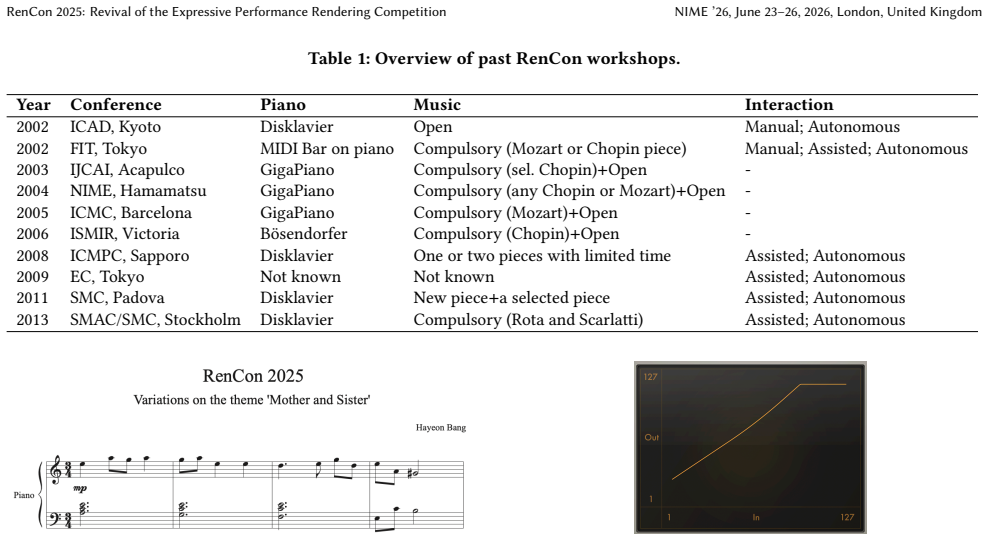
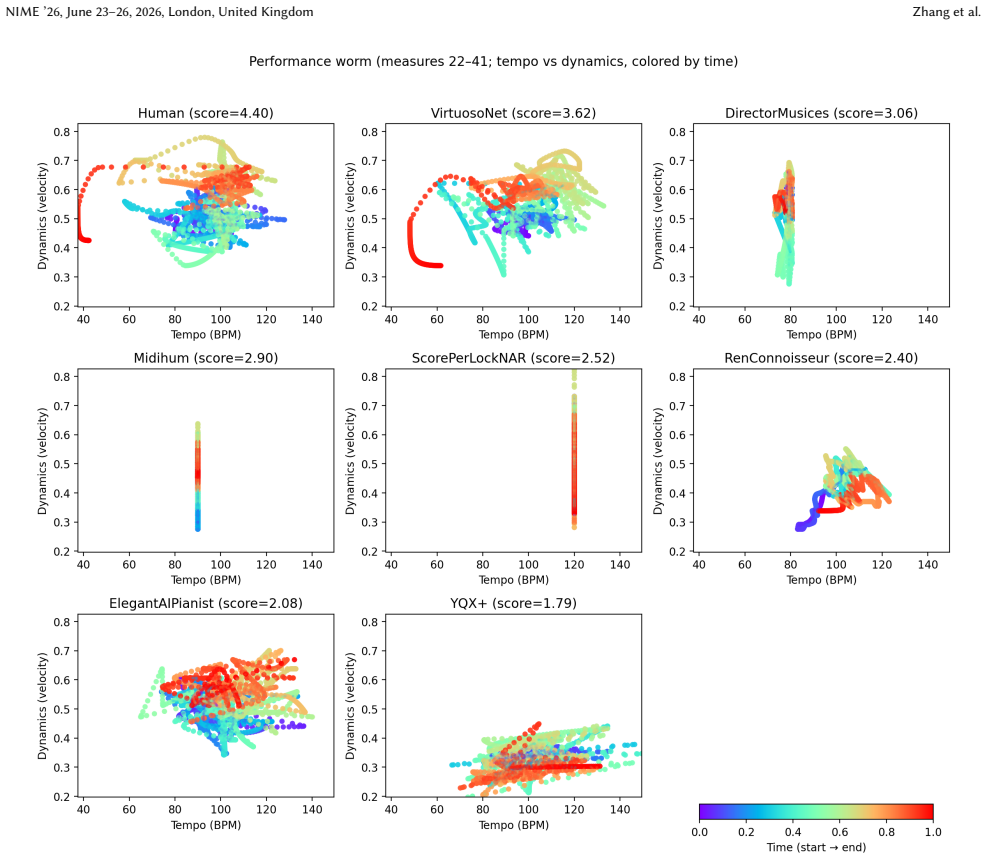
This paper presents a comprehensive documentation of RenCon 2025, the revival of the expressive performance rendering competition which took place at ISMIR 2025 in Daejeon, Korea. The competition attracted 9 entries from international research groups, representing diverse approaches to expressive piano performance rendering. The two-phase assessment structure comprised a preliminary online evaluation and live real-time rendering at the conference. We analyze the competition format, participant demographics, system performance, and lessons learned for future iterations. The results demonstrate significant advances in expressive rendering capabilities while highlighting remaining challenges in achieving human-level musical expression.
Editorial analysis
A structured set of objections, weighed in public.
Referee Report
Summary. The manuscript documents RenCon 2025, the revival of the expressive performance rendering competition held at ISMIR 2025. It describes the attraction of 9 international entries employing diverse approaches to expressive piano rendering, the two-phase evaluation (preliminary online assessment followed by live real-time rendering), participant demographics, system performance observations, and lessons learned. The paper concludes that the results show significant advances in expressive rendering capabilities while underscoring ongoing challenges in reaching human-level musical expression.
Significance. If the performance claims hold with supporting data, the work would offer a useful archival snapshot of the current state of expressive rendering research, helping to benchmark progress since prior RenCon events and identifying concrete directions for future work in MIR and computer music. Its value lies in community documentation and methodological reflection rather than novel algorithmic contributions.
major comments (1)
- Abstract and results/analysis sections: The assertion that 'the results demonstrate significant advances in expressive rendering capabilities' is not accompanied by any quantitative metrics (e.g., listening-test scores, statistical comparisons, deltas versus prior RenCon or non-expressive baselines, or error bars). Without such evidence the claim reduces to qualitative description of the nine entries and cannot substantiate the stated advances or the specific gaps to human-level performance.
minor comments (2)
- The two-phase evaluation structure is described at a high level; adding explicit scoring criteria, inter-rater reliability measures, or the exact protocol for the live real-time component would improve clarity and allow readers to assess the evaluation's rigor.
- A summary table listing the nine entries, their core technical approaches, and key performance observations would enhance readability and make the participant demographics section more accessible.
Simulated Author's Rebuttal
We thank the referee for their constructive review of our manuscript on RenCon 2025. We value the feedback highlighting the need for stronger substantiation of claims about advances in expressive rendering. We respond to the major comment below and indicate planned revisions.
read point-by-point responses
-
Referee: Abstract and results/analysis sections: The assertion that 'the results demonstrate significant advances in expressive rendering capabilities' is not accompanied by any quantitative metrics (e.g., listening-test scores, statistical comparisons, deltas versus prior RenCon or non-expressive baselines, or error bars). Without such evidence the claim reduces to qualitative description of the nine entries and cannot substantiate the stated advances or the specific gaps to human-level performance.
Authors: We agree that the current wording in the abstract and analysis sections overstates the evidence by using 'significant advances' without accompanying quantitative metrics or statistical support. The manuscript is a competition report focused on documenting the nine entries, evaluation format, and participant observations rather than a controlled empirical study. The two-phase evaluation (online assessment and live rendering) yielded qualitative insights into system capabilities and persistent gaps relative to human performance, but no formal listening-test scores, error bars, or baseline comparisons were collected in a manner suitable for statistical analysis. In the revised manuscript we will either incorporate any available raw evaluation data (such as participant ratings from the online phase) if it can be presented meaningfully, or revise the language to describe 'observed improvements in system diversity and real-time rendering feasibility' while retaining the note on remaining challenges to human-level expression. Direct deltas versus prior RenCon events are not feasible due to changes in format and criteria since the original series. revision: partial
Circularity Check
No significant circularity in descriptive competition report
full rationale
The manuscript is a purely descriptive documentation of the RenCon 2025 competition, covering participant entries, two-phase evaluation structure, demographics, and qualitative observations without any equations, derivations, fitted parameters, predictions, or first-principles claims. The statement that results demonstrate significant advances is a summary judgment on observed outcomes rather than a quantity derived from inputs by construction. No self-citations, ansatzes, or uniqueness theorems appear in a load-bearing role for any derivation chain. The paper therefore contains no steps that reduce to their own inputs and is self-contained as an empirical report.
Axiom & Free-Parameter Ledger
Reference graph
Works this paper leans on
-
[1]
Takashi Baba, Mitsuyo Hashida, and Haruhiro Katayose. 2010. ”VirtualPhil- harmony”: A Conducting System with Heuristics of Conducting an Orchestra. In Proceedings of the International Conference on New Interfaces for Musical Ex- pression. 263–270
2010
-
[2]
Roberto Bresin, Anders Friberg, and Johan Sundberg. 2002. Director musices: The KTH performance rules system. InSIGMUS-46, Kyoto, Japan. Information Processing Society of Japan„ 43–48
2002
-
[3]
Leduo Chen, Xinrui Su, Yuqiang Li, Honyu Andy Shing, Junchuan Zhao, Zi- han Chai, Kunyang Zhang, and Shengchen Li. [n. d.]. Automated Expressive MIDI Rendering System for MIREX 2025 RenCon Competition. ([n. d.])
2025
-
[4]
Simon Dixon, Werner Goebl, and Gerhard Widmer. 2002. The Performance Worm: Real Time Visualisation of Expression based on Langner’s Tempo- Loudness Animation. In Proceedings of the International Computer Music Con- ference (ICMC)
2002
-
[5]
Anders Friberg. 1995. Matching the rule parameters of Phrase arch to per- formances of” Träumerei”: A preliminary study. STL-QPSR 36, 2-3 (1995), 063–070
1995
-
[6]
Maarten Grachten, Carlos Eduardo Cancino-Chacón, and Thassilo Gader- maier. 2019. Partitura: A Python Package for Handling Symbolic Music Data . Technical Report. 4–5 pages
2019
-
[7]
M Hashida, M Nakra, H Katayose, T Murao, K Hirata, K Suzuki, and T Kita- hara. 2008. Rencon: Performance Rendering Contest for Automated Music Systems. In Proceedings of the 10th International Conference on Music Percep- tion and Cognition (ICMPC). Sapporo
2008
-
[8]
Rumi Hiraga, Roberto Bresin, Keiji Hirata, and Haruhiro Katayose. 2004. Ren- con 2004 : Tuaring Test for Musical Expression. Proceedings of the 2004 Conference on New Interface for Musical Expression (NIME04) (2004), 120–123. http://portal.acm.org/citation.cfm?id=1085911
2004
-
[9]
Rumi Hiraga, Hashida Mitsuyo, Hirata Keiji, Haruhiro Katayose, and Kenzi Noike. 2002. RENCON: toward a new evaluation method for performance rendering systems. In Proceedings of the 28th International Computer Music Conference (ICMC)
2002
-
[10]
Dasaem Jeong, Taegyun Kwon, Yoojin Kim, Kyogu Lee, and Juhan Nam. 2019. VirtuosoNet: A Hierarchical RNN-based System for Modeling Expressive Pi- ano Performance. In Proceedings of the 20th International Society for Music Information Retrieval Conference (ISMIR) . Delft, Netherlands
2019
-
[11]
Gabriel Jones and Anders Friberg. 2023. Probing the underlying principles of dynamics in piano performances using a modelling approach. Frontiers in Psychology 14 (2023), 1269715
2023
- [12]
-
[13]
Haruhiro Katayose, Mitsuyo Hashida, Giovanni De Poli, and Keiji Hirata
-
[14]
Journal of New Music Research 41, 4 (2012), 299–310
On Evaluating Systems for Generating Expressive Music Performance: the Rencon Experience. Journal of New Music Research 41, 4 (2012), 299–310. https://doi.org/10.1080/09298215.2012.745579
-
[15]
Alia Morsi, Huan Zhang, Akira Maezawa, Simon Dixon, and Xavier Serra
-
[16]
In Pro- ceedings of the Sound and Music Computing Conference (SMC) (2024)
Simulating Piano Performance Mistakes for Music Learning. In Pro- ceedings of the Sound and Music Computing Conference (SMC) (2024). https: //github.com/Alia-morsi/piano-synmist
2024
-
[17]
Kenta Okumura, Shinji Sako, and Tadashi Kitamura. 2011. Stochastic Mod- eling of a Musical Performance with Expressive Representations from the Musical Score.. In ISMIR. 531–536
2011
-
[18]
Silvan David Peter, Carlos Eduardo Cancino-chacón, Francesco Foscarin, Flo- rian Henkel, and Gerhard Widmer. 2023. Automatic Note-Level Alignments in the ASAP Dataset. Transactions of the International Society for Music Infor- mation Retrieval (TISMIR) 6 (2023), 27–42. https://doi.org/10.5334/tismir.149
- [19]
-
[20]
Johan Sundberg, Anders Friberg, and Roberto Bresin. 2010. Attempts to Re- produce a Pianist’s Expressive Timing with Director Musices Performance Rules. Journal of New Music Research (2010). https://doi.org/10.1076/jnmr. 32.3.317.16867
-
[21]
Kyle Worrall, Zongyu Yin, and Tom Collins. 2024. Comparative Evaluation in the Wild: Systems for the Expressive Rendering of Music. IEEE Transactions on Artificial Intelligence PP, 0 (2024), 1–15. https://doi.org/10.1109/TAI.2024. 3408717
-
[22]
Weixi Zhai. 2025. Leveraging PerTok and Domain-Specific Transformer De- sign for Expressive MIDI Ornament Generation. In Ismir 2025 Hybrid Confer- ence
2025
-
[23]
Huan Zhang, Vincent Cheung, Hayato Nishioka, Simon Dixon, and Shinichi Furuya. 2024. How Does the Teacher Rate? Observations From the NeuroPi- ano Dataset. In Late-Breaking and Demo Session of the International Society on Music Information Retrieval (ISMIR) . arXiv: 2410.03139 http://arxiv.org/abs/ 2410.03139
- [24]
-
[25]
Huan Zhang, Jingjing Tang, Syed Rafee, Simon Dixon, and George Fazekas
-
[26]
In Proceedings of the International Society for Music Information Re- trieval Conference (ISMIR)
ATEPP: A Dataset of Automatically Transcribed Expressive Piano Per- formance. In Proceedings of the International Society for Music Information Re- trieval Conference (ISMIR). Bengaluru, India
-
[27]
Jinwen Zhou, Yuncong Xie, Haochen Wang, Aidan Hogg, Simon Dixon, and Huan Zhang. [n. d.]. YQX+: Benchmarking Expressive Piano Rendering with Probabilistic Models. ([n. d.])
discussion (0)
Sign in with ORCID, Apple, or X to comment. Anyone can read and Pith papers without signing in.